Charter School
Performance
in Rhode Island
January 2023
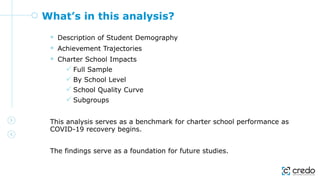
What’s in this analysis?
 Description of Student Demography
 Achievement Trajectories
 Charter School Impacts
 Full Sample
 By School Level
 School Quality Curve
 Subgroups
This analysis serves as a benchmark for charter school performance as
COVID-19 recovery begins.
The findings serve as a foundation for future studies.
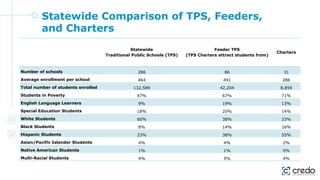
Statewide Comparison of TPS, Feeders,
and Charters
Statewide
Traditional Public Schools (TPS)
Feeder TPS
(TPS Charters attract students from)
Charters
Number of schools 286 86 31
Average enrollment per school 464 491 286
Total number of students enrolled 132,589 42,204 8,859
Students in Poverty 47% 67% 71%
English Language Learners 9% 19% 13%
Special Education Students 18% 20% 14%
White Students 60% 38% 23%
Black Students 8% 14% 16%
Hispanic Students 23% 38% 55%
Asian/Pacific Islander Students 4% 4% 2%
Native American Students 1% 1% 0%
Multi-Racial Students 4% 5% 4%
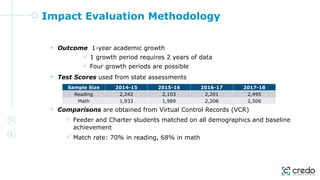
Impact Evaluation Methodology
 Outcome 1-year academic growth
 1 growth period requires 2 years of data
 Four growth periods are possible
 Test Scores used from state assessments
 Comparisons are obtained from Virtual Control Records (VCR)
 Feeder and Charter students matched on all demographics and baseline
achievement
 Match rate: 70% in reading, 68% in math
Sample Size 2014-15 2015-16 2016-17 2017-18
Reading 2,242 2,103 2,201 2,495
Math 1,933 1,989 2,208 2,506
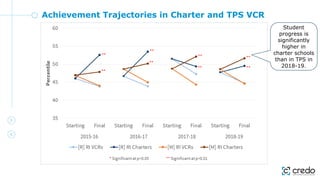
Achievement Trajectories in Charter and TPS VCR
Student
progress is
significantly
higher in
charter schools
than in TPS in
2018-19.
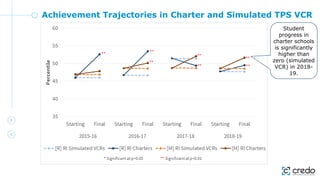
Achievement Trajectories in Charter and Simulated TPS VCR
Student
progress in
charter schools
is significantly
higher than
zero (simulated
VCR) in 2018-
19.
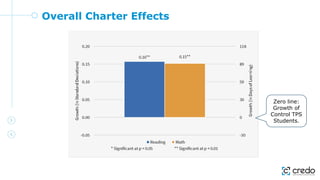
Overall Charter Effects
Zero line:
Growth of
Control TPS
Students.
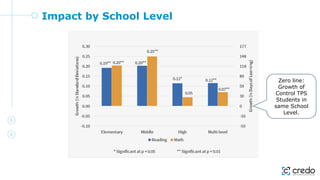
Impact by School Level
Zero line:
Growth of
Control TPS
Students in
same School
Level.
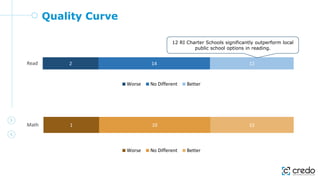
Quality Curve
2 14 12
Read
Worse No Different Better
1 10 15
Math
Worse No Different Better
12 RI Charter Schools significantly outperform local
public school options in reading.
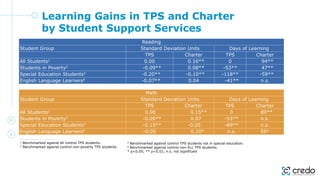
Learning Gains in TPS and Charter
by Student Support Services
Reading
Student Group Standard Deviation Units Days of Learning
TPS Charter TPS Charter
All Students1 0.00 0.16** 0 94**
Students in Poverty2 -0.09** 0.08** -53** 47**
Special Education Students3 -0.20** -0.10** -118** -59**
English Language Learners4 -0.07** 0.04 -41** n.s.
Math
Student Group Standard Deviation Units Days of Learning
TPS Charter TPS Charter
All Students1 0.00 0.15** 0kll 89**
Students in Poverty2 -0.09** 0.07 -53** n.s.
Special Education Students3 -0.15** -0.05 -89** n.s.
English Language Learners4 -0.05 0.10* n.s. 59*
1 Benchmarked against all control TPS students.
2 Benchmarked against control non-poverty TPS students.
3 Benchmarked against control TPS students not in special education.
4 Benchmarked against control non-ELL TPS students.
* p<0.05; ** p<0.01; n.s. not significant
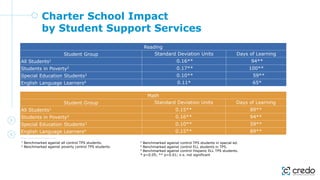
Charter School Impact
by Student Support Services
Reading
Student Group Standard Deviation Units Days of Learning
All Students1 0.16** 94**
Students in Poverty2 0.17** 100**
Special Education Students3 0.10** 59**
English Language Learners4 0.11* 65*
Math
Student Group Standard Deviation Units Days of Learning
All Students1 0.15** 89**
Students in Poverty2 0.16** 94**
Special Education Students3 0.10** 59**
English Language Learners4 0.15** 89**
1 Benchmarked against all control TPS students.
2 Benchmarked against poverty control TPS students.
3 Benchmarked against control TPS students in special ed.
4 Benchmarked against control ELL students in TPS.
5 Benchmarked against control Hispanic ELL TPS students.
* p<0.05; ** p<0.01; n.s. not significant
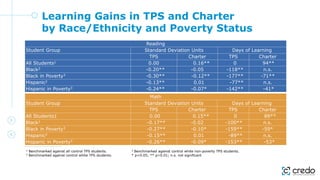
Learning Gains in TPS and Charter
by Race/Ethnicity and Poverty Status
Reading
Student Group Standard Deviation Units Days of Learning
TPS Charter TPS Charter
All Students1 0.00 0.16** 0 94**
Black2 -0.20** -0.05 -118** n.s.
Black in Poverty3 -0.30** -0.12** -177** -71**
Hispanic2 -0.13** 0.01 -77** n.s.
Hispanic in Poverty3 -0.24** -0.07* -142** -41*
Math
Student Group Standard Deviation Units Days of Learning
TPS Charter TPS Charter
All Students1 0.00 0.15** 0kll 89**
Black2 -0.17** -0.02 -100** n.s.
Black in Poverty3 -0.27** -0.10* -159** -59*
Hispanic2 -0.15** 0.01 -89** n.s.
Hispanic in Poverty3 -0.26** -0.09* -153** -53*
1 Benchmarked against all control TPS students.
2 Benchmarked against control white TPS students.
3 Benchmarked against control white non-poverty TPS students.
* p<0.05; ** p<0.01; n.s. not significant
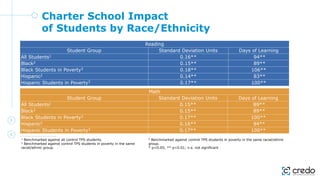
Charter School Impact
of Students by Race/Ethnicity
Reading
Student Group Standard Deviation Units Days of Learning
All Students1 0.16** 94**
Black2 0.15** 89**
Black Students in Poverty3 0.18** 106**
Hispanic2 0.14** 83**
Hispanic Students in Poverty3 0.17** 100**
Math
Student Group Standard Deviation Units Days of Learning
All Students1 0.15** 89**
Black2 0.15** 89**
Black Students in Poverty3 0.17** 100**
Hispanic2 0.16** 94**
Hispanic Students in Poverty3 0.17** 100**
1 Benchmarked against all control TPS students.
2 Benchmarked against control TPS students in poverty in the same
racial/ethnic group.
3 Benchmarked against control TPS students in poverty in the same racial/ethnic
group.
* p<0.05; ** p<0.01; n.s. not significant
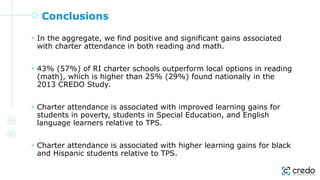
Conclusions
 In the aggregate, we find positive and significant gains associated
with charter attendance in both reading and math.
 43% (57%) of RI charter schools outperform local options in reading
(math), which is higher than 25% (29%) found nationally in the
2013 CREDO Study.
 Charter attendance is associated with improved learning gains for
students in poverty, students in Special Education, and English
language learners relative to TPS.
 Charter attendance is associated with higher learning gains for black
and Hispanic students relative to TPS.
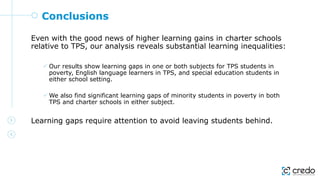
Conclusions
Even with the good news of higher learning gains in charter schools
relative to TPS, our analysis reveals substantial learning inequalities:
 Our results show learning gaps in one or both subjects for TPS students in
poverty, English language learners in TPS, and special education students in
either school setting.
 We also find significant learning gaps of minority students in poverty in both
TPS and charter schools in either subject.
Learning gaps require attention to avoid leaving students behind.
THANK YOU

Charter School Performance in Rhode Island

  • 1.
  • 2.
    What’s in thisanalysis?  Description of Student Demography  Achievement Trajectories  Charter School Impacts  Full Sample  By School Level  School Quality Curve  Subgroups This analysis serves as a benchmark for charter school performance as COVID-19 recovery begins. The findings serve as a foundation for future studies.
  • 3.
    Statewide Comparison ofTPS, Feeders, and Charters Statewide Traditional Public Schools (TPS) Feeder TPS (TPS Charters attract students from) Charters Number of schools 286 86 31 Average enrollment per school 464 491 286 Total number of students enrolled 132,589 42,204 8,859 Students in Poverty 47% 67% 71% English Language Learners 9% 19% 13% Special Education Students 18% 20% 14% White Students 60% 38% 23% Black Students 8% 14% 16% Hispanic Students 23% 38% 55% Asian/Pacific Islander Students 4% 4% 2% Native American Students 1% 1% 0% Multi-Racial Students 4% 5% 4%
  • 4.
    Impact Evaluation Methodology Outcome 1-year academic growth  1 growth period requires 2 years of data  Four growth periods are possible  Test Scores used from state assessments  Comparisons are obtained from Virtual Control Records (VCR)  Feeder and Charter students matched on all demographics and baseline achievement  Match rate: 70% in reading, 68% in math Sample Size 2014-15 2015-16 2016-17 2017-18 Reading 2,242 2,103 2,201 2,495 Math 1,933 1,989 2,208 2,506
  • 5.
    Achievement Trajectories inCharter and TPS VCR Student progress is significantly higher in charter schools than in TPS in 2018-19.
  • 6.
    Achievement Trajectories inCharter and Simulated TPS VCR Student progress in charter schools is significantly higher than zero (simulated VCR) in 2018- 19.
  • 7.
    Overall Charter Effects Zeroline: Growth of Control TPS Students.
  • 8.
    Impact by SchoolLevel Zero line: Growth of Control TPS Students in same School Level.
  • 9.
    Quality Curve 2 1412 Read Worse No Different Better 1 10 15 Math Worse No Different Better 12 RI Charter Schools significantly outperform local public school options in reading.
  • 10.
    Learning Gains inTPS and Charter by Student Support Services Reading Student Group Standard Deviation Units Days of Learning TPS Charter TPS Charter All Students1 0.00 0.16** 0 94** Students in Poverty2 -0.09** 0.08** -53** 47** Special Education Students3 -0.20** -0.10** -118** -59** English Language Learners4 -0.07** 0.04 -41** n.s. Math Student Group Standard Deviation Units Days of Learning TPS Charter TPS Charter All Students1 0.00 0.15** 0kll 89** Students in Poverty2 -0.09** 0.07 -53** n.s. Special Education Students3 -0.15** -0.05 -89** n.s. English Language Learners4 -0.05 0.10* n.s. 59* 1 Benchmarked against all control TPS students. 2 Benchmarked against control non-poverty TPS students. 3 Benchmarked against control TPS students not in special education. 4 Benchmarked against control non-ELL TPS students. * p<0.05; ** p<0.01; n.s. not significant
  • 11.
    Charter School Impact byStudent Support Services Reading Student Group Standard Deviation Units Days of Learning All Students1 0.16** 94** Students in Poverty2 0.17** 100** Special Education Students3 0.10** 59** English Language Learners4 0.11* 65* Math Student Group Standard Deviation Units Days of Learning All Students1 0.15** 89** Students in Poverty2 0.16** 94** Special Education Students3 0.10** 59** English Language Learners4 0.15** 89** 1 Benchmarked against all control TPS students. 2 Benchmarked against poverty control TPS students. 3 Benchmarked against control TPS students in special ed. 4 Benchmarked against control ELL students in TPS. 5 Benchmarked against control Hispanic ELL TPS students. * p<0.05; ** p<0.01; n.s. not significant
  • 12.
    Learning Gains inTPS and Charter by Race/Ethnicity and Poverty Status Reading Student Group Standard Deviation Units Days of Learning TPS Charter TPS Charter All Students1 0.00 0.16** 0 94** Black2 -0.20** -0.05 -118** n.s. Black in Poverty3 -0.30** -0.12** -177** -71** Hispanic2 -0.13** 0.01 -77** n.s. Hispanic in Poverty3 -0.24** -0.07* -142** -41* Math Student Group Standard Deviation Units Days of Learning TPS Charter TPS Charter All Students1 0.00 0.15** 0kll 89** Black2 -0.17** -0.02 -100** n.s. Black in Poverty3 -0.27** -0.10* -159** -59* Hispanic2 -0.15** 0.01 -89** n.s. Hispanic in Poverty3 -0.26** -0.09* -153** -53* 1 Benchmarked against all control TPS students. 2 Benchmarked against control white TPS students. 3 Benchmarked against control white non-poverty TPS students. * p<0.05; ** p<0.01; n.s. not significant
  • 13.
    Charter School Impact ofStudents by Race/Ethnicity Reading Student Group Standard Deviation Units Days of Learning All Students1 0.16** 94** Black2 0.15** 89** Black Students in Poverty3 0.18** 106** Hispanic2 0.14** 83** Hispanic Students in Poverty3 0.17** 100** Math Student Group Standard Deviation Units Days of Learning All Students1 0.15** 89** Black2 0.15** 89** Black Students in Poverty3 0.17** 100** Hispanic2 0.16** 94** Hispanic Students in Poverty3 0.17** 100** 1 Benchmarked against all control TPS students. 2 Benchmarked against control TPS students in poverty in the same racial/ethnic group. 3 Benchmarked against control TPS students in poverty in the same racial/ethnic group. * p<0.05; ** p<0.01; n.s. not significant
  • 14.
    Conclusions  In theaggregate, we find positive and significant gains associated with charter attendance in both reading and math.  43% (57%) of RI charter schools outperform local options in reading (math), which is higher than 25% (29%) found nationally in the 2013 CREDO Study.  Charter attendance is associated with improved learning gains for students in poverty, students in Special Education, and English language learners relative to TPS.  Charter attendance is associated with higher learning gains for black and Hispanic students relative to TPS.
  • 15.
    Conclusions Even with thegood news of higher learning gains in charter schools relative to TPS, our analysis reveals substantial learning inequalities:  Our results show learning gaps in one or both subjects for TPS students in poverty, English language learners in TPS, and special education students in either school setting.  We also find significant learning gaps of minority students in poverty in both TPS and charter schools in either subject. Learning gaps require attention to avoid leaving students behind.
  • 16.