• Physical and chemical composition of solid wastes vary depending on
sources and types of solid wastes.
• The nature of the deposited waste in a landfill will affect gas and leachate
production and composition by virtue of relative proportions of degradable
and non-degradeable components, the moisture content and the specific
nature of the bio-degradeable element.
• The waste composition will effect both the bulk gases and the trace
components.
Determination of Characteristics in the Field:
• Solid wastes are complex, multiphase mixtures.
• Because of the heterogeneous nature of solid wastes, determination of
composition is not easy. Statistical procedures are difficult and usually
procedures based on random sampling techniques are used to determine
composition.
• To obtain a sample for analysis the waste is reduced to about 100 kg by
coning and quartering.
Solid Waste Characteristics
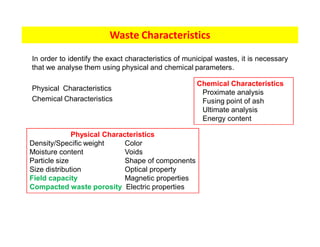
In order to identify the exact characteristics of municipal wastes, it is necessary
that we analyse them using physical and chemical parameters.
Physical Characteristics
Chemical Characteristics
Waste Characteristics
Chemical Characteristics
Proximate analysis
Fusing point of ash
Ultimate analysis
Energy content
Physical Characteristics
Density/Specific weight Color
Moisture content Voids
Particle size Shape of components
Size distribution Optical property
Field capacity Magnetic properties
Compacted waste porosity Electric properties
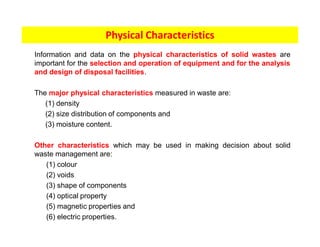
Information and data on the physical characteristics of solid wastes are
important for the selection and operation of equipment and for the analysis
and design of disposal facilities.
The major physical characteristics measured in waste are:
(1) density
(2) size distribution of components and
(3) moisture content.
Other characteristics which may be used in making decision about solid
waste management are:
(1) colour
(2) voids
(3) shape of components
(4) optical property
(5) magnetic properties and
(6) electric properties.
Physical Characteristics
The required information and data include the following:
Density or Specific weight:
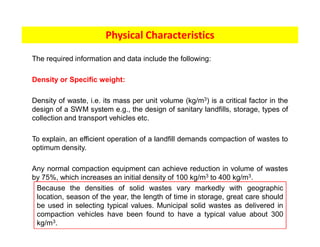
Density of waste, i.e. its mass per unit volume (kg/m3) is a critical factor in the
design of a SWM system e.g., the design of sanitary landfills, storage, types of
collection and transport vehicles etc.
To explain, an efficient operation of a landfill demands compaction of wastes to
optimum density.
Any normal compaction equipment can achieve reduction in volume of wastes
by 75%, which increases an initial density of 100 kg/m3 to 400 kg/m3.
Physical Characteristics
Because the densities of solid wastes vary markedly with geographic
location, season of the year, the length of time in storage, great care should
be used in selecting typical values. Municipal solid wastes as delivered in
compaction vehicles have been found to have a typical value about 300
kg/m3.
In other words, a waste collection vehicle can haul four times the weight of
waste in its compacted state than when it is uncompacted.
A high initial density of waste precludes the achievement of a high compaction
ratio and the compaction ratio achieved is no greater than 1.5:1.
Significant changes in density occur spontaneously as the waste moves from
source to disposal, due to scavenging, handling, wetting and drying by the
weather, vibration in the collection vehicle and decomposition.
Note that:
• the effect of increasing the moisture content of the waste is detrimental in
the sense that dry density decreases at higher moisture levels
• soil-cover plays an important role in containing the waste
• there is an upper limit to the density, and the conservative estimate of in-
place density for waste in a sanitary landfill is about 600 kg/m3
Physical Characteristics
Moisture content:
Moisture content is defined as the ratio of the weight of water (wet weight - dry
weight) to the total weight of the wet waste.
Note: Dry weight is the weight of sample after drying at 105 0C
Moisture increases the weight of solid wastes and thereby, the cost of collection
and transport.
In addition, moisture content is a critical determinant in the economic feasibility
of waste treatment by incineration because wet waste consumes energy for
evaporation of water and in raising the temperature of water vapour.
In the main, wastes should be insulated from rainfall or other extraneous water.
Physical Characteristics
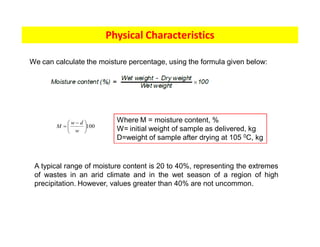
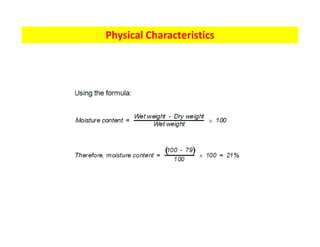
We can calculate the moisture percentage, using the formula given below:
A typical range of moisture content is 20 to 40%, representing the extremes
of wastes in an arid climate and in the wet season of a region of high
precipitation. However, values greater than 40% are not uncommon.
100
÷
ø
ö
ç
è
æ -
=
w
d
w
M
Where M = moisture content, %
W= initial weight of sample as delivered, kg
D=weight of sample after drying at 105 0C, kg
Physical Characteristics
Size:
The size and size distribution of the component materials in solid wastes are
an important consideration in the recovery of materials especially with
mechanical means such as trommel screens and magnetic separators.
Measurement of size distribution of particles in waste stream is important
because of its significance in the design of mechanical separators and
shredders.
Generally, the results of size distribution analysis are expressed in the manner
used for soil particle analysis.
That is to say, they are expressed as a plot of particle size (mm) against
percentage, less than a given value.
Physical Characteristics
Size:
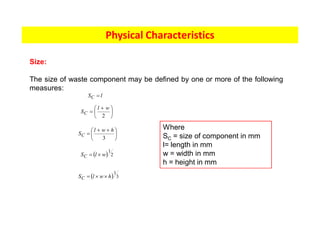
The size of waste component may be defined by one or more of the following
measures:
÷
ø
ö
ç
è
æ +
=
2
w
l
SC
÷
ø
ö
ç
è
æ +
+
=
3
h
w
l
SC
l
SC =
( ) 2
1
w
l
SC ´
=
( ) 3
1
h
w
l
SC ´
´
=
Where
SC = size of component in mm
l= length in mm
w = width in mm
h = height in mm
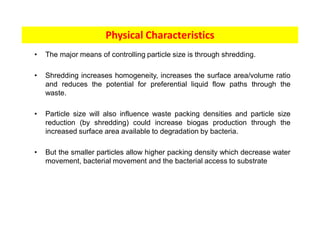
• The major means of controlling particle size is through shredding.
• Shredding increases homogeneity, increases the surface area/volume ratio
and reduces the potential for preferential liquid flow paths through the
waste.
• Particle size will also influence waste packing densities and particle size
reduction (by shredding) could increase biogas production through the
increased surface area available to degradation by bacteria.
• But the smaller particles allow higher packing density which decrease water
movement, bacterial movement and the bacterial access to substrate
Physical Characteristics
• Optical property can be used to segregate opaque materials from
transparent substances which would predominately contain glass and
plastic.
• Magnetic separators are designed based on the magnetic characteristics
of the waste.
• Moisture content is essential for leachate calculation and composting.
• Density is used to assess volume of transportation vehicle and size of the
disposal facility.
• Shape can be used for segregation as flaky substance will behave
differently compared to non-flaky substance.
Physical Characteristics
The physical properties that are essential to analyse wastes disposed at
landfills are:
Field capacity:
The field capacity of MSW is the total amount of moisture which can be
retained in a waste sample subject to gravitational pull.
It is used to determine the formation of leachate in landfills.
It is a critical measure because water in excess of field capacity will form
leachate and leachate can be a major problem in landfills.
Field capacity varies with the degree of applied pressure and the state of
decomposition of the wastes.
Physical Characteristics
Permeability of compacted wastes:
The hydraulic conductivity of compacted wastes is an important physical
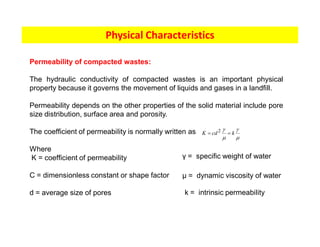
property because it governs the movement of liquids and gases in a landfill.
Permeability depends on the other properties of the solid material include pore
size distribution, surface area and porosity.
The coefficient of permeability is normally written as
Where
K = coefficient of permeability
C = dimensionless constant or shape factor
d = average size of pores
m
g
m
g
k
cd
K =
= 2
γ = specific weight of water
µ = dynamic viscosity of water
k = intrinsic permeability
Physical Characteristics
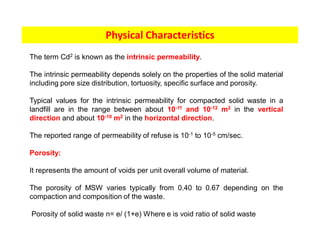
The term Cd2 is known as the intrinsic permeability.
The intrinsic permeability depends solely on the properties of the solid material
including pore size distribution, tortuosity, specific surface and porosity.
Typical values for the intrinsic permeability for compacted solid waste in a
landfill are in the range between about 10-11 and 10-12 m2 in the vertical
direction and about 10-10 m2 in the horizontal direction.
The reported range of permeability of refuse is 10-1 to 10-5 cm/sec.
Porosity:
It represents the amount of voids per unit overall volume of material.
The porosity of MSW varies typically from 0.40 to 0.67 depending on the
compaction and composition of the waste.
Porosity of solid waste n= e/ (1+e) Where e is void ratio of solid waste
Physical Characteristics
Compressibility of MSW:
Degree of physical changes of the suspended solids or filter cake when
subjected to pressure.
ΔHT =ΔHi +ΔHc +Δhα
ΔHT= total settlement
ΔHi=immediate settlement
ΔHc = consolidation settlement
ΔHα = secondary compression or creep
C’α = ΔH/ [H0 X (Log (t2/t1))] = Cα/ (1+e0)
Cα, C’α = Secondary compression index and Modified secondary
Compression index; and t1, t2= Starting and ending time of secondary
settlement respectively
Physical Characteristics
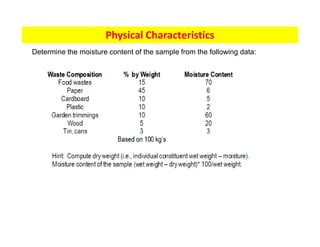
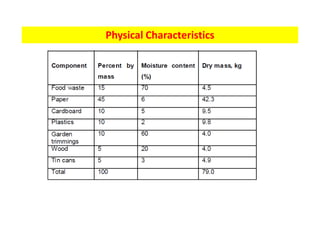
Determine the moisture content of the sample from the following data:
Physical Characteristics
Chemical Characteristics
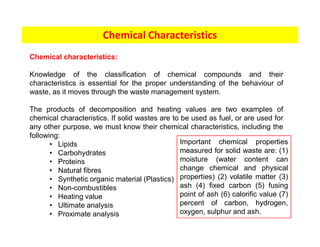
Chemical characteristics:
Knowledge of the classification of chemical compounds and their
characteristics is essential for the proper understanding of the behaviour of
waste, as it moves through the waste management system.
The products of decomposition and heating values are two examples of
chemical characteristics. If solid wastes are to be used as fuel, or are used for
any other purpose, we must know their chemical characteristics, including the
following:
• Lipids
• Carbohydrates
• Proteins
• Natural fibres
• Synthetic organic material (Plastics)
• Non-combustibles
• Heating value
• Ultimate analysis
• Proximate analysis
Important chemical properties
measured for solid waste are: (1)
moisture (water content can
change chemical and physical
properties) (2) volatile matter (3)
ash (4) fixed carbon (5) fusing
point of ash (6) calorific value (7)
percent of carbon, hydrogen,
oxygen, sulphur and ash.
Chemical Characteristics
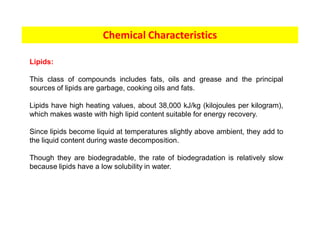
Lipids:
This class of compounds includes fats, oils and grease and the principal
sources of lipids are garbage, cooking oils and fats.
Lipids have high heating values, about 38,000 kJ/kg (kilojoules per kilogram),
which makes waste with high lipid content suitable for energy recovery.
Since lipids become liquid at temperatures slightly above ambient, they add to
the liquid content during waste decomposition.
Though they are biodegradable, the rate of biodegradation is relatively slow
because lipids have a low solubility in water.
Chemical Characteristics
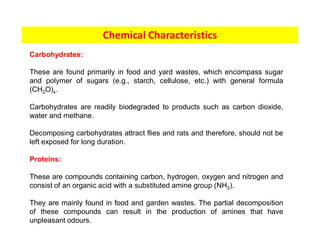
Carbohydrates:
These are found primarily in food and yard wastes, which encompass sugar
and polymer of sugars (e.g., starch, cellulose, etc.) with general formula
(CH2O)x.
Carbohydrates are readily biodegraded to products such as carbon dioxide,
water and methane.
Decomposing carbohydrates attract flies and rats and therefore, should not be
left exposed for long duration.
Proteins:
These are compounds containing carbon, hydrogen, oxygen and nitrogen and
consist of an organic acid with a substituted amine group (NH2).
They are mainly found in food and garden wastes. The partial decomposition
of these compounds can result in the production of amines that have
unpleasant odours.
Chemical Characteristics
Natural fibres:
These are found in paper products, food and yard wastes and include the
natural compounds, cellulose and lignin that are resistant to biodegradation.
(Note that paper is almost 100% cellulose, cotton over 95% and wood
products over 40%.)
Because they are a highly combustible solid waste, having a high proportion of
paper and wood products, they are suitable for incineration.
Calorific values of oven-dried paper products are in the range of 12,000 -
18,000 kJ/kg and of wood about 20,000 kJ/kg, i.e., about half that for fuel oil,
which is 44,200 kJ/kg.
Chemical Characteristics
Synthetic organic material (Plastics):
Accounting for 1 – 10%, plastics have become a significant component of solid
waste in recent years.
They are highly resistant to biodegradation and therefore, are objectionable
and of special concern in SWM.
Hence the increasing attention being paid to the recycling of plastics to reduce
the proportion of this waste component at disposal sites.
Plastics have a high heating value, about 32,000 kJ/kg, which makes them
very suitable for incineration.
But, you must note that polyvinyl chloride (PVC), when burnt, produces dioxin
and acid gas.
The latter increases corrosion in the combustion system and is responsible for
acid rain..
Chemical Characteristics
Non-combustibles:
This class includes glass, ceramics, metals, dust and ashes, and accounts for
12 – 25% of dry solids.
Energy Content of Solid Waste Components:
The energy content of the organic components in MSW can be determined (1)
by using a full scale boiler as a calorimeter (2) by using a laboratory bomb
calorimeter, and (3) by calculation, if the elemental composition is known.
Because of the difficulty in instrumenting a full-scale boiler, most of the data on
the energy content of the organic components of MSW are based on the
results of bomb calorimeter tests.
Chemical Characteristics
Heating value:
An evaluation of the potential of waste material for use as fuel for incineration
requires a determination of its heating value expressed as kilojoules per
kilogram (kJ/kg).
The heating value is determined experimentally using the Bomb calorimeter
test, in which the heat generated, at a constant temperature of 25 0C from the
combustion of a dry sample is measured.
Since the test temperature is below the boiling point of water (100 0C), the
combustion water remains in the liquid state.
However, during combustion, the temperature of the combustion gases
reaches above 100 0C, and the resultant water is in the vapour form.
Chemical Characteristics
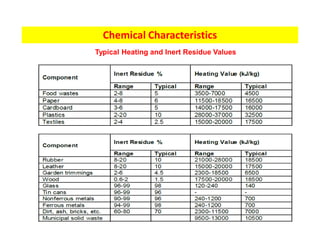
Typical Heating and Inert Residue Values
Chemical Characteristics
Note that while evaluating incineration as a means of disposal or energy
recovery, we need to consider the heating values of respective constituents.
For example:
• Organic material yields energy only when dry.
• The moisture content in the waste reduces the dry organic material per
kilogram of waste and requires a significant amount of energy for drying.
• The ash content of the waste reduces the proportion of dry organic
material per kilogram of waste and retains some heat when removed
from the furnace.
Chemical Characteristics
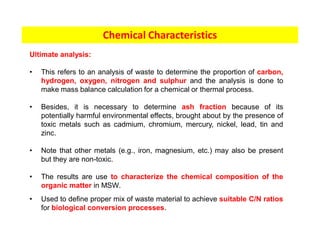
Ultimate analysis:
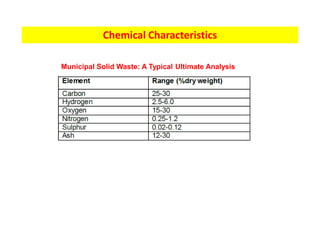
• This refers to an analysis of waste to determine the proportion of carbon,
hydrogen, oxygen, nitrogen and sulphur and the analysis is done to
make mass balance calculation for a chemical or thermal process.
• Besides, it is necessary to determine ash fraction because of its
potentially harmful environmental effects, brought about by the presence of
toxic metals such as cadmium, chromium, mercury, nickel, lead, tin and
zinc.
• Note that other metals (e.g., iron, magnesium, etc.) may also be present
but they are non-toxic.
• The results are use to characterize the chemical composition of the
organic matter in MSW.
• Used to define proper mix of waste material to achieve suitable C/N ratios
for biological conversion processes.
Chemical Characteristics
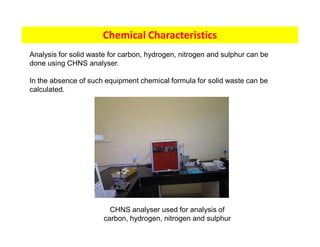
Analysis for solid waste for carbon, hydrogen, nitrogen and sulphur can be
done using CHNS analyser.
In the absence of such equipment chemical formula for solid waste can be
calculated.
CHNS analyser used for analysis of
carbon, hydrogen, nitrogen and sulphur
Chemical Characteristics
Municipal Solid Waste: A Typical Ultimate Analysis
Chemical Characteristics
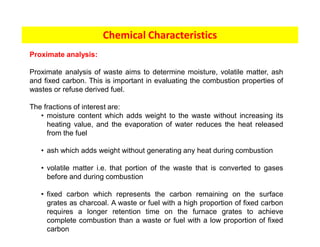
Proximate analysis:
Proximate analysis of waste aims to determine moisture, volatile matter, ash
and fixed carbon. This is important in evaluating the combustion properties of
wastes or refuse derived fuel.
The fractions of interest are:
• moisture content which adds weight to the waste without increasing its
heating value, and the evaporation of water reduces the heat released
from the fuel
• ash which adds weight without generating any heat during combustion
• volatile matter i.e. that portion of the waste that is converted to gases
before and during combustion
• fixed carbon which represents the carbon remaining on the surface
grates as charcoal. A waste or fuel with a high proportion of fixed carbon
requires a longer retention time on the furnace grates to achieve
complete combustion than a waste or fuel with a low proportion of fixed
carbon
Chemical Characteristics
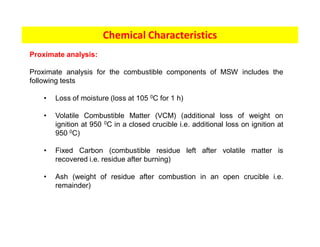
Proximate analysis:
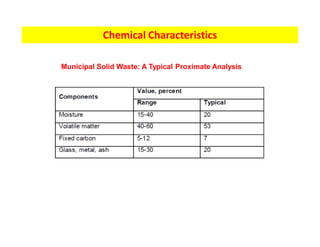
Proximate analysis for the combustible components of MSW includes the
following tests
• Loss of moisture (loss at 105 0C for 1 h)
• Volatile Combustible Matter (VCM) (additional loss of weight on
ignition at 950 0C in a closed crucible i.e. additional loss on ignition at
950 0C)
• Fixed Carbon (combustible residue left after volatile matter is
recovered i.e. residue after burning)
• Ash (weight of residue after combustion in an open crucible i.e.
remainder)
Chemical Characteristics
Municipal Solid Waste: A Typical Proximate Analysis
Chemical Characteristics
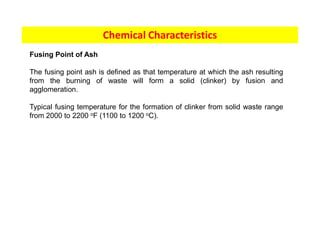
Fusing Point of Ash
The fusing point ash is defined as that temperature at which the ash resulting
from the burning of waste will form a solid (clinker) by fusion and
agglomeration.
Typical fusing temperature for the formation of clinker from solid waste range
from 2000 to 2200 oF (1100 to 1200 oC).
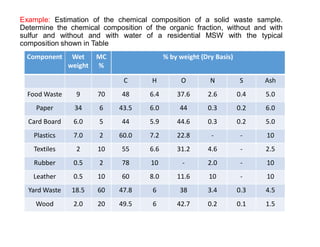
Example: Estimation of the chemical composition of a solid waste sample.
Determine the chemical composition of the organic fraction, without and with
sulfur and without and with water of a residential MSW with the typical
composition shown in Table
Component Wet
weight
MC
%
% by weight (Dry Basis)
C H O N S Ash
Food Waste 9 70 48 6.4 37.6 2.6 0.4 5.0
Paper 34 6 43.5 6.0 44 0.3 0.2 6.0
Card Board 6.0 5 44 5.9 44.6 0.3 0.2 5.0
Plastics 7.0 2 60.0 7.2 22.8 - - 10
Textiles 2 10 55 6.6 31.2 4.6 - 2.5
Rubber 0.5 2 78 10 - 2.0 - 10
Leather 0.5 10 60 8.0 11.6 10 - 10
Yard Waste 18.5 60 47.8 6 38 3.4 0.3 4.5
Wood 2.0 20 49.5 6 42.7 0.2 0.1 1.5
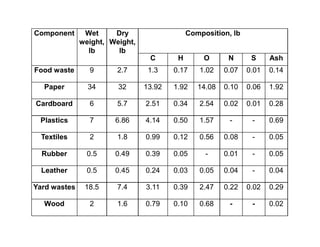
Component Wet
weight,
lb
Dry
Weight,
lb
Composition, lb
C H O N S Ash
Food waste 9 2.7 1.3 0.17 1.02 0.07 0.01 0.14
Paper 34 32 13.92 1.92 14.08 0.10 0.06 1.92
Cardboard 6 5.7 2.51 0.34 2.54 0.02 0.01 0.28
Plastics 7 6.86 4.14 0.50 1.57 - - 0.69
Textiles 2 1.8 0.99 0.12 0.56 0.08 - 0.05
Rubber 0.5 0.49 0.39 0.05 - 0.01 - 0.05
Leather 0.5 0.45 0.24 0.03 0.05 0.04 - 0.04
Yard wastes 18.5 7.4 3.11 0.39 2.47 0.22 0.02 0.29
Wood 2 1.6 0.79 0.10 0.68 - - 0.02
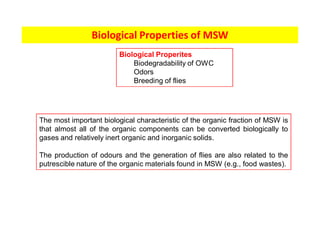
Biological Properties of MSW
The most important biological characteristic of the organic fraction of MSW is
that almost all of the organic components can be converted biologically to
gases and relatively inert organic and inorganic solids.
The production of odours and the generation of flies are also related to the
putrescible nature of the organic materials found in MSW (e.g., food wastes).
Biological Properites
Biodegradability of OWC
Odors
Breeding of flies
Biological Properties of MSW
Excluding plastic, rubber and leather components, the organic fraction of most
MSW can be classified as follows:
• Water-soluble constituents such as sugars, starches, amino acids, and
various organic acids.
• Hemicelluloses, a condensation product of five- and six-carbon sugars
• Cellulose, a condensation product of the six-carbon sugar glucose
• Fats, oils, and waxes which are esters of alcohols and long-chain fatty
acids
• Lignin, a polymeric material containing aromatic rings with methoxyl
groups (-OCH3), the exact chemical nature of which is still not known
(present in some paper products such as newsprint and fibreboard)
• Lignocelluloses, a combination of lignin and cellulose
• Proteins, which are composed of chains of amino acids
Biological Properties of MSW
Biodegradability of Organic Waste Components
Volatile solids (VS) content, determined by ignition at 550 oC, is often used as a
measure of the biodegradability of the organic fraction of MSW.
The use of VS in describing the biodegradability of the organic fraction of MSW is
misleading, as some of the organic constituents of MSW are highly volatile but
low in biodegradability (e.g., newsprint and certain plant trimmings).
Alternatively, the lignin content of a waste can be used to estimate the
biodegradable fraction, using the following relationship:
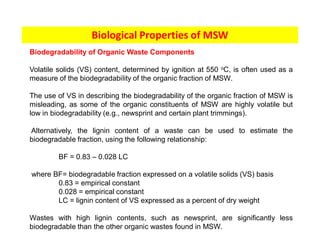
BF = 0.83 – 0.028 LC
where BF= biodegradable fraction expressed on a volatile solids (VS) basis
0.83 = empirical constant
0.028 = empirical constant
LC = lignin content of VS expressed as a percent of dry weight
Wastes with high lignin contents, such as newsprint, are significantly less
biodegradable than the other organic wastes found in MSW.
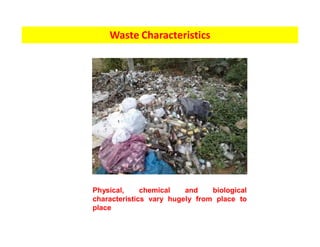
Waste Characteristics
Physical, chemical and biological
characteristics vary hugely from place to
place

Characteristics -of-muncipal-solid waste

  • 1.
    • Physical andchemical composition of solid wastes vary depending on sources and types of solid wastes. • The nature of the deposited waste in a landfill will affect gas and leachate production and composition by virtue of relative proportions of degradable and non-degradeable components, the moisture content and the specific nature of the bio-degradeable element. • The waste composition will effect both the bulk gases and the trace components. Determination of Characteristics in the Field: • Solid wastes are complex, multiphase mixtures. • Because of the heterogeneous nature of solid wastes, determination of composition is not easy. Statistical procedures are difficult and usually procedures based on random sampling techniques are used to determine composition. • To obtain a sample for analysis the waste is reduced to about 100 kg by coning and quartering. Solid Waste Characteristics
  • 2.
    In order toidentify the exact characteristics of municipal wastes, it is necessary that we analyse them using physical and chemical parameters. Physical Characteristics Chemical Characteristics Waste Characteristics Chemical Characteristics Proximate analysis Fusing point of ash Ultimate analysis Energy content Physical Characteristics Density/Specific weight Color Moisture content Voids Particle size Shape of components Size distribution Optical property Field capacity Magnetic properties Compacted waste porosity Electric properties
  • 3.
    Information and dataon the physical characteristics of solid wastes are important for the selection and operation of equipment and for the analysis and design of disposal facilities. The major physical characteristics measured in waste are: (1) density (2) size distribution of components and (3) moisture content. Other characteristics which may be used in making decision about solid waste management are: (1) colour (2) voids (3) shape of components (4) optical property (5) magnetic properties and (6) electric properties. Physical Characteristics
  • 4.
    The required informationand data include the following: Density or Specific weight: Density of waste, i.e. its mass per unit volume (kg/m3) is a critical factor in the design of a SWM system e.g., the design of sanitary landfills, storage, types of collection and transport vehicles etc. To explain, an efficient operation of a landfill demands compaction of wastes to optimum density. Any normal compaction equipment can achieve reduction in volume of wastes by 75%, which increases an initial density of 100 kg/m3 to 400 kg/m3. Physical Characteristics Because the densities of solid wastes vary markedly with geographic location, season of the year, the length of time in storage, great care should be used in selecting typical values. Municipal solid wastes as delivered in compaction vehicles have been found to have a typical value about 300 kg/m3.
  • 5.
    In other words,a waste collection vehicle can haul four times the weight of waste in its compacted state than when it is uncompacted. A high initial density of waste precludes the achievement of a high compaction ratio and the compaction ratio achieved is no greater than 1.5:1. Significant changes in density occur spontaneously as the waste moves from source to disposal, due to scavenging, handling, wetting and drying by the weather, vibration in the collection vehicle and decomposition. Note that: • the effect of increasing the moisture content of the waste is detrimental in the sense that dry density decreases at higher moisture levels • soil-cover plays an important role in containing the waste • there is an upper limit to the density, and the conservative estimate of in- place density for waste in a sanitary landfill is about 600 kg/m3 Physical Characteristics
  • 6.
    Moisture content: Moisture contentis defined as the ratio of the weight of water (wet weight - dry weight) to the total weight of the wet waste. Note: Dry weight is the weight of sample after drying at 105 0C Moisture increases the weight of solid wastes and thereby, the cost of collection and transport. In addition, moisture content is a critical determinant in the economic feasibility of waste treatment by incineration because wet waste consumes energy for evaporation of water and in raising the temperature of water vapour. In the main, wastes should be insulated from rainfall or other extraneous water. Physical Characteristics
  • 7.
    Physical Characteristics We cancalculate the moisture percentage, using the formula given below: A typical range of moisture content is 20 to 40%, representing the extremes of wastes in an arid climate and in the wet season of a region of high precipitation. However, values greater than 40% are not uncommon. 100 ÷ ø ö ç è æ - = w d w M Where M = moisture content, % W= initial weight of sample as delivered, kg D=weight of sample after drying at 105 0C, kg
  • 8.
    Physical Characteristics Size: The sizeand size distribution of the component materials in solid wastes are an important consideration in the recovery of materials especially with mechanical means such as trommel screens and magnetic separators. Measurement of size distribution of particles in waste stream is important because of its significance in the design of mechanical separators and shredders. Generally, the results of size distribution analysis are expressed in the manner used for soil particle analysis. That is to say, they are expressed as a plot of particle size (mm) against percentage, less than a given value.
  • 9.
    Physical Characteristics Size: The sizeof waste component may be defined by one or more of the following measures: ÷ ø ö ç è æ + = 2 w l SC ÷ ø ö ç è æ + + = 3 h w l SC l SC = ( ) 2 1 w l SC ´ = ( ) 3 1 h w l SC ´ ´ = Where SC = size of component in mm l= length in mm w = width in mm h = height in mm
  • 10.
    • The majormeans of controlling particle size is through shredding. • Shredding increases homogeneity, increases the surface area/volume ratio and reduces the potential for preferential liquid flow paths through the waste. • Particle size will also influence waste packing densities and particle size reduction (by shredding) could increase biogas production through the increased surface area available to degradation by bacteria. • But the smaller particles allow higher packing density which decrease water movement, bacterial movement and the bacterial access to substrate Physical Characteristics
  • 11.
    • Optical propertycan be used to segregate opaque materials from transparent substances which would predominately contain glass and plastic. • Magnetic separators are designed based on the magnetic characteristics of the waste. • Moisture content is essential for leachate calculation and composting. • Density is used to assess volume of transportation vehicle and size of the disposal facility. • Shape can be used for segregation as flaky substance will behave differently compared to non-flaky substance. Physical Characteristics
  • 12.
    Physical Characteristics The physicalproperties that are essential to analyse wastes disposed at landfills are: Field capacity: The field capacity of MSW is the total amount of moisture which can be retained in a waste sample subject to gravitational pull. It is used to determine the formation of leachate in landfills. It is a critical measure because water in excess of field capacity will form leachate and leachate can be a major problem in landfills. Field capacity varies with the degree of applied pressure and the state of decomposition of the wastes.
  • 13.
    Physical Characteristics Permeability ofcompacted wastes: The hydraulic conductivity of compacted wastes is an important physical property because it governs the movement of liquids and gases in a landfill. Permeability depends on the other properties of the solid material include pore size distribution, surface area and porosity. The coefficient of permeability is normally written as Where K = coefficient of permeability C = dimensionless constant or shape factor d = average size of pores m g m g k cd K = = 2 γ = specific weight of water µ = dynamic viscosity of water k = intrinsic permeability
  • 14.
    Physical Characteristics The termCd2 is known as the intrinsic permeability. The intrinsic permeability depends solely on the properties of the solid material including pore size distribution, tortuosity, specific surface and porosity. Typical values for the intrinsic permeability for compacted solid waste in a landfill are in the range between about 10-11 and 10-12 m2 in the vertical direction and about 10-10 m2 in the horizontal direction. The reported range of permeability of refuse is 10-1 to 10-5 cm/sec. Porosity: It represents the amount of voids per unit overall volume of material. The porosity of MSW varies typically from 0.40 to 0.67 depending on the compaction and composition of the waste. Porosity of solid waste n= e/ (1+e) Where e is void ratio of solid waste
  • 15.
    Physical Characteristics Compressibility ofMSW: Degree of physical changes of the suspended solids or filter cake when subjected to pressure. ΔHT =ΔHi +ΔHc +Δhα ΔHT= total settlement ΔHi=immediate settlement ΔHc = consolidation settlement ΔHα = secondary compression or creep C’α = ΔH/ [H0 X (Log (t2/t1))] = Cα/ (1+e0) Cα, C’α = Secondary compression index and Modified secondary Compression index; and t1, t2= Starting and ending time of secondary settlement respectively
  • 16.
    Physical Characteristics Determine themoisture content of the sample from the following data:
  • 17.
  • 18.
  • 19.
    Chemical Characteristics Chemical characteristics: Knowledgeof the classification of chemical compounds and their characteristics is essential for the proper understanding of the behaviour of waste, as it moves through the waste management system. The products of decomposition and heating values are two examples of chemical characteristics. If solid wastes are to be used as fuel, or are used for any other purpose, we must know their chemical characteristics, including the following: • Lipids • Carbohydrates • Proteins • Natural fibres • Synthetic organic material (Plastics) • Non-combustibles • Heating value • Ultimate analysis • Proximate analysis Important chemical properties measured for solid waste are: (1) moisture (water content can change chemical and physical properties) (2) volatile matter (3) ash (4) fixed carbon (5) fusing point of ash (6) calorific value (7) percent of carbon, hydrogen, oxygen, sulphur and ash.
  • 20.
    Chemical Characteristics Lipids: This classof compounds includes fats, oils and grease and the principal sources of lipids are garbage, cooking oils and fats. Lipids have high heating values, about 38,000 kJ/kg (kilojoules per kilogram), which makes waste with high lipid content suitable for energy recovery. Since lipids become liquid at temperatures slightly above ambient, they add to the liquid content during waste decomposition. Though they are biodegradable, the rate of biodegradation is relatively slow because lipids have a low solubility in water.
  • 21.
    Chemical Characteristics Carbohydrates: These arefound primarily in food and yard wastes, which encompass sugar and polymer of sugars (e.g., starch, cellulose, etc.) with general formula (CH2O)x. Carbohydrates are readily biodegraded to products such as carbon dioxide, water and methane. Decomposing carbohydrates attract flies and rats and therefore, should not be left exposed for long duration. Proteins: These are compounds containing carbon, hydrogen, oxygen and nitrogen and consist of an organic acid with a substituted amine group (NH2). They are mainly found in food and garden wastes. The partial decomposition of these compounds can result in the production of amines that have unpleasant odours.
  • 22.
    Chemical Characteristics Natural fibres: Theseare found in paper products, food and yard wastes and include the natural compounds, cellulose and lignin that are resistant to biodegradation. (Note that paper is almost 100% cellulose, cotton over 95% and wood products over 40%.) Because they are a highly combustible solid waste, having a high proportion of paper and wood products, they are suitable for incineration. Calorific values of oven-dried paper products are in the range of 12,000 - 18,000 kJ/kg and of wood about 20,000 kJ/kg, i.e., about half that for fuel oil, which is 44,200 kJ/kg.
  • 23.
    Chemical Characteristics Synthetic organicmaterial (Plastics): Accounting for 1 – 10%, plastics have become a significant component of solid waste in recent years. They are highly resistant to biodegradation and therefore, are objectionable and of special concern in SWM. Hence the increasing attention being paid to the recycling of plastics to reduce the proportion of this waste component at disposal sites. Plastics have a high heating value, about 32,000 kJ/kg, which makes them very suitable for incineration. But, you must note that polyvinyl chloride (PVC), when burnt, produces dioxin and acid gas. The latter increases corrosion in the combustion system and is responsible for acid rain..
  • 24.
    Chemical Characteristics Non-combustibles: This classincludes glass, ceramics, metals, dust and ashes, and accounts for 12 – 25% of dry solids. Energy Content of Solid Waste Components: The energy content of the organic components in MSW can be determined (1) by using a full scale boiler as a calorimeter (2) by using a laboratory bomb calorimeter, and (3) by calculation, if the elemental composition is known. Because of the difficulty in instrumenting a full-scale boiler, most of the data on the energy content of the organic components of MSW are based on the results of bomb calorimeter tests.
  • 25.
    Chemical Characteristics Heating value: Anevaluation of the potential of waste material for use as fuel for incineration requires a determination of its heating value expressed as kilojoules per kilogram (kJ/kg). The heating value is determined experimentally using the Bomb calorimeter test, in which the heat generated, at a constant temperature of 25 0C from the combustion of a dry sample is measured. Since the test temperature is below the boiling point of water (100 0C), the combustion water remains in the liquid state. However, during combustion, the temperature of the combustion gases reaches above 100 0C, and the resultant water is in the vapour form.
  • 26.
  • 27.
    Chemical Characteristics Note thatwhile evaluating incineration as a means of disposal or energy recovery, we need to consider the heating values of respective constituents. For example: • Organic material yields energy only when dry. • The moisture content in the waste reduces the dry organic material per kilogram of waste and requires a significant amount of energy for drying. • The ash content of the waste reduces the proportion of dry organic material per kilogram of waste and retains some heat when removed from the furnace.
  • 28.
    Chemical Characteristics Ultimate analysis: •This refers to an analysis of waste to determine the proportion of carbon, hydrogen, oxygen, nitrogen and sulphur and the analysis is done to make mass balance calculation for a chemical or thermal process. • Besides, it is necessary to determine ash fraction because of its potentially harmful environmental effects, brought about by the presence of toxic metals such as cadmium, chromium, mercury, nickel, lead, tin and zinc. • Note that other metals (e.g., iron, magnesium, etc.) may also be present but they are non-toxic. • The results are use to characterize the chemical composition of the organic matter in MSW. • Used to define proper mix of waste material to achieve suitable C/N ratios for biological conversion processes.
  • 29.
    Chemical Characteristics Analysis forsolid waste for carbon, hydrogen, nitrogen and sulphur can be done using CHNS analyser. In the absence of such equipment chemical formula for solid waste can be calculated. CHNS analyser used for analysis of carbon, hydrogen, nitrogen and sulphur
  • 30.
    Chemical Characteristics Municipal SolidWaste: A Typical Ultimate Analysis
  • 31.
    Chemical Characteristics Proximate analysis: Proximateanalysis of waste aims to determine moisture, volatile matter, ash and fixed carbon. This is important in evaluating the combustion properties of wastes or refuse derived fuel. The fractions of interest are: • moisture content which adds weight to the waste without increasing its heating value, and the evaporation of water reduces the heat released from the fuel • ash which adds weight without generating any heat during combustion • volatile matter i.e. that portion of the waste that is converted to gases before and during combustion • fixed carbon which represents the carbon remaining on the surface grates as charcoal. A waste or fuel with a high proportion of fixed carbon requires a longer retention time on the furnace grates to achieve complete combustion than a waste or fuel with a low proportion of fixed carbon
  • 32.
    Chemical Characteristics Proximate analysis: Proximateanalysis for the combustible components of MSW includes the following tests • Loss of moisture (loss at 105 0C for 1 h) • Volatile Combustible Matter (VCM) (additional loss of weight on ignition at 950 0C in a closed crucible i.e. additional loss on ignition at 950 0C) • Fixed Carbon (combustible residue left after volatile matter is recovered i.e. residue after burning) • Ash (weight of residue after combustion in an open crucible i.e. remainder)
  • 33.
    Chemical Characteristics Municipal SolidWaste: A Typical Proximate Analysis
  • 34.
    Chemical Characteristics Fusing Pointof Ash The fusing point ash is defined as that temperature at which the ash resulting from the burning of waste will form a solid (clinker) by fusion and agglomeration. Typical fusing temperature for the formation of clinker from solid waste range from 2000 to 2200 oF (1100 to 1200 oC).
  • 35.
    Example: Estimation ofthe chemical composition of a solid waste sample. Determine the chemical composition of the organic fraction, without and with sulfur and without and with water of a residential MSW with the typical composition shown in Table Component Wet weight MC % % by weight (Dry Basis) C H O N S Ash Food Waste 9 70 48 6.4 37.6 2.6 0.4 5.0 Paper 34 6 43.5 6.0 44 0.3 0.2 6.0 Card Board 6.0 5 44 5.9 44.6 0.3 0.2 5.0 Plastics 7.0 2 60.0 7.2 22.8 - - 10 Textiles 2 10 55 6.6 31.2 4.6 - 2.5 Rubber 0.5 2 78 10 - 2.0 - 10 Leather 0.5 10 60 8.0 11.6 10 - 10 Yard Waste 18.5 60 47.8 6 38 3.4 0.3 4.5 Wood 2.0 20 49.5 6 42.7 0.2 0.1 1.5
  • 36.
    Component Wet weight, lb Dry Weight, lb Composition, lb CH O N S Ash Food waste 9 2.7 1.3 0.17 1.02 0.07 0.01 0.14 Paper 34 32 13.92 1.92 14.08 0.10 0.06 1.92 Cardboard 6 5.7 2.51 0.34 2.54 0.02 0.01 0.28 Plastics 7 6.86 4.14 0.50 1.57 - - 0.69 Textiles 2 1.8 0.99 0.12 0.56 0.08 - 0.05 Rubber 0.5 0.49 0.39 0.05 - 0.01 - 0.05 Leather 0.5 0.45 0.24 0.03 0.05 0.04 - 0.04 Yard wastes 18.5 7.4 3.11 0.39 2.47 0.22 0.02 0.29 Wood 2 1.6 0.79 0.10 0.68 - - 0.02
  • 37.
    Biological Properties ofMSW The most important biological characteristic of the organic fraction of MSW is that almost all of the organic components can be converted biologically to gases and relatively inert organic and inorganic solids. The production of odours and the generation of flies are also related to the putrescible nature of the organic materials found in MSW (e.g., food wastes). Biological Properites Biodegradability of OWC Odors Breeding of flies
  • 38.
    Biological Properties ofMSW Excluding plastic, rubber and leather components, the organic fraction of most MSW can be classified as follows: • Water-soluble constituents such as sugars, starches, amino acids, and various organic acids. • Hemicelluloses, a condensation product of five- and six-carbon sugars • Cellulose, a condensation product of the six-carbon sugar glucose • Fats, oils, and waxes which are esters of alcohols and long-chain fatty acids • Lignin, a polymeric material containing aromatic rings with methoxyl groups (-OCH3), the exact chemical nature of which is still not known (present in some paper products such as newsprint and fibreboard) • Lignocelluloses, a combination of lignin and cellulose • Proteins, which are composed of chains of amino acids
  • 39.
    Biological Properties ofMSW Biodegradability of Organic Waste Components Volatile solids (VS) content, determined by ignition at 550 oC, is often used as a measure of the biodegradability of the organic fraction of MSW. The use of VS in describing the biodegradability of the organic fraction of MSW is misleading, as some of the organic constituents of MSW are highly volatile but low in biodegradability (e.g., newsprint and certain plant trimmings). Alternatively, the lignin content of a waste can be used to estimate the biodegradable fraction, using the following relationship: BF = 0.83 – 0.028 LC where BF= biodegradable fraction expressed on a volatile solids (VS) basis 0.83 = empirical constant 0.028 = empirical constant LC = lignin content of VS expressed as a percent of dry weight Wastes with high lignin contents, such as newsprint, are significantly less biodegradable than the other organic wastes found in MSW.
  • 40.
    Waste Characteristics Physical, chemicaland biological characteristics vary hugely from place to place