LET’S TALK ABOUT
SLOW LEARNERS
Farida Raj, Special Educator
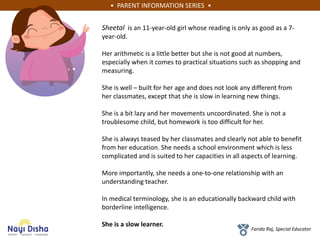
Sheetal is an 11-year-old girl whose reading is only as good as a 7-
year-old.
Her arithmetic is a little better but she is not good at numbers,
especially when it comes to practical situations such as shopping and
measuring.
She is well – built for her age and does not look any different from
her classmates, except that she is slow in learning new things.
She is a bit lazy and her movements uncoordinated. She is not a
troublesome child, but homework is too difficult for her.
She is always teased by her classmates and clearly not able to benefit
from her education. She needs a school environment which is less
complicated and is suited to her capacities in all aspects of learning.
More importantly, she needs a one-to-one relationship with an
understanding teacher.
In medical terminology, she is an educationally backward child with
borderline intelligence.
She is a slow learner.
• PARENT INFORMATION SERIES •
Farida Raj, Special Educator
WHO ARE SLOW LEARNERS? • WAY TO SPOT THE SIGNS • TIPS FOR PARENTS/TEACHERS
Who are slow learners?
SLOW LEARNERS are those whose standard of school work falls below that of an average
child of their age.
A slow learner has learning abilities comparable to children a stage younger than them.
Such children need help to attend to their special academic needs and not medical or
psychological ones.
Some of these children are lucky to get a special educator to help them cope with schoolwork
but most struggle for want of special attention and teaching.
Early intervention play a crucial role in the academic growth of a slow learner.
It is the failure to recognize and provide for their problems that set them back in their
schoolwork.
Farida Raj, Special Educator
WHO ARE SLOW LEARNERS? • WAY TO SPOT THE SIGNS • TIPS FOR PARENTS/TEACHERS
Farida Raj, Special Educator
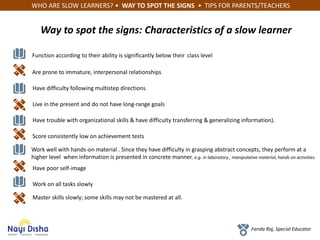
Way to spot the signs: Characteristics of a slow learner
Function according to their ability is significantly below their class level
Are prone to immature, interpersonal relationships
Have difficulty following multistep directions
Live in the present and do not have long-range goals
Score consistently low on achievement tests
Work well with hands-on material . Since they have difficulty in grasping abstract concepts, they perform at a
higher level when information is presented in concrete manner. e.g. in laboratory , manipulative material, hands on activities.
Have poor self-image
Work on all tasks slowly
Master skills slowly; some skills may not be mastered at all.
Have trouble with organizational skills & have difficulty transferring & generalizing information).
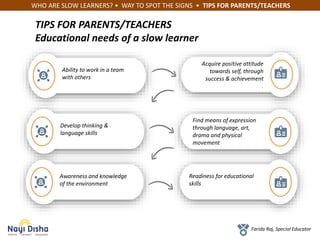
Ability to work in a team
with others
Acquire positive attitude
towards self, through
success & achievement
.
Develop thinking &
language skills
Find means of expression
through language, art,
drama and physical
movement
Awareness and knowledge
of the environment
Readiness for educational
skills
WHO ARE SLOW LEARNERS? • WAY TO SPOT THE SIGNS • TIPS FOR PARENTS/TEACHERS
Farida Raj, Special Educator
TIPS FOR PARENTS/TEACHERS
Educational needs of a slow learner
WHO ARE SLOW LEARNERS? • WAY TO SPOT THE SIGNS • TIPS FOR PARENTS/TEACHERS
Farida Raj, Special Educator
TIPS FOR PARENTS/TEACHERS
Slow learners can benefit from remedial education
Slow learners are very aware of their
difficulties, particularly in reading, spelling,
written expression and math.
As the child grows older, the effects of the
obvious deficits in learning manifest as
behavior problems and deteriorating attitudes.
The slow learner needs to be taught in ways
that adapt to his poor capacity for learning,
such as with Remedial Teaching.
WHO ARE SLOW LEARNERS? • WAY TO SPOT THE SIGNS • TIPS FOR PARENTS/TEACHERS
Farida Raj, Special Educator
TIPS FOR PARENTS/TEACHERS
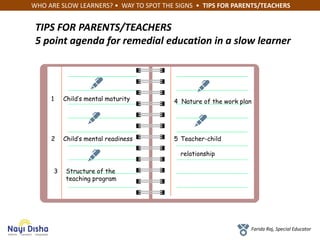
5 point agenda for remedial education in a slow learner
1 Child’s mental maturity
2 Child’s mental readiness
3 Structure of the
teaching program
4 Nature of the work plan
5 Teacher-child
relationship
WHO ARE SLOW LEARNERS? • WAY TO SPOT THE SIGNS • TIPS FOR PARENTS/TEACHERS
Farida Raj, Special Educator
TIPS FOR PARENTS/TEACHERS
5 point agenda for remedial education in a slow learner
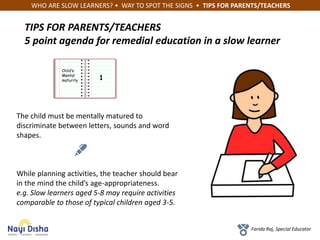
Child’s
Mental
maturity 1
The child must be mentally matured to
discriminate between letters, sounds and word
shapes.
While planning activities, the teacher should bear
in the mind the child’s age-appropriateness.
e.g. Slow learners aged 5-8 may require activities
comparable to those of typical children aged 3-5.
WHO ARE SLOW LEARNERS? • WAY TO SPOT THE SIGNS • TIPS FOR PARENTS/TEACHERS
Farida Raj, Special Educator
TIPS FOR PARENTS/TEACHERS
5 point agenda for remedial education in a slow learner
Child’s
Mental
readiness 2
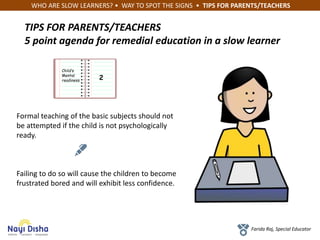
Formal teaching of the basic subjects should not
be attempted if the child is not psychologically
ready.
Failing to do so will cause the children to become
frustrated bored and will exhibit less confidence.
WHO ARE SLOW LEARNERS? • WAY TO SPOT THE SIGNS • TIPS FOR PARENTS/TEACHERS
Farida Raj, Special Educator
TIPS FOR PARENTS/TEACHERS
5 point agenda for remedial education in a slow learner
Structure
of the
teaching
program
3
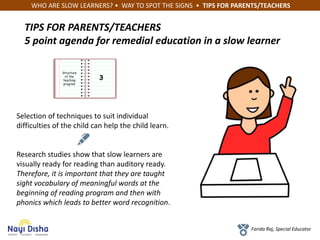
Selection of techniques to suit individual
difficulties of the child can help the child learn.
Research studies show that slow learners are
visually ready for reading than auditory ready.
Therefore, it is important that they are taught
sight vocabulary of meaningful words at the
beginning of reading program and then with
phonics which leads to better word recognition.
WHO ARE SLOW LEARNERS? • WAY TO SPOT THE SIGNS • TIPS FOR PARENTS/TEACHERS
Farida Raj, Special Educator
TIPS FOR PARENTS/TEACHERS
5 point agenda for remedial education in a slow learner
Nature of
the work
plan
4
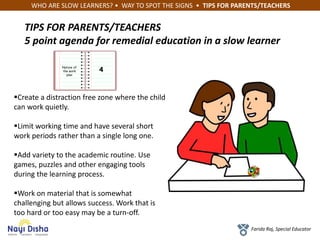
Create a distraction free zone where the child
can work quietly.
Limit working time and have several short
work periods rather than a single long one.
Add variety to the academic routine. Use
games, puzzles and other engaging tools
during the learning process.
Work on material that is somewhat
challenging but allows success. Work that is
too hard or too easy may be a turn-off.
WHO ARE SLOW LEARNERS? • WAY TO SPOT THE SIGNS • TIPS FOR PARENTS/TEACHERS
Farida Raj, Special Educator
TIPS FOR PARENTS/TEACHERS
5 point agenda for remedial education in a slow learner
The
parent/
teacher -
child
relationship
5
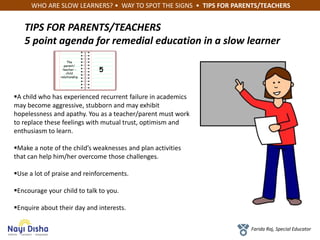
A child who has experienced recurrent failure in academics
may become aggressive, stubborn and may exhibit
hopelessness and apathy. You as a teacher/parent must work
to replace these feelings with mutual trust, optimism and
enthusiasm to learn.
Make a note of the child’s weaknesses and plan activities
that can help him/her overcome those challenges.
Use a lot of praise and reinforcements.
Encourage your child to talk to you.
Enquire about their day and interests.
WHO ARE SLOW LEARNERS? • WAY TO SPOT THE SIGNS • TIPS FOR PARENTS/TEACHERS
Farida Raj, Special Educator
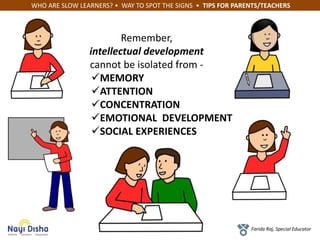
Remember,
intellectual development
cannot be isolated from -
MEMORY
ATTENTION
CONCENTRATION
EMOTIONAL DEVELOPMENT
SOCIAL EXPERIENCES
This content has been developed in collaboration with Remedial & Special
Educator Ms.Farida Raj.
It has been adapted from her book “Breaking Through" - A Hand Book for
Teachers and Parents of Children with Learning Difficulties & reproduced here
with consent.
Nayi Disha Resource Centre is an online information resource platform that
supports families of persons with, Specific Learning Disabilities, Intellectual &
Developmental Disabilities.
www.nayi-disha.org
Visit us at
Join Us on Facebook
Join Us on Twitter
Join Us on Linkedin

Characteristics of a Slow Learner

  • 1.
    LET’S TALK ABOUT SLOWLEARNERS Farida Raj, Special Educator
  • 2.
    Sheetal is an11-year-old girl whose reading is only as good as a 7- year-old. Her arithmetic is a little better but she is not good at numbers, especially when it comes to practical situations such as shopping and measuring. She is well – built for her age and does not look any different from her classmates, except that she is slow in learning new things. She is a bit lazy and her movements uncoordinated. She is not a troublesome child, but homework is too difficult for her. She is always teased by her classmates and clearly not able to benefit from her education. She needs a school environment which is less complicated and is suited to her capacities in all aspects of learning. More importantly, she needs a one-to-one relationship with an understanding teacher. In medical terminology, she is an educationally backward child with borderline intelligence. She is a slow learner. • PARENT INFORMATION SERIES • Farida Raj, Special Educator
  • 3.
    WHO ARE SLOWLEARNERS? • WAY TO SPOT THE SIGNS • TIPS FOR PARENTS/TEACHERS Who are slow learners? SLOW LEARNERS are those whose standard of school work falls below that of an average child of their age. A slow learner has learning abilities comparable to children a stage younger than them. Such children need help to attend to their special academic needs and not medical or psychological ones. Some of these children are lucky to get a special educator to help them cope with schoolwork but most struggle for want of special attention and teaching. Early intervention play a crucial role in the academic growth of a slow learner. It is the failure to recognize and provide for their problems that set them back in their schoolwork. Farida Raj, Special Educator
  • 4.
    WHO ARE SLOWLEARNERS? • WAY TO SPOT THE SIGNS • TIPS FOR PARENTS/TEACHERS Farida Raj, Special Educator Way to spot the signs: Characteristics of a slow learner Function according to their ability is significantly below their class level Are prone to immature, interpersonal relationships Have difficulty following multistep directions Live in the present and do not have long-range goals Score consistently low on achievement tests Work well with hands-on material . Since they have difficulty in grasping abstract concepts, they perform at a higher level when information is presented in concrete manner. e.g. in laboratory , manipulative material, hands on activities. Have poor self-image Work on all tasks slowly Master skills slowly; some skills may not be mastered at all. Have trouble with organizational skills & have difficulty transferring & generalizing information).
  • 5.
    Ability to workin a team with others Acquire positive attitude towards self, through success & achievement . Develop thinking & language skills Find means of expression through language, art, drama and physical movement Awareness and knowledge of the environment Readiness for educational skills WHO ARE SLOW LEARNERS? • WAY TO SPOT THE SIGNS • TIPS FOR PARENTS/TEACHERS Farida Raj, Special Educator TIPS FOR PARENTS/TEACHERS Educational needs of a slow learner
  • 6.
    WHO ARE SLOWLEARNERS? • WAY TO SPOT THE SIGNS • TIPS FOR PARENTS/TEACHERS Farida Raj, Special Educator TIPS FOR PARENTS/TEACHERS Slow learners can benefit from remedial education Slow learners are very aware of their difficulties, particularly in reading, spelling, written expression and math. As the child grows older, the effects of the obvious deficits in learning manifest as behavior problems and deteriorating attitudes. The slow learner needs to be taught in ways that adapt to his poor capacity for learning, such as with Remedial Teaching.
  • 7.
    WHO ARE SLOWLEARNERS? • WAY TO SPOT THE SIGNS • TIPS FOR PARENTS/TEACHERS Farida Raj, Special Educator TIPS FOR PARENTS/TEACHERS 5 point agenda for remedial education in a slow learner 1 Child’s mental maturity 2 Child’s mental readiness 3 Structure of the teaching program 4 Nature of the work plan 5 Teacher-child relationship
  • 8.
    WHO ARE SLOWLEARNERS? • WAY TO SPOT THE SIGNS • TIPS FOR PARENTS/TEACHERS Farida Raj, Special Educator TIPS FOR PARENTS/TEACHERS 5 point agenda for remedial education in a slow learner Child’s Mental maturity 1 The child must be mentally matured to discriminate between letters, sounds and word shapes. While planning activities, the teacher should bear in the mind the child’s age-appropriateness. e.g. Slow learners aged 5-8 may require activities comparable to those of typical children aged 3-5.
  • 9.
    WHO ARE SLOWLEARNERS? • WAY TO SPOT THE SIGNS • TIPS FOR PARENTS/TEACHERS Farida Raj, Special Educator TIPS FOR PARENTS/TEACHERS 5 point agenda for remedial education in a slow learner Child’s Mental readiness 2 Formal teaching of the basic subjects should not be attempted if the child is not psychologically ready. Failing to do so will cause the children to become frustrated bored and will exhibit less confidence.
  • 10.
    WHO ARE SLOWLEARNERS? • WAY TO SPOT THE SIGNS • TIPS FOR PARENTS/TEACHERS Farida Raj, Special Educator TIPS FOR PARENTS/TEACHERS 5 point agenda for remedial education in a slow learner Structure of the teaching program 3 Selection of techniques to suit individual difficulties of the child can help the child learn. Research studies show that slow learners are visually ready for reading than auditory ready. Therefore, it is important that they are taught sight vocabulary of meaningful words at the beginning of reading program and then with phonics which leads to better word recognition.
  • 11.
    WHO ARE SLOWLEARNERS? • WAY TO SPOT THE SIGNS • TIPS FOR PARENTS/TEACHERS Farida Raj, Special Educator TIPS FOR PARENTS/TEACHERS 5 point agenda for remedial education in a slow learner Nature of the work plan 4 Create a distraction free zone where the child can work quietly. Limit working time and have several short work periods rather than a single long one. Add variety to the academic routine. Use games, puzzles and other engaging tools during the learning process. Work on material that is somewhat challenging but allows success. Work that is too hard or too easy may be a turn-off.
  • 12.
    WHO ARE SLOWLEARNERS? • WAY TO SPOT THE SIGNS • TIPS FOR PARENTS/TEACHERS Farida Raj, Special Educator TIPS FOR PARENTS/TEACHERS 5 point agenda for remedial education in a slow learner The parent/ teacher - child relationship 5 A child who has experienced recurrent failure in academics may become aggressive, stubborn and may exhibit hopelessness and apathy. You as a teacher/parent must work to replace these feelings with mutual trust, optimism and enthusiasm to learn. Make a note of the child’s weaknesses and plan activities that can help him/her overcome those challenges. Use a lot of praise and reinforcements. Encourage your child to talk to you. Enquire about their day and interests.
  • 13.
    WHO ARE SLOWLEARNERS? • WAY TO SPOT THE SIGNS • TIPS FOR PARENTS/TEACHERS Farida Raj, Special Educator Remember, intellectual development cannot be isolated from - MEMORY ATTENTION CONCENTRATION EMOTIONAL DEVELOPMENT SOCIAL EXPERIENCES
  • 14.
    This content hasbeen developed in collaboration with Remedial & Special Educator Ms.Farida Raj. It has been adapted from her book “Breaking Through" - A Hand Book for Teachers and Parents of Children with Learning Difficulties & reproduced here with consent. Nayi Disha Resource Centre is an online information resource platform that supports families of persons with, Specific Learning Disabilities, Intellectual & Developmental Disabilities. www.nayi-disha.org Visit us at Join Us on Facebook Join Us on Twitter Join Us on Linkedin