Implementing Character Education Into Curriculum Striving to attain achievement as a school community!
Problem There has been a 25% increase in reported bullying incidents within our building over the past three years. Students are not developing positive character traits that are valued by our school and community
Proposal To cooperatively develop strategies to improve upon the number of reported incidents of bullying through the incorporation of Character Education into our curriculum.
Program Goals   GOAL 1  –  Successful implementation of Character Education into every subject area at the High School level  (Process) GOAL 2  –  Decrease by 30% the number of reported incidents of bullying over the next two years  (Product)
What is  Bullying? Definition: Bullying can be defined as repeated acts against someone who cannot easily defend themselves. Threatening words or gestures Physical/Emotional harm Name calling Mimicking Harassing Shunning (Isolating someone)
What is Character Education? Learning about shared beliefs Moral issues in daily interaction Instruction, curriculum, and assessments based on core values An integral part of the educational process
Character Education   Six Pillars of Character Education: 1. T rustworthiness 2. R espect 3. R esponsibility 4. F airness  5. C aring 6. C itizenship
How can we as a staff collectively approach the problem so that we are working together to achieve a common goal?
Formation of a Character Education Committee Representation will include: -Two Representatives from each Department -Two Building Administrators -Two Community Representatives (PTA/Youth Organizations) -Committee Facilitator
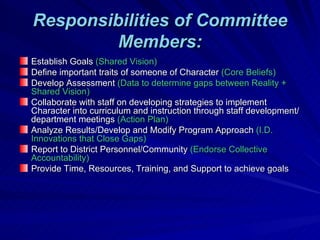
Responsibilities of Committee Members: Establish Goals  (Shared Vision) Define important traits of someone of Character  (Core Beliefs)  Develop Assessment  (Data to determine gaps between Reality + Shared Vision) Collaborate with staff on developing strategies to implement Character into curriculum and instruction through staff development/department meetings  (Action Plan) Analyze Results/Develop and Modify Program Approach  (I.D. Innovations that Close Gaps) Report to District Personnel/Community  (Endorse Collective Accountability) Provide Time, Resources, Training, and Support to achieve goals
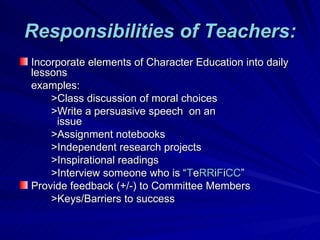
Responsibilities of Teachers: Incorporate elements of Character Education into daily lessons examples: >Class discussion of moral choices >Write a persuasive speech  on an        issue >Assignment notebooks >Independent research projects >Inspirational readings >Interview someone who is ā€œ T e RR i F i CC ā€ Provide feedback (+/-) to Committee Members >Keys/Barriers to success
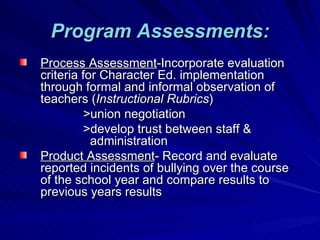
Program Assessments: Process Assessment -Incorporate evaluation criteria for Character Ed. implementation through formal and informal observation of teachers ( Instructional Rubrics ) >union negotiation >develop trust between staff &    administration Product Assessment - Record and evaluate reported incidents of bullying over the course of the school year and compare results to previous years results
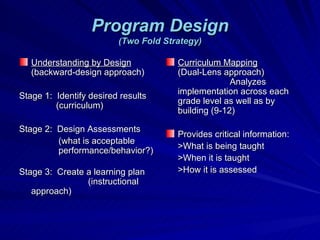
Program Design (Two Fold Strategy) Understanding by Design  (backward-design approach) Stage 1:  Identify desired results    (curriculum) Stage 2:  Design Assessments   (what is acceptable    performance/behavior?)    Stage 3:  Create a learning plan      (instructional approach) Curriculum Mapping   (Dual-Lens approach)  Analyzes implementation across each grade level as well as by building (9-12) Provides critical information: >What is being taught >When it is taught >How it is assessed
Program Goals For Students: Develop Tolerance Treat others with Respect and Kindness Be Polite Develop Empathy Display Stewardship
In addition to achieving program goals, the aim of this intervention is to become a more competent staff, where we can work  together  more efficiently and effectively for the benefit of student learning.

Character Ed.

  • 1.
    Implementing Character EducationInto Curriculum Striving to attain achievement as a school community!
  • 2.
    Problem There hasbeen a 25% increase in reported bullying incidents within our building over the past three years. Students are not developing positive character traits that are valued by our school and community
  • 3.
    Proposal To cooperativelydevelop strategies to improve upon the number of reported incidents of bullying through the incorporation of Character Education into our curriculum.
  • 4.
    Program Goals GOAL 1 – Successful implementation of Character Education into every subject area at the High School level (Process) GOAL 2 – Decrease by 30% the number of reported incidents of bullying over the next two years (Product)
  • 5.
    What is Bullying? Definition: Bullying can be defined as repeated acts against someone who cannot easily defend themselves. Threatening words or gestures Physical/Emotional harm Name calling Mimicking Harassing Shunning (Isolating someone)
  • 6.
    What is CharacterEducation? Learning about shared beliefs Moral issues in daily interaction Instruction, curriculum, and assessments based on core values An integral part of the educational process
  • 7.
    Character Education Six Pillars of Character Education: 1. T rustworthiness 2. R espect 3. R esponsibility 4. F airness 5. C aring 6. C itizenship
  • 8.
    How can weas a staff collectively approach the problem so that we are working together to achieve a common goal?
  • 9.
    Formation of aCharacter Education Committee Representation will include: -Two Representatives from each Department -Two Building Administrators -Two Community Representatives (PTA/Youth Organizations) -Committee Facilitator
  • 10.
    Responsibilities of CommitteeMembers: Establish Goals (Shared Vision) Define important traits of someone of Character (Core Beliefs) Develop Assessment (Data to determine gaps between Reality + Shared Vision) Collaborate with staff on developing strategies to implement Character into curriculum and instruction through staff development/department meetings (Action Plan) Analyze Results/Develop and Modify Program Approach (I.D. Innovations that Close Gaps) Report to District Personnel/Community (Endorse Collective Accountability) Provide Time, Resources, Training, and Support to achieve goals
  • 11.
    Responsibilities of Teachers:Incorporate elements of Character Education into daily lessons examples: >Class discussion of moral choices >Write a persuasive speech on an issue >Assignment notebooks >Independent research projects >Inspirational readings >Interview someone who is ā€œ T e RR i F i CC ā€ Provide feedback (+/-) to Committee Members >Keys/Barriers to success
  • 12.
    Program Assessments: ProcessAssessment -Incorporate evaluation criteria for Character Ed. implementation through formal and informal observation of teachers ( Instructional Rubrics ) >union negotiation >develop trust between staff & administration Product Assessment - Record and evaluate reported incidents of bullying over the course of the school year and compare results to previous years results
  • 13.
    Program Design (TwoFold Strategy) Understanding by Design (backward-design approach) Stage 1: Identify desired results (curriculum) Stage 2: Design Assessments (what is acceptable performance/behavior?) Stage 3: Create a learning plan (instructional approach) Curriculum Mapping (Dual-Lens approach) Analyzes implementation across each grade level as well as by building (9-12) Provides critical information: >What is being taught >When it is taught >How it is assessed
  • 14.
    Program Goals ForStudents: Develop Tolerance Treat others with Respect and Kindness Be Polite Develop Empathy Display Stewardship
  • 15.
    In addition toachieving program goals, the aim of this intervention is to become a more competent staff, where we can work together more efficiently and effectively for the benefit of student learning.