© 2013 by Pearson Higher Education, Inc
Upper Saddle River, New Jersey 07458 • All Rights Reserved
Crisis Intervention
William Harmening
Roosevelt University
Harmening, Crisis Intervention: The Criminal Justice Response to Chaos, Mayhem, and
Disaster
Chapter 8
THE VICTIMS OF CRISIS
© 2013 by Pearson Higher Education, Inc
Upper Saddle River, New Jersey 07458 • All Rights Reserved
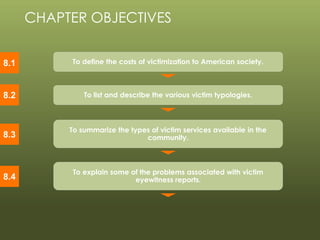
8.1
8.2
8.3
8.4
To define the costs of victimization to American society.
To list and describe the various victim typologies.
To summarize the types of victim services available in the
community.
To explain some of the problems associated with victim
eyewitness reports.
CHAPTER OBJECTIVES
To define the costs of victimization to
American society.
Learning Objectives
After this lecture, you should be able to complete the following Learning Outcomes
8.1
8.1 The Costs of Victimization
Who is a Victim?
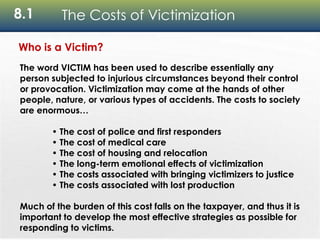
The word VICTIM has been used to describe essentially any
person subjected to injurious circumstances beyond their control
or provocation. Victimization may come at the hands of other
people, nature, or various types of accidents. The costs to society
are enormous…
• The cost of police and first responders
• The cost of medical care
• The cost of housing and relocation
• The long-term emotional effects of victimization
• The costs associated with bringing victimizers to justice
• The costs associated with lost production
Much of the burden of this cost falls on the taxpayer, and thus it is
important to develop the most effective strategies as possible for
responding to victims.
To list and describe the various victim
typologies.
Learning Objectives
After this lecture, you should be able to complete the following Learning Outcomes
8.2
8.2 Victim Typologies
Categorizing Victims
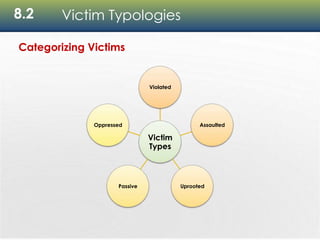
Victim
Types
Violated
Assaulted
UprootedPassive
Oppressed
8.2 Victim Typologies
Categorizing Victims
• The VIOLATED Victim
Victims of sex crimes, including sexual assault, sexual abuse, and
sexual battery.
• The ASSAULTED Victim
Victims of physical violence. Includes both active and passive victims, as well
as abducted children.
• The UPROOTED Victim
Victims of forced relocation and deculturation following natural disasters and
large-scale crises.
• The PASSIVE Victim
Victims of observing and vicariously experiencing another’s trauma.
• The OPPRESSED Victim
Victims of economic, social, or emotional oppression or cruelty.
8.2 Victim Typologies
The Violated Victim
Includes those who are sexually assaulted, both adults and
children.
Scope of the Problem
In 2009 there were 88,097 reported forcible rapes in America.
This doesn’t include those that go unreported.
Types of Rape
• Stranger rapes
• Acquaintance rapes
• Statutory rapes
Depending on the State, the crime of rape may be referred to
as sexual assault, sexual abuse, sexual battery, or predatory
sexual assault.
8.2 Victim Typologies
The Violated Victim
In an effort to change the public’s perception of rape
victims, and also how the male-dominated criminal justice
system has in the past handled their cases, RAPE SHIELD LAWS
have been enacted around the country.
Prior to these laws it was not uncommon or defense attorneys to
argue that victims of rape actually wanted to be raped, or that
it was their own sexual promiscuity that led to the assault. This
had the effect in most cases of traumatizing the victim all over
again.
Rape shield laws now prevent a victim’s sexual history in most
cases from becoming an issue during the trial.
8.2 Victim Typologies
The Violated Victim
THE POLICE RESPONSE
When the police respond to most crimes, their response is
offender-centered, meaning their primary focus is on identifying
and apprehending the offender. In the case of sexual
assault, their response must be victim-centered.
If done correctly, their response will help to lessen the
psychological trauma to the victim. If done incorrectly, it will
only exacerbate it.
An appropriate response will also lead to the gathering of more
credible evidence with which to identify, apprehend, and
convict the offender.
8.2 Victim Typologies
The Violated Victim
THE POLICE RESPONSE
• It is critical that a female officer become involved in the response.
• Officers should be reassuring and comforting, and remain with the
victim throughout the initial evidence gathering phase.
• Detailed questioning about the rape beyond the attacker’s description
should be avoided until the crisis is properly de-escalated and the victim
decompresses psychologically.
• it is critical that the victim not change clothes or shower. They should
be transported to the hospital for a physical exam and evidence
collection by qualified staff.
• Only after the medical exam is completed, and the victim has had the
opportunity to shower, should a detailed interview be attempted. A
qualified representative from local women’s shelter should be present.
8.2 Victim Typologies
The Violated Victim
RAPE TRAUMA SYNDROME
It is important that anyone responding to or investigating cases of
rape understand this syndrome. A rape victim’s behavior may be
confusing to an officer if they are suffering the effects of RTS.
During the acute phase of RTS, which can last from 2-4 weeks
after the attack, the following reactions may be experienced:
- Revulsion toward self
- Self-blame
- Extreme mood swings from anger to fear
- Sorrow and grief
- Disorientation
- Physical symptoms such as nausea and insomnia
8.2 Victim Typologies
The Violated Victim
RAPE TRAUMA SYNDROME
The second phase of RTS can last longer, from months to even
years. Symptoms may include:
- Recurring nightmares
- Strained relationships with men
- Loss of sexual desire
- Intense fear of things they associate with attack
In the most extreme cases, victims may even experience a
complete emotional breakdown and demonstrate
schizophrenic-like behaviors.
8.2 Victim Typologies
The Assaulted Victim
PASSIVE VS. ACTIVE VICTIMS
Assaulted victims are those who are physically attacked, but
without a sexual component.
PASSIVE: Those victims who have no prior connection to their
attackers.
ACTIVE: Those victims who were participants in the situation that
led to their assault.
8.2 Victim Typologies
The Assaulted Victim
CHILD ABDUCTION
Approximately 115 non-family child abductions each year in
America in which the child is detained at least
overnight, transported at least 50 miles, held for ransom, or
intended to be kept permanently or killed.
In almost all states now, when an abduction takes place, there is
an AMBER ALERT. This alert notifies the general public that an
abduction has happened, along with descriptive information
about the child, the abductor, and the vehicle used.
8.2 Victim Typologies
The Assaulted Victim
THE AMBER ALERT
• A.M.B.E.R. – “America’s Missing: Broadcasting Emergency
Response”
• Established following the abduction and murder of 9-year-old
Amber Hagerman in Arlington, TX. Has been responsible for the
safe return of over 500 children.
• Criteria for initiating an alert:
Police must confirm that an abduction has taken place.
The abducted child must be at risk of death or serious injury (as opposed to
parental abduction).
There must be sufficient descriptive information available about the child, the
abductor, or the abductor’s vehicle to make the alert potentially useful.
The child must be 17-years-old or younger.
8.2 Victim Typologies
The Uprooted Victim
Primarily victims of natural disasters.
Hurricane Katrina resulted in nearly 1 million residents of New
Orleans being relocated as far away as Texas and Georgia.
Oftentimes victims of these types of circumstances will become
desperate, and may do desperate things like looting, stealing
vehicles, and resorting to violence against one another.
Those who respond to large-scale disasters must be cognizant of
the effects of uprooting on the victims of those disasters.
8.2 Victim Typologies
The Oppressed Victim
This category includes those who are victims of psychological
and economic abuse or oppression.
• The wife of an emotionally-abusive husband
• The person stuck in the web of a cult
• The single mother who cannot escape abject poverty
• The elder residents of an emotionally-abusive nursing
home
Oftentimes because there is no crime involved, and because of privacy
restrictions, the police fail to get involved in many of these situations.
They can certainly act as a referral source however. It is thus critical that
they understand this type of victimization.
8.2 Victim Typologies
The Passive Victim
Those who are traumatized by simply observing another person
being victimized.
• One of the most common types confronted by police officers is
the child-witness of spousal abuse. It is estimated that 3.3 million
children each year witness domestic violence. These kids are a
high risk for juvenile delinquency, sexual promiscuity, and
substance abuse.
• This category also includes those who are exposed daily to
inner-city violence. These young people are particularly
vulnerable to stress disorders resulting from death immersion.
These young people experience a profound loss of trust, a hatred
for self, a lack of internalized morals and ethics, and a
breakdown of their sense of caring.
To summarize the types of victim
services available in the community.
Learning Objectives
After this lecture, you should be able to complete the following Learning Outcomes
8.3
8.3 Victim Services
Community Services
It is critical that every criminal justice professional who may come in
contact with victims be familiar with all the various victim services that are
available in the community and serve as a referral source/ facilitator.
• Victim compensation
• Victim advocacy programs
• Crisis counseling
• Emergency legal advocacy
• Shelter/ Safe houses
To explain some of the problems
associated with victim eyewitness
reports.
Learning Objectives
After this lecture, you should be able to complete the following Learning Outcomes
8.4
8.4 Victim Eyewitness Reports
The Victim-Witness
Trauma can and often does have a negative effect on memory and
recall. Perception is less accurate in a crisis situation. Stresses increases
a person’s emotional response, and this acts to constrict their
perceptual field.
Memory and recall may also be impacted by personal bias. For
example, a woman assaulted in an unlit area of a particular ethnic
neighborhood may erroneously report that her attacker was a member
of that ethnic group because she expects it to have been. Her
perception is impacted both by the stress of the attack, and by personal
bias.
It is natural for the brain to fill in the missing pieces of a memory based
on expectations and experience. Thus, a victim may unknowingly recall
details of their attack that are false memories.
8.4 Victim Eyewitness Reports
The Victim-Witness
One method often used for victim-witness recall is FORENSIC
HYPNOSIS. It is used when the stress and trauma of the event is
preventing the victim-witness from recovering memories that
have either been repressed or not consciously processed at the
time they were witnessed.
In a state of heightened relaxation, or a trance-state, the person’s
conscious mind no longer blocks the recovery of threatening
memories.
© 2013 by Pearson Higher Education, Inc
Upper Saddle River, New Jersey 07458 • All Rights Reserved
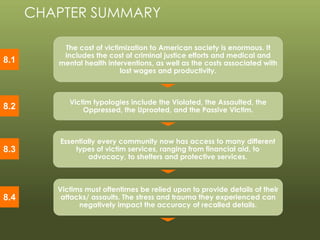
The cost of victimization to American society is enormous. It
includes the cost of criminal justice efforts and medical and
mental health interventions, as well as the costs associated with
lost wages and productivity.
Victim typologies include the Violated, the Assaulted, the
Oppressed, the Uprooted, and the Passive Victim.
Victims must oftentimes be relied upon to provide details of their
attacks/ assaults. The stress and trauma they experienced can
negatively impact the accuracy of recalled details.
CHAPTER SUMMARY
8.1
8.2
8.4
Essentially every community now has access to many different
types of victim services, ranging from financial aid, to
advocacy, to shelters and protective services.
8.3
© 2013 by Pearson Higher Education, Inc
Upper Saddle River, New Jersey 07458 • All Rights Reserved
DISCUSSION QUESTIONS
1. Many minor drug offenders are serving time in prison. Given
the oppressive nature of prison life, do you consider these
people to be “victims of oppression,” and therefore in need
of victim services, or because they committed some type of
crime, should we consider them victims at all?
2. We have seen cases in America where an adult man is
charged with statutory rape when the girl is nearly an adult
and fully consenting. Do you consider this girl to really be a
victim? What factors do you believe the criminal justice
system should weigh when determining whether to
criminally charge such a man?
3. Should the government take any steps or feel any
obligation to remove small children from gang-infested
neighborhoods in order to proactively reduce the chances
of them becoming victims of either violence or long-term
exposure to violence?

Chapter Eight

  • 1.
    © 2013 byPearson Higher Education, Inc Upper Saddle River, New Jersey 07458 • All Rights Reserved Crisis Intervention William Harmening Roosevelt University Harmening, Crisis Intervention: The Criminal Justice Response to Chaos, Mayhem, and Disaster Chapter 8 THE VICTIMS OF CRISIS
  • 2.
    © 2013 byPearson Higher Education, Inc Upper Saddle River, New Jersey 07458 • All Rights Reserved 8.1 8.2 8.3 8.4 To define the costs of victimization to American society. To list and describe the various victim typologies. To summarize the types of victim services available in the community. To explain some of the problems associated with victim eyewitness reports. CHAPTER OBJECTIVES
  • 3.
    To define thecosts of victimization to American society. Learning Objectives After this lecture, you should be able to complete the following Learning Outcomes 8.1
  • 4.
    8.1 The Costsof Victimization Who is a Victim? The word VICTIM has been used to describe essentially any person subjected to injurious circumstances beyond their control or provocation. Victimization may come at the hands of other people, nature, or various types of accidents. The costs to society are enormous… • The cost of police and first responders • The cost of medical care • The cost of housing and relocation • The long-term emotional effects of victimization • The costs associated with bringing victimizers to justice • The costs associated with lost production Much of the burden of this cost falls on the taxpayer, and thus it is important to develop the most effective strategies as possible for responding to victims.
  • 5.
    To list anddescribe the various victim typologies. Learning Objectives After this lecture, you should be able to complete the following Learning Outcomes 8.2
  • 6.
    8.2 Victim Typologies CategorizingVictims Victim Types Violated Assaulted UprootedPassive Oppressed
  • 7.
    8.2 Victim Typologies CategorizingVictims • The VIOLATED Victim Victims of sex crimes, including sexual assault, sexual abuse, and sexual battery. • The ASSAULTED Victim Victims of physical violence. Includes both active and passive victims, as well as abducted children. • The UPROOTED Victim Victims of forced relocation and deculturation following natural disasters and large-scale crises. • The PASSIVE Victim Victims of observing and vicariously experiencing another’s trauma. • The OPPRESSED Victim Victims of economic, social, or emotional oppression or cruelty.
  • 8.
    8.2 Victim Typologies TheViolated Victim Includes those who are sexually assaulted, both adults and children. Scope of the Problem In 2009 there were 88,097 reported forcible rapes in America. This doesn’t include those that go unreported. Types of Rape • Stranger rapes • Acquaintance rapes • Statutory rapes Depending on the State, the crime of rape may be referred to as sexual assault, sexual abuse, sexual battery, or predatory sexual assault.
  • 9.
    8.2 Victim Typologies TheViolated Victim In an effort to change the public’s perception of rape victims, and also how the male-dominated criminal justice system has in the past handled their cases, RAPE SHIELD LAWS have been enacted around the country. Prior to these laws it was not uncommon or defense attorneys to argue that victims of rape actually wanted to be raped, or that it was their own sexual promiscuity that led to the assault. This had the effect in most cases of traumatizing the victim all over again. Rape shield laws now prevent a victim’s sexual history in most cases from becoming an issue during the trial.
  • 10.
    8.2 Victim Typologies TheViolated Victim THE POLICE RESPONSE When the police respond to most crimes, their response is offender-centered, meaning their primary focus is on identifying and apprehending the offender. In the case of sexual assault, their response must be victim-centered. If done correctly, their response will help to lessen the psychological trauma to the victim. If done incorrectly, it will only exacerbate it. An appropriate response will also lead to the gathering of more credible evidence with which to identify, apprehend, and convict the offender.
  • 11.
    8.2 Victim Typologies TheViolated Victim THE POLICE RESPONSE • It is critical that a female officer become involved in the response. • Officers should be reassuring and comforting, and remain with the victim throughout the initial evidence gathering phase. • Detailed questioning about the rape beyond the attacker’s description should be avoided until the crisis is properly de-escalated and the victim decompresses psychologically. • it is critical that the victim not change clothes or shower. They should be transported to the hospital for a physical exam and evidence collection by qualified staff. • Only after the medical exam is completed, and the victim has had the opportunity to shower, should a detailed interview be attempted. A qualified representative from local women’s shelter should be present.
  • 12.
    8.2 Victim Typologies TheViolated Victim RAPE TRAUMA SYNDROME It is important that anyone responding to or investigating cases of rape understand this syndrome. A rape victim’s behavior may be confusing to an officer if they are suffering the effects of RTS. During the acute phase of RTS, which can last from 2-4 weeks after the attack, the following reactions may be experienced: - Revulsion toward self - Self-blame - Extreme mood swings from anger to fear - Sorrow and grief - Disorientation - Physical symptoms such as nausea and insomnia
  • 13.
    8.2 Victim Typologies TheViolated Victim RAPE TRAUMA SYNDROME The second phase of RTS can last longer, from months to even years. Symptoms may include: - Recurring nightmares - Strained relationships with men - Loss of sexual desire - Intense fear of things they associate with attack In the most extreme cases, victims may even experience a complete emotional breakdown and demonstrate schizophrenic-like behaviors.
  • 14.
    8.2 Victim Typologies TheAssaulted Victim PASSIVE VS. ACTIVE VICTIMS Assaulted victims are those who are physically attacked, but without a sexual component. PASSIVE: Those victims who have no prior connection to their attackers. ACTIVE: Those victims who were participants in the situation that led to their assault.
  • 15.
    8.2 Victim Typologies TheAssaulted Victim CHILD ABDUCTION Approximately 115 non-family child abductions each year in America in which the child is detained at least overnight, transported at least 50 miles, held for ransom, or intended to be kept permanently or killed. In almost all states now, when an abduction takes place, there is an AMBER ALERT. This alert notifies the general public that an abduction has happened, along with descriptive information about the child, the abductor, and the vehicle used.
  • 16.
    8.2 Victim Typologies TheAssaulted Victim THE AMBER ALERT • A.M.B.E.R. – “America’s Missing: Broadcasting Emergency Response” • Established following the abduction and murder of 9-year-old Amber Hagerman in Arlington, TX. Has been responsible for the safe return of over 500 children. • Criteria for initiating an alert: Police must confirm that an abduction has taken place. The abducted child must be at risk of death or serious injury (as opposed to parental abduction). There must be sufficient descriptive information available about the child, the abductor, or the abductor’s vehicle to make the alert potentially useful. The child must be 17-years-old or younger.
  • 17.
    8.2 Victim Typologies TheUprooted Victim Primarily victims of natural disasters. Hurricane Katrina resulted in nearly 1 million residents of New Orleans being relocated as far away as Texas and Georgia. Oftentimes victims of these types of circumstances will become desperate, and may do desperate things like looting, stealing vehicles, and resorting to violence against one another. Those who respond to large-scale disasters must be cognizant of the effects of uprooting on the victims of those disasters.
  • 18.
    8.2 Victim Typologies TheOppressed Victim This category includes those who are victims of psychological and economic abuse or oppression. • The wife of an emotionally-abusive husband • The person stuck in the web of a cult • The single mother who cannot escape abject poverty • The elder residents of an emotionally-abusive nursing home Oftentimes because there is no crime involved, and because of privacy restrictions, the police fail to get involved in many of these situations. They can certainly act as a referral source however. It is thus critical that they understand this type of victimization.
  • 19.
    8.2 Victim Typologies ThePassive Victim Those who are traumatized by simply observing another person being victimized. • One of the most common types confronted by police officers is the child-witness of spousal abuse. It is estimated that 3.3 million children each year witness domestic violence. These kids are a high risk for juvenile delinquency, sexual promiscuity, and substance abuse. • This category also includes those who are exposed daily to inner-city violence. These young people are particularly vulnerable to stress disorders resulting from death immersion. These young people experience a profound loss of trust, a hatred for self, a lack of internalized morals and ethics, and a breakdown of their sense of caring.
  • 20.
    To summarize thetypes of victim services available in the community. Learning Objectives After this lecture, you should be able to complete the following Learning Outcomes 8.3
  • 21.
    8.3 Victim Services CommunityServices It is critical that every criminal justice professional who may come in contact with victims be familiar with all the various victim services that are available in the community and serve as a referral source/ facilitator. • Victim compensation • Victim advocacy programs • Crisis counseling • Emergency legal advocacy • Shelter/ Safe houses
  • 22.
    To explain someof the problems associated with victim eyewitness reports. Learning Objectives After this lecture, you should be able to complete the following Learning Outcomes 8.4
  • 23.
    8.4 Victim EyewitnessReports The Victim-Witness Trauma can and often does have a negative effect on memory and recall. Perception is less accurate in a crisis situation. Stresses increases a person’s emotional response, and this acts to constrict their perceptual field. Memory and recall may also be impacted by personal bias. For example, a woman assaulted in an unlit area of a particular ethnic neighborhood may erroneously report that her attacker was a member of that ethnic group because she expects it to have been. Her perception is impacted both by the stress of the attack, and by personal bias. It is natural for the brain to fill in the missing pieces of a memory based on expectations and experience. Thus, a victim may unknowingly recall details of their attack that are false memories.
  • 24.
    8.4 Victim EyewitnessReports The Victim-Witness One method often used for victim-witness recall is FORENSIC HYPNOSIS. It is used when the stress and trauma of the event is preventing the victim-witness from recovering memories that have either been repressed or not consciously processed at the time they were witnessed. In a state of heightened relaxation, or a trance-state, the person’s conscious mind no longer blocks the recovery of threatening memories.
  • 25.
    © 2013 byPearson Higher Education, Inc Upper Saddle River, New Jersey 07458 • All Rights Reserved The cost of victimization to American society is enormous. It includes the cost of criminal justice efforts and medical and mental health interventions, as well as the costs associated with lost wages and productivity. Victim typologies include the Violated, the Assaulted, the Oppressed, the Uprooted, and the Passive Victim. Victims must oftentimes be relied upon to provide details of their attacks/ assaults. The stress and trauma they experienced can negatively impact the accuracy of recalled details. CHAPTER SUMMARY 8.1 8.2 8.4 Essentially every community now has access to many different types of victim services, ranging from financial aid, to advocacy, to shelters and protective services. 8.3
  • 26.
    © 2013 byPearson Higher Education, Inc Upper Saddle River, New Jersey 07458 • All Rights Reserved DISCUSSION QUESTIONS 1. Many minor drug offenders are serving time in prison. Given the oppressive nature of prison life, do you consider these people to be “victims of oppression,” and therefore in need of victim services, or because they committed some type of crime, should we consider them victims at all? 2. We have seen cases in America where an adult man is charged with statutory rape when the girl is nearly an adult and fully consenting. Do you consider this girl to really be a victim? What factors do you believe the criminal justice system should weigh when determining whether to criminally charge such a man? 3. Should the government take any steps or feel any obligation to remove small children from gang-infested neighborhoods in order to proactively reduce the chances of them becoming victims of either violence or long-term exposure to violence?