BTEC3301
Plant biotechnology is a process to produce a
genetically modified plant by removing
genetic information from an organism,
manipulating it in the laboratory and then
transferring it into a plant to change certain of
its characteristics .
Plant Biotechnology is a rapidly expanding field
within Biotechnology.
 It chiefly involves the introduction of foreign
genes into economically important plant
species, resulting in crop improvement and
the production of novel products in plants.
 Today, biotechnology is being used as a tool
to give plants new traits that benefit
agricultural production, the environment, and
human nutrition and health.
…INTRODUCTION
 The goal of plant breeding is to combine
desirable traits from different varieties of
plants to produce plants of superior quality.
 This approach to improving crop production
has been very successful over the years.
 For example, it would be beneficial to cross a
tomato plant that bears sweeter fruit with one
that exhibits increased disease resistance.
…INTRODUCTION
 The red juicy tomatoes on shelves are results
of genetic engineering.
 For hundreds of years plant breeders have
cross fertilised related plant, selecting
combinations from the offspring that provide
the plant with new characteristics beneficial
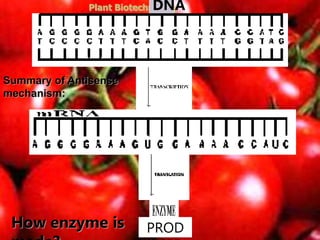
to men.
 Today plant biotechnology encompasses two
major areas, plant tissues culture and plant
genetic engineering.
…INTRODUCTION
 A transgenic crop plant contains a gene or
genes which have been artificially inserted
instead of the plant acquiring them through
pollination.
 The inserted gene sequence (known as the
transgene) may come from another unrelated
plant, or from a completely different species
 Example transgenic Bt corn, for example,
which produces its own insecticide, contains
a gene from a bacterium.
 Plants containing transgenes are often called
genetically modified or GM crops
 Desirable genes may provide features such as
higher yield or improved quality, pest or
disease resistance, or tolerance to heat, cold
and drought.
..What are transgenic plants?
 Combining the best genes in one plant is a
long and difficult process, especially as
traditional plant breeding has been limited to
artificially crossing plants within the same
species or with closely related species to
bring different genes together.
 Corn and soybean to resist pest in US are in
the forefront of Biotechnological revolution.
…What are transgenic plants?
 This is usually done by crossing two
members of the same species which has
dominant alleles for particular genes such as
long life and quick metabolism in one
organism crossed with another organism
possessing genes for fast growth and high
yield.
A. Selective Breeding
 Since both these organisms have dominant
genes for these desirable characteristics, when
they are crossed they will produce at least
some offspring that will show ALL of these
desirable characteristics.
 When such a cross occurs, the offspring is
termed a hybrid
….A. Selective Breeding
 Cloning is the process of creating
an identical copy of an original.
 In plant cloning is done by tissue
culture methods.
Refer for more info on tissue culture:
 http://www.jmu.edu/biology/biofac/facfro/cloning/cloning3.htm
Plant Biotechnology
Plant Biotechnology Techniques
B. Cloning:
(Growing plant from a single cell)
 Agrobacterium tumefaciens is a common soil
bacterium that causes crown gall disease by
transferring some of its DNA to the plant
host.
 The transferred DNA (T-DNA) is stably
integrated into the plant genome, where its
expression leads to the synthesis of plant
hormones and thus to the tumorous growth of
the cells.
 After discovering this process, scientists were
able to "disarm" the bacterium, put new genes
into it, and use the bacterium to harmlessly
insert the desired genes into the plant
genome
Plant Biotechnology
Plant Biotechnology Techniques
C. Nature's way:
Many of the techniques used in plant biotechnology
can be grouped under the headings of Plant Tissue
Culture and Plant Genetic Engineering.
 One problem with working with plants is that
they have a cell wall - how do you get a
recombinant plasmid to cross that barrier?
 The following are some of the techniques used:
1.Microinjection of single cells
Plant Biotechnology
Plant Biotechnology Techniques
D. Cellular target practice:
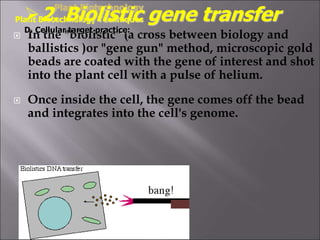
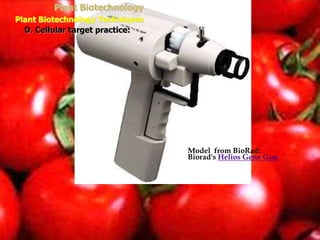
 In the "biolistic" (a cross between biology and
ballistics )or "gene gun" method, microscopic gold
beads are coated with the gene of interest and shot
into the plant cell with a pulse of helium.
 Once inside the cell, the gene comes off the bead
and integrates into the cell's genome.
Plant Biotechnology
Plant Biotechnology Techniques
D. Cellular target practice:
2. Biolistic gene transfer
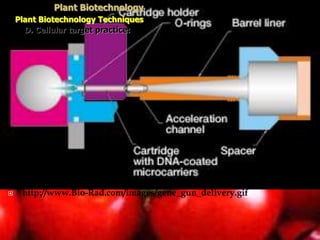
 http://www.Bio-Rad.com/images/gene_gun_delivery.gif
Plant Biotechnology
Plant Biotechnology Techniques
D. Cellular target practice:
 Model from BioRad:
Biorad's Helios Gene Gun
Plant Biotechnology
Plant Biotechnology Techniques
D. Cellular target practice:
 Plant cells could be "electroporated" or
mixed with a gene and "shocked" with
a pulse of electricity, causing holes to
form in the cell through which the
DNA could flow.
 The cell is subsequently able to repair
the holes and the gene becomes a part
of the plant genome.
Plant Biotechnology
Plant Biotechnology Techniques
D. Cellular target practice:
3.Electroporation of cells grown
without a cell wall (protoplasts)
 This process is called Agrobacterium -
mediated transformation. (Refer article
PN Achar 2000).
 The process "disarm" the bacterium,
put new genes into it, and use the
bacterium to harmlessly insert the
desired genes into the plant genome.
Plant Biotechnology
Plant Biotechnology Techniques
D. Cellular target practice:
4. Agrobacterium-mediated
transfer
 Plant tissue culture is the cultivation of
plant cells or tissues on specifically
formulated nutrient enriched media.
 Under appropriate conditions, an
entire plant can be regenerated from
each single cell, permitting the rapid
production of many identical plants.
Plant Biotechnology
Plant Biotechnology Techniques
D. Cellular target practice:
 5. Protoplast Fusion (Plant
tissue culture)
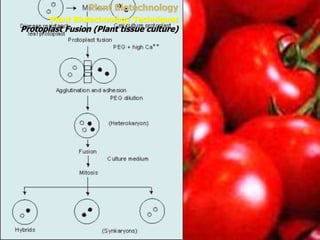
 Protoplast is a cell without cell wall
 Protoplasts are capable of fusing; forms
somatic hybrids of even genetically
incompatible plants
 Hybrid protoplasts are then regenerated
by tissue culture into whole hybrid
plants .
 Boccoflower is a hybrid between
broccoli and cauliflower. (Refer pg fig.6.2 in text
book)
Plant Biotechnology
Plant Biotechnology Techniques
Protoplast Fusion (Plant tissue culture)
Plant Biotechnology
Plant Biotechnology Techniques
Protoplast Fusion (Plant tissue culture)
 Culture leaf disc in genetically modified
Agrobacterium.
 Soil bacterium Agrobacterium tumefaciens causes
crown gall disease in plants.
 This disease is characterized by the formation of
tumors on plants after infection of wound sites by
the bacterium.
Plant Biotechnology
Plant Biotechnology Techniques
D. Cellular target practice:
6. Leaf Fragment technique/ Leaf
Disk Method For Agrobacterium Mediated
Transformation of Higher Plants:
 The crown gall cells gain two genetic properties
not possessed by normal plant cells.
 These are the ability to grow in culture in the
absence of externally added hormones, and the
production of unusual compounds called opines.
 These opines are used by the bacterium as
sources of carbon and nitrogen. The bacterium
therefore creates a niche in the crown gall which
is favorable for growth.
Plant Biotechnology
Plant Biotechnology Techniques
6. Leaf Fragment technique
 The molecular basis for this disease was
identified in 1974 with the discovery of a 200 kb
plasmid called the Ti plasmid (tumor inducing).
 Removal of the plasmid leads to avirulence, and
re introduction restores virulence.
 This Ti plasmid can be constructed with foreign
genes include antibiotic resistance markers,
genes for useful agronomic traits such as
herbicide tolerance, virus resistance, and insect
resistance.
Plant Biotechnology
Plant Biotechnology Techniques
6. Leaf Fragment technique
 The significant finding was that a 13 kb
piece of the Ti plasmid is transferred
into the genome of the recipient cell.
 This piece of transferred DNA is called
the T DNA.
 The transfer of this T DNA to plant cells
is the key step in using Agrobacterium
tumefaciens as an agent for directed
transformation and genetic modification
of higher plants.
Plant Biotechnology
Plant Biotechnology Techniques
6. Leaf Fragment technique
 A growing number of plant species have been
successfully transformed with foreign genes
using such artificially constructed plasmid
vectors. .
 The bacterial plasmid serves as an ideal
vehicle for transferring DNA. And this is
done by culturing leaf discs in medium
containing genetically modified
Agrobacterium.
 Major limitation of this technique is that
Agrobacterium cannot infect monocotyledons
e.g. corn but can easily infect dicotyledons e.g.
potatoes, tomatoes, soybeans etc.
Plant Biotechnology
Plant Biotechnology Techniques
6. Leaf Fragment technique
 Refer pg 138; fig 6.4
 for regeneration of plants from leaf disc with the
aid of Agrobacterium tumefaciens.
Note:
 Gene gun an alternative method for inserting
gene instead of Agrobacterium!!!
 Assignment for next week: The gene Guns: Pg
140;fig.6.5
Plant Biotechnology
Plant Biotechnology Techniques
6. Leaf Fragment technique
 Plant genetic engineering involves the
manipulation of genes at cellular and
molecular levels. Using techniques of plant
genetic engineering, it is now possible to
isolate genes of interest form one kind of
organism incorporating them into another,
thus resulting in the permanent change inn
the genetic make-up of the recipient.
Plant Biotechnology
 DNA in a cell chloroplast can also accept new
genes.
 Plant can be transformed with new traits
using chloroplast DNA
 Pollen DNA is separate from chloroplast
DNA hence, transformed chloroplast cannot
be released along with pollen DNA
Plant Biotechnology
 Generally ripe tomatoes are red and juicy;
usually perish quickly if not refrigerated and
mushy….
 The FlavrSavrTM tomato (introduced in
1994by Calgene Inc.) can stay ripe for
weeks!!!! Without perishing quickly. Why?
 The Flavr Savr tomato is designed to ripen on
the vine, with minimal softening and
transported to consumers, a definite plus for
grocery stores.
Plant Biotechnology
Chloroplast Engineering:
 Ripe tomatoes produces the enzyme
polyglacturonase(PG).
 The PG enzyme is responsible for the
breakdown pectin, a building block in cell
walls, which gives tomatoes their firmness.
 To slow down the softening process, the Flavr
Savr employs antisense technology to block
PG enzyme production.
 Antisense technology is a method of gene
silencing.
Plant Biotechnology
Chloroplast Engineering:
 Antisense technology is a method of gene
silencing.
 The first step in this process involved the
isolation of the PG gene from the tomato.
 The first step is to clone the antisense DNA
with the PG gene and insert this DNA into
the plasmid of an agrobacterium.
 The bacterium is introduced to plant cells
which transfers the gene of interest into plant
cells.
 The cells with the plasmid are grown by
adding specific hormones.
Plant Biotechnology
Chloroplast Engineering:
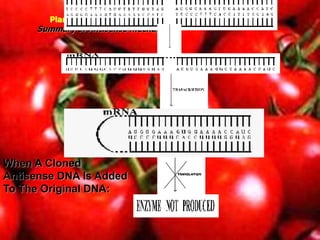
 The re-generated plants will express the
antisense DNA and when the mRNA is made
through the process of transcription the sense
mRNA will bind to the anti-sense mRNA.
This interferes with protein production (PG
enzyme in tomato).
 Antisense is being developed for potatoes to
resist bruising.
 Refer fig 6.7:The Flavr SavrTM tomato.
Plant Biotechnology
Chloroplast Engineering:
Plant Biotechnology
Plant Biotechnology Techniques
Summary of Antisense mechanism:
How enzyme is
DNA
PROD
Summary of Antisense
mechanism:
Plant Biotechnology
Plant Biotechnology Techniques
Summary of Antisense mechanism:
What Happens
When A Cloned
Antisense DNA Is
Added To The
Original DNA?
Plant Biotechnology
Plant Biotechnology Techniques
Summary of Antisense mechanism:
How enzyme is made?
DNA
Plant Biotechnology
Plant Biotechnology Techniques
Summary of Antisense mechanism:
When A Cloned
Antisense DNA Is Added
To The Original DNA:
 http://www.biores-irl.ie/biozone/plants.html
 http://search.yahoo.com/search?p=Selective+breeding
&ei=UTF-8&fr=FP-tab-web-t&fl=0&x=wrt
 http://www.colorado.edu/che/BioProcess%20Engineer
ing/Lecture%208/protoplastfusion.htm
 http://www.inform.umd.edu/genetics/leafdisc.html
 http://dragon.zoo.utoronto.ca/~jlm-
gmf/T0501D/methods.html for gene slicing
 http://dragon.zoo.utoronto.ca/~jlm-
gmf/T0101A/Enzyme.html for Flavr Slavr
Plant Biotechnology
 Practical Applications of Genetic
Engineering in Plants
 Vaccine for plants

Chapter_6_Plant_Biotechnology lecture note.ppt

  • 1.
  • 2.
    Plant biotechnology isa process to produce a genetically modified plant by removing genetic information from an organism, manipulating it in the laboratory and then transferring it into a plant to change certain of its characteristics . Plant Biotechnology is a rapidly expanding field within Biotechnology.
  • 3.
     It chieflyinvolves the introduction of foreign genes into economically important plant species, resulting in crop improvement and the production of novel products in plants.  Today, biotechnology is being used as a tool to give plants new traits that benefit agricultural production, the environment, and human nutrition and health. …INTRODUCTION
  • 4.
     The goalof plant breeding is to combine desirable traits from different varieties of plants to produce plants of superior quality.  This approach to improving crop production has been very successful over the years.  For example, it would be beneficial to cross a tomato plant that bears sweeter fruit with one that exhibits increased disease resistance. …INTRODUCTION
  • 5.
     The redjuicy tomatoes on shelves are results of genetic engineering.  For hundreds of years plant breeders have cross fertilised related plant, selecting combinations from the offspring that provide the plant with new characteristics beneficial to men.  Today plant biotechnology encompasses two major areas, plant tissues culture and plant genetic engineering. …INTRODUCTION
  • 6.
     A transgeniccrop plant contains a gene or genes which have been artificially inserted instead of the plant acquiring them through pollination.  The inserted gene sequence (known as the transgene) may come from another unrelated plant, or from a completely different species
  • 7.
     Example transgenicBt corn, for example, which produces its own insecticide, contains a gene from a bacterium.  Plants containing transgenes are often called genetically modified or GM crops  Desirable genes may provide features such as higher yield or improved quality, pest or disease resistance, or tolerance to heat, cold and drought. ..What are transgenic plants?
  • 8.
     Combining thebest genes in one plant is a long and difficult process, especially as traditional plant breeding has been limited to artificially crossing plants within the same species or with closely related species to bring different genes together.  Corn and soybean to resist pest in US are in the forefront of Biotechnological revolution. …What are transgenic plants?
  • 9.
     This isusually done by crossing two members of the same species which has dominant alleles for particular genes such as long life and quick metabolism in one organism crossed with another organism possessing genes for fast growth and high yield. A. Selective Breeding
  • 10.
     Since boththese organisms have dominant genes for these desirable characteristics, when they are crossed they will produce at least some offspring that will show ALL of these desirable characteristics.  When such a cross occurs, the offspring is termed a hybrid ….A. Selective Breeding
  • 11.
     Cloning isthe process of creating an identical copy of an original.  In plant cloning is done by tissue culture methods. Refer for more info on tissue culture:  http://www.jmu.edu/biology/biofac/facfro/cloning/cloning3.htm Plant Biotechnology Plant Biotechnology Techniques B. Cloning: (Growing plant from a single cell)
  • 12.
     Agrobacterium tumefaciensis a common soil bacterium that causes crown gall disease by transferring some of its DNA to the plant host.  The transferred DNA (T-DNA) is stably integrated into the plant genome, where its expression leads to the synthesis of plant hormones and thus to the tumorous growth of the cells.  After discovering this process, scientists were able to "disarm" the bacterium, put new genes into it, and use the bacterium to harmlessly insert the desired genes into the plant genome Plant Biotechnology Plant Biotechnology Techniques C. Nature's way:
  • 13.
    Many of thetechniques used in plant biotechnology can be grouped under the headings of Plant Tissue Culture and Plant Genetic Engineering.  One problem with working with plants is that they have a cell wall - how do you get a recombinant plasmid to cross that barrier?  The following are some of the techniques used: 1.Microinjection of single cells Plant Biotechnology Plant Biotechnology Techniques D. Cellular target practice:
  • 14.
     In the"biolistic" (a cross between biology and ballistics )or "gene gun" method, microscopic gold beads are coated with the gene of interest and shot into the plant cell with a pulse of helium.  Once inside the cell, the gene comes off the bead and integrates into the cell's genome. Plant Biotechnology Plant Biotechnology Techniques D. Cellular target practice: 2. Biolistic gene transfer
  • 15.
     http://www.Bio-Rad.com/images/gene_gun_delivery.gif Plant Biotechnology PlantBiotechnology Techniques D. Cellular target practice:
  • 16.
     Model fromBioRad: Biorad's Helios Gene Gun Plant Biotechnology Plant Biotechnology Techniques D. Cellular target practice:
  • 17.
     Plant cellscould be "electroporated" or mixed with a gene and "shocked" with a pulse of electricity, causing holes to form in the cell through which the DNA could flow.  The cell is subsequently able to repair the holes and the gene becomes a part of the plant genome. Plant Biotechnology Plant Biotechnology Techniques D. Cellular target practice: 3.Electroporation of cells grown without a cell wall (protoplasts)
  • 18.
     This processis called Agrobacterium - mediated transformation. (Refer article PN Achar 2000).  The process "disarm" the bacterium, put new genes into it, and use the bacterium to harmlessly insert the desired genes into the plant genome. Plant Biotechnology Plant Biotechnology Techniques D. Cellular target practice: 4. Agrobacterium-mediated transfer
  • 19.
     Plant tissueculture is the cultivation of plant cells or tissues on specifically formulated nutrient enriched media.  Under appropriate conditions, an entire plant can be regenerated from each single cell, permitting the rapid production of many identical plants. Plant Biotechnology Plant Biotechnology Techniques D. Cellular target practice:  5. Protoplast Fusion (Plant tissue culture)
  • 20.
     Protoplast isa cell without cell wall  Protoplasts are capable of fusing; forms somatic hybrids of even genetically incompatible plants  Hybrid protoplasts are then regenerated by tissue culture into whole hybrid plants .  Boccoflower is a hybrid between broccoli and cauliflower. (Refer pg fig.6.2 in text book) Plant Biotechnology Plant Biotechnology Techniques Protoplast Fusion (Plant tissue culture)
  • 21.
    Plant Biotechnology Plant BiotechnologyTechniques Protoplast Fusion (Plant tissue culture)
  • 22.
     Culture leafdisc in genetically modified Agrobacterium.  Soil bacterium Agrobacterium tumefaciens causes crown gall disease in plants.  This disease is characterized by the formation of tumors on plants after infection of wound sites by the bacterium. Plant Biotechnology Plant Biotechnology Techniques D. Cellular target practice: 6. Leaf Fragment technique/ Leaf Disk Method For Agrobacterium Mediated Transformation of Higher Plants:
  • 23.
     The crowngall cells gain two genetic properties not possessed by normal plant cells.  These are the ability to grow in culture in the absence of externally added hormones, and the production of unusual compounds called opines.  These opines are used by the bacterium as sources of carbon and nitrogen. The bacterium therefore creates a niche in the crown gall which is favorable for growth. Plant Biotechnology Plant Biotechnology Techniques 6. Leaf Fragment technique
  • 24.
     The molecularbasis for this disease was identified in 1974 with the discovery of a 200 kb plasmid called the Ti plasmid (tumor inducing).  Removal of the plasmid leads to avirulence, and re introduction restores virulence.  This Ti plasmid can be constructed with foreign genes include antibiotic resistance markers, genes for useful agronomic traits such as herbicide tolerance, virus resistance, and insect resistance. Plant Biotechnology Plant Biotechnology Techniques 6. Leaf Fragment technique
  • 25.
     The significantfinding was that a 13 kb piece of the Ti plasmid is transferred into the genome of the recipient cell.  This piece of transferred DNA is called the T DNA.  The transfer of this T DNA to plant cells is the key step in using Agrobacterium tumefaciens as an agent for directed transformation and genetic modification of higher plants. Plant Biotechnology Plant Biotechnology Techniques 6. Leaf Fragment technique
  • 26.
     A growingnumber of plant species have been successfully transformed with foreign genes using such artificially constructed plasmid vectors. .  The bacterial plasmid serves as an ideal vehicle for transferring DNA. And this is done by culturing leaf discs in medium containing genetically modified Agrobacterium.  Major limitation of this technique is that Agrobacterium cannot infect monocotyledons e.g. corn but can easily infect dicotyledons e.g. potatoes, tomatoes, soybeans etc. Plant Biotechnology Plant Biotechnology Techniques 6. Leaf Fragment technique
  • 27.
     Refer pg138; fig 6.4  for regeneration of plants from leaf disc with the aid of Agrobacterium tumefaciens. Note:  Gene gun an alternative method for inserting gene instead of Agrobacterium!!!  Assignment for next week: The gene Guns: Pg 140;fig.6.5 Plant Biotechnology Plant Biotechnology Techniques 6. Leaf Fragment technique
  • 28.
     Plant geneticengineering involves the manipulation of genes at cellular and molecular levels. Using techniques of plant genetic engineering, it is now possible to isolate genes of interest form one kind of organism incorporating them into another, thus resulting in the permanent change inn the genetic make-up of the recipient. Plant Biotechnology
  • 29.
     DNA ina cell chloroplast can also accept new genes.  Plant can be transformed with new traits using chloroplast DNA  Pollen DNA is separate from chloroplast DNA hence, transformed chloroplast cannot be released along with pollen DNA Plant Biotechnology
  • 30.
     Generally ripetomatoes are red and juicy; usually perish quickly if not refrigerated and mushy….  The FlavrSavrTM tomato (introduced in 1994by Calgene Inc.) can stay ripe for weeks!!!! Without perishing quickly. Why?  The Flavr Savr tomato is designed to ripen on the vine, with minimal softening and transported to consumers, a definite plus for grocery stores. Plant Biotechnology Chloroplast Engineering:
  • 31.
     Ripe tomatoesproduces the enzyme polyglacturonase(PG).  The PG enzyme is responsible for the breakdown pectin, a building block in cell walls, which gives tomatoes their firmness.  To slow down the softening process, the Flavr Savr employs antisense technology to block PG enzyme production.  Antisense technology is a method of gene silencing. Plant Biotechnology Chloroplast Engineering:
  • 32.
     Antisense technologyis a method of gene silencing.  The first step in this process involved the isolation of the PG gene from the tomato.  The first step is to clone the antisense DNA with the PG gene and insert this DNA into the plasmid of an agrobacterium.  The bacterium is introduced to plant cells which transfers the gene of interest into plant cells.  The cells with the plasmid are grown by adding specific hormones. Plant Biotechnology Chloroplast Engineering:
  • 33.
     The re-generatedplants will express the antisense DNA and when the mRNA is made through the process of transcription the sense mRNA will bind to the anti-sense mRNA. This interferes with protein production (PG enzyme in tomato).  Antisense is being developed for potatoes to resist bruising.  Refer fig 6.7:The Flavr SavrTM tomato. Plant Biotechnology Chloroplast Engineering:
  • 34.
    Plant Biotechnology Plant BiotechnologyTechniques Summary of Antisense mechanism: How enzyme is DNA PROD Summary of Antisense mechanism:
  • 35.
    Plant Biotechnology Plant BiotechnologyTechniques Summary of Antisense mechanism: What Happens When A Cloned Antisense DNA Is Added To The Original DNA?
  • 36.
    Plant Biotechnology Plant BiotechnologyTechniques Summary of Antisense mechanism: How enzyme is made? DNA
  • 37.
    Plant Biotechnology Plant BiotechnologyTechniques Summary of Antisense mechanism: When A Cloned Antisense DNA Is Added To The Original DNA:
  • 38.
     http://www.biores-irl.ie/biozone/plants.html  http://search.yahoo.com/search?p=Selective+breeding &ei=UTF-8&fr=FP-tab-web-t&fl=0&x=wrt http://www.colorado.edu/che/BioProcess%20Engineer ing/Lecture%208/protoplastfusion.htm  http://www.inform.umd.edu/genetics/leafdisc.html  http://dragon.zoo.utoronto.ca/~jlm- gmf/T0501D/methods.html for gene slicing  http://dragon.zoo.utoronto.ca/~jlm- gmf/T0101A/Enzyme.html for Flavr Slavr Plant Biotechnology
  • 39.
     Practical Applicationsof Genetic Engineering in Plants  Vaccine for plants