2-1
The Nature of Genetic Material
Historical Background
• Miescher isolated nuclei from pus (white
blood cells) in 1869
– Found a novel phosphorus-bearing substance =
nuclein
– Nuclein is mostly chromatin, a complex of DNA
and chromosomal proteins
• End of 19th
century – DNA and RNA
separated from proteins
• Levene, Jacobs, et al. characterized basic
composition of DNA and RNA
2-2
Transformation in Bacteria
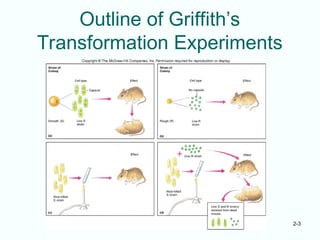
• Key experiments done by Frederick Griffith
in 1928
• Observed change in Streptococcus
pneumoniae — from virulent (S) smooth
colonies where bacterial had capsules, to
avirulent (R) rough colonies without
capsules
• Heat-killed virulent colonies could
transform avirulent colonies to virulent
ones
2-3
Outline of Griffith’s
Transformation Experiments
2-4
DNA: The Transforming
Material
In 1944 a group used a transformation test
similar to Griffith’s procedure taking care to
define the chemical nature of the
transforming substance
– Techniques used excluded both protein and
RNA as the chemical agent of transformation
– Other treatments verified that DNA is the
chemical agent of transformation of S.
pneumoniae from avirulent to virulent
2-5
Analytical Tools
Physical-chemical analysis has often used:
1. Ultracentrifugation
Used to estimate size of material
2. Electrophoresis
Indicated high charge-to-mass ratio
3. Ultraviolet Absorption Spectrophotometry
Absorbance of UV light matched that of DNA
4. Elementary Chemical Analysis
Nitrogen-to-phosphorus ratio of 1.67, not
found in protein
2-6
DNA Confirmation
• In 1940s geneticists doubted use of DNA
as it appeared to be monotonous repeats
of 4 bases
• By 1953 Watson & Crick published the
double-helical model of DNA structure and
Chargaff had shown that the 4 bases were
not present in equal proportions
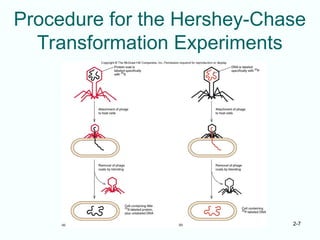
• Hershey and Chase demonstrated that
bacteriophage infection comes from DNA
2-7
Procedure for the Hershey-Chase
Transformation Experiments
2-8
Summary
• Genes are made of nucleic acid, usually
DNA
• Some simple genetic systems such as
viruses have RNA genes
2-9
The Chemical Nature of
Polynucleotides
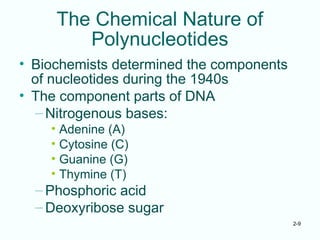
• Biochemists determined the components
of nucleotides during the 1940s
• The component parts of DNA
–Nitrogenous bases:
• Adenine (A)
• Cytosine (C)
• Guanine (G)
• Thymine (T)
–Phosphoric acid
–Deoxyribose sugar
2-10
Nucleotides and Nucleosides
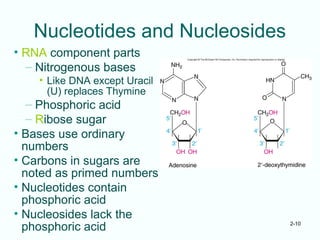
• RNA component parts
– Nitrogenous bases
• Like DNA except Uracil
(U) replaces Thymine
– Phosphoric acid
– Ribose sugar
• Bases use ordinary
numbers
• Carbons in sugars are
noted as primed numbers
• Nucleotides contain
phosphoric acid
• Nucleosides lack the
phosphoric acid
2-11
Purines and Pyrimidines
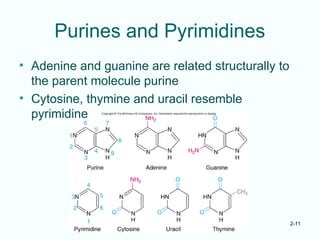
• Adenine and guanine are related structurally to
the parent molecule purine
• Cytosine, thymine and uracil resemble
pyrimidine
2-12
DNA Linkage
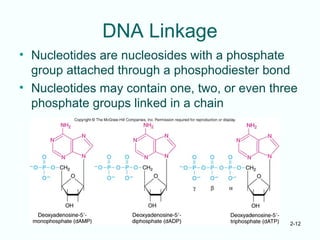
• Nucleotides are nucleosides with a phosphate
group attached through a phosphodiester bond
• Nucleotides may contain one, two, or even three
phosphate groups linked in a chain
2-13
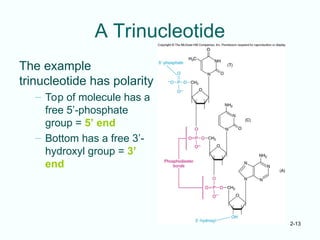
A Trinucleotide
The example
trinucleotide has polarity
– Top of molecule has a
free 5’-phosphate
group = 5’ end
– Bottom has a free 3’-
hydroxyl group = 3’
end
2-14
Summary
• DNA and RNA are chain-lie molecules
composed of subunits called nucleotides
• Nucleotides contain a base linked to the
1’-position of a sugar and a phosphate
group
• Phosphate joins the sugars in a DNA or
RNA chain through their 5’- and 3’-
hydroxyl groups by phosphodiester bonds
2-15
DNA Structure
The Double Helix
• Rosalind Franklin’s x-ray data suggested that
DNA had a helical shape
• The data also indicated a regular, repeating
structure
• DNA was believed to require an irregular
sequence
• Watson and Crick proposed a double helix with
sugar-phosphate backbones on the outside and
bases aligned to the interior
2-16
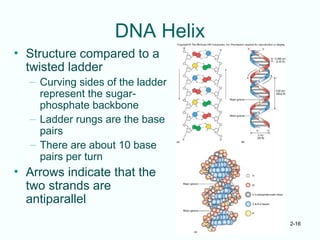
DNA Helix
• Structure compared to a
twisted ladder
– Curving sides of the ladder
represent the sugar-
phosphate backbone
– Ladder rungs are the base
pairs
– There are about 10 base
pairs per turn
• Arrows indicate that the
two strands are
antiparallel
2-17
Summary
• The DNA molecule is a double helix, with
sugar-phosphate backbones on the
outside and base pairs on the inside
• The bases pair in a specific way:
– Adenine (A) with thymine (T)
– Guanine (G) with cytosine (C)
2-18
Genes Made of RNA
Hershey & Chase investigated bacteriophage,
virus particle by itself, a package of genes
– This has no metabolic activity of its own
– When virus infects a host cell, the cell begins to
make viral proteins
– Viral genes are replicated and newly made
genes with viral protein assemble into virus
particles
Some viruses contain DNA genes, but some
viruses have RNA genes, either double- or
single-stranded
2-19
Physical Chemistry of Nucleic
Acids
DNA and RNA molecules can appear in
several different structural variants
– Changes in relative humidity will cause
variation in DNA molecular structure
– The twist of the DNA molecule is normally
shown to be right-handed, but left-handed
DNA was identified in 1979
2-20
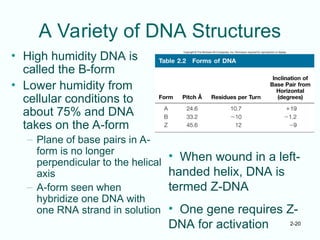
A Variety of DNA Structures
• High humidity DNA is
called the B-form
• Lower humidity from
cellular conditions to
about 75% and DNA
takes on the A-form
– Plane of base pairs in A-
form is no longer
perpendicular to the helical
axis
– A-form seen when
hybridize one DNA with
one RNA strand in solution
• When wound in a left-
handed helix, DNA is
termed Z-DNA
• One gene requires Z-
DNA for activation
2-21
Variation in DNA between
Organisms
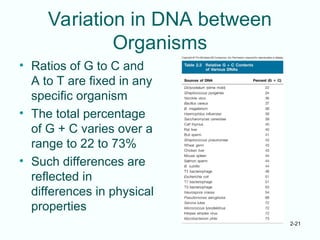
• Ratios of G to C and
A to T are fixed in any
specific organism
• The total percentage
of G + C varies over a
range to 22 to 73%
• Such differences are
reflected in
differences in physical
properties
2-22
DNA Melting
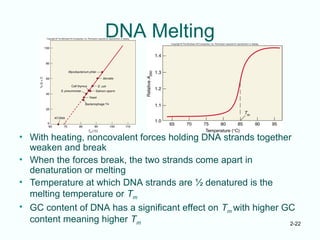
• With heating, noncovalent forces holding DNA strands together
weaken and break
• When the forces break, the two strands come apart in
denaturation or melting
• Temperature at which DNA strands are ½ denatured is the
melting temperature or Tm
• GC content of DNA has a significant effect on Tm with higher GC
content meaning higher Tm
2-23
DNA Denaturation
• In addition to heat, DNA
can be denatured by:
– Organic solvents
– High pH
– Low salt concentration
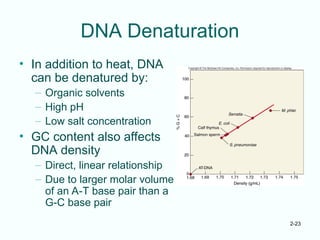
• GC content also affects
DNA density
– Direct, linear relationship
– Due to larger molar volume
of an A-T base pair than a
G-C base pair
2-24
Summary
• GC content of a natural DNA can vary from less
than 25% to almost 75%
• GC content has a strong effect on physical
properties that increase linearly with GC content
– Melting temperature, the temperature at which the
two strands are half-dissociated or denatured
– Density
– Low ionic strength, high pH and organic solvents also
promote DNA denaturation
2-25
DNA Renaturation
• After two DNA strands separate, under proper
conditions the strands can come back together
• Process is called annealing or renaturation
• Three most important factors:
– Temperature – best at about 25 C below Tm
– DNA Concentration – within limits higher
concentration better likelihood that 2 complementary
will find each other
– Renaturation Time – as increase time, more
annealing will occur
2-26
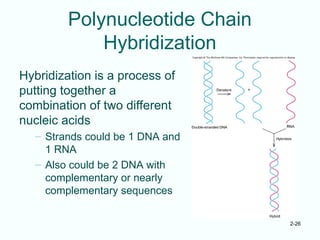
Polynucleotide Chain
Hybridization
Hybridization is a process of
putting together a
combination of two different
nucleic acids
– Strands could be 1 DNA and
1 RNA
– Also could be 2 DNA with
complementary or nearly
complementary sequences
2-27
DNA Sizes
DNA size is expressed in 3 different ways:
– Number of base pairs
– Molecular weight – 660 is molecular weight of
1 base pair
– Length – 33.2 Å per helical turn of 10.4 base
pairs
Measure DNA size either using electron
microscopy or gel electrophoresis
2-28
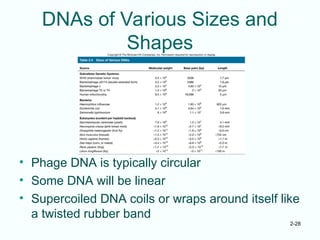
DNAs of Various Sizes and
Shapes
• Phage DNA is typically circular
• Some DNA will be linear
• Supercoiled DNA coils or wraps around itself like
a twisted rubber band
2-29
Summary
• Natural DNAs come in sizes ranging from
several kilobases to thousands of
megabases
• The size of a small DNA can be estimated
by electron microscopy
• This technique can also reveal whether a
DNA is circular or linear and whether it is
supercoiled
2-30
Relationship between DNA Size
and Genetic Capacity
How does one know how many genes are in
a particular piece of DNA?
– Can’t determine from DNA size alone
– Factors include:
• How DNA is devoted to genes?
• What is the space between genes?
– Can estimate the upper limit of number genes
a piece of DNA can hold
2-31
DNA Size and Genetic Capacity
How many genes are in a piece of DNA?
– Start with basic assumptions
• Gene encodes protein
• Protein is abut 40,000 D
– How many amino acids does this represent?
• Average mass of an amino acid is about 110 D
• Average protein – 40,000 / 110 = 364 amino acids
• Each amino acid = 3 DNA base pairs
• 364 amino acids requires 1092 base pairs
2-32
DNA Genetic Capacity
How large is an average piece of DNA?
– E. coli chromosome
• 4.6 x 10⁶
bp
• ~4200 proteins
– Phage (infects E. coli)
• 4.85 x 10⁴
bp
• ~44 proteins
– Phage x(one of smallest)
• 5375 bp
• ~5 proteins
2-33
DNA Content and the C-Value
Paradox
• C-value is the DNA content per haploid
cell
• Might expect that more complex
organisms need more genes than simple
organisms
• For the mouse or human compared to
yeast this is correct
• Yet the frog has 7 times more per cell than
humans
2-34
C-Value Paradox
• The observation that more complex
organisms will not always need more
genes than simple organisms is called the
C-value paradox
• Most likely explanation for the paradox is
that DNA that does not code for genes is
present when the less complex organism
has more DNA
2-35
Summary
• There is a rough correlation between DNA
content and number of genes in a cell or
virus
• This correlation breaks down in several
cases of closely related organisms where
the DNA content per haploid cell (C-value)
varies widely
• C-value paradox is probably explained not
by extra genes, but by extra noncoding
DNA in some organisms

The Genetic Material Lecture Note ppt.ppt

  • 1.
    2-1 The Nature ofGenetic Material Historical Background • Miescher isolated nuclei from pus (white blood cells) in 1869 – Found a novel phosphorus-bearing substance = nuclein – Nuclein is mostly chromatin, a complex of DNA and chromosomal proteins • End of 19th century – DNA and RNA separated from proteins • Levene, Jacobs, et al. characterized basic composition of DNA and RNA
  • 2.
    2-2 Transformation in Bacteria •Key experiments done by Frederick Griffith in 1928 • Observed change in Streptococcus pneumoniae — from virulent (S) smooth colonies where bacterial had capsules, to avirulent (R) rough colonies without capsules • Heat-killed virulent colonies could transform avirulent colonies to virulent ones
  • 3.
  • 4.
    2-4 DNA: The Transforming Material In1944 a group used a transformation test similar to Griffith’s procedure taking care to define the chemical nature of the transforming substance – Techniques used excluded both protein and RNA as the chemical agent of transformation – Other treatments verified that DNA is the chemical agent of transformation of S. pneumoniae from avirulent to virulent
  • 5.
    2-5 Analytical Tools Physical-chemical analysishas often used: 1. Ultracentrifugation Used to estimate size of material 2. Electrophoresis Indicated high charge-to-mass ratio 3. Ultraviolet Absorption Spectrophotometry Absorbance of UV light matched that of DNA 4. Elementary Chemical Analysis Nitrogen-to-phosphorus ratio of 1.67, not found in protein
  • 6.
    2-6 DNA Confirmation • In1940s geneticists doubted use of DNA as it appeared to be monotonous repeats of 4 bases • By 1953 Watson & Crick published the double-helical model of DNA structure and Chargaff had shown that the 4 bases were not present in equal proportions • Hershey and Chase demonstrated that bacteriophage infection comes from DNA
  • 7.
    2-7 Procedure for theHershey-Chase Transformation Experiments
  • 8.
    2-8 Summary • Genes aremade of nucleic acid, usually DNA • Some simple genetic systems such as viruses have RNA genes
  • 9.
    2-9 The Chemical Natureof Polynucleotides • Biochemists determined the components of nucleotides during the 1940s • The component parts of DNA –Nitrogenous bases: • Adenine (A) • Cytosine (C) • Guanine (G) • Thymine (T) –Phosphoric acid –Deoxyribose sugar
  • 10.
    2-10 Nucleotides and Nucleosides •RNA component parts – Nitrogenous bases • Like DNA except Uracil (U) replaces Thymine – Phosphoric acid – Ribose sugar • Bases use ordinary numbers • Carbons in sugars are noted as primed numbers • Nucleotides contain phosphoric acid • Nucleosides lack the phosphoric acid
  • 11.
    2-11 Purines and Pyrimidines •Adenine and guanine are related structurally to the parent molecule purine • Cytosine, thymine and uracil resemble pyrimidine
  • 12.
    2-12 DNA Linkage • Nucleotidesare nucleosides with a phosphate group attached through a phosphodiester bond • Nucleotides may contain one, two, or even three phosphate groups linked in a chain
  • 13.
    2-13 A Trinucleotide The example trinucleotidehas polarity – Top of molecule has a free 5’-phosphate group = 5’ end – Bottom has a free 3’- hydroxyl group = 3’ end
  • 14.
    2-14 Summary • DNA andRNA are chain-lie molecules composed of subunits called nucleotides • Nucleotides contain a base linked to the 1’-position of a sugar and a phosphate group • Phosphate joins the sugars in a DNA or RNA chain through their 5’- and 3’- hydroxyl groups by phosphodiester bonds
  • 15.
    2-15 DNA Structure The DoubleHelix • Rosalind Franklin’s x-ray data suggested that DNA had a helical shape • The data also indicated a regular, repeating structure • DNA was believed to require an irregular sequence • Watson and Crick proposed a double helix with sugar-phosphate backbones on the outside and bases aligned to the interior
  • 16.
    2-16 DNA Helix • Structurecompared to a twisted ladder – Curving sides of the ladder represent the sugar- phosphate backbone – Ladder rungs are the base pairs – There are about 10 base pairs per turn • Arrows indicate that the two strands are antiparallel
  • 17.
    2-17 Summary • The DNAmolecule is a double helix, with sugar-phosphate backbones on the outside and base pairs on the inside • The bases pair in a specific way: – Adenine (A) with thymine (T) – Guanine (G) with cytosine (C)
  • 18.
    2-18 Genes Made ofRNA Hershey & Chase investigated bacteriophage, virus particle by itself, a package of genes – This has no metabolic activity of its own – When virus infects a host cell, the cell begins to make viral proteins – Viral genes are replicated and newly made genes with viral protein assemble into virus particles Some viruses contain DNA genes, but some viruses have RNA genes, either double- or single-stranded
  • 19.
    2-19 Physical Chemistry ofNucleic Acids DNA and RNA molecules can appear in several different structural variants – Changes in relative humidity will cause variation in DNA molecular structure – The twist of the DNA molecule is normally shown to be right-handed, but left-handed DNA was identified in 1979
  • 20.
    2-20 A Variety ofDNA Structures • High humidity DNA is called the B-form • Lower humidity from cellular conditions to about 75% and DNA takes on the A-form – Plane of base pairs in A- form is no longer perpendicular to the helical axis – A-form seen when hybridize one DNA with one RNA strand in solution • When wound in a left- handed helix, DNA is termed Z-DNA • One gene requires Z- DNA for activation
  • 21.
    2-21 Variation in DNAbetween Organisms • Ratios of G to C and A to T are fixed in any specific organism • The total percentage of G + C varies over a range to 22 to 73% • Such differences are reflected in differences in physical properties
  • 22.
    2-22 DNA Melting • Withheating, noncovalent forces holding DNA strands together weaken and break • When the forces break, the two strands come apart in denaturation or melting • Temperature at which DNA strands are ½ denatured is the melting temperature or Tm • GC content of DNA has a significant effect on Tm with higher GC content meaning higher Tm
  • 23.
    2-23 DNA Denaturation • Inaddition to heat, DNA can be denatured by: – Organic solvents – High pH – Low salt concentration • GC content also affects DNA density – Direct, linear relationship – Due to larger molar volume of an A-T base pair than a G-C base pair
  • 24.
    2-24 Summary • GC contentof a natural DNA can vary from less than 25% to almost 75% • GC content has a strong effect on physical properties that increase linearly with GC content – Melting temperature, the temperature at which the two strands are half-dissociated or denatured – Density – Low ionic strength, high pH and organic solvents also promote DNA denaturation
  • 25.
    2-25 DNA Renaturation • Aftertwo DNA strands separate, under proper conditions the strands can come back together • Process is called annealing or renaturation • Three most important factors: – Temperature – best at about 25 C below Tm – DNA Concentration – within limits higher concentration better likelihood that 2 complementary will find each other – Renaturation Time – as increase time, more annealing will occur
  • 26.
    2-26 Polynucleotide Chain Hybridization Hybridization isa process of putting together a combination of two different nucleic acids – Strands could be 1 DNA and 1 RNA – Also could be 2 DNA with complementary or nearly complementary sequences
  • 27.
    2-27 DNA Sizes DNA sizeis expressed in 3 different ways: – Number of base pairs – Molecular weight – 660 is molecular weight of 1 base pair – Length – 33.2 Å per helical turn of 10.4 base pairs Measure DNA size either using electron microscopy or gel electrophoresis
  • 28.
    2-28 DNAs of VariousSizes and Shapes • Phage DNA is typically circular • Some DNA will be linear • Supercoiled DNA coils or wraps around itself like a twisted rubber band
  • 29.
    2-29 Summary • Natural DNAscome in sizes ranging from several kilobases to thousands of megabases • The size of a small DNA can be estimated by electron microscopy • This technique can also reveal whether a DNA is circular or linear and whether it is supercoiled
  • 30.
    2-30 Relationship between DNASize and Genetic Capacity How does one know how many genes are in a particular piece of DNA? – Can’t determine from DNA size alone – Factors include: • How DNA is devoted to genes? • What is the space between genes? – Can estimate the upper limit of number genes a piece of DNA can hold
  • 31.
    2-31 DNA Size andGenetic Capacity How many genes are in a piece of DNA? – Start with basic assumptions • Gene encodes protein • Protein is abut 40,000 D – How many amino acids does this represent? • Average mass of an amino acid is about 110 D • Average protein – 40,000 / 110 = 364 amino acids • Each amino acid = 3 DNA base pairs • 364 amino acids requires 1092 base pairs
  • 32.
    2-32 DNA Genetic Capacity Howlarge is an average piece of DNA? – E. coli chromosome • 4.6 x 10⁶ bp • ~4200 proteins – Phage (infects E. coli) • 4.85 x 10⁴ bp • ~44 proteins – Phage x(one of smallest) • 5375 bp • ~5 proteins
  • 33.
    2-33 DNA Content andthe C-Value Paradox • C-value is the DNA content per haploid cell • Might expect that more complex organisms need more genes than simple organisms • For the mouse or human compared to yeast this is correct • Yet the frog has 7 times more per cell than humans
  • 34.
    2-34 C-Value Paradox • Theobservation that more complex organisms will not always need more genes than simple organisms is called the C-value paradox • Most likely explanation for the paradox is that DNA that does not code for genes is present when the less complex organism has more DNA
  • 35.
    2-35 Summary • There isa rough correlation between DNA content and number of genes in a cell or virus • This correlation breaks down in several cases of closely related organisms where the DNA content per haploid cell (C-value) varies widely • C-value paradox is probably explained not by extra genes, but by extra noncoding DNA in some organisms