Chapter 4
Ratios and Proportions
Introductory Mathematics
& Statistics for Business
4-2
Copyright  2010 McGraw-Hill Australia Pty Ltd
PowerPoint slides to accompany Croucher, Introductory Mathematics and Statistics, 5e
Learning Objectives
• Calculate ratios and proportions
• Calculate and apply profit ratios
• Calculate and apply efficiency ratios
• Calculate and apply liquidity ratios
4.1 Ratios and Proportions
• A ratio
ratio is a method of comparing two or more numbers or rates.
• A proportion
proportion represents the relative
relative contribution of a quantity to
the whole.
• The value of a proportion should lie between 0 and 1.
• Ratios are often reduced to proportions.
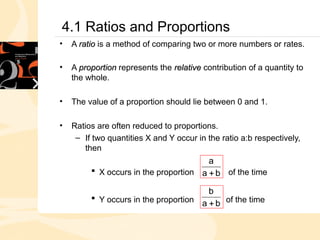
– If two quantities X and Y occur in the ratio a:b respectively,
then
 X occurs in the proportion of the time
 Y occurs in the proportion of the time
b
a
a

b
a
b

Ratios and Proportions (cont…)
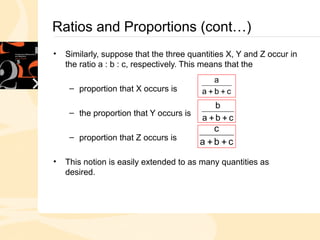
• Similarly, suppose that the three quantities X, Y and Z occur in
the ratio a : b : c, respectively. This means that the
– proportion that X occurs is
– the proportion that Y occurs is
– proportion that Z occurs is
• This notion is easily extended to as many quantities as
desired.
c
b
a
a


c
b
a
b


c
b
a
c


Ratios and Proportions (cont…)
• Rates
• When comparisons involving large numbers are made, ratios
are used to express the rate at which events take place
– E.g. The rate at which a car uses fuel is expressed as a rate
in the form:
number of kilometres : 100 litres
• In the case above the first number is a non-integer and the
second number in the ratio is a base figure such as a standard
unit of measurement.
• Hence, a rate is really a ratio expressed with a specified base.
Ratios and Proportions (cont…)
• Ratios with common first numbers may also be used to compare
several items to indicate the percentage difference between one
figure and another.
• For example: The first driver drove 1125 kilometres and the
second driver only 1068.2 kilometres, using 100 litres of petrol
• We can therefore use these ratios as a basis of comparison for
fuel economy
4.2 Profit Ratios
• Profit ratios express the relationship of profit to some financial quantity
(e.g. total assets or sales).
.
• The financial position of a company is indicated by a balance sheet.
• A balance sheet lists the resources of value (assets) and liabilities. An
important issue is whether the company has the assets to cover its
liabilities.
• The components of a profit and loss statement (or income statement)
for a business produce the ratio of net profit to sales.
Profit Ratios (cont…)
• Asset Turnover
– An asset is a resource of value controlled by a business
 e.g. cash,
 bank deposits,
 inventory,
 receivables
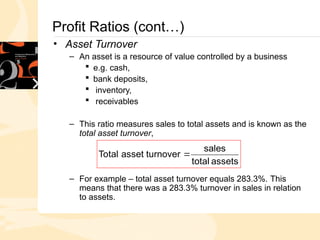
– This ratio measures sales to total assets and is known as the
total asset turnover,
– For example – total asset turnover equals 283.3%. This
means that there was a 283.3% turnover in sales in relation
to assets.
assets
total
sales
turnover
asset
Total 
Profit Ratios (cont…)
Example
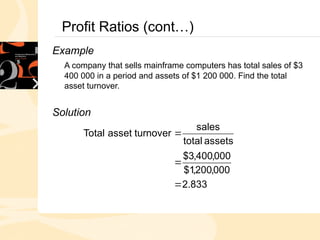
A company that sells mainframe computers has total sales of $3
400 000 in a period and assets of $1 200 000. Find the total
asset turnover.
Solution
833
.
2
000
,
200
,
1
$
000
,
400
,
3
$
assets
total
sales
turnover
asset
Total



Profit Ratios (cont…)
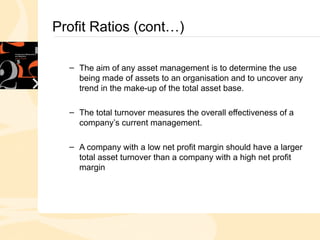
– The aim of any asset management is to determine the use
being made of assets to an organisation and to uncover any
trend in the make-up of the total asset base.
– The total turnover measures the overall effectiveness of a
company’s current management.
– A company with a low net profit margin should have a larger
total asset turnover than a company with a high net profit
margin
Profit Ratios (cont…)
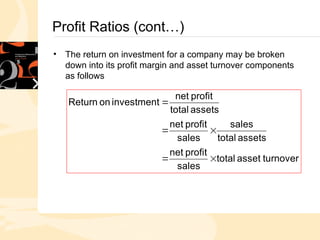
• The return on investment for a company may be broken
down into its profit margin and asset turnover components
as follows
turnover
asset
total
sales
profit
net
assets
total
sales
sales
profit
net
assets
total
profit
net
investment
on
Return





4.3 Efficiency Ratios
• An efficiency ratio of a company reflects its ability to achieve the
maximum return for the lowest possible level of assets. .
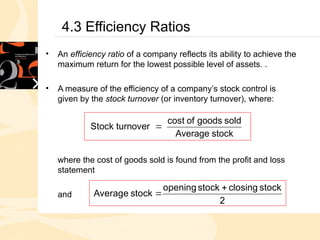
• A measure of the efficiency of a company’s stock control is
given by the stock turnover (or inventory turnover), where:
where the cost of goods sold is found from the profit and loss
statement
and
stock
Average
sold
goods
of
cost
over
Stock turn 
2
stock
closing
stock
opening
stock
Average


Efficiency Ratios (cont…)
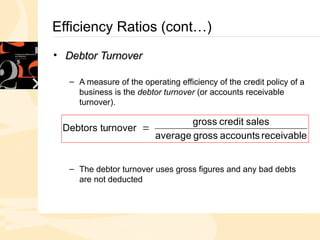
• Debtor Turnover
Debtor Turnover
– A measure of the operating efficiency of the credit policy of a
business is the debtor turnover (or accounts receivable
turnover).
– The debtor turnover uses gross figures and any bad debts
are not deducted
receivable
accounts
gross
average
sales
credit
gross
rnover
Debtors tu 
Efficiency Ratios (cont…)
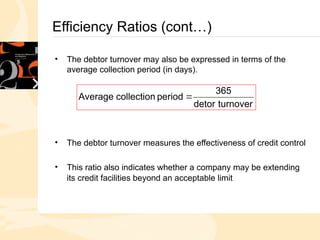
• The debtor turnover may also be expressed in terms of the
average collection period (in days).
• The debtor turnover measures the effectiveness of credit control
• This ratio also indicates whether a company may be extending
its credit facilities beyond an acceptable limit
turnover
detor
365
period
collection
Average 
Copyright  2010 McGraw-Hill Australia Pty Ltd
PowerPoint slides to accompany Croucher, Introductory Mathematics and Statistics, 5e
4.4 Liquidity Ratios
• Liquidity—the ability of a company to pay its immediate debts.
• There are two methods to measure this ability. They are
Current-asset ratio and Acid-test ratio
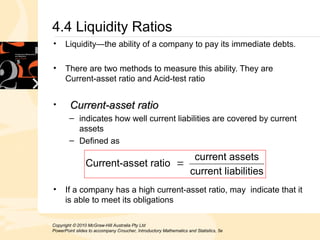
• Current-asset ratio
Current-asset ratio
– indicates how well current liabilities are covered by current
assets
– Defined as
• If a company has a high current-asset ratio, may indicate that it
is able to meet its obligations
abilities
current li
sets
current as
set ratio
Current-as 
Liquidity Ratios (cont…)
• Whether a current-asset ratio is acceptable or not
depends on how readily stock and accounts receivable
can be converted into cash and how quickly cash flows
in from sales
• This ratio can be used to compare companies of
varying sizes as well as to measure the liquidity of the
same company from year to year
Liquidity Ratios (cont…)
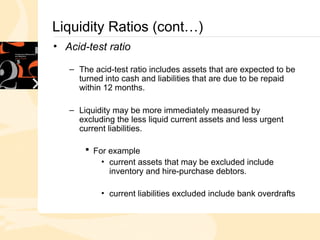
• Acid-test ratio
– The acid-test ratio includes assets that are expected to be
turned into cash and liabilities that are due to be repaid
within 12 months.
– Liquidity may be more immediately measured by
excluding the less liquid current assets and less urgent
current liabilities.
 For example
• current assets that may be excluded include
inventory and hire-purchase debtors.
• current liabilities excluded include bank overdrafts
Liquidity Ratios (cont…)
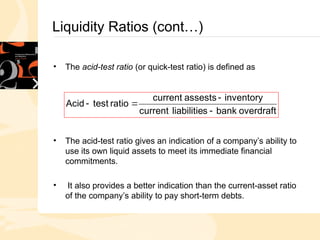
• The acid-test ratio (or quick-test ratio) is defined as
• The acid-test ratio gives an indication of a company’s ability to
use its own liquid assets to meet its immediate financial
commitments.
• It also provides a better indication than the current-asset ratio
of the company’s ability to pay short-term debts.
overdraft
bank
s
liabilitie
current
inventory
assests
current
ratio
test
Acid




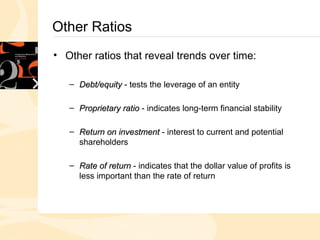
Other Ratios
• Other ratios that reveal trends over time:
– Debt/equity
Debt/equity - tests the leverage of an entity
– Proprietary ratio
Proprietary ratio - indicates long-term financial stability
– Return on investment
Return on investment - interest to current and potential
shareholders
– Rate of return
Rate of return - indicates that the dollar value of profits is
less important than the rate of return

Chapter_04lfadjfhadfodlfkladsflhsdlflasdjfkl.ppt

  • 1.
    Chapter 4 Ratios andProportions Introductory Mathematics & Statistics for Business
  • 2.
    4-2 Copyright  2010McGraw-Hill Australia Pty Ltd PowerPoint slides to accompany Croucher, Introductory Mathematics and Statistics, 5e Learning Objectives • Calculate ratios and proportions • Calculate and apply profit ratios • Calculate and apply efficiency ratios • Calculate and apply liquidity ratios
  • 3.
    4.1 Ratios andProportions • A ratio ratio is a method of comparing two or more numbers or rates. • A proportion proportion represents the relative relative contribution of a quantity to the whole. • The value of a proportion should lie between 0 and 1. • Ratios are often reduced to proportions. – If two quantities X and Y occur in the ratio a:b respectively, then  X occurs in the proportion of the time  Y occurs in the proportion of the time b a a  b a b 
  • 4.
    Ratios and Proportions(cont…) • Similarly, suppose that the three quantities X, Y and Z occur in the ratio a : b : c, respectively. This means that the – proportion that X occurs is – the proportion that Y occurs is – proportion that Z occurs is • This notion is easily extended to as many quantities as desired. c b a a   c b a b   c b a c  
  • 5.
    Ratios and Proportions(cont…) • Rates • When comparisons involving large numbers are made, ratios are used to express the rate at which events take place – E.g. The rate at which a car uses fuel is expressed as a rate in the form: number of kilometres : 100 litres • In the case above the first number is a non-integer and the second number in the ratio is a base figure such as a standard unit of measurement. • Hence, a rate is really a ratio expressed with a specified base.
  • 6.
    Ratios and Proportions(cont…) • Ratios with common first numbers may also be used to compare several items to indicate the percentage difference between one figure and another. • For example: The first driver drove 1125 kilometres and the second driver only 1068.2 kilometres, using 100 litres of petrol • We can therefore use these ratios as a basis of comparison for fuel economy
  • 7.
    4.2 Profit Ratios •Profit ratios express the relationship of profit to some financial quantity (e.g. total assets or sales). . • The financial position of a company is indicated by a balance sheet. • A balance sheet lists the resources of value (assets) and liabilities. An important issue is whether the company has the assets to cover its liabilities. • The components of a profit and loss statement (or income statement) for a business produce the ratio of net profit to sales.
  • 8.
    Profit Ratios (cont…) •Asset Turnover – An asset is a resource of value controlled by a business  e.g. cash,  bank deposits,  inventory,  receivables – This ratio measures sales to total assets and is known as the total asset turnover, – For example – total asset turnover equals 283.3%. This means that there was a 283.3% turnover in sales in relation to assets. assets total sales turnover asset Total 
  • 9.
    Profit Ratios (cont…) Example Acompany that sells mainframe computers has total sales of $3 400 000 in a period and assets of $1 200 000. Find the total asset turnover. Solution 833 . 2 000 , 200 , 1 $ 000 , 400 , 3 $ assets total sales turnover asset Total   
  • 10.
    Profit Ratios (cont…) –The aim of any asset management is to determine the use being made of assets to an organisation and to uncover any trend in the make-up of the total asset base. – The total turnover measures the overall effectiveness of a company’s current management. – A company with a low net profit margin should have a larger total asset turnover than a company with a high net profit margin
  • 11.
    Profit Ratios (cont…) •The return on investment for a company may be broken down into its profit margin and asset turnover components as follows turnover asset total sales profit net assets total sales sales profit net assets total profit net investment on Return     
  • 12.
    4.3 Efficiency Ratios •An efficiency ratio of a company reflects its ability to achieve the maximum return for the lowest possible level of assets. . • A measure of the efficiency of a company’s stock control is given by the stock turnover (or inventory turnover), where: where the cost of goods sold is found from the profit and loss statement and stock Average sold goods of cost over Stock turn  2 stock closing stock opening stock Average  
  • 13.
    Efficiency Ratios (cont…) •Debtor Turnover Debtor Turnover – A measure of the operating efficiency of the credit policy of a business is the debtor turnover (or accounts receivable turnover). – The debtor turnover uses gross figures and any bad debts are not deducted receivable accounts gross average sales credit gross rnover Debtors tu 
  • 14.
    Efficiency Ratios (cont…) •The debtor turnover may also be expressed in terms of the average collection period (in days). • The debtor turnover measures the effectiveness of credit control • This ratio also indicates whether a company may be extending its credit facilities beyond an acceptable limit turnover detor 365 period collection Average 
  • 15.
    Copyright  2010McGraw-Hill Australia Pty Ltd PowerPoint slides to accompany Croucher, Introductory Mathematics and Statistics, 5e 4.4 Liquidity Ratios • Liquidity—the ability of a company to pay its immediate debts. • There are two methods to measure this ability. They are Current-asset ratio and Acid-test ratio • Current-asset ratio Current-asset ratio – indicates how well current liabilities are covered by current assets – Defined as • If a company has a high current-asset ratio, may indicate that it is able to meet its obligations abilities current li sets current as set ratio Current-as 
  • 16.
    Liquidity Ratios (cont…) •Whether a current-asset ratio is acceptable or not depends on how readily stock and accounts receivable can be converted into cash and how quickly cash flows in from sales • This ratio can be used to compare companies of varying sizes as well as to measure the liquidity of the same company from year to year
  • 17.
    Liquidity Ratios (cont…) •Acid-test ratio – The acid-test ratio includes assets that are expected to be turned into cash and liabilities that are due to be repaid within 12 months. – Liquidity may be more immediately measured by excluding the less liquid current assets and less urgent current liabilities.  For example • current assets that may be excluded include inventory and hire-purchase debtors. • current liabilities excluded include bank overdrafts
  • 18.
    Liquidity Ratios (cont…) •The acid-test ratio (or quick-test ratio) is defined as • The acid-test ratio gives an indication of a company’s ability to use its own liquid assets to meet its immediate financial commitments. • It also provides a better indication than the current-asset ratio of the company’s ability to pay short-term debts. overdraft bank s liabilitie current inventory assests current ratio test Acid    
  • 19.
    Other Ratios • Otherratios that reveal trends over time: – Debt/equity Debt/equity - tests the leverage of an entity – Proprietary ratio Proprietary ratio - indicates long-term financial stability – Return on investment Return on investment - interest to current and potential shareholders – Rate of return Rate of return - indicates that the dollar value of profits is less important than the rate of return