Economic empowerment is a process that increases people’s access to
and control over economic resources and opportunities including jobs,
financial services, property and other productive assets (from which
one can generate an income), skills development and market
information.
WOMEN EMPOWERMENT AND FINANCE
WHY ECONOMIC EMPOWERMENT?
Economic empowerment matters for women and girls –
contributing to their broader empowerment, agency and
voice, and to better welfare outcomes for them, their
households and their wider communities.
It also matters for economic growth – for example, through its
impacts on firm performance, agricultural productivity and
generation of tax revenues.
There are multiple barriers to accessing resources and
opportunities - discriminatory cultural and social norms, de
facto implementation of formal or customary laws and
regulations, unequal access to resources, knowledge,
information, networks and markets, informality and
workplace discrimination and exploitation.
ECONOMIC EMPOWERMENT OF WOMEN AND
GIRLS
DFID Business Plan 2011-15: “Recognise the role of women in development
and promote gender equality”
 One of 6 Ministerial priorities, critical to MDGs
DFID Strategic Vision for Women and Girls
1. Delay first pregnancy and support safe childbirth;
2. Get economic assets directly to girls and women;
3. Get girls through secondary school; and
4. Prevent violence against girls and women.
‘Women account for 50% of informal employment globally’ World Development Report 2012
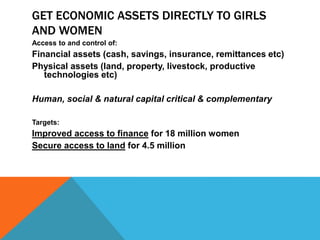
GET ECONOMIC ASSETS DIRECTLY TO GIRLS
AND WOMEN
Access to and control of:
Financial assets (cash, savings, insurance, remittances etc)
Physical assets (land, property, livestock, productive
technologies etc)
Human, social & natural capital critical & complementary
Targets:
Improved access to finance for 18 million women
Secure access to land for 4.5 million
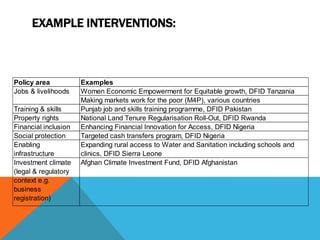
EXAMPLE INTERVENTIONS:
Policy area Examples
Women Economic Empowerment for Equitable growth, DFID Tanzania
Making markets work for the poor (M4P), various countries
Training & skills Punjab job and skills training programme, DFID Pakistan
Property rights National Land Tenure Regularisation Roll-Out, DFID Rwanda
Financial inclusion Enhancing Financial Innovation for Access, DFID Nigeria
Social protection Targeted cash transfers program, DFID Nigeria
Enabling
infrastructure
Expanding rural access to Water and Sanitation including schools and
clinics, DFID Sierra Leone
Investment climate
(legal & regulatory
context e.g.
business
registration)
Afghan Climate Investment Fund, DFID Afghanistan
Jobs & livelihoods
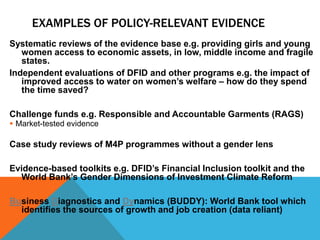
EXAMPLES OF POLICY-RELEVANT EVIDENCE
Systematic reviews of the evidence base e.g. providing girls and young
women access to economic assets, in low, middle income and fragile
states.
Independent evaluations of DFID and other programs e.g. the impact of
improved access to water on women’s welfare – how do they spend
the time saved?
Challenge funds e.g. Responsible and Accountable Garments (RAGS)
 Market-tested evidence
Case study reviews of M4P programmes without a gender lens
Evidence-based toolkits e.g. DFID’s Financial Inclusion toolkit and the
World Bank’s Gender Dimensions of Investment Climate Reform
Business Diagnostics and Dynamics (BUDDY): World Bank tool which
identifies the sources of growth and job creation (data reliant)
WOMEN AND WORK: SOME REACTIONS
Need to focus on demand for, more than supply of, labour.
Reality around informed choice – what should the timeframe be for this
aspiration?
Pace of change given social norms? How can we bring about quick but
sustainable change?
How can we address the care economy? Is measurement and awareness
raising enough to bring about change?
Is growth of the informal sector an inevitable and permanent trend?
SOME POLICY CHALLENGES: PROCESS
How can researchers engage policy-makers from the outset?
How can research findings be best packaged and
communicated for policy-makers?
 Graded by quality
 Policy briefs
 Relative value for money of potential interventions (cost versus outcome)
What types of evidence (including data) are most accessible
and useful?
 sex and age-disaggregated data
 ownership versus use of productive assets
Women account for 60% of the world’s working poor but own less than 10% of the world’s property.
ILO and Commission for Legal Empowerment of the Poor
SOME POLICY CHALLENGES: CONTENT
Can we take a life-cycle/age-segmented approach to research
on women’s economic empowerment?
 WDR: “Investing in girls is smart. It is central to boosting development, breaking
the cycle of inter-generational poverty, and allowing girls, and then women – 50% of
the world’s population – to lead better, fairer and more productive lives.”
Which sectors should we target? Where can we have the most
impact and engage women in higher value activity?
How can we ensure that getting economic assets to women and
girls does no harm?
What time and labour saving technologies could most benefit
women and girls?
How can we most effectively engage men and boys in this
agenda?
Reference Books
1. Brigham Ehrhadt. Financial management theory and
practice. 13th Ed
2. Khanna & Jain. Financial management.
3. Financial management. Pandey Anthony G. Puxty, J.
Colin, Richard M.S. Wilson; Financial Management: Method
and meaning.
4. Block & Hurt, 1989.Foundation of Financial Management.
5th ed.
5. Bodil Dickerson, 1998. Introduction to Financial
Management. 4th ed. USA: McGraw hill Co.
6. Dayananda, Ridard Irons, steve Harrison, John Herb
Ohan, and Patrick Rowland, Capital Budgeting.
7. Eugene F. Brigham, Louis C.Gapenski, 1993. Intermediate
Financial Management. 4th Edition. Dryden press.
8. Gallagher H. and Andrew M., Fincial Management;
Principles and Practice; 4th edition.
Thank you!

Chapter-7.ppt

  • 1.
    Economic empowerment isa process that increases people’s access to and control over economic resources and opportunities including jobs, financial services, property and other productive assets (from which one can generate an income), skills development and market information. WOMEN EMPOWERMENT AND FINANCE
  • 2.
    WHY ECONOMIC EMPOWERMENT? Economicempowerment matters for women and girls – contributing to their broader empowerment, agency and voice, and to better welfare outcomes for them, their households and their wider communities. It also matters for economic growth – for example, through its impacts on firm performance, agricultural productivity and generation of tax revenues. There are multiple barriers to accessing resources and opportunities - discriminatory cultural and social norms, de facto implementation of formal or customary laws and regulations, unequal access to resources, knowledge, information, networks and markets, informality and workplace discrimination and exploitation.
  • 3.
    ECONOMIC EMPOWERMENT OFWOMEN AND GIRLS DFID Business Plan 2011-15: “Recognise the role of women in development and promote gender equality”  One of 6 Ministerial priorities, critical to MDGs DFID Strategic Vision for Women and Girls 1. Delay first pregnancy and support safe childbirth; 2. Get economic assets directly to girls and women; 3. Get girls through secondary school; and 4. Prevent violence against girls and women. ‘Women account for 50% of informal employment globally’ World Development Report 2012
  • 4.
    GET ECONOMIC ASSETSDIRECTLY TO GIRLS AND WOMEN Access to and control of: Financial assets (cash, savings, insurance, remittances etc) Physical assets (land, property, livestock, productive technologies etc) Human, social & natural capital critical & complementary Targets: Improved access to finance for 18 million women Secure access to land for 4.5 million
  • 5.
    EXAMPLE INTERVENTIONS: Policy areaExamples Women Economic Empowerment for Equitable growth, DFID Tanzania Making markets work for the poor (M4P), various countries Training & skills Punjab job and skills training programme, DFID Pakistan Property rights National Land Tenure Regularisation Roll-Out, DFID Rwanda Financial inclusion Enhancing Financial Innovation for Access, DFID Nigeria Social protection Targeted cash transfers program, DFID Nigeria Enabling infrastructure Expanding rural access to Water and Sanitation including schools and clinics, DFID Sierra Leone Investment climate (legal & regulatory context e.g. business registration) Afghan Climate Investment Fund, DFID Afghanistan Jobs & livelihoods
  • 6.
    EXAMPLES OF POLICY-RELEVANTEVIDENCE Systematic reviews of the evidence base e.g. providing girls and young women access to economic assets, in low, middle income and fragile states. Independent evaluations of DFID and other programs e.g. the impact of improved access to water on women’s welfare – how do they spend the time saved? Challenge funds e.g. Responsible and Accountable Garments (RAGS)  Market-tested evidence Case study reviews of M4P programmes without a gender lens Evidence-based toolkits e.g. DFID’s Financial Inclusion toolkit and the World Bank’s Gender Dimensions of Investment Climate Reform Business Diagnostics and Dynamics (BUDDY): World Bank tool which identifies the sources of growth and job creation (data reliant)
  • 7.
    WOMEN AND WORK:SOME REACTIONS Need to focus on demand for, more than supply of, labour. Reality around informed choice – what should the timeframe be for this aspiration? Pace of change given social norms? How can we bring about quick but sustainable change? How can we address the care economy? Is measurement and awareness raising enough to bring about change? Is growth of the informal sector an inevitable and permanent trend?
  • 8.
    SOME POLICY CHALLENGES:PROCESS How can researchers engage policy-makers from the outset? How can research findings be best packaged and communicated for policy-makers?  Graded by quality  Policy briefs  Relative value for money of potential interventions (cost versus outcome) What types of evidence (including data) are most accessible and useful?  sex and age-disaggregated data  ownership versus use of productive assets Women account for 60% of the world’s working poor but own less than 10% of the world’s property. ILO and Commission for Legal Empowerment of the Poor
  • 9.
    SOME POLICY CHALLENGES:CONTENT Can we take a life-cycle/age-segmented approach to research on women’s economic empowerment?  WDR: “Investing in girls is smart. It is central to boosting development, breaking the cycle of inter-generational poverty, and allowing girls, and then women – 50% of the world’s population – to lead better, fairer and more productive lives.” Which sectors should we target? Where can we have the most impact and engage women in higher value activity? How can we ensure that getting economic assets to women and girls does no harm? What time and labour saving technologies could most benefit women and girls? How can we most effectively engage men and boys in this agenda?
  • 10.
    Reference Books 1. BrighamEhrhadt. Financial management theory and practice. 13th Ed 2. Khanna & Jain. Financial management. 3. Financial management. Pandey Anthony G. Puxty, J. Colin, Richard M.S. Wilson; Financial Management: Method and meaning. 4. Block & Hurt, 1989.Foundation of Financial Management. 5th ed. 5. Bodil Dickerson, 1998. Introduction to Financial Management. 4th ed. USA: McGraw hill Co. 6. Dayananda, Ridard Irons, steve Harrison, John Herb Ohan, and Patrick Rowland, Capital Budgeting. 7. Eugene F. Brigham, Louis C.Gapenski, 1993. Intermediate Financial Management. 4th Edition. Dryden press. 8. Gallagher H. and Andrew M., Fincial Management; Principles and Practice; 4th edition.
  • 11.