Math Fundamentals for
Capital Market
Corporate Finance Institute®
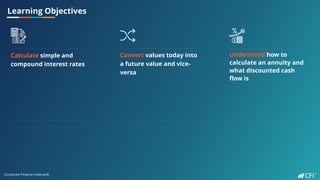
Calculate simple and
compound interest rates
Convert values today into
a future value and vice-
versa
Understand how to
calculate an annuity and
what discounted cash
flow is
Learning Objectives
Corporate Finance Institute®
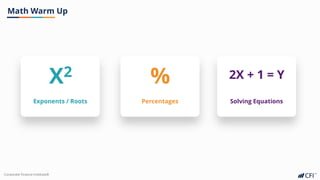
Math Warm Up
Exponents / Roots
X2
Percentages
%
Solving Equations
2X + 1 = Y
Corporate Finance Institute®
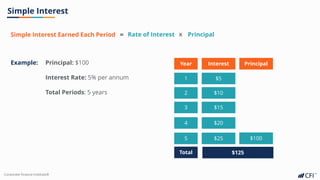
Simple Interest
=
Simple Interest Earned Each Period Rate of Interest X Principal
Example: Principal: $100
Interest Rate: 5% per annum
Total Periods: 5 years
Year
1
Interest
$5
2 $10
3 $15
4 $20
5 $25 $100
Principal
Total $125
Corporate Finance Institute®
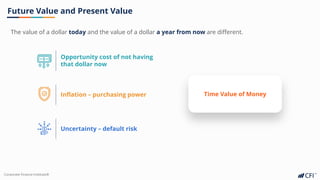
Future Value and Present Value
The value of a dollar today and the value of a dollar a year from now are different.
Opportunity cost of not having
that dollar now
Inflation – purchasing power
Uncertainty – default risk
Time Value of Money
Corporate Finance Institute®
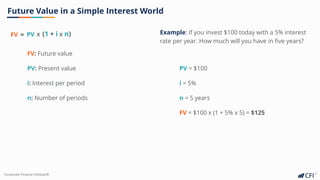
Future Value in a Simple Interest World
Example: If you invest $100 today with a 5% interest
rate per year. How much will you have in five years?
=
FV PV X (1 + i X n)
PV: Present value
i: Interest per period
n: Number of periods
FV: Future value
PV = $100
i = 5%
n = 5 years
FV = $100 x (1 + 5% x 5) = $125
Corporate Finance Institute®
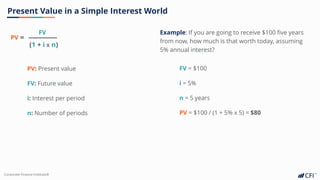
Present Value in a Simple Interest World
Example: If you are going to receive $100 five years
from now, how much is that worth today, assuming
5% annual interest?
FV: Future value
i: Interest per period
n: Number of periods
PV: Present value
=
PV
FV
(1 + i X n)
FV = $100
i = 5%
n = 5 years
PV = $100 / (1 + 5% x 5) = $80
Corporate Finance Institute®
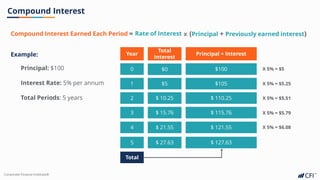
Compound Interest
Example:
Principal: $100
Interest Rate: 5% per annum
Total Periods: 5 years
1 $5 $105
2 $ 10.25 $ 110.25
3 $ 15.76 $ 115.76
Total
X 5% = $5
X 5% = $5.25
X 5% = $5.51
4 $ 21.55 $ 121.55
5 $ 27.63 $ 127.63
X 5% = $5.79
X 5% = $6.08
Compound Interest Earned Each Period = Rate of Interest X (Principal + Previously earned interest)
Year
Total
Interest
Principal + Interest
0 $100
$0
Corporate Finance Institute®
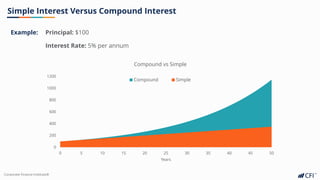
Simple Interest Versus Compound Interest
Example: Principal: $100
Interest Rate: 5% per annum
0
200
400
600
800
1000
1200
0 5 10 15 20 25 30 35 40 45 50
Years
Compound vs Simple
Compound Simple
Corporate Finance Institute®
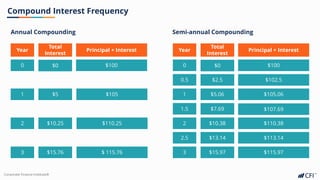
Annual Compounding
Compound Interest Frequency
1 $5 $105
2 $10.25 $110.25
3 $15.76 $ 115.76
0.5 $2.5
1 $5.06
$102.5
$105.06
1.5 $7.69 $107.69
2 $10.38 $110.38
2.5
3
$13.14 $113.14
$15.97 $115.97
Semi-annual Compounding
Year
Total
Interest
Principal + Interest
0 $100
$0
Year
Total
Interest
Principal + Interest
0 $100
$0
Corporate Finance Institute®
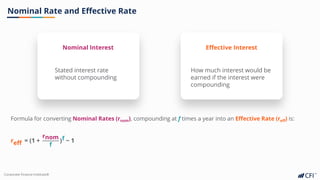
Nominal Rate and Effective Rate
Formula for converting Nominal Rates (rnom), compounding at f times a year into an Effective Rate (reff) is:
reff = (1 +
rnom
f
)f − 1
Nominal Interest
Stated interest rate
without compounding
Effective Interest
How much interest would be
earned if the interest were
compounding
Corporate Finance Institute®
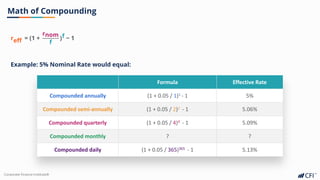
Math of Compounding
Formula Effective Rate
Compounded annually (1 + 0.05 / 1)1 - 1 5%
Compounded semi-annually (1 + 0.05 / 2)2 - 1 5.06%
Compounded quarterly (1 + 0.05 / 4)4 - 1 5.09%
Compounded monthly ? ?
Compounded daily (1 + 0.05 / 365)365 - 1 5.13%
Example: 5% Nominal Rate would equal:
reff = (1 +
rnom
f
)f − 1
Corporate Finance Institute®
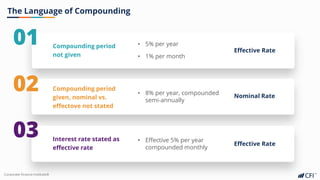
01 Compounding period
not given
Effective Rate
• 5% per year
• 1% per month
02 Compounding period
given, nominal vs.
effectove not stated
• 8% per year, compounded
semi-annually
Nominal Rate
03 Interest rate stated as
effective rate
• Effective 5% per year
compounded monthly
Effective Rate
The Language of Compounding
Corporate Finance Institute®
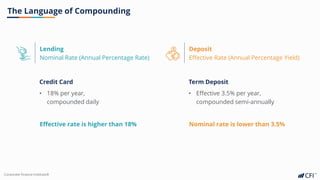
The Language of Compounding
Lending
Nominal Rate (Annual Percentage Rate)
Credit Card
• 18% per year,
compounded daily
Deposit
Effective Rate (Annual Percentage Yield)
Term Deposit
• Effective 3.5% per year,
compounded semi-annually
Effective rate is higher than 18% Nominal rate is lower than 3.5%
Corporate Finance Institute®
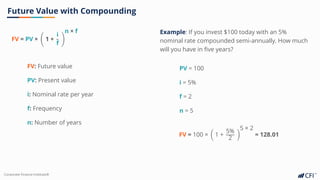
Future Value with Compounding
PV: Present value
i: Nominal rate per year
n: Number of years
FV: Future value
Example: If you invest $100 today with an 5%
nominal rate compounded semi-annually. How much
will you have in five years?
PV = 100
i = 5%
f = 2
f: Frequency n = 5
FV = PV × 1 +
i
f
n × f
FV = 100 × 1 +
5%
2
5 × 2
= 128.01
Corporate Finance Institute®
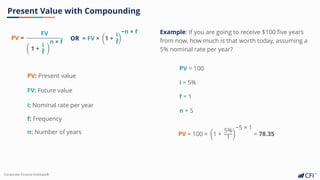
Present Value with Compounding
FV: Future value
i: Nominal rate per year
n: Number of years
PV: Present value
Example: If you are going to receive $100 five years
from now, how much is that worth today, assuming a
5% nominal rate per year?
f: Frequency
PV = 100
i = 5%
f = 1
n = 5
PV =
FV
1 +
i
f
n × f
PV = 100 × 1 +
5%
1
−5 × 1
= 78.35
OR = FV × 1 +
i
f
−n × f
Corporate Finance Institute®
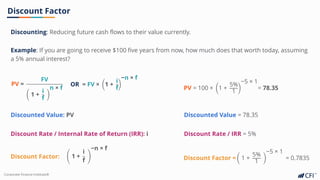
Discount Factor
Discounting: Reducing future cash flows to their value currently.
Discounted Value = 78.35
Discount Rate / IRR = 5%
Discounted Value: PV
Discount Rate / Internal Rate of Return (IRR): i
Discount Factor:
Example: If you are going to receive $100 five years from now, how much does that worth today, assuming
a 5% annual interest?
1 +
i
f
−n × f
PV = 100 × 1 +
5%
1
−5 × 1
= 78.35
Discount Factor = 1 +
5%
1
−5 × 1
= 0.7835
PV =
FV
1 +
i
f
n × f
OR = FV × 1 +
i
f
−n × f
Corporate Finance Institute®
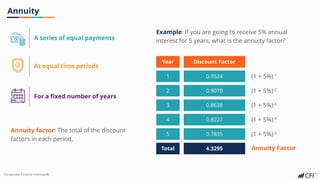
Annuity
A series of equal payments
At equal time periods
For a fixed number of years
Example: If you are going to receive 5% annual
interest for 5 years, what is the annuity factor?
4.3295
Total Annuity Factor
Year
2
Discount Factor
0.9070
3 0.8638
1 0.9524 (1 + 5%)-1
4 0.8227
5 0.7835
(1 + 5%)-2
(1 + 5%)-3
(1 + 5%)-4
(1 + 5%)-5
Annuity factor: The total of the discount
factors in each period.
Corporate Finance Institute®
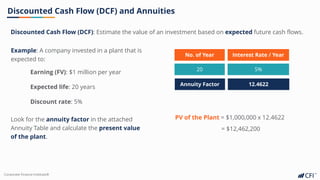
Discounted Cash Flow (DCF) and Annuities
Discounted Cash Flow (DCF): Estimate the value of an investment based on expected future cash flows.
Example: A company invested in a plant that is
expected to:
Earning (FV): $1 million per year
Expected life: 20 years
Discount rate: 5%
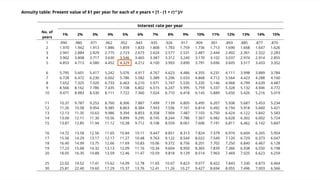
PV of the Plant = $1,000,000 x 12.4622
Look for the annuity factor in the attached
Annuity Table and calculate the present value
of the plant.
= $12,462,200
No. of Year Interest Rate / Year
20 5%
Annuity Factor 12.4622
Corporate Finance Institute®
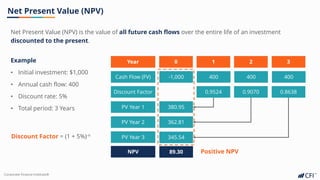
Net Present Value (NPV) is the value of all future cash flows over the entire life of an investment
discounted to the present.
Net Present Value (NPV)
Example
• Initial investment: $1,000
• Annual cash flow: 400
• Discount rate: 5%
• Total period: 3 Years
Discount Factor = (1 + 5%)-n
Year 0
Cash Flow (FV) -1,000
1
400
2
400
3
400
Discount Factor 0.9524 0.9070 0.8638
PV Year 1 380.95
PV Year 2 362.81
PV Year 3 345.54
NPV 89.30 Positive NPV
Corporate Finance Institute®
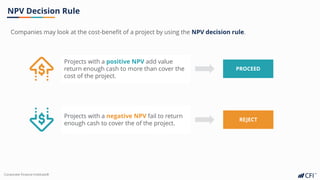
NPV Decision Rule
Companies may look at the cost-benefit of a project by using the NPV decision rule.
Projects with a positive NPV add value
return enough cash to more than cover the
cost of the project.
Projects with a negative NPV fail to return
enough cash to cover the of the project.
PROCEED
REJECT
Corporate Finance Institute®
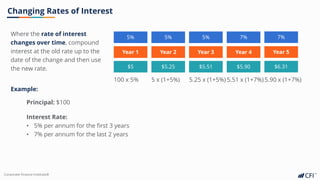
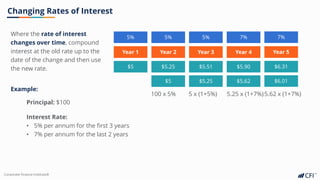
Changing Rates of Interest
Where the rate of interest
changes over time, compound
interest at the old rate up to the
date of the change and then use
the new rate.
Example:
Principal: $100
Interest Rate:
• 5% per annum for the first 3 years
• 7% per annum for the last 2 years
$5 $5.25 $5.51 $5.90 $6.31
Year 1
5%
Year 2
5%
Year 3
5%
Year 4
7%
Year 5
7%
100 x 5% 5 x (1+5%) 5.25 x (1+5%) 5.51 x (1+7%) 5.90 x (1+7%)
Corporate Finance Institute®
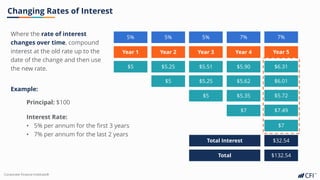
Changing Rates of Interest
Year 1
$5
5%
Year 2
$5.25
$5
5%
Year 3
$5.51
$5.25
5%
Year 4
$5.90
$5.62
7%
Year 5
$6.31
$6.01
7%
Example:
Principal: $100
Interest Rate:
• 5% per annum for the first 3 years
• 7% per annum for the last 2 years
Where the rate of interest
changes over time, compound
interest at the old rate up to the
date of the change and then use
the new rate.
100 x 5% 5 x (1+5%) 5.25 x (1+7%)5.62 x (1+7%)
Corporate Finance Institute®
Changing Rates of Interest
Year 1
$5
5%
Year 2
$5.25
$5
5%
Year 3
$5.51
$5.25
5%
Year 4
$5.90
$5.62
7%
Year 5
$6.31
$6.01
$5 $5.35
$7
$5.72
$7.49
$7
7%
Total Interest $32.54
Total $132.54
Example:
Principal: $100
Interest Rate:
• 5% per annum for the first 3 years
• 7% per annum for the last 2 years
Where the rate of interest
changes over time, compound
interest at the old rate up to the
date of the change and then use
the new rate.

MathFundamentalsforCapitalMarketsCoursePresentation-191230-111251.pdf

  • 1.
  • 2.
    Corporate Finance Institute® Calculatesimple and compound interest rates Convert values today into a future value and vice- versa Understand how to calculate an annuity and what discounted cash flow is Learning Objectives
  • 3.
    Corporate Finance Institute® MathWarm Up Exponents / Roots X2 Percentages % Solving Equations 2X + 1 = Y
  • 4.
    Corporate Finance Institute® SimpleInterest = Simple Interest Earned Each Period Rate of Interest X Principal Example: Principal: $100 Interest Rate: 5% per annum Total Periods: 5 years Year 1 Interest $5 2 $10 3 $15 4 $20 5 $25 $100 Principal Total $125
  • 5.
    Corporate Finance Institute® FutureValue and Present Value The value of a dollar today and the value of a dollar a year from now are different. Opportunity cost of not having that dollar now Inflation – purchasing power Uncertainty – default risk Time Value of Money
  • 6.
    Corporate Finance Institute® FutureValue in a Simple Interest World Example: If you invest $100 today with a 5% interest rate per year. How much will you have in five years? = FV PV X (1 + i X n) PV: Present value i: Interest per period n: Number of periods FV: Future value PV = $100 i = 5% n = 5 years FV = $100 x (1 + 5% x 5) = $125
  • 7.
    Corporate Finance Institute® PresentValue in a Simple Interest World Example: If you are going to receive $100 five years from now, how much is that worth today, assuming 5% annual interest? FV: Future value i: Interest per period n: Number of periods PV: Present value = PV FV (1 + i X n) FV = $100 i = 5% n = 5 years PV = $100 / (1 + 5% x 5) = $80
  • 8.
    Corporate Finance Institute® CompoundInterest Example: Principal: $100 Interest Rate: 5% per annum Total Periods: 5 years 1 $5 $105 2 $ 10.25 $ 110.25 3 $ 15.76 $ 115.76 Total X 5% = $5 X 5% = $5.25 X 5% = $5.51 4 $ 21.55 $ 121.55 5 $ 27.63 $ 127.63 X 5% = $5.79 X 5% = $6.08 Compound Interest Earned Each Period = Rate of Interest X (Principal + Previously earned interest) Year Total Interest Principal + Interest 0 $100 $0
  • 9.
    Corporate Finance Institute® SimpleInterest Versus Compound Interest Example: Principal: $100 Interest Rate: 5% per annum 0 200 400 600 800 1000 1200 0 5 10 15 20 25 30 35 40 45 50 Years Compound vs Simple Compound Simple
  • 10.
    Corporate Finance Institute® AnnualCompounding Compound Interest Frequency 1 $5 $105 2 $10.25 $110.25 3 $15.76 $ 115.76 0.5 $2.5 1 $5.06 $102.5 $105.06 1.5 $7.69 $107.69 2 $10.38 $110.38 2.5 3 $13.14 $113.14 $15.97 $115.97 Semi-annual Compounding Year Total Interest Principal + Interest 0 $100 $0 Year Total Interest Principal + Interest 0 $100 $0
  • 11.
    Corporate Finance Institute® NominalRate and Effective Rate Formula for converting Nominal Rates (rnom), compounding at f times a year into an Effective Rate (reff) is: reff = (1 + rnom f )f − 1 Nominal Interest Stated interest rate without compounding Effective Interest How much interest would be earned if the interest were compounding
  • 12.
    Corporate Finance Institute® Mathof Compounding Formula Effective Rate Compounded annually (1 + 0.05 / 1)1 - 1 5% Compounded semi-annually (1 + 0.05 / 2)2 - 1 5.06% Compounded quarterly (1 + 0.05 / 4)4 - 1 5.09% Compounded monthly ? ? Compounded daily (1 + 0.05 / 365)365 - 1 5.13% Example: 5% Nominal Rate would equal: reff = (1 + rnom f )f − 1
  • 13.
    Corporate Finance Institute® 01Compounding period not given Effective Rate • 5% per year • 1% per month 02 Compounding period given, nominal vs. effectove not stated • 8% per year, compounded semi-annually Nominal Rate 03 Interest rate stated as effective rate • Effective 5% per year compounded monthly Effective Rate The Language of Compounding
  • 14.
    Corporate Finance Institute® TheLanguage of Compounding Lending Nominal Rate (Annual Percentage Rate) Credit Card • 18% per year, compounded daily Deposit Effective Rate (Annual Percentage Yield) Term Deposit • Effective 3.5% per year, compounded semi-annually Effective rate is higher than 18% Nominal rate is lower than 3.5%
  • 15.
    Corporate Finance Institute® FutureValue with Compounding PV: Present value i: Nominal rate per year n: Number of years FV: Future value Example: If you invest $100 today with an 5% nominal rate compounded semi-annually. How much will you have in five years? PV = 100 i = 5% f = 2 f: Frequency n = 5 FV = PV × 1 + i f n × f FV = 100 × 1 + 5% 2 5 × 2 = 128.01
  • 16.
    Corporate Finance Institute® PresentValue with Compounding FV: Future value i: Nominal rate per year n: Number of years PV: Present value Example: If you are going to receive $100 five years from now, how much is that worth today, assuming a 5% nominal rate per year? f: Frequency PV = 100 i = 5% f = 1 n = 5 PV = FV 1 + i f n × f PV = 100 × 1 + 5% 1 −5 × 1 = 78.35 OR = FV × 1 + i f −n × f
  • 17.
    Corporate Finance Institute® DiscountFactor Discounting: Reducing future cash flows to their value currently. Discounted Value = 78.35 Discount Rate / IRR = 5% Discounted Value: PV Discount Rate / Internal Rate of Return (IRR): i Discount Factor: Example: If you are going to receive $100 five years from now, how much does that worth today, assuming a 5% annual interest? 1 + i f −n × f PV = 100 × 1 + 5% 1 −5 × 1 = 78.35 Discount Factor = 1 + 5% 1 −5 × 1 = 0.7835 PV = FV 1 + i f n × f OR = FV × 1 + i f −n × f
  • 18.
    Corporate Finance Institute® Annuity Aseries of equal payments At equal time periods For a fixed number of years Example: If you are going to receive 5% annual interest for 5 years, what is the annuity factor? 4.3295 Total Annuity Factor Year 2 Discount Factor 0.9070 3 0.8638 1 0.9524 (1 + 5%)-1 4 0.8227 5 0.7835 (1 + 5%)-2 (1 + 5%)-3 (1 + 5%)-4 (1 + 5%)-5 Annuity factor: The total of the discount factors in each period.
  • 19.
  • 20.
    Corporate Finance Institute® DiscountedCash Flow (DCF) and Annuities Discounted Cash Flow (DCF): Estimate the value of an investment based on expected future cash flows. Example: A company invested in a plant that is expected to: Earning (FV): $1 million per year Expected life: 20 years Discount rate: 5% PV of the Plant = $1,000,000 x 12.4622 Look for the annuity factor in the attached Annuity Table and calculate the present value of the plant. = $12,462,200 No. of Year Interest Rate / Year 20 5% Annuity Factor 12.4622
  • 21.
    Corporate Finance Institute® NetPresent Value (NPV) is the value of all future cash flows over the entire life of an investment discounted to the present. Net Present Value (NPV) Example • Initial investment: $1,000 • Annual cash flow: 400 • Discount rate: 5% • Total period: 3 Years Discount Factor = (1 + 5%)-n Year 0 Cash Flow (FV) -1,000 1 400 2 400 3 400 Discount Factor 0.9524 0.9070 0.8638 PV Year 1 380.95 PV Year 2 362.81 PV Year 3 345.54 NPV 89.30 Positive NPV
  • 22.
    Corporate Finance Institute® NPVDecision Rule Companies may look at the cost-benefit of a project by using the NPV decision rule. Projects with a positive NPV add value return enough cash to more than cover the cost of the project. Projects with a negative NPV fail to return enough cash to cover the of the project. PROCEED REJECT
  • 23.
    Corporate Finance Institute® ChangingRates of Interest Where the rate of interest changes over time, compound interest at the old rate up to the date of the change and then use the new rate. Example: Principal: $100 Interest Rate: • 5% per annum for the first 3 years • 7% per annum for the last 2 years $5 $5.25 $5.51 $5.90 $6.31 Year 1 5% Year 2 5% Year 3 5% Year 4 7% Year 5 7% 100 x 5% 5 x (1+5%) 5.25 x (1+5%) 5.51 x (1+7%) 5.90 x (1+7%)
  • 24.
    Corporate Finance Institute® ChangingRates of Interest Year 1 $5 5% Year 2 $5.25 $5 5% Year 3 $5.51 $5.25 5% Year 4 $5.90 $5.62 7% Year 5 $6.31 $6.01 7% Example: Principal: $100 Interest Rate: • 5% per annum for the first 3 years • 7% per annum for the last 2 years Where the rate of interest changes over time, compound interest at the old rate up to the date of the change and then use the new rate. 100 x 5% 5 x (1+5%) 5.25 x (1+7%)5.62 x (1+7%)
  • 25.
    Corporate Finance Institute® ChangingRates of Interest Year 1 $5 5% Year 2 $5.25 $5 5% Year 3 $5.51 $5.25 5% Year 4 $5.90 $5.62 7% Year 5 $6.31 $6.01 $5 $5.35 $7 $5.72 $7.49 $7 7% Total Interest $32.54 Total $132.54 Example: Principal: $100 Interest Rate: • 5% per annum for the first 3 years • 7% per annum for the last 2 years Where the rate of interest changes over time, compound interest at the old rate up to the date of the change and then use the new rate.