Copyright 2008 John Wiley & Sons
Fundamentals of Corporate
Finance
by
Robert Parrino, Ph.D. & David S. Kidwell, Ph.D.
Created by
Babu G. Baradwaj, Ph.D.
Lawrence L. Licon, Ph.D.
Chapter 3 – Financial Statements, Cash Flows, and Taxes
2
Chapter 3 – Financial Statements, Cash Flows, and Taxes Copyright 2008 John Wiley & Sons
CHAPTER 3
Financial Statements,
Cash Flows, and Taxes
3
Chapter 3 – Financial Statements, Cash Flows, and Taxes Copyright 2008 John Wiley & Sons
Quick Links
Financial Statements and Accounting Principles
Market Value vs. Book Value
The Income Statement
Statement of Retained Earnings
Cash Flows
The Balance Sheet
Federal Income Tax
Exhibits
4
Chapter 3 – Financial Statements, Cash Flows, and Taxes Copyright 2008 John Wiley & Sons
 Annual Report comprised of three sections:
 Financial summary related to the past
year’s performance
 Information about the company, its
products, and its activities
 Audited financial statements including
historical financial data
 Annual Report – Used by management to
communicate with firm’s shareholders and
public
Financial Statements and
Accounting Principles
Annual Reports
5
Chapter 3 – Financial Statements, Cash Flows, and Taxes Copyright 2008 John Wiley & Sons
 Prepared by the Financial Accounting
Standards Board (FASB) and authorized by
the SEC
Generally Accepted Accounting Principles (GAAP)
 These are accounting rules and standards
that companies need to adhere to when they
prepare financial statements and reports
Financial Statements and
Accounting Principles
6
Chapter 3 – Financial Statements, Cash Flows, and Taxes Copyright 2008 John Wiley & Sons
Five Important Accounting Principles
Financial Statements and
Accounting Principles
 The Cost Principle:
Transactions are recorded at the cost
at which they occurred
 The Assumption of Arm’s Length Transaction:
Two parties involved in an economic
transaction arrive at a decision
independently and rationally
7
Chapter 3 – Financial Statements, Cash Flows, and Taxes Copyright 2008 John Wiley & Sons
Five Important Accounting Principles
Financial Statements and
Accounting Principles
 The Going Concern Assumption:
It is assumed that a company will continue
to operate for the predictable future
 The Matching Principle:
Expenses related to generating any
revenue are matched
 The Realization Principle:
Revenue is recognized when transaction
is completed, while cash may not be
collected until a later time
8
Chapter 3 – Financial Statements, Cash Flows, and Taxes Copyright 2008 John Wiley & Sons
International GAAP
Financial Statements and
Accounting Principles
 Uniform accounting rules and procedures
promoted by the International Accounting
Standards Board
 All European Union firms required to
comply with International Accounting
Standards (IAS) since 2007
 SEC does not recognize IAS, and requires
foreign firms listed on U.S. stock
exchanges to use U.S. GAAP
9
Chapter 3 – Financial Statements, Cash Flows, and Taxes Copyright 2008 John Wiley & Sons
Criticisms of U.S. GAAP
Financial Statements and
Accounting Principles
 It can easily be circumvented by sharp
financial managers and accountants
 It is too complicated and detail oriented,
and leaves no room for accountants to
use their judgment
10
Chapter 3 – Financial Statements, Cash Flows, and Taxes Copyright 2008 John Wiley & Sons
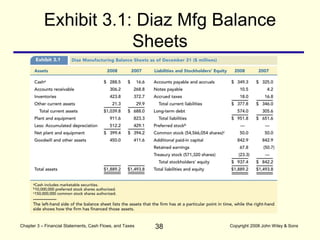
This financial statement identifies all the assets and
liabilities of a firm at a point in time
 Left side of the balance shows all assets
the firm owns and uses to generate
revenues
 Right side represents the liabilities of the
firm – money that the firm has borrowed
from both creditors and shareholders
The Balance Sheet
Go to Exhibit 3.1
11
Chapter 3 – Financial Statements, Cash Flows, and Taxes Copyright 2008 John Wiley & Sons
The Balance Sheet
 Balance sheet also lists the capital raised from
its shareholders
 Shareholders of the firm’s common equity are
listed last
 Will be paid with whatever remains after
paying all other suppliers of funds
 Assets listed in order of their liquidity
 Liabilities listed in order in which they must be
paid
12
Chapter 3 – Financial Statements, Cash Flows, and Taxes Copyright 2008 John Wiley & Sons
Current Assets and Liabilities
The Balance Sheet
 Current assets include all assets likely to be
converted to cash within a year (or within an
operating cycle)
 These include cash and marketable
securities, accounts receivables, and
inventory
13
Chapter 3 – Financial Statements, Cash Flows, and Taxes Copyright 2008 John Wiley & Sons
The Balance Sheet
Current Assets and Liabilities
 Net Working Capital = Difference between
amount of current assets and current
liabilities
 Current Liabilities include all liabilities that
have to be paid within a year
 Bank loans and other borrowings with
less than a year’s maturity, accounts
payables, accrued wages and taxes
14
Chapter 3 – Financial Statements, Cash Flows, and Taxes Copyright 2008 John Wiley & Sons
Inventory Accounting
 FIFO (First in first out) refers to practice of
recognizing a sale as being made up of
inventory purchased earlier and having
lowest cost
 LIFO (Last in last out) calls for firm to
attribute any sale made to the most recently
acquired and most expensive inventory
 Inventory (least liquid of current assets)
reported in one of two ways on balance sheet
The Balance Sheet
15
Chapter 3 – Financial Statements, Cash Flows, and Taxes Copyright 2008 John Wiley & Sons
Inventory Accounting
 FIFO reporting leads to higher current asset
value and higher net income
 Firms may switch from one to another only
under extraordinary circumstances and not
frequently
The Balance Sheet
16
Chapter 3 – Financial Statements, Cash Flows, and Taxes Copyright 2008 John Wiley & Sons
Long-Term Assets
The Balance Sheet
 Intangible assets also listed here
 Goodwill, patents, copyrights, etc.
 Real assets firm acquires to produce its
products and generate cash flows
 Land, buildings, plant and equipment
17
Chapter 3 – Financial Statements, Cash Flows, and Taxes Copyright 2008 John Wiley & Sons
Long-Term Assets
The Balance Sheet
 All long-term real assets are depreciated
 Intangible assets are amortized
 Depreciating assets allow a firm to lower
taxable income and reduce taxes
 Firms are allowed to depreciate assets
using straight line method or accelerated
depreciation method allowed by IRS
18
Chapter 3 – Financial Statements, Cash Flows, and Taxes Copyright 2008 John Wiley & Sons
Long-Term Liabilities
The Balance Sheet
 Long-term debt of the company
 Including bank loans, mortgages, and bonds
with a maturity of one year or longer
19
Chapter 3 – Financial Statements, Cash Flows, and Taxes Copyright 2008 John Wiley & Sons
Equity – There are two sources of equity funds:
The Balance Sheet
 Preferred Equity:
The other source of equity capital is
preferred stock
Has features that make it a
combination of a fixed income security
and an equity security
 Common Equity:
Common equity represents the true
ownership of the firm
20
Chapter 3 – Financial Statements, Cash Flows, and Taxes Copyright 2008 John Wiley & Sons
The Balance Sheet
More Balance Sheet Accounts
 Retained earnings:
Results from funds the firm has
reinvested from its earnings
These funds are not cash–they already
have been put to work
 Treasury stock:
This account reflects the value of the
shares that the firm has repurchased
from investors
21
Chapter 3 – Financial Statements, Cash Flows, and Taxes Copyright 2008 John Wiley & Sons
Market Value vs. Book Value
 All assets are traditionally reported at their
historical costs
 Balance sheet does not reflect current
market value of the assets–only their
acquired costs
Asset Valuation
22
Chapter 3 – Financial Statements, Cash Flows, and Taxes Copyright 2008 John Wiley & Sons
Market Value vs. Book Value
 Downside is the difficulty in estimating market
values of assets
 When both liabilities and assets are
reported at their current market values,
their difference represents true market
value of shareholders’ equity
Asset Valuation
 Better information is provided to management
and investors by adopting a marking to market
approach—reporting assets at their current
market value
23
Chapter 3 – Financial Statements, Cash Flows, and Taxes Copyright 2008 John Wiley & Sons
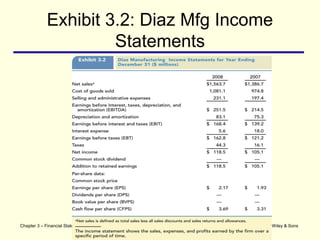
The Income Statement
 Measures the profitability of a firm for any
reporting period
 Revenues represent value of products and
services sold by firm–include both cash and
credit sales
 Expenses range from cost of producing
goods for sale and asset utilization costs-
depreciation or amortization
 Net income = Difference between the firm’s
revenues and expenses
The Income Statement: Overview
Go to Exhibit 3.2
24
Chapter 3 – Financial Statements, Cash Flows, and Taxes Copyright 2008 John Wiley & Sons
 The cost of any physical asset, such as plant
or machinery, is written off over its lifetime.
This is called depreciation and is a non-cash
expense
The Income Statement
The Income Statement: Depreciation
 Firms use one of these for depreciating
an asset:
Straight line method
Accelerated depreciation method
 Firms allowed to use one for internal purposes
and another for tax purposes
25
Chapter 3 – Financial Statements, Cash Flows, and Taxes Copyright 2008 John Wiley & Sons
 Amortization expenses are related to the
writing off of the value of intangible
assets, such as:
 Goodwill, Patents, Licenses, etc.
The Income Statement
The Income Statement: Amortization
 It is also a non-cash expense like depreciation
26
Chapter 3 – Financial Statements, Cash Flows, and Taxes Copyright 2008 John Wiley & Sons
 Nonrecurring expenses are associated with
the closing down of unprofitable operations,
or restructuring of a firm’s operations
The Income Statement
Nonrecurring and Extraordinary Items
 Extraordinary Items refer to income or
expenses associated with events that are
not expected to happen on a regular basis
27
Chapter 3 – Financial Statements, Cash Flows, and Taxes Copyright 2008 John Wiley & Sons
 Earnings before interest, taxes, depreciation and
amortization (EBITDA)
 Earnings generated from operations prior to
payment of expenses not directly connected to
production of products
The Income Statement
Bottom Line Accounts
 After netting out the expenses related to
depreciation and amortization, we arrive at
earnings before interest and taxes (EBIT)
28
Chapter 3 – Financial Statements, Cash Flows, and Taxes Copyright 2008 John Wiley & Sons
 Subtracting taxes from EBT yields net
income or net income after taxes
 This amount tells us amount available
to management to pay dividends, pay
off debt, or reinvest in firm
The Income Statement
Bottom Line Accounts
 Earnings before taxes (EBT) represents the
taxable income for the period
29
Chapter 3 – Financial Statements, Cash Flows, and Taxes Copyright 2008 John Wiley & Sons
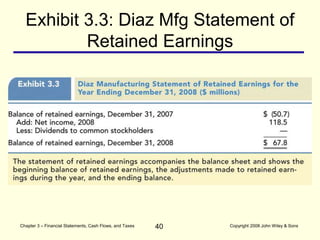
Statement of Retained Earnings
 This account will show changes whenever
a firm reports a loss or profit and when a
cash dividend is declared
 This financial statement shows the
changes in this account (Retained
Earnings) from one period to the next
Go to Exhibit 3.3
30
Chapter 3 – Financial Statements, Cash Flows, and Taxes Copyright 2008 John Wiley & Sons
Cash Flows
Net Cash Flow versus Net Income
 While accountants focus on net income,
shareholders would be more interested
in net cash flows
 These two are not the same, because of
the presence of non-cash revenues and
expenses
31
Chapter 3 – Financial Statements, Cash Flows, and Taxes Copyright 2008 John Wiley & Sons
Cash Flows
Cash Flow Statement
 Helps to measure cash outflows and cash
inflows generated during any period
 Indicates cash flows resulting from:
 Operating activities, investing activities,
and financing activities
 Sum of cash flows measures net cash
flows of firm during a given period
 It is the bottom line of this financial
statement
Go to Exhibit 3.4
32
Chapter 3 – Financial Statements, Cash Flows, and Taxes Copyright 2008 John Wiley & Sons
Cash Flows
Operating Activities
 Cash inflows result from producing and
selling goods and services
 Cash outflows are tied to the purchase of
raw materials, inventory, salaries and
wages, utilities, rent, interest and other
related expenses
Go to Exhibit 3.5
33
Chapter 3 – Financial Statements, Cash Flows, and Taxes Copyright 2008 John Wiley & Sons
Cash Flows
 Cash inflows and outflows arise out of the
acquisition and selling of real assets
necessary to operate the business
investing activities
Investing Activities
 Also result from:
 Buying and selling financial assets
(bonds, stocks)
 Making and collecting loans
 Selling and settling insurance contracts
34
Chapter 3 – Financial Statements, Cash Flows, and Taxes Copyright 2008 John Wiley & Sons
Cash Flows
 Cash Inflows–when a firm issues debt or
equity securities, or borrows money from
banks or other lenders
 Cash Outflows–if they pay interest or
dividends on the investor’s funds, pay off
debt, or purchase treasury stock
Financing activities
35
Chapter 3 – Financial Statements, Cash Flows, and Taxes Copyright 2008 John Wiley & Sons
Federal Income Tax
Corporate Income Tax Rates
 It is a progressive tax schedule with rates
ranging from 15 percent to 39 percent
 The higher a firm’s taxable income, the
higher the tax liability
Go to Exhibit 3.6
36
Chapter 3 – Financial Statements, Cash Flows, and Taxes Copyright 2008 John Wiley & Sons
Average versus Marginal Tax Rates
 Average tax rate = total taxes paid divided
by taxable income for the period
 Marginal tax rate = tax rate paid on the
last dollar earned or the next dollar earned
Federal Income Tax
37
Chapter 3 – Financial Statements, Cash Flows, and Taxes Copyright 2008 John Wiley & Sons
Federal Income Tax
Dividends and interest payments
 Current U.S. tax code allows interest
payments on debt issued by firms to be tax
deductible
 Dividends paid on firm’s preferred stock or
common stock are not deductible for tax
purposes–they are paid from after-tax
income
 The result is a lower cost of debt financing
relative to the cost of equity financing
38
Chapter 3 – Financial Statements, Cash Flows, and Taxes Copyright 2008 John Wiley & Sons
Exhibit 3.1: Diaz Mfg Balance
Sheets
39
Chapter 3 – Financial Statements, Cash Flows, and Taxes Copyright 2008 John Wiley & Sons
Exhibit 3.2: Diaz Mfg Income
Statements
40
Chapter 3 – Financial Statements, Cash Flows, and Taxes Copyright 2008 John Wiley & Sons
Exhibit 3.3: Diaz Mfg Statement of
Retained Earnings
41
Chapter 3 – Financial Statements, Cash Flows, and Taxes Copyright 2008 John Wiley & Sons
Exhibit 3.4: Diaz Mfg Statement of
Cash Flows
42
Chapter 3 – Financial Statements, Cash Flows, and Taxes Copyright 2008 John Wiley & Sons
Exhibit 3.5: Interrelations among
the Financial Statements
43
Chapter 3 – Financial Statements, Cash Flows, and Taxes Copyright 2008 John Wiley & Sons
Exhibit 3.6: Corporate Tax Rates
for 2007

ch03.ppt

  • 1.
    Copyright 2008 JohnWiley & Sons Fundamentals of Corporate Finance by Robert Parrino, Ph.D. & David S. Kidwell, Ph.D. Created by Babu G. Baradwaj, Ph.D. Lawrence L. Licon, Ph.D. Chapter 3 – Financial Statements, Cash Flows, and Taxes
  • 2.
    2 Chapter 3 –Financial Statements, Cash Flows, and Taxes Copyright 2008 John Wiley & Sons CHAPTER 3 Financial Statements, Cash Flows, and Taxes
  • 3.
    3 Chapter 3 –Financial Statements, Cash Flows, and Taxes Copyright 2008 John Wiley & Sons Quick Links Financial Statements and Accounting Principles Market Value vs. Book Value The Income Statement Statement of Retained Earnings Cash Flows The Balance Sheet Federal Income Tax Exhibits
  • 4.
    4 Chapter 3 –Financial Statements, Cash Flows, and Taxes Copyright 2008 John Wiley & Sons  Annual Report comprised of three sections:  Financial summary related to the past year’s performance  Information about the company, its products, and its activities  Audited financial statements including historical financial data  Annual Report – Used by management to communicate with firm’s shareholders and public Financial Statements and Accounting Principles Annual Reports
  • 5.
    5 Chapter 3 –Financial Statements, Cash Flows, and Taxes Copyright 2008 John Wiley & Sons  Prepared by the Financial Accounting Standards Board (FASB) and authorized by the SEC Generally Accepted Accounting Principles (GAAP)  These are accounting rules and standards that companies need to adhere to when they prepare financial statements and reports Financial Statements and Accounting Principles
  • 6.
    6 Chapter 3 –Financial Statements, Cash Flows, and Taxes Copyright 2008 John Wiley & Sons Five Important Accounting Principles Financial Statements and Accounting Principles  The Cost Principle: Transactions are recorded at the cost at which they occurred  The Assumption of Arm’s Length Transaction: Two parties involved in an economic transaction arrive at a decision independently and rationally
  • 7.
    7 Chapter 3 –Financial Statements, Cash Flows, and Taxes Copyright 2008 John Wiley & Sons Five Important Accounting Principles Financial Statements and Accounting Principles  The Going Concern Assumption: It is assumed that a company will continue to operate for the predictable future  The Matching Principle: Expenses related to generating any revenue are matched  The Realization Principle: Revenue is recognized when transaction is completed, while cash may not be collected until a later time
  • 8.
    8 Chapter 3 –Financial Statements, Cash Flows, and Taxes Copyright 2008 John Wiley & Sons International GAAP Financial Statements and Accounting Principles  Uniform accounting rules and procedures promoted by the International Accounting Standards Board  All European Union firms required to comply with International Accounting Standards (IAS) since 2007  SEC does not recognize IAS, and requires foreign firms listed on U.S. stock exchanges to use U.S. GAAP
  • 9.
    9 Chapter 3 –Financial Statements, Cash Flows, and Taxes Copyright 2008 John Wiley & Sons Criticisms of U.S. GAAP Financial Statements and Accounting Principles  It can easily be circumvented by sharp financial managers and accountants  It is too complicated and detail oriented, and leaves no room for accountants to use their judgment
  • 10.
    10 Chapter 3 –Financial Statements, Cash Flows, and Taxes Copyright 2008 John Wiley & Sons This financial statement identifies all the assets and liabilities of a firm at a point in time  Left side of the balance shows all assets the firm owns and uses to generate revenues  Right side represents the liabilities of the firm – money that the firm has borrowed from both creditors and shareholders The Balance Sheet Go to Exhibit 3.1
  • 11.
    11 Chapter 3 –Financial Statements, Cash Flows, and Taxes Copyright 2008 John Wiley & Sons The Balance Sheet  Balance sheet also lists the capital raised from its shareholders  Shareholders of the firm’s common equity are listed last  Will be paid with whatever remains after paying all other suppliers of funds  Assets listed in order of their liquidity  Liabilities listed in order in which they must be paid
  • 12.
    12 Chapter 3 –Financial Statements, Cash Flows, and Taxes Copyright 2008 John Wiley & Sons Current Assets and Liabilities The Balance Sheet  Current assets include all assets likely to be converted to cash within a year (or within an operating cycle)  These include cash and marketable securities, accounts receivables, and inventory
  • 13.
    13 Chapter 3 –Financial Statements, Cash Flows, and Taxes Copyright 2008 John Wiley & Sons The Balance Sheet Current Assets and Liabilities  Net Working Capital = Difference between amount of current assets and current liabilities  Current Liabilities include all liabilities that have to be paid within a year  Bank loans and other borrowings with less than a year’s maturity, accounts payables, accrued wages and taxes
  • 14.
    14 Chapter 3 –Financial Statements, Cash Flows, and Taxes Copyright 2008 John Wiley & Sons Inventory Accounting  FIFO (First in first out) refers to practice of recognizing a sale as being made up of inventory purchased earlier and having lowest cost  LIFO (Last in last out) calls for firm to attribute any sale made to the most recently acquired and most expensive inventory  Inventory (least liquid of current assets) reported in one of two ways on balance sheet The Balance Sheet
  • 15.
    15 Chapter 3 –Financial Statements, Cash Flows, and Taxes Copyright 2008 John Wiley & Sons Inventory Accounting  FIFO reporting leads to higher current asset value and higher net income  Firms may switch from one to another only under extraordinary circumstances and not frequently The Balance Sheet
  • 16.
    16 Chapter 3 –Financial Statements, Cash Flows, and Taxes Copyright 2008 John Wiley & Sons Long-Term Assets The Balance Sheet  Intangible assets also listed here  Goodwill, patents, copyrights, etc.  Real assets firm acquires to produce its products and generate cash flows  Land, buildings, plant and equipment
  • 17.
    17 Chapter 3 –Financial Statements, Cash Flows, and Taxes Copyright 2008 John Wiley & Sons Long-Term Assets The Balance Sheet  All long-term real assets are depreciated  Intangible assets are amortized  Depreciating assets allow a firm to lower taxable income and reduce taxes  Firms are allowed to depreciate assets using straight line method or accelerated depreciation method allowed by IRS
  • 18.
    18 Chapter 3 –Financial Statements, Cash Flows, and Taxes Copyright 2008 John Wiley & Sons Long-Term Liabilities The Balance Sheet  Long-term debt of the company  Including bank loans, mortgages, and bonds with a maturity of one year or longer
  • 19.
    19 Chapter 3 –Financial Statements, Cash Flows, and Taxes Copyright 2008 John Wiley & Sons Equity – There are two sources of equity funds: The Balance Sheet  Preferred Equity: The other source of equity capital is preferred stock Has features that make it a combination of a fixed income security and an equity security  Common Equity: Common equity represents the true ownership of the firm
  • 20.
    20 Chapter 3 –Financial Statements, Cash Flows, and Taxes Copyright 2008 John Wiley & Sons The Balance Sheet More Balance Sheet Accounts  Retained earnings: Results from funds the firm has reinvested from its earnings These funds are not cash–they already have been put to work  Treasury stock: This account reflects the value of the shares that the firm has repurchased from investors
  • 21.
    21 Chapter 3 –Financial Statements, Cash Flows, and Taxes Copyright 2008 John Wiley & Sons Market Value vs. Book Value  All assets are traditionally reported at their historical costs  Balance sheet does not reflect current market value of the assets–only their acquired costs Asset Valuation
  • 22.
    22 Chapter 3 –Financial Statements, Cash Flows, and Taxes Copyright 2008 John Wiley & Sons Market Value vs. Book Value  Downside is the difficulty in estimating market values of assets  When both liabilities and assets are reported at their current market values, their difference represents true market value of shareholders’ equity Asset Valuation  Better information is provided to management and investors by adopting a marking to market approach—reporting assets at their current market value
  • 23.
    23 Chapter 3 –Financial Statements, Cash Flows, and Taxes Copyright 2008 John Wiley & Sons The Income Statement  Measures the profitability of a firm for any reporting period  Revenues represent value of products and services sold by firm–include both cash and credit sales  Expenses range from cost of producing goods for sale and asset utilization costs- depreciation or amortization  Net income = Difference between the firm’s revenues and expenses The Income Statement: Overview Go to Exhibit 3.2
  • 24.
    24 Chapter 3 –Financial Statements, Cash Flows, and Taxes Copyright 2008 John Wiley & Sons  The cost of any physical asset, such as plant or machinery, is written off over its lifetime. This is called depreciation and is a non-cash expense The Income Statement The Income Statement: Depreciation  Firms use one of these for depreciating an asset: Straight line method Accelerated depreciation method  Firms allowed to use one for internal purposes and another for tax purposes
  • 25.
    25 Chapter 3 –Financial Statements, Cash Flows, and Taxes Copyright 2008 John Wiley & Sons  Amortization expenses are related to the writing off of the value of intangible assets, such as:  Goodwill, Patents, Licenses, etc. The Income Statement The Income Statement: Amortization  It is also a non-cash expense like depreciation
  • 26.
    26 Chapter 3 –Financial Statements, Cash Flows, and Taxes Copyright 2008 John Wiley & Sons  Nonrecurring expenses are associated with the closing down of unprofitable operations, or restructuring of a firm’s operations The Income Statement Nonrecurring and Extraordinary Items  Extraordinary Items refer to income or expenses associated with events that are not expected to happen on a regular basis
  • 27.
    27 Chapter 3 –Financial Statements, Cash Flows, and Taxes Copyright 2008 John Wiley & Sons  Earnings before interest, taxes, depreciation and amortization (EBITDA)  Earnings generated from operations prior to payment of expenses not directly connected to production of products The Income Statement Bottom Line Accounts  After netting out the expenses related to depreciation and amortization, we arrive at earnings before interest and taxes (EBIT)
  • 28.
    28 Chapter 3 –Financial Statements, Cash Flows, and Taxes Copyright 2008 John Wiley & Sons  Subtracting taxes from EBT yields net income or net income after taxes  This amount tells us amount available to management to pay dividends, pay off debt, or reinvest in firm The Income Statement Bottom Line Accounts  Earnings before taxes (EBT) represents the taxable income for the period
  • 29.
    29 Chapter 3 –Financial Statements, Cash Flows, and Taxes Copyright 2008 John Wiley & Sons Statement of Retained Earnings  This account will show changes whenever a firm reports a loss or profit and when a cash dividend is declared  This financial statement shows the changes in this account (Retained Earnings) from one period to the next Go to Exhibit 3.3
  • 30.
    30 Chapter 3 –Financial Statements, Cash Flows, and Taxes Copyright 2008 John Wiley & Sons Cash Flows Net Cash Flow versus Net Income  While accountants focus on net income, shareholders would be more interested in net cash flows  These two are not the same, because of the presence of non-cash revenues and expenses
  • 31.
    31 Chapter 3 –Financial Statements, Cash Flows, and Taxes Copyright 2008 John Wiley & Sons Cash Flows Cash Flow Statement  Helps to measure cash outflows and cash inflows generated during any period  Indicates cash flows resulting from:  Operating activities, investing activities, and financing activities  Sum of cash flows measures net cash flows of firm during a given period  It is the bottom line of this financial statement Go to Exhibit 3.4
  • 32.
    32 Chapter 3 –Financial Statements, Cash Flows, and Taxes Copyright 2008 John Wiley & Sons Cash Flows Operating Activities  Cash inflows result from producing and selling goods and services  Cash outflows are tied to the purchase of raw materials, inventory, salaries and wages, utilities, rent, interest and other related expenses Go to Exhibit 3.5
  • 33.
    33 Chapter 3 –Financial Statements, Cash Flows, and Taxes Copyright 2008 John Wiley & Sons Cash Flows  Cash inflows and outflows arise out of the acquisition and selling of real assets necessary to operate the business investing activities Investing Activities  Also result from:  Buying and selling financial assets (bonds, stocks)  Making and collecting loans  Selling and settling insurance contracts
  • 34.
    34 Chapter 3 –Financial Statements, Cash Flows, and Taxes Copyright 2008 John Wiley & Sons Cash Flows  Cash Inflows–when a firm issues debt or equity securities, or borrows money from banks or other lenders  Cash Outflows–if they pay interest or dividends on the investor’s funds, pay off debt, or purchase treasury stock Financing activities
  • 35.
    35 Chapter 3 –Financial Statements, Cash Flows, and Taxes Copyright 2008 John Wiley & Sons Federal Income Tax Corporate Income Tax Rates  It is a progressive tax schedule with rates ranging from 15 percent to 39 percent  The higher a firm’s taxable income, the higher the tax liability Go to Exhibit 3.6
  • 36.
    36 Chapter 3 –Financial Statements, Cash Flows, and Taxes Copyright 2008 John Wiley & Sons Average versus Marginal Tax Rates  Average tax rate = total taxes paid divided by taxable income for the period  Marginal tax rate = tax rate paid on the last dollar earned or the next dollar earned Federal Income Tax
  • 37.
    37 Chapter 3 –Financial Statements, Cash Flows, and Taxes Copyright 2008 John Wiley & Sons Federal Income Tax Dividends and interest payments  Current U.S. tax code allows interest payments on debt issued by firms to be tax deductible  Dividends paid on firm’s preferred stock or common stock are not deductible for tax purposes–they are paid from after-tax income  The result is a lower cost of debt financing relative to the cost of equity financing
  • 38.
    38 Chapter 3 –Financial Statements, Cash Flows, and Taxes Copyright 2008 John Wiley & Sons Exhibit 3.1: Diaz Mfg Balance Sheets
  • 39.
    39 Chapter 3 –Financial Statements, Cash Flows, and Taxes Copyright 2008 John Wiley & Sons Exhibit 3.2: Diaz Mfg Income Statements
  • 40.
    40 Chapter 3 –Financial Statements, Cash Flows, and Taxes Copyright 2008 John Wiley & Sons Exhibit 3.3: Diaz Mfg Statement of Retained Earnings
  • 41.
    41 Chapter 3 –Financial Statements, Cash Flows, and Taxes Copyright 2008 John Wiley & Sons Exhibit 3.4: Diaz Mfg Statement of Cash Flows
  • 42.
    42 Chapter 3 –Financial Statements, Cash Flows, and Taxes Copyright 2008 John Wiley & Sons Exhibit 3.5: Interrelations among the Financial Statements
  • 43.
    43 Chapter 3 –Financial Statements, Cash Flows, and Taxes Copyright 2008 John Wiley & Sons Exhibit 3.6: Corporate Tax Rates for 2007