Chapter 6 Presentation “ Jugar” and Informal Commands
The verb “jugar” The verb “jugar” is the infinitive for “to play.”  It is a stem-changing verb or “boot verb” like “querer” which you learned about in the last chapter.
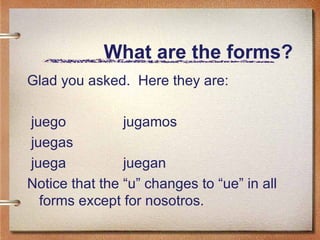
What are the forms? Glad you asked.  Here they are: juego jugamos juegas juega  juegan Notice that the “u” changes to “ue” in all forms except for nosotros.
So what? Well, you just have to memorize those forms.  They will be on the Chapter 6 test.  Now, let’s get to the meatier grammar issue in Chapter 6--commands.
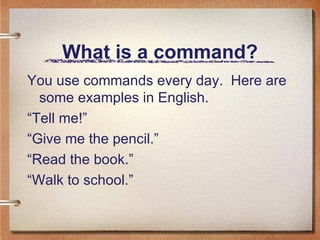
What is a command? You use commands every day.  Here are some examples in English. “ Tell me!” “ Give me the pencil.” “ Read the book.” “ Walk to school.”
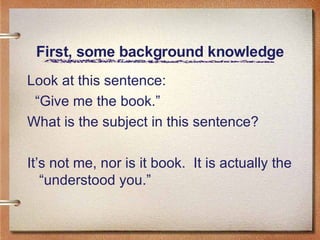
First, some background knowledge Look at this sentence: “ Give me the book.” What is the subject in this sentence? It’s not me, nor is it book.  It is actually the “understood you.”
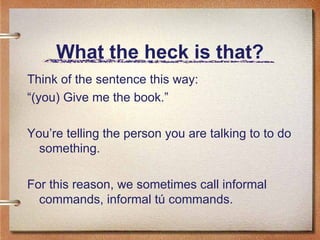
What the heck is that? Think of the sentence this way: “ (you) Give me the book.” You’re telling the person you are talking to to do something. For this reason, we sometimes call informal commands, informal t ú commands.
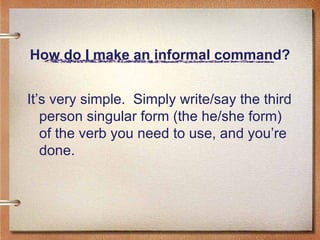
How do I make an informal command? It’s very simple.  Simply write/say the third person singular form (the he/she form) of the verb you need to use, and you’re done.
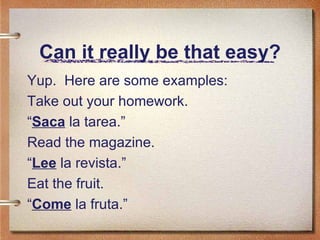
Can it really be that easy? Yup.  Here are some examples: Take out your homework. “ Saca  la tarea.” Read the magazine. “ Lee  la revista.” Eat the fruit. “ Come  la fruta.”
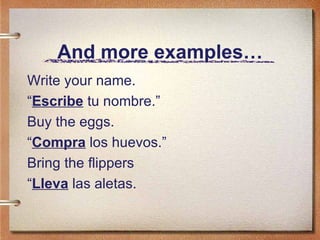
And more examples… Write your name. “ Escribe  tu nombre.” Buy the eggs. “ Compra  los huevos.” Bring the flippers “ Lleva  las aletas.
But what if I want to tell someone they shouldn’t do something? Simple as well. Merely place the words “no debes” which means “you shouldn’t” in front of the infinitive that you need to use. You shouldn’t go outside. “ No debes  ir afuera.” You shouldn’t walk in the rain. “ No debes  caminar en la lluvia.”
And more examples… You shouldn’t eat before dinner. “ No debes  comer antes de la cena.” You shouldn’t talk with your mouth full. “ No debes  comer con la boca llena.” You shouldn’t play in the garbage.” “ No debes  jugar en la basura.”
You get the idea… And if you don’t, LET ME KNOW.  I am available at  [email_address] , or stop by before school.

Chapter6

  • 1.
    Chapter 6 Presentation“ Jugar” and Informal Commands
  • 2.
    The verb “jugar”The verb “jugar” is the infinitive for “to play.” It is a stem-changing verb or “boot verb” like “querer” which you learned about in the last chapter.
  • 3.
    What are theforms? Glad you asked. Here they are: juego jugamos juegas juega juegan Notice that the “u” changes to “ue” in all forms except for nosotros.
  • 4.
    So what? Well,you just have to memorize those forms. They will be on the Chapter 6 test. Now, let’s get to the meatier grammar issue in Chapter 6--commands.
  • 5.
    What is acommand? You use commands every day. Here are some examples in English. “ Tell me!” “ Give me the pencil.” “ Read the book.” “ Walk to school.”
  • 6.
    First, some backgroundknowledge Look at this sentence: “ Give me the book.” What is the subject in this sentence? It’s not me, nor is it book. It is actually the “understood you.”
  • 7.
    What the heckis that? Think of the sentence this way: “ (you) Give me the book.” You’re telling the person you are talking to to do something. For this reason, we sometimes call informal commands, informal t ú commands.
  • 8.
    How do Imake an informal command? It’s very simple. Simply write/say the third person singular form (the he/she form) of the verb you need to use, and you’re done.
  • 9.
    Can it reallybe that easy? Yup. Here are some examples: Take out your homework. “ Saca la tarea.” Read the magazine. “ Lee la revista.” Eat the fruit. “ Come la fruta.”
  • 10.
    And more examples…Write your name. “ Escribe tu nombre.” Buy the eggs. “ Compra los huevos.” Bring the flippers “ Lleva las aletas.
  • 11.
    But what ifI want to tell someone they shouldn’t do something? Simple as well. Merely place the words “no debes” which means “you shouldn’t” in front of the infinitive that you need to use. You shouldn’t go outside. “ No debes ir afuera.” You shouldn’t walk in the rain. “ No debes caminar en la lluvia.”
  • 12.
    And more examples…You shouldn’t eat before dinner. “ No debes comer antes de la cena.” You shouldn’t talk with your mouth full. “ No debes comer con la boca llena.” You shouldn’t play in the garbage.” “ No debes jugar en la basura.”
  • 13.
    You get theidea… And if you don’t, LET ME KNOW. I am available at [email_address] , or stop by before school.