Case Studies in Biblical Leaders
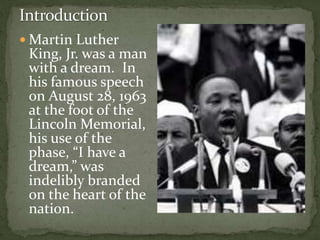
 Martin Luther
King, Jr. was a man
with a dream. In
his famous speech
on August 28, 1963
at the foot of the
Lincoln Memorial,
his use of the
phase, “I have a
dream,” was
indelibly branded
on the heart of the
nation.
 The nature of leadership presupposes
vision.
 Visionary leaders define the task, not
by what could be done, but by what
should be done.
 Then they develop effective strategies
to accomplish that vision.
 They often accomplish more than they
thought they would.
 Visionary leaders are growth-oriented
leaders in every context in which they lead.
Common visionary leaders include:
Entrepreneurs who see a product before it
exists.
College Presidents who see trends and
develop courses accordingly.
Church planters who see a church with
people no one else is reaching.
Pastors who see the possibility, even in a
declining church.
Visionary leaders face challenges:
 A world happy with status quo
 They are ahead of their time
 Dream bigger than people think
possible
 Initially find themselves standing
alone
 They often see the answers before
others see the question
The downside of visionary leaders:
 May take on a task beyond their baility and
flounder
 Dream too far ahead of the followers and
cause them to feel overwhelmed
 May struggle with their attitudes toward
followers
 Greatest danger is the tendency to pursue
the dream before they develop the strategy.
Paul has been described as the greatest
Christian leader of all time.
Why do you think some people have
that opinion of Paul?
Paul developed strategies still found
effective in missions today.
Paul developed and used strategy to
accomplish goals that grew out of his
vision.
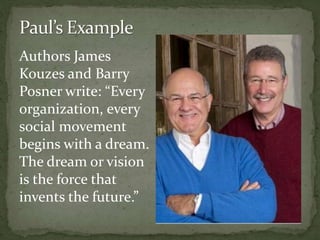
Authors James
Kouzes and Barry
Posner write: “Every
organization, every
social movement
begins with a dream.
The dream or vision
is the force that
invents the future.”
Paul’s strategy was two pronged:
 First, he believed the gospel was for
both Jew and Greek, saying that the
gospel “is the power of God to
salvation for everyone who believes,
for the Jew first and also for the
Greek” (Rom. 1:16). So he usually
started first by reaching out to the
Jewish people in various cities.
Paul’s strategy was two pronged:
 Second, he developed his unique
ministry to the Gentiles: “Inasmuch as
I am apostle to the Gentiles, I magnify
my ministry, if by any means I may
provoke to jealousy those who are my
flesh and save some of them” (Rom.
11:13-14).
Paul adapted the message (without
changing it) to the audience. When
speaking with Jews he had a common
point of reference with OT Scriptures.
However, when speaking to Gentiles he
had to find the common spiritual
connection through creation (Acts
17:24).
Paul also understood the principle of
reaching key people in communities.
This was God’s plan for Paul Who
described Paul as “a chosen vessel of
Mine to bear My name before Gentiles,
kings, and the children of Israel” (Acts
9:15a)
Another key was Paul’s geographic
strategy:
 He reached large centers as the base
of a broader regional ministry
 He established new churches in cities
that were regional centers with an
influence beyond their city bondaries.
Paul had a “bridge building” strategy to reach as
may diverse people as possible:
19 For though I am free from all men, I have made
myself a servant to all, that I might win the more;
20 and to the Jews I became as a Jew, that I might
win Jews; to those who are under the law, as under
the law, that I might win those who are under the
law; 21 to those who are without law, as without law
(not being without law toward God, but under law
toward Christ), that I might win those who are
without law; 22 to the weak I became as weak, that
I might win the weak. I have become all things to
all men, that I might by all means save some.
(1 Cor. 9:19-22, NKJV)
Paul developed a strategy to ensure that
all who were under his spiritual care
were taught the Scriptures. He told the
Ephesians, “I kept back nothing that
was helpful, but proclaimed it to you,
and taught you publicly and from house
to house, testifying to Jews, and also to
Greeks, repentance toward God and
faith toward our Lord Jesus Christ” (Acts
20:31)
Despite his commitment to developing
ministry strategies, Paul never allowed
his strategy to change or alter his
message in any way. He said, “For I
determined not to know anything
among you except Jesus Christ and Him
crucified” (1 Cor. 2:2)
Effective long-term leaders know how to
develop and implement a strategic plan.
There are essentially seven steps to
developing a strategic plan:
First, identify the goal you hope to
achieve in a clearly written goal
statement.
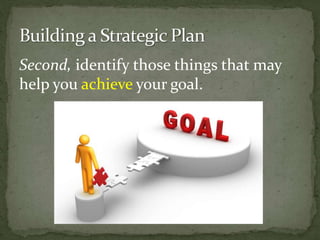
Second, identify those things that may
help you achieve your goal.
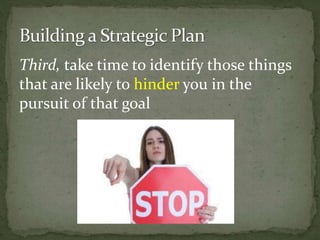
Third, take time to identify those things
that are likely to hinder you in the
pursuit of that goal
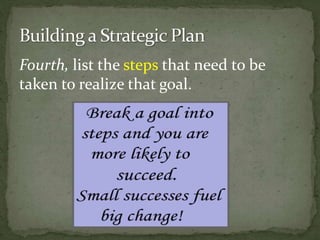
Fourth, list the steps that need to be
taken to realize that goal.
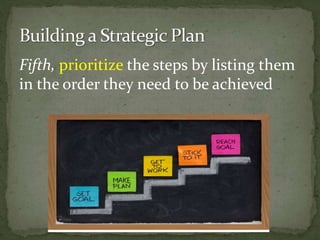
Fifth, prioritize the steps by listing them
in the order they need to be achieved
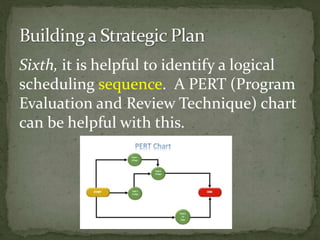
Sixth, it is helpful to identify a logical
scheduling sequence. A PERT (Program
Evaluation and Review Technique) chart
can be helpful with this.
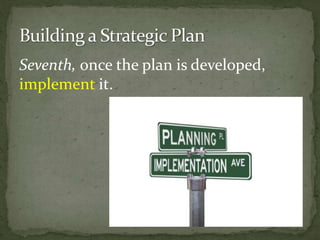
Seventh, once the plan is developed,
implement it.
Erica Olsen, COO and Co-Founder of OnStrategy HQ illustrates
the full strategic planning process in less than five minutes.

Chapter 23 Paul

  • 1.
    Case Studies inBiblical Leaders
  • 2.
     Martin Luther King,Jr. was a man with a dream. In his famous speech on August 28, 1963 at the foot of the Lincoln Memorial, his use of the phase, “I have a dream,” was indelibly branded on the heart of the nation.
  • 3.
     The natureof leadership presupposes vision.  Visionary leaders define the task, not by what could be done, but by what should be done.  Then they develop effective strategies to accomplish that vision.  They often accomplish more than they thought they would.
  • 4.
     Visionary leadersare growth-oriented leaders in every context in which they lead. Common visionary leaders include: Entrepreneurs who see a product before it exists. College Presidents who see trends and develop courses accordingly. Church planters who see a church with people no one else is reaching. Pastors who see the possibility, even in a declining church.
  • 5.
    Visionary leaders facechallenges:  A world happy with status quo  They are ahead of their time  Dream bigger than people think possible  Initially find themselves standing alone  They often see the answers before others see the question
  • 6.
    The downside ofvisionary leaders:  May take on a task beyond their baility and flounder  Dream too far ahead of the followers and cause them to feel overwhelmed  May struggle with their attitudes toward followers  Greatest danger is the tendency to pursue the dream before they develop the strategy.
  • 7.
    Paul has beendescribed as the greatest Christian leader of all time. Why do you think some people have that opinion of Paul? Paul developed strategies still found effective in missions today. Paul developed and used strategy to accomplish goals that grew out of his vision.
  • 8.
    Authors James Kouzes andBarry Posner write: “Every organization, every social movement begins with a dream. The dream or vision is the force that invents the future.”
  • 9.
    Paul’s strategy wastwo pronged:  First, he believed the gospel was for both Jew and Greek, saying that the gospel “is the power of God to salvation for everyone who believes, for the Jew first and also for the Greek” (Rom. 1:16). So he usually started first by reaching out to the Jewish people in various cities.
  • 10.
    Paul’s strategy wastwo pronged:  Second, he developed his unique ministry to the Gentiles: “Inasmuch as I am apostle to the Gentiles, I magnify my ministry, if by any means I may provoke to jealousy those who are my flesh and save some of them” (Rom. 11:13-14).
  • 11.
    Paul adapted themessage (without changing it) to the audience. When speaking with Jews he had a common point of reference with OT Scriptures. However, when speaking to Gentiles he had to find the common spiritual connection through creation (Acts 17:24).
  • 12.
    Paul also understoodthe principle of reaching key people in communities. This was God’s plan for Paul Who described Paul as “a chosen vessel of Mine to bear My name before Gentiles, kings, and the children of Israel” (Acts 9:15a)
  • 13.
    Another key wasPaul’s geographic strategy:  He reached large centers as the base of a broader regional ministry  He established new churches in cities that were regional centers with an influence beyond their city bondaries.
  • 14.
    Paul had a“bridge building” strategy to reach as may diverse people as possible: 19 For though I am free from all men, I have made myself a servant to all, that I might win the more; 20 and to the Jews I became as a Jew, that I might win Jews; to those who are under the law, as under the law, that I might win those who are under the law; 21 to those who are without law, as without law (not being without law toward God, but under law toward Christ), that I might win those who are without law; 22 to the weak I became as weak, that I might win the weak. I have become all things to all men, that I might by all means save some. (1 Cor. 9:19-22, NKJV)
  • 15.
    Paul developed astrategy to ensure that all who were under his spiritual care were taught the Scriptures. He told the Ephesians, “I kept back nothing that was helpful, but proclaimed it to you, and taught you publicly and from house to house, testifying to Jews, and also to Greeks, repentance toward God and faith toward our Lord Jesus Christ” (Acts 20:31)
  • 16.
    Despite his commitmentto developing ministry strategies, Paul never allowed his strategy to change or alter his message in any way. He said, “For I determined not to know anything among you except Jesus Christ and Him crucified” (1 Cor. 2:2)
  • 17.
    Effective long-term leadersknow how to develop and implement a strategic plan. There are essentially seven steps to developing a strategic plan: First, identify the goal you hope to achieve in a clearly written goal statement.
  • 18.
    Second, identify thosethings that may help you achieve your goal.
  • 19.
    Third, take timeto identify those things that are likely to hinder you in the pursuit of that goal
  • 20.
    Fourth, list thesteps that need to be taken to realize that goal.
  • 21.
    Fifth, prioritize thesteps by listing them in the order they need to be achieved
  • 22.
    Sixth, it ishelpful to identify a logical scheduling sequence. A PERT (Program Evaluation and Review Technique) chart can be helpful with this.
  • 23.
    Seventh, once theplan is developed, implement it.
  • 24.
    Erica Olsen, COOand Co-Founder of OnStrategy HQ illustrates the full strategic planning process in less than five minutes.