Slide © 2010 by Lovelock & Wirtz Services Marketing 7/e Chapter 4 – Page 1
Chapter 4:
Developing
Service Products:
Core and Supplementary
Elements
Services Marketing 7e, Global Edition
Slide © 2010 by Lovelock & Wirtz Services Marketing 7/e Chapter 4 – Page 2
Overview of Chapter 4
 Planning and Creating Services
 The Flower of Service
 Branding Service Products and Experiences
 New Service Development
Slide © 2010 by Lovelock & Wirtz Services Marketing 7/e Chapter 4 – Page 3
Planning and Creating
Service Products
Slide © 2010 by Lovelock & Wirtz Services Marketing 7/e Chapter 4 – Page 4
Service Products
A service product comprises of all elements of service performance,
both tangible and intangible, that create value for customers.
Service products consist of:
 Core Product  central component that supplies the principal,
problem-solving benefits customers seek
 Supplementary Services  augments the core product,
facilitating its use and enhancing its value and appeal
 Delivery Processes  used to deliver both the core product and
each of the supplementary services
Slide © 2010 by Lovelock & Wirtz Services Marketing 7/e Chapter 4 – Page 5
Designing a Service Concept
 Service concept design must address the following issues:
 How the different service components are delivered to the
customer
 The nature of the customer’s role in those processes
 How long delivery lasts
 The recommended level and style of service to be offered
Slide © 2010 by Lovelock & Wirtz Services Marketing 7/e Chapter 4 – Page 6
Documenting Delivery Sequence
Over Time
 Must address sequence in which customers will use each
core and supplementary service
 Determine approximate length of time required for each
step
 Information should reflect good understanding of
customers, especially their:
 needs
 habits
 expectations
Slide © 2010 by Lovelock & Wirtz Services Marketing 7/e Chapter 4 – Page 7
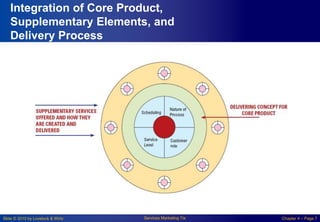
Integration of Core Product,
Supplementary Elements, and
Delivery Process
Slide © 2010 by Lovelock & Wirtz Services Marketing 7/e Chapter 4 – Page 8
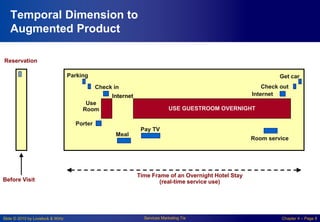
Temporal Dimension to
Augmented Product
Before Visit
Reservation
internet
Parking Get car
Check in
Porter
Use
Room
Meal
Pay TV
Room service
Internet
Check out
Time Frame of an Overnight Hotel Stay
(real-time service use)
USE GUESTROOM OVERNIGHT
Internet
Slide © 2010 by Lovelock & Wirtz Services Marketing 7/e Chapter 4 – Page 9
The Flower of Service
Slide © 2010 by Lovelock & Wirtz Services Marketing 7/e Chapter 4 – Page 10
The Flower of Service
 There are two types of supplementary services
 Facilitating: either needed for service delivery, or help in the use
of the core product
 Enhancing: add extra value for the customer
 In a well-managed service organization, the petals and
core are fresh and well-formed
 Market positioning strategy helps to determine which
supplementary services should be included
Slide © 2010 by Lovelock & Wirtz Services Marketing 7/e Chapter 4 – Page 11
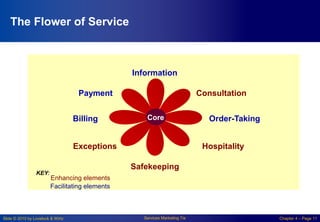
The Flower of Service
Core
Information
Consultation
Order-Taking
Hospitality
Payment
Billing
Exceptions
Safekeeping
Enhancing elements
Facilitating elements
KEY:
Slide © 2010 by Lovelock & Wirtz Services Marketing 7/e Chapter 4 – Page 12
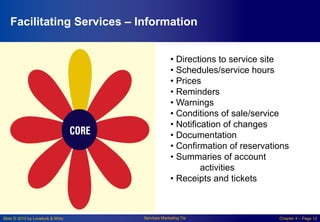
Facilitating Services – Information
• Directions to service site
• Schedules/service hours
• Prices
• Reminders
• Warnings
• Conditions of sale/service
• Notification of changes
• Documentation
• Confirmation of reservations
• Summaries of account
activities
• Receipts and tickets
Slide © 2010 by Lovelock & Wirtz Services Marketing 7/e Chapter 4 – Page 13
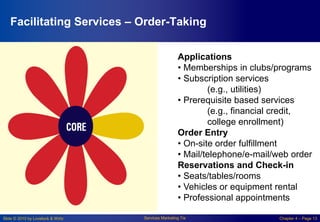
Facilitating Services – Order-Taking
Applications
• Memberships in clubs/programs
• Subscription services
(e.g., utilities)
• Prerequisite based services
(e.g., financial credit,
college enrollment)
Order Entry
• On-site order fulfillment
• Mail/telephone/e-mail/web order
Reservations and Check-in
• Seats/tables/rooms
• Vehicles or equipment rental
• Professional appointments
Slide © 2010 by Lovelock & Wirtz Services Marketing 7/e Chapter 4 – Page 14
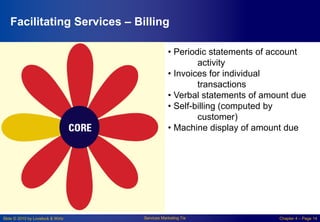
Facilitating Services – Billing
• Periodic statements of account
activity
• Invoices for individual
transactions
• Verbal statements of amount due
• Self-billing (computed by
customer)
• Machine display of amount due
Slide © 2010 by Lovelock & Wirtz Services Marketing 7/e Chapter 4 – Page 15
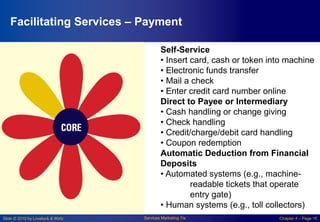
Facilitating Services – Payment
Self-Service
• Insert card, cash or token into machine
• Electronic funds transfer
• Mail a check
• Enter credit card number online
Direct to Payee or Intermediary
• Cash handling or change giving
• Check handling
• Credit/charge/debit card handling
• Coupon redemption
Automatic Deduction from Financial
Deposits
• Automated systems (e.g., machine-
readable tickets that operate
entry gate)
• Human systems (e.g., toll collectors)
Slide © 2010 by Lovelock & Wirtz Services Marketing 7/e Chapter 4 – Page 16
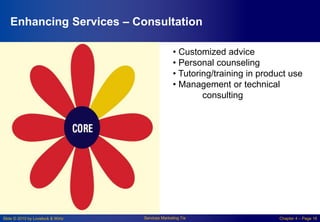
Enhancing Services – Consultation
• Customized advice
• Personal counseling
• Tutoring/training in product use
• Management or technical
consulting
Slide © 2010 by Lovelock & Wirtz Services Marketing 7/e Chapter 4 – Page 17
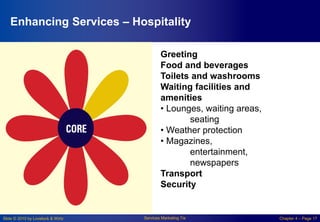
Enhancing Services – Hospitality
Greeting
Food and beverages
Toilets and washrooms
Waiting facilities and
amenities
• Lounges, waiting areas,
seating
• Weather protection
• Magazines,
entertainment,
newspapers
Transport
Security
Slide © 2010 by Lovelock & Wirtz Services Marketing 7/e Chapter 4 – Page 18
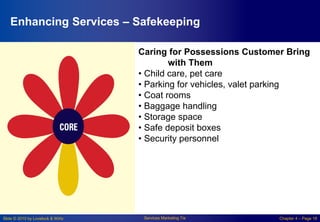
Enhancing Services – Safekeeping
Caring for Possessions Customer Bring
with Them
• Child care, pet care
• Parking for vehicles, valet parking
• Coat rooms
• Baggage handling
• Storage space
• Safe deposit boxes
• Security personnel
Slide © 2010 by Lovelock & Wirtz Services Marketing 7/e Chapter 4 – Page 19
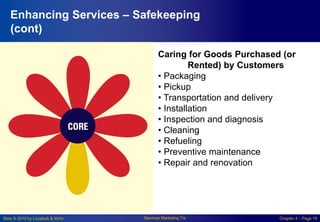
Enhancing Services – Safekeeping
(cont)
Caring for Goods Purchased (or
Rented) by Customers
• Packaging
• Pickup
• Transportation and delivery
• Installation
• Inspection and diagnosis
• Cleaning
• Refueling
• Preventive maintenance
• Repair and renovation
Slide © 2010 by Lovelock & Wirtz Services Marketing 7/e Chapter 4 – Page 20
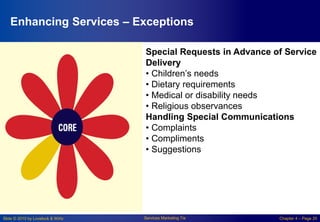
Enhancing Services – Exceptions
Special Requests in Advance of Service
Delivery
• Children’s needs
• Dietary requirements
• Medical or disability needs
• Religious observances
Handling Special Communications
• Complaints
• Compliments
• Suggestions
Slide © 2010 by Lovelock & Wirtz Services Marketing 7/e Chapter 4 – Page 21
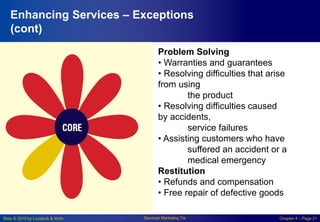
Enhancing Services – Exceptions
(cont)
Problem Solving
• Warranties and guarantees
• Resolving difficulties that arise
from using
the product
• Resolving difficulties caused
by accidents,
service failures
• Assisting customers who have
suffered an accident or a
medical emergency
Restitution
• Refunds and compensation
• Free repair of defective goods
Slide © 2010 by Lovelock & Wirtz Services Marketing 7/e Chapter 4 – Page 22
Managerial Implications
 Core products do not have to have supplementary elements
 Nature of product helps determine supplementary services
offered to enhance value
 People-processing and high contact services have more
supplementary services
 Different levels of service can add extra supplementary services
for each upgrade in service level
 Low-cost, no-frills basis firms needs fewer supplementary
elements
Slide © 2010 by Lovelock & Wirtz Services Marketing 7/e Chapter 4 – Page 23
Branding Service
Products and Experiences
Slide © 2010 by Lovelock & Wirtz Services Marketing 7/e Chapter 4 – Page 24
Service Products, Product Lines,
and Brands
 Service Product: A defined and consistent “bundle of output”
 Supported by supplementary services (assembly of elements that are built
around the core product)
 Differentiated by bundle of output
 Product Line: Most service organizations offer a line of products
rather than just a single product.
 There are three broad alternatives for product lines:
 Single brand to cover all products and services
 A separate, stand-alone brand for each offering
 Some combination of these two extremes
Slide © 2010 by Lovelock & Wirtz Services Marketing 7/e Chapter 4 – Page 25
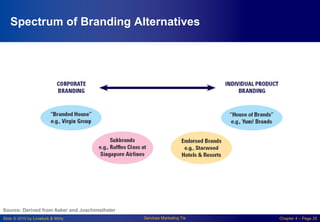
Spectrum of Branding Alternatives
Source: Derived from Aaker and Joachimsthaler
Slide © 2010 by Lovelock & Wirtz Services Marketing 7/e Chapter 4 – Page 26
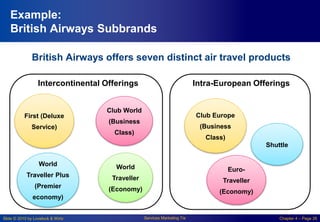
Example:
British Airways Subbrands
British Airways offers seven distinct air travel products
Intercontinental Offerings Intra-European Offerings
First (Deluxe
Service)
Club World
(Business
Class)
World
Traveller Plus
(Premier
economy)
World
Traveller
(Economy)
Club Europe
(Business
Class)
Euro-
Traveller
(Economy)
Shuttle
Slide © 2010 by Lovelock & Wirtz Services Marketing 7/e Chapter 4 – Page 27
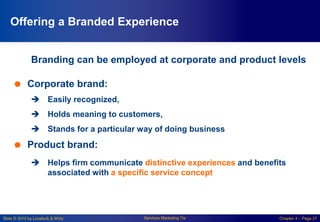
Offering a Branded Experience
Branding can be employed at corporate and product levels
 Corporate brand:
 Easily recognized,
 Holds meaning to customers,
 Stands for a particular way of doing business
 Product brand:
 Helps firm communicate distinctive experiences and benefits
associated with a specific service concept
Slide © 2010 by Lovelock & Wirtz Services Marketing 7/e Chapter 4 – Page 28
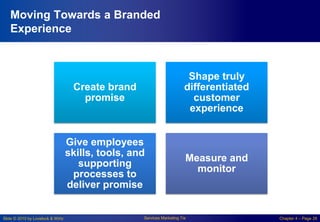
Moving Towards a Branded
Experience
Create brand
promise
Shape truly
differentiated
customer
experience
Give employees
skills, tools, and
supporting
processes to
deliver promise
Measure and
monitor
Slide © 2010 by Lovelock & Wirtz Services Marketing 7/e Chapter 4 – Page 29
Offering A Branded Experience
“The brand promise or value proposition is not a tag line, an
icon, or a color or a graphic element, although all of these
may contribute.
It is, instead, the heart and soul of the brand.”
Don Schultz
Slide © 2010 by Lovelock & Wirtz Services Marketing 7/e Chapter 4 – Page 30
New Service Development
Slide © 2010 by Lovelock & Wirtz Services Marketing 7/e Chapter 4 – Page 31
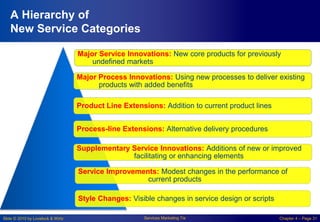
A Hierarchy of
New Service Categories
Major Service Innovations: New core products for previously
undefined markets
Major Process Innovations: Using new processes to deliver existing
products with added benefits
Product Line Extensions: Addition to current product lines
Process-line Extensions: Alternative delivery procedures
Supplementary Service Innovations: Additions of new or improved
facilitating or enhancing elements
Service Improvements: Modest changes in the performance of
current products
Style Changes: Visible changes in service design or scripts
Slide © 2010 by Lovelock & Wirtz Services Marketing 7/e Chapter 4 – Page 32
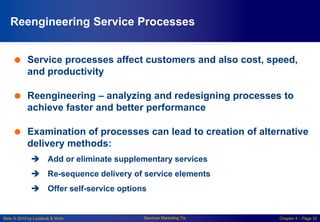
Reengineering Service Processes
 Service processes affect customers and also cost, speed,
and productivity
 Reengineering – analyzing and redesigning processes to
achieve faster and better performance
 Examination of processes can lead to creation of alternative
delivery methods:
 Add or eliminate supplementary services
 Re-sequence delivery of service elements
 Offer self-service options
Slide © 2010 by Lovelock & Wirtz Services Marketing 7/e Chapter 4 – Page 33
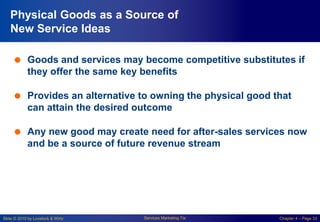
Physical Goods as a Source of
New Service Ideas
 Goods and services may become competitive substitutes if
they offer the same key benefits
 Provides an alternative to owning the physical good that
can attain the desired outcome
 Any new good may create need for after-sales services now
and be a source of future revenue stream
Slide © 2010 by Lovelock & Wirtz Services Marketing 7/e Chapter 4 – Page 34
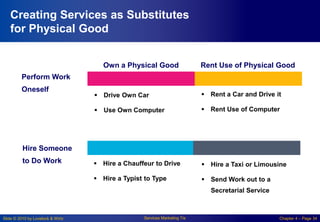
Creating Services as Substitutes
for Physical Good
 Drive Own Car
 Use Own Computer
 Rent a Car and Drive it
 Rent Use of Computer
 Hire a Chauffeur to Drive
 Hire a Typist to Type
 Hire a Taxi or Limousine
 Send Work out to a
Secretarial Service
Own a Physical Good Rent Use of Physical Good
Perform Work
Oneself
Hire Someone
to Do Work
Slide © 2010 by Lovelock & Wirtz Services Marketing 7/e Chapter 4 – Page 35
Achieving Success in Developing
New Services
 Services are not immune to high failure rates that plague
new manufactured products
 In developing new services:
 core product is often of secondary importance, many innovations
are in supplementary services or service delivery
 ability to maintain quality of the total service offering is key
 accompanying marketing support activities are vital
 Market knowledge is of utmost importance
Slide © 2010 by Lovelock & Wirtz Services Marketing 7/e Chapter 4 – Page 36
Success Factors in
New Service Development
 Market synergy
 Good fit between new product and firm’s image
 Advantage in meeting customers’ needs
 Strong support from firm during and after launch
 Understands customer purchase decision behavior
 Organizational factors
 Strong inter-functional cooperation and coordination
 Internal marketing to educate staff on new product and its
importance
Slide © 2010 by Lovelock & Wirtz Services Marketing 7/e Chapter 4 – Page 37
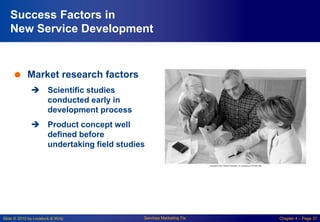
Success Factors in
New Service Development
 Market research factors
 Scientific studies
conducted early in
development process
 Product concept well
defined before
undertaking field studies
Slide © 2010 by Lovelock & Wirtz Services Marketing 7/e Chapter 4 – Page 38
Summary
 Creating services involve:
 Designing the core product, supplementary services, and their
delivery processes
 Flower of service includes core product and two types of
supplementary services: facilitating and enhancing
 Facilitating services include information, order taking, billing, and
payment
 Enhancing services include consultation, hospitality, safekeeping,
and exceptions
Slide © 2010 by Lovelock & Wirtz Services Marketing 7/e Chapter 4 – Page 39
Summary
 Spectrum of branding alternatives exists for services
 Branded house
 Subbrands
 Endorsed brands
 House of brands
 To develop new services, we can
 Reengineer service processes
 Use physical goods as a source of new service ideas
 Use research to design new services
 Understand how to achieve success in new service development

sm7_ch04_product_ge.ppt organization value

  • 1.
    Slide © 2010by Lovelock & Wirtz Services Marketing 7/e Chapter 4 – Page 1 Chapter 4: Developing Service Products: Core and Supplementary Elements Services Marketing 7e, Global Edition
  • 2.
    Slide © 2010by Lovelock & Wirtz Services Marketing 7/e Chapter 4 – Page 2 Overview of Chapter 4  Planning and Creating Services  The Flower of Service  Branding Service Products and Experiences  New Service Development
  • 3.
    Slide © 2010by Lovelock & Wirtz Services Marketing 7/e Chapter 4 – Page 3 Planning and Creating Service Products
  • 4.
    Slide © 2010by Lovelock & Wirtz Services Marketing 7/e Chapter 4 – Page 4 Service Products A service product comprises of all elements of service performance, both tangible and intangible, that create value for customers. Service products consist of:  Core Product  central component that supplies the principal, problem-solving benefits customers seek  Supplementary Services  augments the core product, facilitating its use and enhancing its value and appeal  Delivery Processes  used to deliver both the core product and each of the supplementary services
  • 5.
    Slide © 2010by Lovelock & Wirtz Services Marketing 7/e Chapter 4 – Page 5 Designing a Service Concept  Service concept design must address the following issues:  How the different service components are delivered to the customer  The nature of the customer’s role in those processes  How long delivery lasts  The recommended level and style of service to be offered
  • 6.
    Slide © 2010by Lovelock & Wirtz Services Marketing 7/e Chapter 4 – Page 6 Documenting Delivery Sequence Over Time  Must address sequence in which customers will use each core and supplementary service  Determine approximate length of time required for each step  Information should reflect good understanding of customers, especially their:  needs  habits  expectations
  • 7.
    Slide © 2010by Lovelock & Wirtz Services Marketing 7/e Chapter 4 – Page 7 Integration of Core Product, Supplementary Elements, and Delivery Process
  • 8.
    Slide © 2010by Lovelock & Wirtz Services Marketing 7/e Chapter 4 – Page 8 Temporal Dimension to Augmented Product Before Visit Reservation internet Parking Get car Check in Porter Use Room Meal Pay TV Room service Internet Check out Time Frame of an Overnight Hotel Stay (real-time service use) USE GUESTROOM OVERNIGHT Internet
  • 9.
    Slide © 2010by Lovelock & Wirtz Services Marketing 7/e Chapter 4 – Page 9 The Flower of Service
  • 10.
    Slide © 2010by Lovelock & Wirtz Services Marketing 7/e Chapter 4 – Page 10 The Flower of Service  There are two types of supplementary services  Facilitating: either needed for service delivery, or help in the use of the core product  Enhancing: add extra value for the customer  In a well-managed service organization, the petals and core are fresh and well-formed  Market positioning strategy helps to determine which supplementary services should be included
  • 11.
    Slide © 2010by Lovelock & Wirtz Services Marketing 7/e Chapter 4 – Page 11 The Flower of Service Core Information Consultation Order-Taking Hospitality Payment Billing Exceptions Safekeeping Enhancing elements Facilitating elements KEY:
  • 12.
    Slide © 2010by Lovelock & Wirtz Services Marketing 7/e Chapter 4 – Page 12 Facilitating Services – Information • Directions to service site • Schedules/service hours • Prices • Reminders • Warnings • Conditions of sale/service • Notification of changes • Documentation • Confirmation of reservations • Summaries of account activities • Receipts and tickets
  • 13.
    Slide © 2010by Lovelock & Wirtz Services Marketing 7/e Chapter 4 – Page 13 Facilitating Services – Order-Taking Applications • Memberships in clubs/programs • Subscription services (e.g., utilities) • Prerequisite based services (e.g., financial credit, college enrollment) Order Entry • On-site order fulfillment • Mail/telephone/e-mail/web order Reservations and Check-in • Seats/tables/rooms • Vehicles or equipment rental • Professional appointments
  • 14.
    Slide © 2010by Lovelock & Wirtz Services Marketing 7/e Chapter 4 – Page 14 Facilitating Services – Billing • Periodic statements of account activity • Invoices for individual transactions • Verbal statements of amount due • Self-billing (computed by customer) • Machine display of amount due
  • 15.
    Slide © 2010by Lovelock & Wirtz Services Marketing 7/e Chapter 4 – Page 15 Facilitating Services – Payment Self-Service • Insert card, cash or token into machine • Electronic funds transfer • Mail a check • Enter credit card number online Direct to Payee or Intermediary • Cash handling or change giving • Check handling • Credit/charge/debit card handling • Coupon redemption Automatic Deduction from Financial Deposits • Automated systems (e.g., machine- readable tickets that operate entry gate) • Human systems (e.g., toll collectors)
  • 16.
    Slide © 2010by Lovelock & Wirtz Services Marketing 7/e Chapter 4 – Page 16 Enhancing Services – Consultation • Customized advice • Personal counseling • Tutoring/training in product use • Management or technical consulting
  • 17.
    Slide © 2010by Lovelock & Wirtz Services Marketing 7/e Chapter 4 – Page 17 Enhancing Services – Hospitality Greeting Food and beverages Toilets and washrooms Waiting facilities and amenities • Lounges, waiting areas, seating • Weather protection • Magazines, entertainment, newspapers Transport Security
  • 18.
    Slide © 2010by Lovelock & Wirtz Services Marketing 7/e Chapter 4 – Page 18 Enhancing Services – Safekeeping Caring for Possessions Customer Bring with Them • Child care, pet care • Parking for vehicles, valet parking • Coat rooms • Baggage handling • Storage space • Safe deposit boxes • Security personnel
  • 19.
    Slide © 2010by Lovelock & Wirtz Services Marketing 7/e Chapter 4 – Page 19 Enhancing Services – Safekeeping (cont) Caring for Goods Purchased (or Rented) by Customers • Packaging • Pickup • Transportation and delivery • Installation • Inspection and diagnosis • Cleaning • Refueling • Preventive maintenance • Repair and renovation
  • 20.
    Slide © 2010by Lovelock & Wirtz Services Marketing 7/e Chapter 4 – Page 20 Enhancing Services – Exceptions Special Requests in Advance of Service Delivery • Children’s needs • Dietary requirements • Medical or disability needs • Religious observances Handling Special Communications • Complaints • Compliments • Suggestions
  • 21.
    Slide © 2010by Lovelock & Wirtz Services Marketing 7/e Chapter 4 – Page 21 Enhancing Services – Exceptions (cont) Problem Solving • Warranties and guarantees • Resolving difficulties that arise from using the product • Resolving difficulties caused by accidents, service failures • Assisting customers who have suffered an accident or a medical emergency Restitution • Refunds and compensation • Free repair of defective goods
  • 22.
    Slide © 2010by Lovelock & Wirtz Services Marketing 7/e Chapter 4 – Page 22 Managerial Implications  Core products do not have to have supplementary elements  Nature of product helps determine supplementary services offered to enhance value  People-processing and high contact services have more supplementary services  Different levels of service can add extra supplementary services for each upgrade in service level  Low-cost, no-frills basis firms needs fewer supplementary elements
  • 23.
    Slide © 2010by Lovelock & Wirtz Services Marketing 7/e Chapter 4 – Page 23 Branding Service Products and Experiences
  • 24.
    Slide © 2010by Lovelock & Wirtz Services Marketing 7/e Chapter 4 – Page 24 Service Products, Product Lines, and Brands  Service Product: A defined and consistent “bundle of output”  Supported by supplementary services (assembly of elements that are built around the core product)  Differentiated by bundle of output  Product Line: Most service organizations offer a line of products rather than just a single product.  There are three broad alternatives for product lines:  Single brand to cover all products and services  A separate, stand-alone brand for each offering  Some combination of these two extremes
  • 25.
    Slide © 2010by Lovelock & Wirtz Services Marketing 7/e Chapter 4 – Page 25 Spectrum of Branding Alternatives Source: Derived from Aaker and Joachimsthaler
  • 26.
    Slide © 2010by Lovelock & Wirtz Services Marketing 7/e Chapter 4 – Page 26 Example: British Airways Subbrands British Airways offers seven distinct air travel products Intercontinental Offerings Intra-European Offerings First (Deluxe Service) Club World (Business Class) World Traveller Plus (Premier economy) World Traveller (Economy) Club Europe (Business Class) Euro- Traveller (Economy) Shuttle
  • 27.
    Slide © 2010by Lovelock & Wirtz Services Marketing 7/e Chapter 4 – Page 27 Offering a Branded Experience Branding can be employed at corporate and product levels  Corporate brand:  Easily recognized,  Holds meaning to customers,  Stands for a particular way of doing business  Product brand:  Helps firm communicate distinctive experiences and benefits associated with a specific service concept
  • 28.
    Slide © 2010by Lovelock & Wirtz Services Marketing 7/e Chapter 4 – Page 28 Moving Towards a Branded Experience Create brand promise Shape truly differentiated customer experience Give employees skills, tools, and supporting processes to deliver promise Measure and monitor
  • 29.
    Slide © 2010by Lovelock & Wirtz Services Marketing 7/e Chapter 4 – Page 29 Offering A Branded Experience “The brand promise or value proposition is not a tag line, an icon, or a color or a graphic element, although all of these may contribute. It is, instead, the heart and soul of the brand.” Don Schultz
  • 30.
    Slide © 2010by Lovelock & Wirtz Services Marketing 7/e Chapter 4 – Page 30 New Service Development
  • 31.
    Slide © 2010by Lovelock & Wirtz Services Marketing 7/e Chapter 4 – Page 31 A Hierarchy of New Service Categories Major Service Innovations: New core products for previously undefined markets Major Process Innovations: Using new processes to deliver existing products with added benefits Product Line Extensions: Addition to current product lines Process-line Extensions: Alternative delivery procedures Supplementary Service Innovations: Additions of new or improved facilitating or enhancing elements Service Improvements: Modest changes in the performance of current products Style Changes: Visible changes in service design or scripts
  • 32.
    Slide © 2010by Lovelock & Wirtz Services Marketing 7/e Chapter 4 – Page 32 Reengineering Service Processes  Service processes affect customers and also cost, speed, and productivity  Reengineering – analyzing and redesigning processes to achieve faster and better performance  Examination of processes can lead to creation of alternative delivery methods:  Add or eliminate supplementary services  Re-sequence delivery of service elements  Offer self-service options
  • 33.
    Slide © 2010by Lovelock & Wirtz Services Marketing 7/e Chapter 4 – Page 33 Physical Goods as a Source of New Service Ideas  Goods and services may become competitive substitutes if they offer the same key benefits  Provides an alternative to owning the physical good that can attain the desired outcome  Any new good may create need for after-sales services now and be a source of future revenue stream
  • 34.
    Slide © 2010by Lovelock & Wirtz Services Marketing 7/e Chapter 4 – Page 34 Creating Services as Substitutes for Physical Good  Drive Own Car  Use Own Computer  Rent a Car and Drive it  Rent Use of Computer  Hire a Chauffeur to Drive  Hire a Typist to Type  Hire a Taxi or Limousine  Send Work out to a Secretarial Service Own a Physical Good Rent Use of Physical Good Perform Work Oneself Hire Someone to Do Work
  • 35.
    Slide © 2010by Lovelock & Wirtz Services Marketing 7/e Chapter 4 – Page 35 Achieving Success in Developing New Services  Services are not immune to high failure rates that plague new manufactured products  In developing new services:  core product is often of secondary importance, many innovations are in supplementary services or service delivery  ability to maintain quality of the total service offering is key  accompanying marketing support activities are vital  Market knowledge is of utmost importance
  • 36.
    Slide © 2010by Lovelock & Wirtz Services Marketing 7/e Chapter 4 – Page 36 Success Factors in New Service Development  Market synergy  Good fit between new product and firm’s image  Advantage in meeting customers’ needs  Strong support from firm during and after launch  Understands customer purchase decision behavior  Organizational factors  Strong inter-functional cooperation and coordination  Internal marketing to educate staff on new product and its importance
  • 37.
    Slide © 2010by Lovelock & Wirtz Services Marketing 7/e Chapter 4 – Page 37 Success Factors in New Service Development  Market research factors  Scientific studies conducted early in development process  Product concept well defined before undertaking field studies
  • 38.
    Slide © 2010by Lovelock & Wirtz Services Marketing 7/e Chapter 4 – Page 38 Summary  Creating services involve:  Designing the core product, supplementary services, and their delivery processes  Flower of service includes core product and two types of supplementary services: facilitating and enhancing  Facilitating services include information, order taking, billing, and payment  Enhancing services include consultation, hospitality, safekeeping, and exceptions
  • 39.
    Slide © 2010by Lovelock & Wirtz Services Marketing 7/e Chapter 4 – Page 39 Summary  Spectrum of branding alternatives exists for services  Branded house  Subbrands  Endorsed brands  House of brands  To develop new services, we can  Reengineer service processes  Use physical goods as a source of new service ideas  Use research to design new services  Understand how to achieve success in new service development