Chapter 2: Lecture 5 
Application Layer 
2: Application Layer 1
Chapter 2: Application layer 
2: Application Layer 2 
 2.1 Principles of 
network applications 
 2.2 Web and HTTP 
 2.3 FTP 
 2.4 Electronic Mail 
 SMTP, POP3, IMAP 
 2.5 DNS 
 2.6 P2P applications 
 2.7 Socket programming 
with TCP 
 2.8 Socket programming 
with UDP
2: Application Layer 3 
Some network apps 
 e-mail 
 web 
 instant messaging 
 remote login 
 P2P file sharing 
 multi-user network 
games 
 streaming stored video 
clips 
 voice over IP 
 real-time video 
conferencing 
 grid computing
2: Application Layer 4 
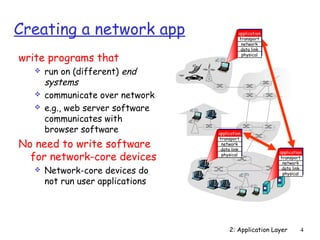
Creating a network app 
write programs that 
 run on (different) end 
systems 
 communicate over network 
 e.g., web server software 
communicates with 
browser software 
No need to write software 
for network-core devices 
 Network-core devices do 
not run user applications 
application 
transport 
network 
data link 
physical 
application 
transport 
network 
data link 
physical 
application 
transport 
network 
data link 
physical
Chapter 2: Application layer 
2: Application Layer 5 
 2.1 Principles of 
network applications 
 2.2 Web and HTTP 
 2.3 FTP 
 2.4 Electronic Mail 
 SMTP, POP3, IMAP 
 2.5 DNS 
 2.6 P2P applications 
 2.7 Socket programming 
with TCP 
 2.8 Socket programming 
with UDP 
 2.9 Building a Web 
server
Application architectures 
2: Application Layer 6 
 Client-server 
 Peer-to-peer (P2P) 
 Hybrid of client-server and P2P
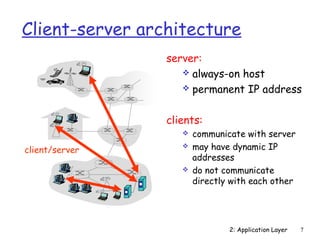
Client-server architecture 
2: Application Layer 7 
server: 
 always-on host 
 permanent IP address 
clients: 
 communicate with server 
 may have dynamic IP 
addresses 
 do not communicate 
directly with each other 
client/server
2: Application Layer 8 
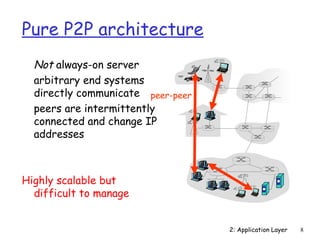
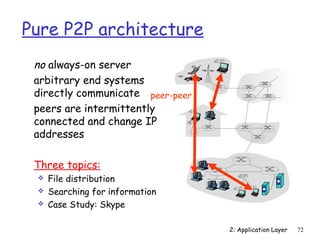
Pure P2P architecture 
 Not always-on server 
 arbitrary end systems 
directly communicate 
 peers are intermittently 
connected and change IP 
addresses 
Highly scalable but 
difficult to manage 
peer-peer
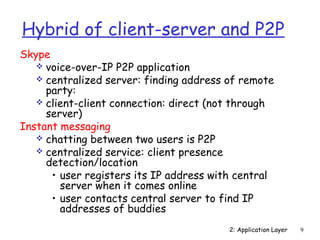
Hybrid of client-server and P2P 
Skype 
 voice-over-IP P2P application 
 centralized server: finding address of remote 
party: 
 client-client connection: direct (not through 
server) 
2: Application Layer 9 
Instant messaging 
 chatting between two users is P2P 
 centralized service: client presence 
detection/location 
• user registers its IP address with central 
server when it comes online 
• user contacts central server to find IP 
addresses of buddies
2: Application Layer 10 
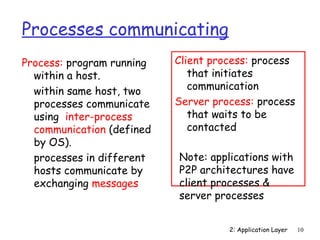
Processes communicating 
Process: program running 
within a host. 
 within same host, two 
processes communicate 
using inter-process 
communication (defined 
by OS). 
 processes in different 
hosts communicate by 
exchanging messages 
Client process: process 
that initiates 
communication 
Server process: process 
that waits to be 
contacted 
 Note: applications with 
P2P architectures have 
client processes  
server processes
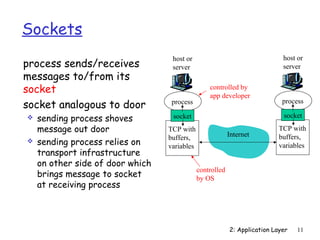
host or 
server 
socket 
controlled by 
app developer 
2: Application Layer 11 
Sockets 
 process sends/receives 
messages to/from its 
socket 
 socket analogous to door 
 sending process shoves 
message out door 
 sending process relies on 
transport infrastructure 
on other side of door which 
brings message to socket 
at receiving process 
host or 
server 
process 
socket 
TCP with 
buffers, 
variables 
process 
TCP with 
buffers, 
variables 
Internet 
controlled 
by OS
2: Application Layer 12 
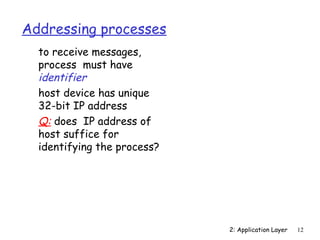
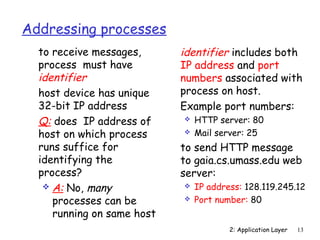
Addressing processes 
 to receive messages, 
process must have 
identifier 
 host device has unique 
32-bit IP address 
 Q: does IP address of 
host suffice for 
identifying the process?
2: Application Layer 13 
Addressing processes 
 to receive messages, 
process must have 
identifier 
 host device has unique 
32-bit IP address 
 Q: does IP address of 
host on which process 
runs suffice for 
identifying the 
process? 
A: No, many 
processes can be 
running on same host 
 identifier includes both 
IP address and port 
numbers associated with 
process on host. 
 Example port numbers: 
 HTTP server: 80 
 Mail server: 25 
 to send HTTP message 
to gaia.cs.umass.edu web 
server: 
 IP address: 128.119.245.12 
 Port number: 80
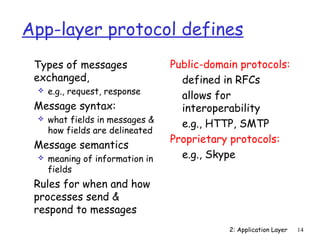
App-layer protocol defines 
2: Application Layer 14 
 Types of messages 
exchanged, 
 e.g., request, response 
 Message syntax: 
 what fields in messages  
how fields are delineated 
 Message semantics 
 meaning of information in 
fields 
 Rules for when and how 
processes send  
respond to messages 
Public-domain protocols: 
 defined in RFCs 
 allows for 
interoperability 
 e.g., HTTP, SMTP 
Proprietary protocols: 
 e.g., Skype
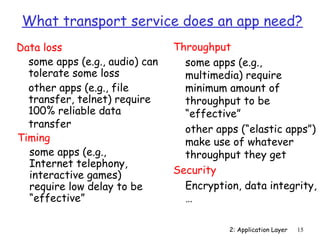
What transport service does an app need? 
Data loss 
 some apps (e.g., audio) can 
tolerate some loss 
 other apps (e.g., file 
transfer, telnet) require 
100% reliable data 
transfer 
Timing 
 some apps (e.g., 
Internet telephony, 
interactive games) 
require low delay to be 
“effective” 
Throughput 
 some apps (e.g., 
multimedia) require 
minimum amount of 
throughput to be 
“effective” 
 other apps (“elastic apps”) 
make use of whatever 
throughput they get 
Security 
 Encryption, data integrity, 
… 
2: Application Layer 15
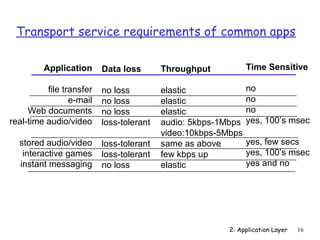
Transport service requirements of common apps 
2: Application Layer 16 
Application 
file transfer 
e-mail 
Web documents 
real-time audio/video 
stored audio/video 
interactive games 
instant messaging 
Data loss 
no loss 
no loss 
no loss 
loss-tolerant 
loss-tolerant 
loss-tolerant 
no loss 
Throughput 
elastic 
elastic 
elastic 
audio: 5kbps-1Mbps 
video:10kbps-5Mbps 
same as above 
few kbps up 
elastic 
Time Sensitive 
no 
no 
no 
yes, 100’s msec 
yes, few secs 
yes, 100’s msec 
yes and no
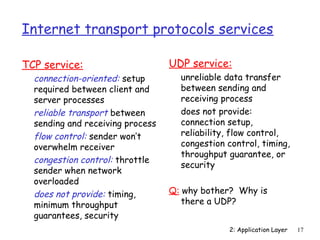
Internet transport protocols services 
2: Application Layer 17 
TCP service: 
 connection-oriented: setup 
required between client and 
server processes 
 reliable transport between 
sending and receiving process 
 flow control: sender won’t 
overwhelm receiver 
 congestion control: throttle 
sender when network 
overloaded 
 does not provide: timing, 
minimum throughput 
guarantees, security 
UDP service: 
 unreliable data transfer 
between sending and 
receiving process 
 does not provide: 
connection setup, 
reliability, flow control, 
congestion control, timing, 
throughput guarantee, or 
security 
Q: why bother? Why is 
there a UDP?
Internet apps: application, transport protocols 
2: Application Layer 18 
Application 
e-mail 
remote terminal access 
Web 
file transfer 
streaming multimedia 
Internet telephony 
Application 
layer protocol 
SMTP [RFC 2821] 
Telnet [RFC 854] 
HTTP [RFC 2616] 
FTP [RFC 959] 
HTTP (eg Youtube), 
RTP [RFC 1889] 
SIP, RTP, proprietary 
(e.g., Skype) 
Underlying 
transport protocol 
TCP 
TCP 
TCP 
TCP 
TCP or UDP 
typically UDP
Chapter 2: Application layer 
2: Application Layer 19 
 2.1 Principles of 
network applications 
 app architectures 
 app requirements 
 2.2 Web and HTTP 
 2.4 Electronic Mail 
 SMTP, POP3, IMAP 
 2.5 DNS 
 2.6 P2P applications 
 2.7 Socket programming 
with TCP 
 2.8 Socket programming 
with UDP
2: Application Layer 20 
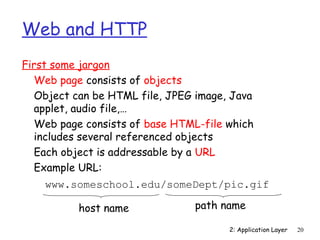
Web and HTTP 
First some jargon 
 Web page consists of objects 
 Object can be HTML file, JPEG image, Java 
applet, audio file,… 
 Web page consists of base HTML-file which 
includes several referenced objects 
 Each object is addressable by a URL 
 Example URL: 
www.someschool.edu/someDept/pic.gif 
host name path name
HTTP response 
2: Application Layer 21 
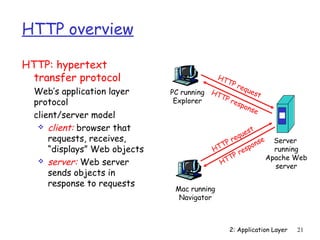
HTTP overview 
HTTP: hypertext 
transfer protocol 
 Web’s application layer 
protocol 
 client/server model 
 client: browser that 
requests, receives, 
“displays” Web objects 
 server: Web server 
sends objects in 
response to requests 
PC running 
Explorer 
Server 
running 
Apache Web 
server 
Mac running 
Navigator 
HTTP request 
HTTP request 
HTTP response
HTTP overview (continued) 
aside 
2: Application Layer 22 
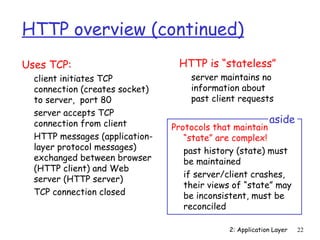
Uses TCP: 
 client initiates TCP 
connection (creates socket) 
to server, port 80 
 server accepts TCP 
connection from client 
 HTTP messages (application-layer 
protocol messages) 
exchanged between browser 
(HTTP client) and Web 
server (HTTP server) 
 TCP connection closed 
HTTP is “stateless” 
 server maintains no 
information about 
past client requests 
Protocols that maintain 
“state” are complex! 
 past history (state) must 
be maintained 
 if server/client crashes, 
their views of “state” may 
be inconsistent, must be 
reconciled
2: Application Layer 23 
HTTP connections 
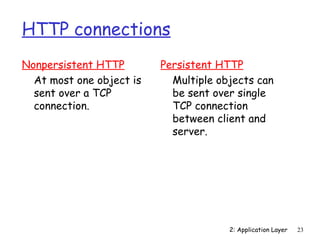
Nonpersistent HTTP 
 At most one object is 
sent over a TCP 
connection. 
Persistent HTTP 
 Multiple objects can 
be sent over single 
TCP connection 
between client and 
server.
2: Application Layer 24 
Nonpersistent HTTP 
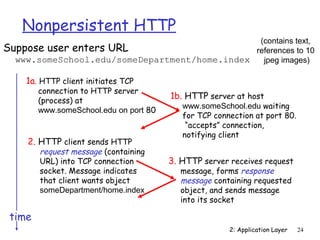
Suppose user enters URL 
www.someSchool.edu/someDepartment/home.index 
1a. HTTP client initiates TCP 
connection to HTTP server 
(process) at 
www.someSchool.edu on port 80 
2. HTTP client sends HTTP 
request message (containing 
URL) into TCP connection 
socket. Message indicates 
that client wants object 
someDepartment/home.index 
1b. HTTP server at host 
www.someSchool.edu waiting 
for TCP connection at port 80. 
“accepts” connection, 
notifying client 
3. HTTP server receives request 
message, forms response 
message containing requested 
object, and sends message 
into its socket 
time 
(contains text, 
references to 10 
jpeg images)
2: Application Layer 25 
Nonpersistent HTTP (cont.) 
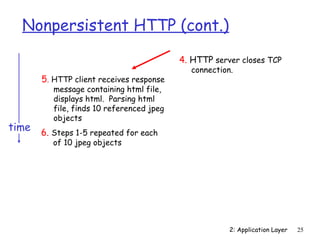
5. HTTP client receives response 
message containing html file, 
displays html. Parsing html 
file, finds 10 referenced jpeg 
objects 
6. Steps 1-5 repeated for each 
of 10 jpeg objects 
4. HTTP server closes TCP 
connection. 
time
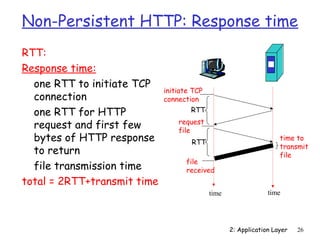
Non-Persistent HTTP: Response time 
RTT: 
Response time: 
 one RTT to initiate TCP 
connection 
 one RTT for HTTP 
request and first few 
bytes of HTTP response 
to return 
 file transmission time 
total = 2RTT+transmit time 
time to 
transmit 
file 
2: Application Layer 26 
initiate TCP 
connection 
RTT 
request 
file 
RTT 
file 
received 
time time
2: Application Layer 27 
Persistent HTTP 
Nonpersistent HTTP issues: 
 requires 2 RTTs per object 
 OS overhead for each TCP 
connection 
 browsers often open parallel 
TCP connections to fetch 
referenced objects 
Persistent HTTP 
 server leaves connection 
open after sending 
response 
 subsequent HTTP messages 
between same 
client/server sent over 
open connection 
 client sends requests as 
soon as it encounters a 
referenced object 
 as little as two RTTs for all 
the referenced objects
2: Application Layer 28 
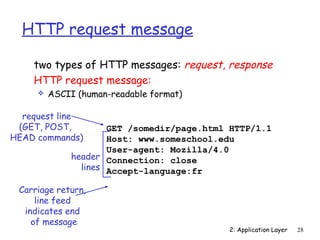
HTTP request message 
 two types of HTTP messages: request, response 
 HTTP request message: 
 ASCII (human-readable format) 
GET /somedir/page.html HTTP/1.1 
Host: www.someschool.edu 
User-agent: Mozilla/4.0 
Connection: close 
Accept-language:fr 
request line 
(GET, POST, 
HEAD commands) 
header 
lines 
Carriage return, 
line feed 
indicates end 
of message
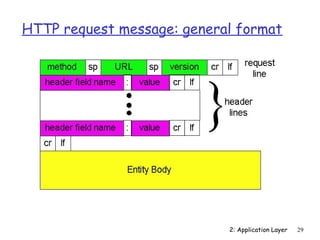
HTTP request message: general format 
2: Application Layer 29
2: Application Layer 30 
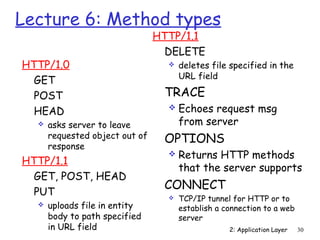
Lecture 6: Method types 
HTTP/1.0 
 GET 
 POST 
 HEAD 
 asks server to leave 
requested object out of 
response 
HTTP/1.1 
 GET, POST, HEAD 
 PUT 
 uploads file in entity 
body to path specified 
in URL field 
HTTP/1.1 
 DELETE 
 deletes file specified in the 
URL field 
 TRACE 
 Echoes request msg 
from server 
 OPTIONS 
 Returns HTTP methods 
that the server supports 
 CONNECT 
 TCP/IP tunnel for HTTP or to 
establish a connection to a web 
server
2: Application Layer 31 
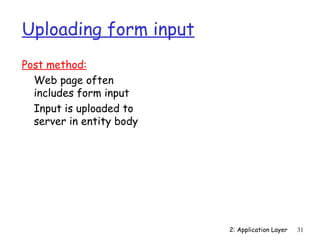
Uploading form input 
Post method: 
 Web page often 
includes form input 
 Input is uploaded to 
server in entity body
2: Application Layer 32 
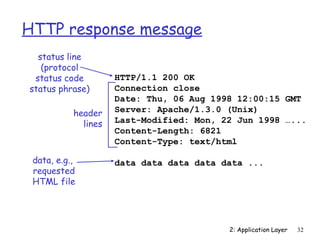
HTTP response message 
HTTP/1.1 200 OK 
Connection close 
Date: Thu, 06 Aug 1998 12:00:15 GMT 
Server: Apache/1.3.0 (Unix) 
Last-Modified: Mon, 22 Jun 1998 …... 
Content-Length: 6821 
Content-Type: text/html 
data data data data data ... 
status line 
(protocol 
status code 
status phrase) 
header 
lines 
data, e.g., 
requested 
HTML file
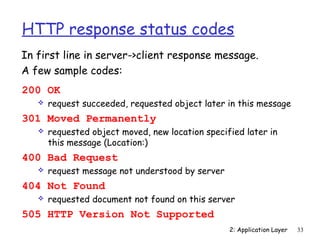
HTTP response status codes 
In first line in server-client response message. 
A few sample codes: 
2: Application Layer 33 
200 OK 
 request succeeded, requested object later in this message 
301 Moved Permanently 
 requested object moved, new location specified later in 
this message (Location:) 
400 Bad Request 
 request message not understood by server 
404 Not Found 
 requested document not found on this server 
505 HTTP Version Not Supported
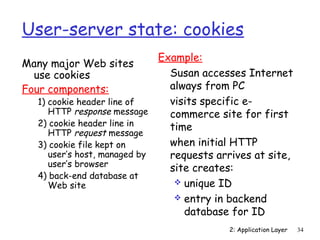
User-server state: cookies 
Many major Web sites 
use cookies 
Four components: 
2: Application Layer 34 
1) cookie header line of 
HTTP response message 
2) cookie header line in 
HTTP request message 
3) cookie file kept on 
user’s host, managed by 
user’s browser 
4) back-end database at 
Web site 
Example: 
 Susan accesses Internet 
always from PC 
 visits specific e-commerce 
site for first 
time 
 when initial HTTP 
requests arrives at site, 
site creates: 
 unique ID 
 entry in backend 
database for ID
2: Application Layer 35 
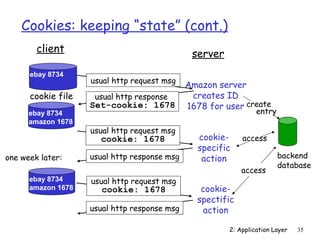
Cookies: keeping “state” (cont.) 
client server 
usual http response msg 
cookie file 
one week later: 
usual http request msg 
cookie: 1678 cookie-specific 
action 
access 
ebay 8734 
usual http request msg Amazon server 
creates ID 
1678 for user create 
entry 
usual http response 
Set-cookie: 1678 
ebay 8734 
amazon 1678 
usual http request msg 
cookie: 1678 cookie-spectific 
action 
access 
ebay 8734 
amazon 1678 
backend 
database
2: Application Layer 36 
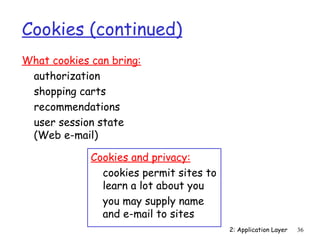
Cookies (continued) 
What cookies can bring: 
 authorization 
 shopping carts 
 recommendations 
 user session state 
(Web e-mail) 
Cookies and privacy: 
 cookies permit sites to 
learn a lot about you 
 you may supply name 
and e-mail to sites
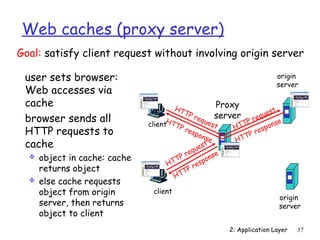
Goal: satisfy client request without involving origin server 
origin 
server 
2: Application Layer 37 
Web caches (proxy server) 
 user sets browser: 
Web accesses via 
cache 
 browser sends all 
HTTP requests to 
cache 
 object in cache: cache 
returns object 
 else cache requests 
object from origin 
server, then returns 
object to client 
client 
Proxy 
server 
HTTP request 
HTTP response 
client 
HTTP request 
HTTP request 
origin 
server 
HTTP response 
HTTP response
2: Application Layer 38 
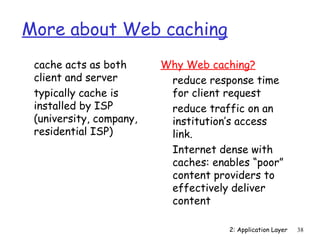
More about Web caching 
 cache acts as both 
client and server 
 typically cache is 
installed by ISP 
(university, company, 
residential ISP) 
Why Web caching? 
 reduce response time 
for client request 
 reduce traffic on an 
institution’s access 
link. 
 Internet dense with 
caches: enables “poor” 
content providers to 
effectively deliver 
content
15 Mbps 
access link 
2: Application Layer 39 
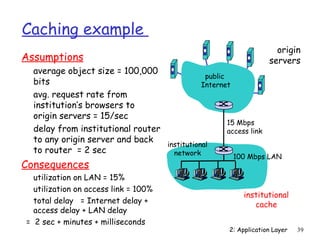
Caching example 
Assumptions 
 average object size = 100,000 
bits 
 avg. request rate from 
institution’s browsers to 
origin servers = 15/sec 
 delay from institutional router 
to any origin server and back 
to router = 2 sec 
Consequences 
 utilization on LAN = 15% 
 utilization on access link = 100% 
 total delay = Internet delay + 
access delay + LAN delay 
= 2 sec + minutes + milliseconds 
origin 
servers 
public 
Internet 
institutional 
network 100 Mbps LAN 
institutional 
cache
100 Mbps 
access link 
2: Application Layer 40 
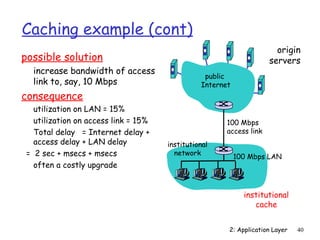
Caching example (cont) 
possible solution 
 increase bandwidth of access 
link to, say, 10 Mbps 
consequence 
 utilization on LAN = 15% 
 utilization on access link = 15% 
 Total delay = Internet delay + 
access delay + LAN delay 
= 2 sec + msecs + msecs 
 often a costly upgrade 
origin 
servers 
public 
Internet 
institutional 
network 100 Mbps LAN 
institutional 
cache
15 Mbps 
access link 
2: Application Layer 41 
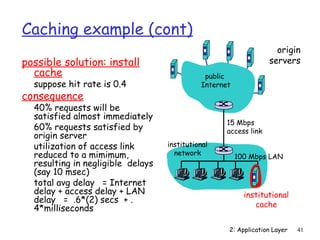
Caching example (cont) 
possible solution: install 
cache 
 suppose hit rate is 0.4 
consequence 
 40% requests will be 
satisfied almost immediately 
 60% requests satisfied by 
origin server 
 utilization of access link 
reduced to a mimimum, 
resulting in negligible delays 
(say 10 msec) 
 total avg delay = Internet 
delay + access delay + LAN 
delay = .6*(2) secs + . 
4*milliseconds 
origin 
servers 
public 
Internet 
institutional 
network 100 Mbps LAN 
institutional 
cache
Chapter 2: Application layer 
2: Application Layer 42 
 2.1 Principles of 
network applications 
 2.2 Web and HTTP 
 2.3 FTP 
 2.4 Electronic Mail 
 SMTP, POP3, IMAP 
 2.5 DNS 
 2.6 P2P applications 
 2.7 Socket programming 
with TCP 
 2.8 Socket programming 
with UDP 
 2.9 Building a Web 
server
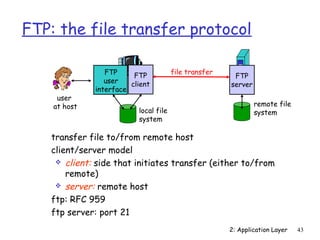
FTP: the file transfer protocol 
2: Application Layer 43 
 transfer file to/from remote host 
 client/server model 
 client: side that initiates transfer (either to/from 
remote) 
 server: remote host 
 ftp: RFC 959 
 ftp server: port 21 
file transfer FTP 
server 
FTP 
user 
interface 
FTP 
client 
local file 
system 
remote file 
system 
user 
at host
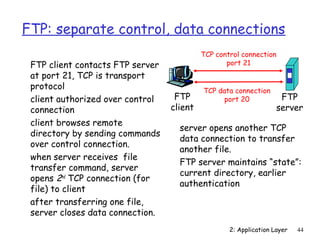
FTP: separate control, data connections 
TCP control connection 
2: Application Layer 44 
 FTP client contacts FTP server 
at port 21, TCP is transport 
protocol 
 client authorized over control 
connection 
 client browses remote 
directory by sending commands 
over control connection. 
 when server receives file 
transfer command, server 
opens 2nd TCP connection (for 
file) to client 
 after transferring one file, 
server closes data connection. 
FTP 
client 
FTP 
server 
port 21 
TCP data connection 
port 20 
 server opens another TCP 
data connection to transfer 
another file. 
 FTP server maintains “state”: 
current directory, earlier 
authentication
2: Application Layer 45 
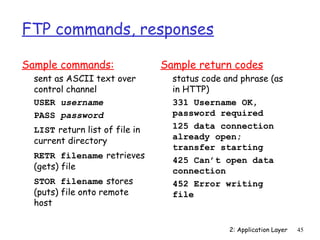
FTP commands, responses 
Sample commands: 
 sent as ASCII text over 
control channel 
 USER username 
 PASS password 
 LIST return list of file in 
current directory 
 RETR filename retrieves 
(gets) file 
 STOR filename stores 
(puts) file onto remote 
host 
Sample return codes 
 status code and phrase (as 
in HTTP) 
 331 Username OK, 
password required 
 125 data connection 
already open; 
transfer starting 
 425 Can’t open data 
connection 
 452 Error writing 
file
Chapter 2: Application layer 
2: Application Layer 46 
 2.1 Principles of 
network applications 
 2.2 Web and HTTP 
 2.3 FTP 
 2.4 Electronic Mail 
 SMTP, POP3, IMAP 
 2.5 DNS 
 2.6 P2P applications 
 2.7 Socket programming 
with TCP 
 2.8 Socket programming 
with UDP
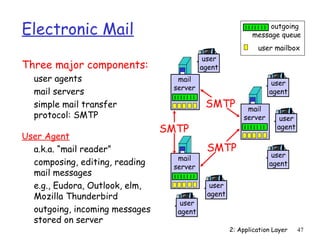
outgoing 
message queue 
SMTP 
2: Application Layer 47 
Electronic Mail 
Three major components: 
 user agents 
 mail servers 
 simple mail transfer 
protocol: SMTP 
User Agent 
 a.k.a. “mail reader” 
 composing, editing, reading 
mail messages 
 e.g., Eudora, Outlook, elm, 
Mozilla Thunderbird 
 outgoing, incoming messages 
stored on server 
user mailbox 
mail 
server 
user 
agent 
user 
agent 
user 
agent 
mail 
server 
mail 
server 
user 
agent 
user 
agent 
user 
agent 
SMTP 
SMTP
SMTP 
2: Application Layer 48 
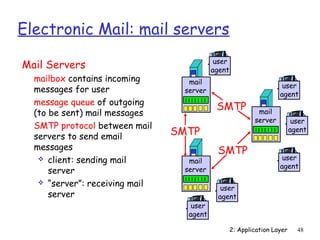
Electronic Mail: mail servers 
Mail Servers 
 mailbox contains incoming 
messages for user 
 message queue of outgoing 
(to be sent) mail messages 
 SMTP protocol between mail 
servers to send email 
messages 
 client: sending mail 
server 
 “server”: receiving mail 
server 
mail 
server 
user 
agent 
user 
agent 
user 
agent 
mail 
server 
mail 
server 
user 
agent 
user 
agent 
user 
agent 
SMTP 
SMTP
Electronic Mail: SMTP [RFC 2821] 
 uses TCP to reliably transfer email message from client 
to server, port 25 
 direct transfer: sending server to receiving server 
 three phases of transfer 
2: Application Layer 49 
 handshaking (greeting) 
 transfer of messages 
 closure 
 command/response interaction 
 commands: ASCII text 
 response: status code and phrase 
 messages must be in 7-bit ASCII
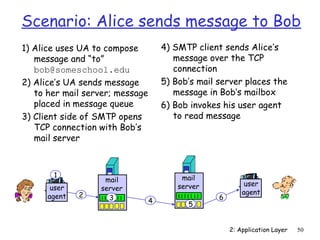
Scenario: Alice sends message to Bob 
1) Alice uses UA to compose 
message and “to” 
2: Application Layer 50 
bob@someschool.edu 
2) Alice’s UA sends message 
to her mail server; message 
placed in message queue 
3) Client side of SMTP opens 
TCP connection with Bob’s 
mail server 
4) SMTP client sends Alice’s 
message over the TCP 
connection 
5) Bob’s mail server places the 
message in Bob’s mailbox 
6) Bob invokes his user agent 
to read message 
user 
agent 
mail 
server 
mail 
server user 
agent 
1 
2 3 4 5 
6
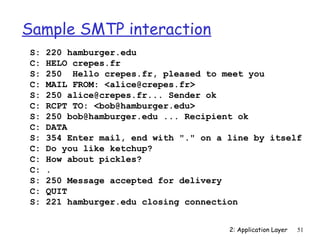
Sample SMTP interaction 
S: 220 hamburger.edu 
C: HELO crepes.fr 
S: 250 Hello crepes.fr, pleased to meet you 
C: MAIL FROM: alice@crepes.fr 
S: 250 alice@crepes.fr... Sender ok 
C: RCPT TO: bob@hamburger.edu 
S: 250 bob@hamburger.edu ... Recipient ok 
C: DATA 
S: 354 Enter mail, end with . on a line by itself 
C: Do you like ketchup? 
C: How about pickles? 
C: . 
S: 250 Message accepted for delivery 
C: QUIT 
S: 221 hamburger.edu closing connection 
2: Application Layer 51
2: Application Layer 52 
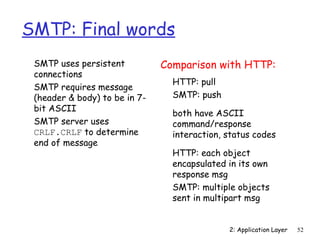
SMTP: Final words 
 SMTP uses persistent 
connections 
 SMTP requires message 
(header  body) to be in 7- 
bit ASCII 
 SMTP server uses 
CRLF.CRLF to determine 
end of message 
Comparison with HTTP: 
 HTTP: pull 
 SMTP: push 
 both have ASCII 
command/response 
interaction, status codes 
 HTTP: each object 
encapsulated in its own 
response msg 
 SMTP: multiple objects 
sent in multipart msg
2: Application Layer 53 
Mail access protocols 
 SMTP: delivery/storage to receiver’s server 
 Mail access protocol: retrieval from server 
 POP: Post Office Protocol [RFC 1939] 
• authorization (agent --server) and download 
 IMAP: Internet Mail Access Protocol [RFC 1730] 
• more features (more complex) 
• manipulation of stored msgs on server 
 HTTP: gmail, Hotmail, Yahoo! Mail, etc. 
user 
agent 
sender’s mail 
server 
user 
agent 
SMTP SMTP access 
protocol 
receiver’s mail 
server
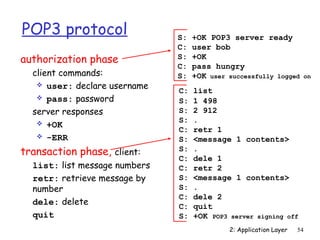
S: +OK POP3 server ready 
C: user bob 
S: +OK 
C: pass hungry 
S: +OK user successfully logged on 
2: Application Layer 54 
POP3 protocol 
authorization phase 
 client commands: 
 user: declare username 
 pass: password 
 server responses 
 +OK 
 -ERR 
transaction phase, client: 
 list: list message numbers 
 retr: retrieve message by 
number 
 dele: delete 
 quit 
C: list 
S: 1 498 
S: 2 912 
S: . 
C: retr 1 
S: message 1 contents 
S: . 
C: dele 1 
C: retr 2 
S: message 1 contents 
S: . 
C: dele 2 
C: quit 
S: +OK POP3 server signing off
2: Application Layer 55 
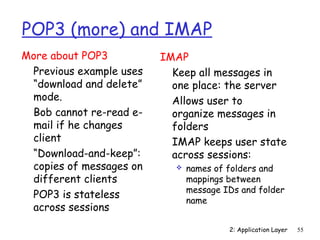
POP3 (more) and IMAP 
More about POP3 
 Previous example uses 
“download and delete” 
mode. 
 Bob cannot re-read e-mail 
if he changes 
client 
 “Download-and-keep”: 
copies of messages on 
different clients 
 POP3 is stateless 
across sessions 
IMAP 
 Keep all messages in 
one place: the server 
 Allows user to 
organize messages in 
folders 
 IMAP keeps user state 
across sessions: 
 names of folders and 
mappings between 
message IDs and folder 
name
Chapter 2: Application layer 
2: Application Layer 56 
 2.1 Principles of 
network applications 
 2.2 Web and HTTP 
 2.3 FTP 
 2.4 Electronic Mail 
 SMTP, POP3, IMAP 
 2.5 DNS 
 2.6 P2P applications 
 2.7 Socket programming 
with TCP 
 2.8 Socket programming 
with UDP 
 2.9 Building a Web 
server
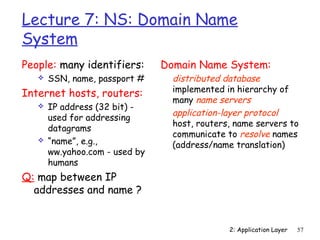
Lecture 7: NS: Domain Name 
System 
People: many identifiers: 
2: Application Layer 57 
 SSN, name, passport # 
Internet hosts, routers: 
 IP address (32 bit) - 
used for addressing 
datagrams 
 “name”, e.g., 
ww.yahoo.com - used by 
humans 
Q: map between IP 
addresses and name ? 
Domain Name System: 
 distributed database 
implemented in hierarchy of 
many name servers 
 application-layer protocol 
host, routers, name servers to 
communicate to resolve names 
(address/name translation)
2: Application Layer 58 
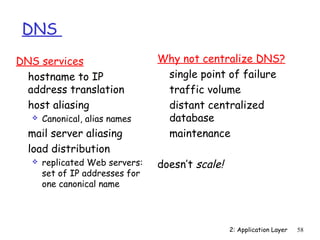
DNS 
Why not centralize DNS? 
 single point of failure 
 traffic volume 
 distant centralized 
database 
 maintenance 
doesn’t scale! 
DNS services 
 hostname to IP 
address translation 
 host aliasing 
 Canonical, alias names 
 mail server aliasing 
 load distribution 
 replicated Web servers: 
set of IP addresses for 
one canonical name
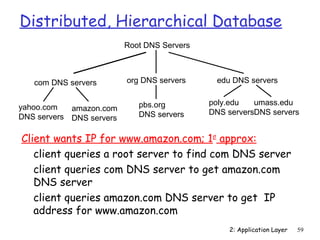
Distributed, Hierarchical Database 
2: Application Layer 59 
Root DNS Servers 
com DNS servers org DNS servers edu DNS servers 
poly.edu 
DNS servers 
umass.edu 
yahoo.com DNS servers 
DNS servers 
amazon.com 
DNS servers 
pbs.org 
DNS servers 
Client wants IP for www.amazon.com; 1st approx: 
 client queries a root server to find com DNS server 
 client queries com DNS server to get amazon.com 
DNS server 
 client queries amazon.com DNS server to get IP 
address for www.amazon.com
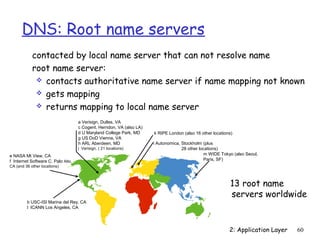
k RIPE London (also 16 other locations) 
2: Application Layer 60 
DNS: Root name servers 
 contacted by local name server that can not resolve name 
 root name server: 
 contacts authoritative name server if name mapping not known 
 gets mapping 
 returns mapping to local name server 
13 root name 
servers worldwide 
e NASA Mt View, CA 
f Internet Software C. Palo Alto, 
CA (and 36 other locations) 
b USC-ISI Marina del Rey, CA 
l ICANN Los Angeles, CA 
i Autonomica, Stockholm (plus 
28 other locations) 
m WIDE Tokyo (also Seoul, 
Paris, SF) 
a Verisign, Dulles, VA 
c Cogent, Herndon, VA (also LA) 
d U Maryland College Park, MD 
g US DoD Vienna, VA 
h ARL Aberdeen, MD 
j Verisign, ( 21 locations)
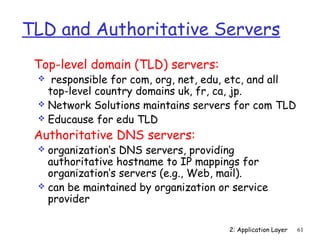
TLD and Authoritative Servers 
2: Application Layer 61 
 Top-level domain (TLD) servers: 
 responsible for com, org, net, edu, etc, and all 
top-level country domains uk, fr, ca, jp. 
 Network Solutions maintains servers for com TLD 
 Educause for edu TLD 
 Authoritative DNS servers: 
 organization’s DNS servers, providing 
authoritative hostname to IP mappings for 
organization’s servers (e.g., Web, mail). 
 can be maintained by organization or service 
provider
2: Application Layer 62 
Local Name Server 
 does not strictly belong to hierarchy 
 each ISP (residential ISP, company, 
university) has one. 
 also called “default name server” 
 when host makes DNS query, query is sent 
to its local DNS server 
 acts as proxy, forwards query into hierarchy
root DNS server 
2: Application Layer 63 
requesting host 
cis.poly.edu 
gaia.cs.umass.edu 
local DNS server 
dns.poly.edu 
1 
2 
3 
4 
5 
6 
authoritative DNS server 
dns.cs.umass.edu 
8 7 
TLD DNS server 
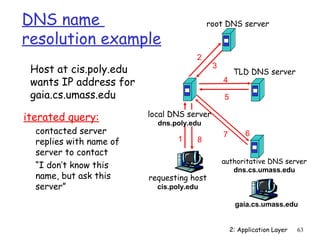
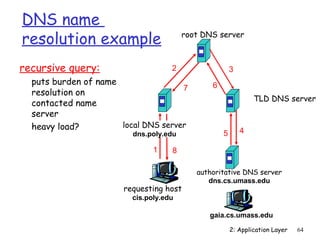
DNS name 
resolution example 
 Host at cis.poly.edu 
wants IP address for 
gaia.cs.umass.edu 
iterated query: 
 contacted server 
replies with name of 
server to contact 
 “I don’t know this 
name, but ask this 
server”
root DNS server 
2: Application Layer 64 
DNS name 
resolution example 
requesting host 
cis.poly.edu 
gaia.cs.umass.edu 
local DNS server 
dns.poly.edu 
1 
2 
5 4 
6 
authoritative DNS server 
dns.cs.umass.edu 
7 
8 
TLD DNS server 
recursive query: 3 
 puts burden of name 
resolution on 
contacted name 
server 
 heavy load?
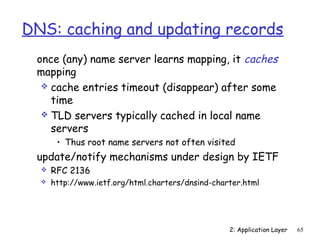
DNS: caching and updating records 
 once (any) name server learns mapping, it caches 
mapping 
 cache entries timeout (disappear) after some 
time 
 TLD servers typically cached in local name 
servers 
• Thus root name servers not often visited 
 update/notify mechanisms under design by IETF 
 RFC 2136 
 http://www.ietf.org/html.charters/dnsind-charter.html 
2: Application Layer 65
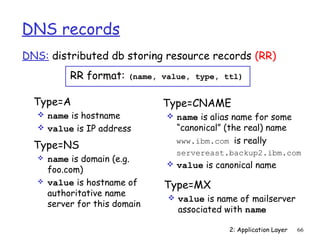
DNS records 
DNS: distributed db storing resource records (RR) 
RR format: (name, value, type, ttl) 
2: Application Layer 66 
 Type=A 
 name is hostname 
 value is IP address 
 Type=NS 
 name is domain (e.g. 
foo.com) 
 value is hostname of 
authoritative name 
server for this domain 
 Type=CNAME 
 name is alias name for some 
“canonical” (the real) name 
www.ibm.com is really 
servereast.backup2.ibm.com 
 value is canonical name 
 Type=MX 
 value is name of mailserver 
associated with name
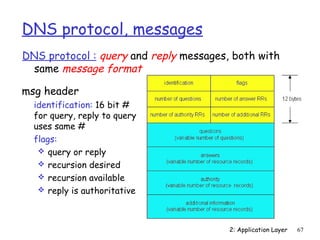
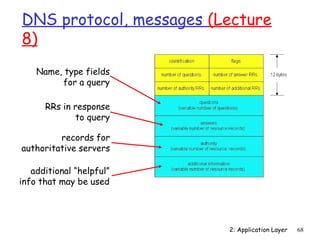
DNS protocol, messages 
DNS protocol : query and reply messages, both with 
same message format 
msg header 
 identification: 16 bit # 
for query, reply to query 
uses same # 
 flags: 
2: Application Layer 67 
 query or reply 
 recursion desired 
 recursion available 
 reply is authoritative
DNS protocol, messages (Lecture 
8) 
2: Application Layer 68 
Name, type fields 
for a query 
RRs in response 
to query 
records for 
authoritative servers 
additional “helpful” 
info that may be used
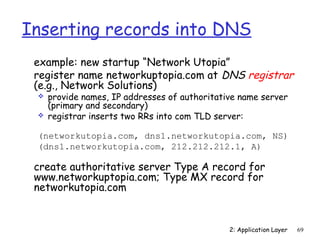
Inserting records into DNS 
 example: new startup “Network Utopia” 
 register name networkuptopia.com at DNS registrar 
(e.g., Network Solutions) 
 provide names, IP addresses of authoritative name server 
(primary and secondary) 
 registrar inserts two RRs into com TLD server: 
(networkutopia.com, dns1.networkutopia.com, NS) 
(dns1.networkutopia.com, 212.212.212.1, A) 
 create authoritative server Type A record for 
www.networkuptopia.com; Type MX record for 
networkutopia.com 
2: Application Layer 69
Quiz 2 (Lecture 8) 
 How do people get IP address of your Web 
site’s Mail Server? Write at least a 4- 
steps Process. 
 Time = 10-15 Minutes 
2: Application Layer 70
Chapter 2: Application layer 
2: Application Layer 71 
 2.1 Principles of 
network applications 
 app architectures 
 app requirements 
 2.2 Web and HTTP 
 2.4 Electronic Mail 
 SMTP, POP3, IMAP 
 2.5 DNS 
 2.6 P2P applications 
 2.7 Socket programming 
with TCP 
 2.8 Socket programming 
with UDP
2: Application Layer 72 
Pure P2P architecture 
 no always-on server 
 arbitrary end systems 
directly communicate 
 peers are intermittently 
connected and change IP 
addresses 
 Three topics: 
peer-peer 
 File distribution 
 Searching for information 
 Case Study: Skype
File Distribution: Server-Client vs P2P 
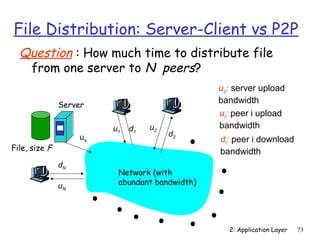
Question : How much time to distribute file 
2: Application Layer 73 
from one server to N peers? 
Server 
us 
d u2 1 d2 
u1 
dN 
uN 
Network (with 
abundant bandwidth) 
File, size F 
us: server upload 
bandwidth 
ui: peer i upload 
bandwidth 
di: peer i download 
bandwidth
File distribution time: server-client 
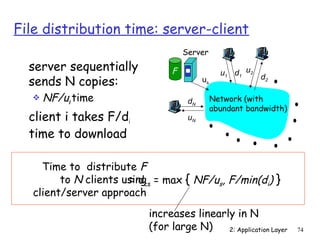
Time to distribute F 
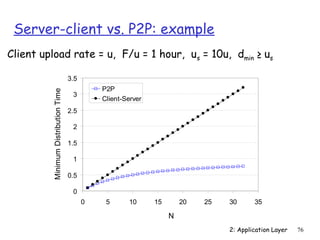
= dcs = max { NF/us, F/min(di) } 
2: Application Layer 74 
Server 
us 
d u2 1 d2 
u1 
dN 
uN 
Network (with 
abundant bandwidth) 
server sequentially F 
sends N copies: 
NF/ us 
time 
 client i takes F/di 
time to download 
increases linearly in N 
(for large N) 
to N clients using 
client/server approach
2: Application Layer 75 
File distribution time: P2P 
Server 
us 
d u2 1 d2 
u1 
dN 
uN 
Network (with 
abundant bandwidth) 
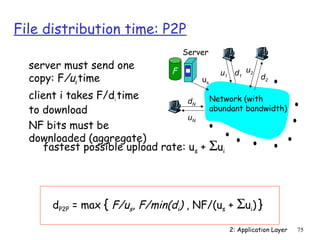
F 
 server must send one 
copy: F/ us 
time 
 client i takes F/di time 
to download 
 NF bits must be 
downloaded (aggregate) 
 fastest possible upload rate: us + Sui 
dP2P = max { F/us, F/min(di) , NF/(us + Sui) }
Server-client vs. P2P: example 
Client upload rate = u, F/u = 1 hour, us = 10u, dmin ≥ us 
2: Application Layer 76 
3.5 
3 
2.5 
2 
1.5 
1 
0.5 
0 
0 5 10 15 20 25 30 35 
N 
Minimum Distribution Time 
P2P 
Client-Server
File distribution: BitTorrent 
2: Application Layer 77 
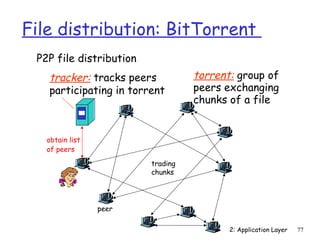
 P2P file distribution 
tracker: tracks peers 
participating in torrent 
torrent: group of 
peers exchanging 
chunks of a file 
obtain list 
of peers 
trading 
chunks 
peer
2: Application Layer 78 
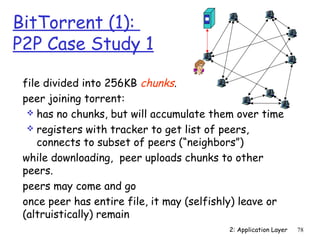
BitTorrent (1): 
P2P Case Study 1 
 file divided into 256KB chunks. 
 peer joining torrent: 
 has no chunks, but will accumulate them over time 
 registers with tracker to get list of peers, 
connects to subset of peers (“neighbors”) 
 while downloading, peer uploads chunks to other 
peers. 
 peers may come and go 
 once peer has entire file, it may (selfishly) leave or 
(altruistically) remain
2: Application Layer 79 
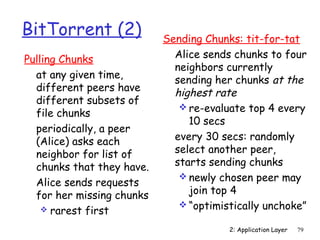
BitTorrent (2) 
Pulling Chunks 
 at any given time, 
different peers have 
different subsets of 
file chunks 
 periodically, a peer 
(Alice) asks each 
neighbor for list of 
chunks that they have. 
 Alice sends requests 
for her missing chunks 
 rarest first 
Sending Chunks: tit-for-tat 
 Alice sends chunks to four 
neighbors currently 
sending her chunks at the 
highest rate 
re-evaluate top 4 every 
10 secs 
 every 30 secs: randomly 
select another peer, 
starts sending chunks 
newly chosen peer may 
join top 4 
“optimistically unchoke”
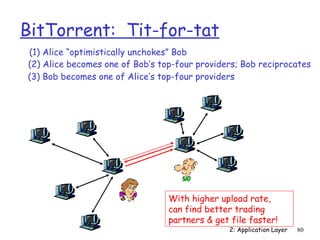
BitTorrent: Tit-for-tat 
(1) Alice “optimistically unchokes” Bob 
(2) Alice becomes one of Bob’s top-four providers; Bob reciprocates 
(3) Bob becomes one of Alice’s top-four providers 
With higher upload rate, 
can find better trading 
partners  get file faster! 
2: Application Layer 80
2: Application Layer 81 
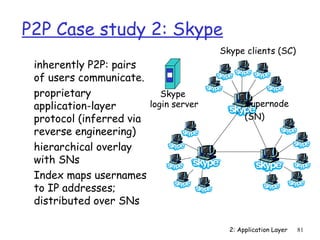
P2P Case study 2: Skype 
 inherently P2P: pairs 
of users communicate. 
 proprietary 
application-layer 
protocol (inferred via 
reverse engineering) 
 hierarchical overlay 
with SNs 
 Index maps usernames 
to IP addresses; 
distributed over SNs 
Skype clients (SC) 
Supernode 
(SN) 
Skype 
login server
2: Application Layer 82 
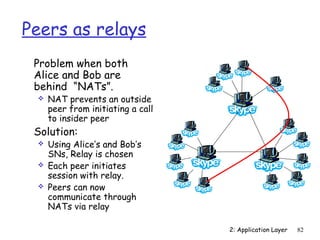
Peers as relays 
 Problem when both 
Alice and Bob are 
behind “NATs”. 
 NAT prevents an outside 
peer from initiating a call 
to insider peer 
 Solution: 
 Using Alice’s and Bob’s 
SNs, Relay is chosen 
 Each peer initiates 
session with relay. 
 Peers can now 
communicate through 
NATs via relay
Distributed Hash Table (DHT) 
(Lecture 9) 
 DHT = distributed P2P database 
 Database has (key, value) pairs; 
 key: ss number; value: human name 
 key: content type; value: IP address 
 Peers query DB with key 
 DB returns values that match the key 
 Peers can also insert (key, value) peers
DHT Identifiers 
 Assign integer identifier to each peer in range 
[0,2n-1]. 
 Each identifier can be represented by n bits. 
 Require each key to be an integer in same range. 
 To get integer keys, hash original key. 
 eg, key = h(“Led Zeppelin IV”) 
 This is why they call it a distributed “hash” table
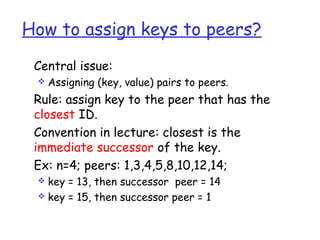
How to assign keys to peers? 
 Central issue: 
 Assigning (key, value) pairs to peers. 
 Rule: assign key to the peer that has the 
closest ID. 
 Convention in lecture: closest is the 
immediate successor of the key. 
 Ex: n=4; peers: 1,3,4,5,8,10,12,14; 
 key = 13, then successor peer = 14 
 key = 15, then successor peer = 1
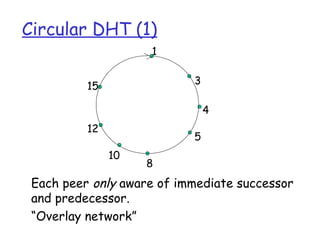
Circular DHT (1) 
1 
3 
4 
5 
8 
10 
15 
12 
 Each peer only aware of immediate successor 
and predecessor. 
 “Overlay network”
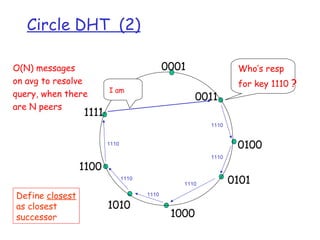
Circle DHT (2) 
0001 
0011 
0100 
0101 
1000 
1010 
1111 
1100 
Who’s resp 
for key 1110 ? I am 
O(N) messages 
on avg to resolve 
query, when there 
are N peers 
1110 
1110 
1110 
1110 
1110 
1110 
Define closest 
as closest 
successor
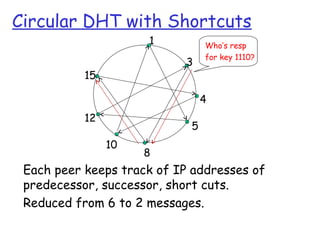
Circular DHT with Shortcuts 
1 
3 
Who’s resp 
for key 1110? 
4 
5 
8 
10 
15 
12 
 Each peer keeps track of IP addresses of 
predecessor, successor, short cuts. 
 Reduced from 6 to 2 messages.
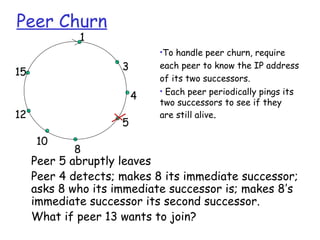
Peer Churn 
1 
3 
4 
5 
8 
10 
15 
12 
•To handle peer churn, require 
each peer to know the IP address 
of its two successors. 
• Each peer periodically pings its 
two successors to see if they 
are still alive. 
 Peer 5 abruptly leaves 
 Peer 4 detects; makes 8 its immediate successor; 
asks 8 who its immediate successor is; makes 8’s 
immediate successor its second successor. 
 What if peer 13 wants to join?
Chapter 2: Application layer 
2: Application Layer 90 
 2.1 Principles of 
network applications 
 2.2 Web and HTTP 
 2.3 FTP 
 2.4 Electronic Mail 
 SMTP, POP3, IMAP 
 2.5 DNS 
 2.6 P2P applications 
 2.7 Socket programming 
with TCP 
 2.8 Socket programming 
with UDP
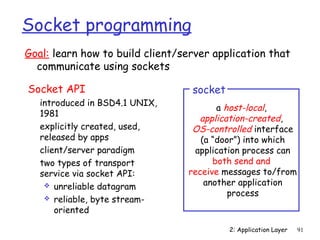
Goal: learn how to build client/server application that 
communicate using sockets 
2: Application Layer 91 
Socket programming 
Socket API 
 introduced in BSD4.1 UNIX, 
1981 
 explicitly created, used, 
released by apps 
 client/server paradigm 
 two types of transport 
service via socket API: 
 unreliable datagram 
 reliable, byte stream-oriented 
a host-local, 
application-created, 
OS-controlled interface 
(a “door”) into which 
application process can 
both send and 
receive messages to/from 
another application 
process 
socket
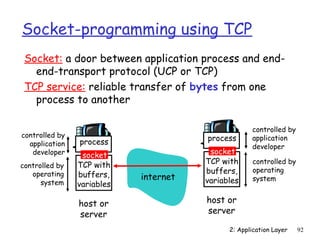
Socket-programming using TCP 
Socket: a door between application process and end-end- 
socket 
2: Application Layer 92 
transport protocol (UCP or TCP) 
TCP service: reliable transfer of bytes from one 
process to another 
process 
socket 
TCP with 
buffers, 
variables 
controlled by 
application 
developer 
controlled by 
operating 
system 
host or 
server 
process 
TCP with 
buffers, 
variables 
controlled by 
application 
developer 
controlled by 
operating 
system 
host or 
server 
internet
Socket programming with TCP 
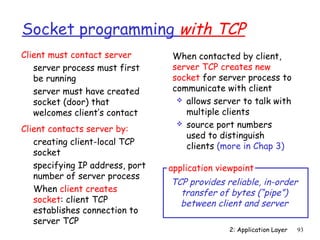
Client must contact server 
 server process must first 
be running 
 server must have created 
socket (door) that 
welcomes client’s contact 
Client contacts server by: 
 creating client-local TCP 
socket 
 specifying IP address, port 
number of server process 
 When client creates 
socket: client TCP 
establishes connection to 
server TCP 
 When contacted by client, 
server TCP creates new 
socket for server process to 
communicate with client 
 allows server to talk with 
multiple clients 
 source port numbers 
used to distinguish 
clients (more in Chap 3) 
application viewpoint 
TCP provides reliable, in-order 
transfer of bytes (“pipe”) 
between client and server 
2: Application Layer 93
Client/server socket interaction: TCP 
send request using 
2: Application Layer 94 
Server (running on hostid) Client 
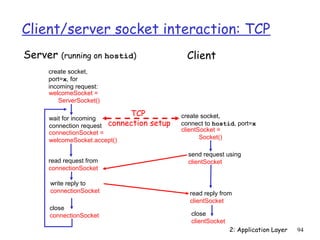
create socket, 
port=x, for 
incoming request: 
welcomeSocket = 
ServerSocket() 
wait for incoming 
connection request 
connectionSocket = 
welcomeSocket.accept() 
create socket, 
connect to hostid, port=x 
clientSocket = 
Socket() 
read request from clientSocket 
connectionSocket 
write reply to 
connectionSocket 
close 
connectionSocket 
read reply from 
clientSocket 
close 
clientSocket 
TCP 
connection setup
keyboard monitor 
inFromServer 
inFromUser 
outToServer 
to network from network 
2: Application Layer 95 
Process 
clientSocket 
input 
stream 
input 
stream 
output 
stream 
TCP 
socket 
Client 
process 
client TCP 
socket 
Stream jargon 
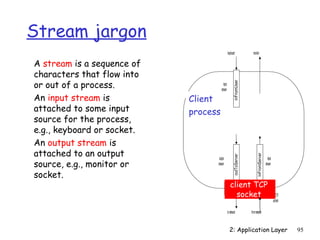
 A stream is a sequence of 
characters that flow into 
or out of a process. 
 An input stream is 
attached to some input 
source for the process, 
e.g., keyboard or socket. 
 An output stream is 
attached to an output 
source, e.g., monitor or 
socket.
Socket programming with TCP 
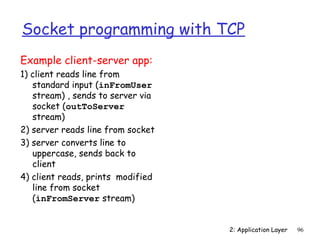
Example client-server app: 
1) client reads line from 
standard input (inFromUser 
stream) , sends to server via 
socket (outToServer 
stream) 
2) server reads line from socket 
3) server converts line to 
uppercase, sends back to 
client 
4) client reads, prints modified 
line from socket 
(inFromServer stream) 
2: Application Layer 96
2: Application Layer 97 
Example: Java client (TCP) 
import java.io.*; 
import java.net.*; 
class TCPClient { 
public static void main(String argv[]) throws Exception 
{ 
String sentence; 
String modifiedSentence; 
BufferedReader inFromUser = 
new BufferedReader(new InputStreamReader(System.in)); 
Socket clientSocket = new Socket(hostname, 6789); 
DataOutputStream outToServer = 
new DataOutputStream(clientSocket.getOutputStream()); 
Create 
input stream 
Create 
client socket, 
connect to server 
Create 
output stream 
attached to socket
Example: Java client (TCP), cont. 
BufferedReader inFromServer = 
new BufferedReader(new 
InputStreamReader(clientSocket.getInputStream())); 
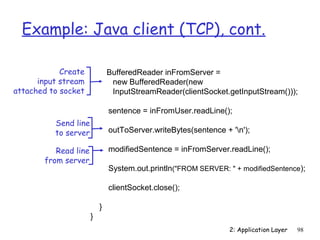
sentence = inFromUser.readLine(); 
outToServer.writeBytes(sentence + 'n'); 
modifiedSentence = inFromServer.readLine(); 
System.out.println(FROM SERVER:  + modifiedSentence); 
clientSocket.close(); 
} 
} 
2: Application Layer 98 
Create 
input stream 
attached to socket 
Send line 
to server 
Read line 
from server
2: Application Layer 99 
Example: Java server (TCP) 
import java.io.*; 
import java.net.*; 
class TCPServer { 
public static void main(String argv[]) throws Exception 
{ 
String clientSentence; 
String capitalizedSentence; 
ServerSocket welcomeSocket = new ServerSocket(6789); 
while(true) { 
Socket connectionSocket = welcomeSocket.accept(); 
BufferedReader inFromClient = 
new BufferedReader(new 
InputStreamReader(connectionSocket.getInputStream())); 
Create 
welcoming socket 
at port 6789 
Wait, on welcoming 
socket for contact 
by client 
Create input 
stream, attached 
to socket
Example: Java server (TCP), cont 
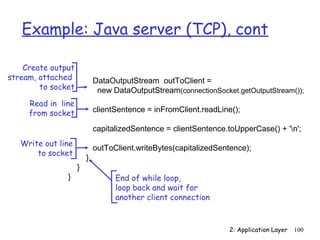
Create output 
stream, attached 
DataOutputStream outToClient = 
new DataOutputStream(connectionSocket.getOutputStream()); 
clientSentence = inFromClient.readLine(); 
capitalizedSentence = clientSentence.toUpperCase() + 'n'; 
outToClient.writeBytes(capitalizedSentence); 
} 
} 
} 
2: Application Layer 100 
to socket 
Read in line 
from socket 
Write out line 
to socket 
End of while loop, 
loop back and wait for 
another client connection
Chapter 2: Application layer 
2: Application Layer 101 
 2.1 Principles of 
network applications 
 2.2 Web and HTTP 
 2.3 FTP 
 2.4 Electronic Mail 
 SMTP, POP3, IMAP 
 2.5 DNS 
 2.6 P2P applications 
 2.7 Socket programming 
with TCP 
 2.8 Socket programming 
with UDP
Socket programming with UDP 
2: Application Layer 102 
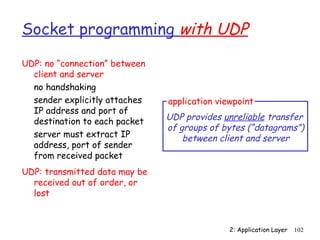
UDP: no “connection” between 
client and server 
 no handshaking 
 sender explicitly attaches 
IP address and port of 
destination to each packet 
 server must extract IP 
address, port of sender 
from received packet 
UDP: transmitted data may be 
received out of order, or 
lost 
application viewpoint 
UDP provides unreliable transfer 
of groups of bytes (“datagrams”) 
between client and server
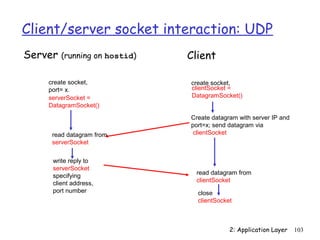
Client/server socket interaction: UDP 
Server (running on hostid) 
create socket, 
clientSocket = 
DatagramSocket() 
read datagram from 
clientSocket 
close 
clientSocket 
2: Application Layer 103 
Client 
Create datagram with server IP and 
port=x; send datagram via 
clientSocket 
create socket, 
port= x. 
serverSocket = 
DatagramSocket() 
read datagram from 
serverSocket 
write reply to 
serverSocket 
specifying 
client address, 
port number
2: Application Layer 104 
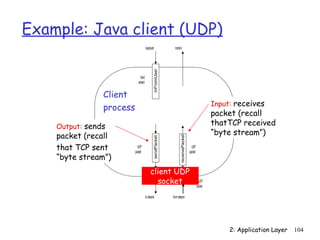
Example: Java client (UDP) 
keyboard monitor 
receivePacket 
inFromUser 
sendPacket 
to network from network 
Process 
clientSocket 
UDP 
packet 
input 
stream 
UDP 
packet 
UDP 
socket 
Output: sends 
packet (recall 
that TCP sent 
“byte stream”) 
Input: receives 
packet (recall 
thatTCP received 
“byte stream”) 
Client 
process 
client UDP 
socket
2: Application Layer 105 
Example: Java client (UDP) 
import java.io.*; 
import java.net.*; 
class UDPClient { 
public static void main(String args[]) throws Exception 
{ 
BufferedReader inFromUser = 
new BufferedReader(new InputStreamReader(System.in)); 
DatagramSocket clientSocket = new DatagramSocket(); 
InetAddress IPAddress = InetAddress.getByName(hostname); 
byte[] sendData = new byte[1024]; 
byte[] receiveData = new byte[1024]; 
String sentence = inFromUser.readLine(); 
sendData = sentence.getBytes(); 
Create 
input stream 
Create 
client socket 
Translate 
hostname to IP 
address using DNS
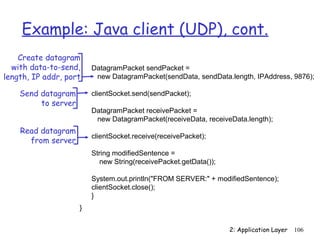
Example: Java client (UDP), cont. 
DatagramPacket sendPacket = 
new DatagramPacket(sendData, sendData.length, IPAddress, 9876); 
clientSocket.send(sendPacket); 
DatagramPacket receivePacket = 
new DatagramPacket(receiveData, receiveData.length); 
clientSocket.receive(receivePacket); 
String modifiedSentence = 
new String(receivePacket.getData()); 
System.out.println(FROM SERVER: + modifiedSentence); 
clientSocket.close(); 
} 
2: Application Layer 106 
Create datagram 
with data-to-send, 
length, IP addr, port 
} 
Send datagram 
to server 
Read datagram 
from server
2: Application Layer 107 
Example: Java server (UDP) 
import java.io.*; 
import java.net.*; 
class UDPServer { 
public static void main(String args[]) throws Exception 
{ 
DatagramSocket serverSocket = new DatagramSocket(9876); 
byte[] receiveData = new byte[1024]; 
byte[] sendData = new byte[1024]; 
while(true) 
{ 
DatagramPacket receivePacket = 
new DatagramPacket(receiveData, receiveData.length); 
serverSocket.receive(receivePacket); 
Create 
datagram socket 
at port 9876 
Create space for 
received datagram 
Receive 
datagram
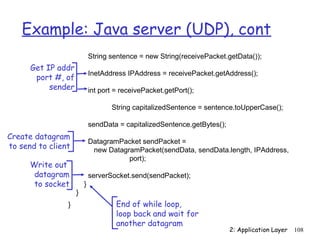
Example: Java server (UDP), cont 
String sentence = new String(receivePacket.getData()); 
InetAddress IPAddress = receivePacket.getAddress(); 
int port = receivePacket.getPort(); 
String capitalizedSentence = sentence.toUpperCase(); 
sendData = capitalizedSentence.getBytes(); 
DatagramPacket sendPacket = 
new DatagramPacket(sendData, sendData.length, IPAddress, 
2: Application Layer 108 
port); 
Get IP addr 
port #, of 
sender 
Write out 
datagram 
to socket 
serverSocket.send(sendPacket); 
} 
} 
} 
End of while loop, 
loop back and wait for 
another datagram 
Create datagram 
to send to client
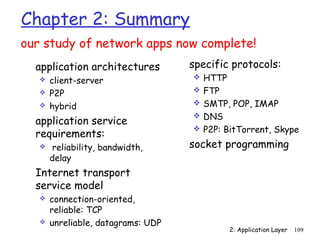
our study of network apps now complete! 
2: Application Layer 109 
Chapter 2: Summary 
 application architectures 
 client-server 
 P2P 
 hybrid 
 application service 
requirements: 
 reliability, bandwidth, 
delay 
 Internet transport 
service model 
 connection-oriented, 
reliable: TCP 
 unreliable, datagrams: UDP 
 specific protocols: 
 HTTP 
 FTP 
 SMTP, POP, IMAP 
 DNS 
 P2P: BitTorrent, Skype 
 socket programming
Most importantly: learned about protocols 
2: Application Layer 110 
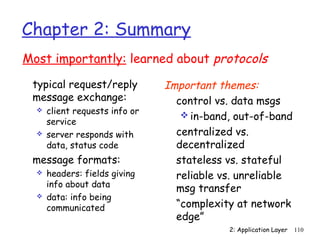
Chapter 2: Summary 
 typical request/reply 
message exchange: 
 client requests info or 
service 
 server responds with 
data, status code 
 message formats: 
 headers: fields giving 
info about data 
 data: info being 
communicated 
Important themes: 
 control vs. data msgs 
in-band, out-of-band 
 centralized vs. 
decentralized 
 stateless vs. stateful 
 reliable vs. unreliable 
msg transfer 
 “complexity at network 
edge”

Chapter2 l2 modified_um

  • 1.
    Chapter 2: Lecture5 Application Layer 2: Application Layer 1
  • 2.
    Chapter 2: Applicationlayer 2: Application Layer 2 2.1 Principles of network applications 2.2 Web and HTTP 2.3 FTP 2.4 Electronic Mail  SMTP, POP3, IMAP 2.5 DNS 2.6 P2P applications 2.7 Socket programming with TCP 2.8 Socket programming with UDP
  • 3.
    2: Application Layer3 Some network apps e-mail web instant messaging remote login P2P file sharing multi-user network games streaming stored video clips voice over IP real-time video conferencing grid computing
  • 4.
    2: Application Layer4 Creating a network app write programs that  run on (different) end systems  communicate over network  e.g., web server software communicates with browser software No need to write software for network-core devices  Network-core devices do not run user applications application transport network data link physical application transport network data link physical application transport network data link physical
  • 5.
    Chapter 2: Applicationlayer 2: Application Layer 5 2.1 Principles of network applications 2.2 Web and HTTP 2.3 FTP 2.4 Electronic Mail  SMTP, POP3, IMAP 2.5 DNS 2.6 P2P applications 2.7 Socket programming with TCP 2.8 Socket programming with UDP 2.9 Building a Web server
  • 6.
    Application architectures 2:Application Layer 6 Client-server Peer-to-peer (P2P) Hybrid of client-server and P2P
  • 7.
    Client-server architecture 2:Application Layer 7 server:  always-on host  permanent IP address clients:  communicate with server  may have dynamic IP addresses  do not communicate directly with each other client/server
  • 8.
    2: Application Layer8 Pure P2P architecture Not always-on server arbitrary end systems directly communicate peers are intermittently connected and change IP addresses Highly scalable but difficult to manage peer-peer
  • 9.
    Hybrid of client-serverand P2P Skype  voice-over-IP P2P application  centralized server: finding address of remote party:  client-client connection: direct (not through server) 2: Application Layer 9 Instant messaging  chatting between two users is P2P  centralized service: client presence detection/location • user registers its IP address with central server when it comes online • user contacts central server to find IP addresses of buddies
  • 10.
    2: Application Layer10 Processes communicating Process: program running within a host. within same host, two processes communicate using inter-process communication (defined by OS). processes in different hosts communicate by exchanging messages Client process: process that initiates communication Server process: process that waits to be contacted Note: applications with P2P architectures have client processes server processes
  • 11.
    host or server socket controlled by app developer 2: Application Layer 11 Sockets process sends/receives messages to/from its socket socket analogous to door  sending process shoves message out door  sending process relies on transport infrastructure on other side of door which brings message to socket at receiving process host or server process socket TCP with buffers, variables process TCP with buffers, variables Internet controlled by OS
  • 12.
    2: Application Layer12 Addressing processes to receive messages, process must have identifier host device has unique 32-bit IP address Q: does IP address of host suffice for identifying the process?
  • 13.
    2: Application Layer13 Addressing processes to receive messages, process must have identifier host device has unique 32-bit IP address Q: does IP address of host on which process runs suffice for identifying the process? A: No, many processes can be running on same host identifier includes both IP address and port numbers associated with process on host. Example port numbers:  HTTP server: 80  Mail server: 25 to send HTTP message to gaia.cs.umass.edu web server:  IP address: 128.119.245.12  Port number: 80
  • 14.
    App-layer protocol defines 2: Application Layer 14 Types of messages exchanged,  e.g., request, response Message syntax:  what fields in messages how fields are delineated Message semantics  meaning of information in fields Rules for when and how processes send respond to messages Public-domain protocols: defined in RFCs allows for interoperability e.g., HTTP, SMTP Proprietary protocols: e.g., Skype
  • 15.
    What transport servicedoes an app need? Data loss some apps (e.g., audio) can tolerate some loss other apps (e.g., file transfer, telnet) require 100% reliable data transfer Timing some apps (e.g., Internet telephony, interactive games) require low delay to be “effective” Throughput some apps (e.g., multimedia) require minimum amount of throughput to be “effective” other apps (“elastic apps”) make use of whatever throughput they get Security Encryption, data integrity, … 2: Application Layer 15
  • 16.
    Transport service requirementsof common apps 2: Application Layer 16 Application file transfer e-mail Web documents real-time audio/video stored audio/video interactive games instant messaging Data loss no loss no loss no loss loss-tolerant loss-tolerant loss-tolerant no loss Throughput elastic elastic elastic audio: 5kbps-1Mbps video:10kbps-5Mbps same as above few kbps up elastic Time Sensitive no no no yes, 100’s msec yes, few secs yes, 100’s msec yes and no
  • 17.
    Internet transport protocolsservices 2: Application Layer 17 TCP service: connection-oriented: setup required between client and server processes reliable transport between sending and receiving process flow control: sender won’t overwhelm receiver congestion control: throttle sender when network overloaded does not provide: timing, minimum throughput guarantees, security UDP service: unreliable data transfer between sending and receiving process does not provide: connection setup, reliability, flow control, congestion control, timing, throughput guarantee, or security Q: why bother? Why is there a UDP?
  • 18.
    Internet apps: application,transport protocols 2: Application Layer 18 Application e-mail remote terminal access Web file transfer streaming multimedia Internet telephony Application layer protocol SMTP [RFC 2821] Telnet [RFC 854] HTTP [RFC 2616] FTP [RFC 959] HTTP (eg Youtube), RTP [RFC 1889] SIP, RTP, proprietary (e.g., Skype) Underlying transport protocol TCP TCP TCP TCP TCP or UDP typically UDP
  • 19.
    Chapter 2: Applicationlayer 2: Application Layer 19 2.1 Principles of network applications  app architectures  app requirements 2.2 Web and HTTP 2.4 Electronic Mail  SMTP, POP3, IMAP 2.5 DNS 2.6 P2P applications 2.7 Socket programming with TCP 2.8 Socket programming with UDP
  • 20.
    2: Application Layer20 Web and HTTP First some jargon Web page consists of objects Object can be HTML file, JPEG image, Java applet, audio file,… Web page consists of base HTML-file which includes several referenced objects Each object is addressable by a URL Example URL: www.someschool.edu/someDept/pic.gif host name path name
  • 21.
    HTTP response 2:Application Layer 21 HTTP overview HTTP: hypertext transfer protocol Web’s application layer protocol client/server model  client: browser that requests, receives, “displays” Web objects  server: Web server sends objects in response to requests PC running Explorer Server running Apache Web server Mac running Navigator HTTP request HTTP request HTTP response
  • 22.
    HTTP overview (continued) aside 2: Application Layer 22 Uses TCP: client initiates TCP connection (creates socket) to server, port 80 server accepts TCP connection from client HTTP messages (application-layer protocol messages) exchanged between browser (HTTP client) and Web server (HTTP server) TCP connection closed HTTP is “stateless” server maintains no information about past client requests Protocols that maintain “state” are complex! past history (state) must be maintained if server/client crashes, their views of “state” may be inconsistent, must be reconciled
  • 23.
    2: Application Layer23 HTTP connections Nonpersistent HTTP At most one object is sent over a TCP connection. Persistent HTTP Multiple objects can be sent over single TCP connection between client and server.
  • 24.
    2: Application Layer24 Nonpersistent HTTP Suppose user enters URL www.someSchool.edu/someDepartment/home.index 1a. HTTP client initiates TCP connection to HTTP server (process) at www.someSchool.edu on port 80 2. HTTP client sends HTTP request message (containing URL) into TCP connection socket. Message indicates that client wants object someDepartment/home.index 1b. HTTP server at host www.someSchool.edu waiting for TCP connection at port 80. “accepts” connection, notifying client 3. HTTP server receives request message, forms response message containing requested object, and sends message into its socket time (contains text, references to 10 jpeg images)
  • 25.
    2: Application Layer25 Nonpersistent HTTP (cont.) 5. HTTP client receives response message containing html file, displays html. Parsing html file, finds 10 referenced jpeg objects 6. Steps 1-5 repeated for each of 10 jpeg objects 4. HTTP server closes TCP connection. time
  • 26.
    Non-Persistent HTTP: Responsetime RTT: Response time: one RTT to initiate TCP connection one RTT for HTTP request and first few bytes of HTTP response to return file transmission time total = 2RTT+transmit time time to transmit file 2: Application Layer 26 initiate TCP connection RTT request file RTT file received time time
  • 27.
    2: Application Layer27 Persistent HTTP Nonpersistent HTTP issues: requires 2 RTTs per object OS overhead for each TCP connection browsers often open parallel TCP connections to fetch referenced objects Persistent HTTP server leaves connection open after sending response subsequent HTTP messages between same client/server sent over open connection client sends requests as soon as it encounters a referenced object as little as two RTTs for all the referenced objects
  • 28.
    2: Application Layer28 HTTP request message two types of HTTP messages: request, response HTTP request message:  ASCII (human-readable format) GET /somedir/page.html HTTP/1.1 Host: www.someschool.edu User-agent: Mozilla/4.0 Connection: close Accept-language:fr request line (GET, POST, HEAD commands) header lines Carriage return, line feed indicates end of message
  • 29.
    HTTP request message:general format 2: Application Layer 29
  • 30.
    2: Application Layer30 Lecture 6: Method types HTTP/1.0 GET POST HEAD  asks server to leave requested object out of response HTTP/1.1 GET, POST, HEAD PUT  uploads file in entity body to path specified in URL field HTTP/1.1 DELETE  deletes file specified in the URL field TRACE  Echoes request msg from server OPTIONS  Returns HTTP methods that the server supports CONNECT  TCP/IP tunnel for HTTP or to establish a connection to a web server
  • 31.
    2: Application Layer31 Uploading form input Post method: Web page often includes form input Input is uploaded to server in entity body
  • 32.
    2: Application Layer32 HTTP response message HTTP/1.1 200 OK Connection close Date: Thu, 06 Aug 1998 12:00:15 GMT Server: Apache/1.3.0 (Unix) Last-Modified: Mon, 22 Jun 1998 …... Content-Length: 6821 Content-Type: text/html data data data data data ... status line (protocol status code status phrase) header lines data, e.g., requested HTML file
  • 33.
    HTTP response statuscodes In first line in server-client response message. A few sample codes: 2: Application Layer 33 200 OK  request succeeded, requested object later in this message 301 Moved Permanently  requested object moved, new location specified later in this message (Location:) 400 Bad Request  request message not understood by server 404 Not Found  requested document not found on this server 505 HTTP Version Not Supported
  • 34.
    User-server state: cookies Many major Web sites use cookies Four components: 2: Application Layer 34 1) cookie header line of HTTP response message 2) cookie header line in HTTP request message 3) cookie file kept on user’s host, managed by user’s browser 4) back-end database at Web site Example: Susan accesses Internet always from PC visits specific e-commerce site for first time when initial HTTP requests arrives at site, site creates:  unique ID  entry in backend database for ID
  • 35.
    2: Application Layer35 Cookies: keeping “state” (cont.) client server usual http response msg usual http response msg cookie file one week later: usual http request msg cookie: 1678 cookie-specific action access ebay 8734 usual http request msg Amazon server creates ID 1678 for user create entry usual http response Set-cookie: 1678 ebay 8734 amazon 1678 usual http request msg cookie: 1678 cookie-spectific action access ebay 8734 amazon 1678 backend database
  • 36.
    2: Application Layer36 Cookies (continued) What cookies can bring: authorization shopping carts recommendations user session state (Web e-mail) Cookies and privacy: cookies permit sites to learn a lot about you you may supply name and e-mail to sites
  • 37.
    Goal: satisfy clientrequest without involving origin server origin server 2: Application Layer 37 Web caches (proxy server) user sets browser: Web accesses via cache browser sends all HTTP requests to cache  object in cache: cache returns object  else cache requests object from origin server, then returns object to client client Proxy server HTTP request HTTP response client HTTP request HTTP request origin server HTTP response HTTP response
  • 38.
    2: Application Layer38 More about Web caching cache acts as both client and server typically cache is installed by ISP (university, company, residential ISP) Why Web caching? reduce response time for client request reduce traffic on an institution’s access link. Internet dense with caches: enables “poor” content providers to effectively deliver content
  • 39.
    15 Mbps accesslink 2: Application Layer 39 Caching example Assumptions average object size = 100,000 bits avg. request rate from institution’s browsers to origin servers = 15/sec delay from institutional router to any origin server and back to router = 2 sec Consequences utilization on LAN = 15% utilization on access link = 100% total delay = Internet delay + access delay + LAN delay = 2 sec + minutes + milliseconds origin servers public Internet institutional network 100 Mbps LAN institutional cache
  • 40.
    100 Mbps accesslink 2: Application Layer 40 Caching example (cont) possible solution increase bandwidth of access link to, say, 10 Mbps consequence utilization on LAN = 15% utilization on access link = 15% Total delay = Internet delay + access delay + LAN delay = 2 sec + msecs + msecs often a costly upgrade origin servers public Internet institutional network 100 Mbps LAN institutional cache
  • 41.
    15 Mbps accesslink 2: Application Layer 41 Caching example (cont) possible solution: install cache suppose hit rate is 0.4 consequence 40% requests will be satisfied almost immediately 60% requests satisfied by origin server utilization of access link reduced to a mimimum, resulting in negligible delays (say 10 msec) total avg delay = Internet delay + access delay + LAN delay = .6*(2) secs + . 4*milliseconds origin servers public Internet institutional network 100 Mbps LAN institutional cache
  • 42.
    Chapter 2: Applicationlayer 2: Application Layer 42 2.1 Principles of network applications 2.2 Web and HTTP 2.3 FTP 2.4 Electronic Mail  SMTP, POP3, IMAP 2.5 DNS 2.6 P2P applications 2.7 Socket programming with TCP 2.8 Socket programming with UDP 2.9 Building a Web server
  • 43.
    FTP: the filetransfer protocol 2: Application Layer 43 transfer file to/from remote host client/server model  client: side that initiates transfer (either to/from remote)  server: remote host ftp: RFC 959 ftp server: port 21 file transfer FTP server FTP user interface FTP client local file system remote file system user at host
  • 44.
    FTP: separate control,data connections TCP control connection 2: Application Layer 44 FTP client contacts FTP server at port 21, TCP is transport protocol client authorized over control connection client browses remote directory by sending commands over control connection. when server receives file transfer command, server opens 2nd TCP connection (for file) to client after transferring one file, server closes data connection. FTP client FTP server port 21 TCP data connection port 20 server opens another TCP data connection to transfer another file. FTP server maintains “state”: current directory, earlier authentication
  • 45.
    2: Application Layer45 FTP commands, responses Sample commands: sent as ASCII text over control channel USER username PASS password LIST return list of file in current directory RETR filename retrieves (gets) file STOR filename stores (puts) file onto remote host Sample return codes status code and phrase (as in HTTP) 331 Username OK, password required 125 data connection already open; transfer starting 425 Can’t open data connection 452 Error writing file
  • 46.
    Chapter 2: Applicationlayer 2: Application Layer 46 2.1 Principles of network applications 2.2 Web and HTTP 2.3 FTP 2.4 Electronic Mail  SMTP, POP3, IMAP 2.5 DNS 2.6 P2P applications 2.7 Socket programming with TCP 2.8 Socket programming with UDP
  • 47.
    outgoing message queue SMTP 2: Application Layer 47 Electronic Mail Three major components: user agents mail servers simple mail transfer protocol: SMTP User Agent a.k.a. “mail reader” composing, editing, reading mail messages e.g., Eudora, Outlook, elm, Mozilla Thunderbird outgoing, incoming messages stored on server user mailbox mail server user agent user agent user agent mail server mail server user agent user agent user agent SMTP SMTP
  • 48.
    SMTP 2: ApplicationLayer 48 Electronic Mail: mail servers Mail Servers mailbox contains incoming messages for user message queue of outgoing (to be sent) mail messages SMTP protocol between mail servers to send email messages  client: sending mail server  “server”: receiving mail server mail server user agent user agent user agent mail server mail server user agent user agent user agent SMTP SMTP
  • 49.
    Electronic Mail: SMTP[RFC 2821] uses TCP to reliably transfer email message from client to server, port 25 direct transfer: sending server to receiving server three phases of transfer 2: Application Layer 49  handshaking (greeting)  transfer of messages  closure command/response interaction  commands: ASCII text  response: status code and phrase messages must be in 7-bit ASCII
  • 50.
    Scenario: Alice sendsmessage to Bob 1) Alice uses UA to compose message and “to” 2: Application Layer 50 bob@someschool.edu 2) Alice’s UA sends message to her mail server; message placed in message queue 3) Client side of SMTP opens TCP connection with Bob’s mail server 4) SMTP client sends Alice’s message over the TCP connection 5) Bob’s mail server places the message in Bob’s mailbox 6) Bob invokes his user agent to read message user agent mail server mail server user agent 1 2 3 4 5 6
  • 51.
    Sample SMTP interaction S: 220 hamburger.edu C: HELO crepes.fr S: 250 Hello crepes.fr, pleased to meet you C: MAIL FROM: alice@crepes.fr S: 250 alice@crepes.fr... Sender ok C: RCPT TO: bob@hamburger.edu S: 250 bob@hamburger.edu ... Recipient ok C: DATA S: 354 Enter mail, end with . on a line by itself C: Do you like ketchup? C: How about pickles? C: . S: 250 Message accepted for delivery C: QUIT S: 221 hamburger.edu closing connection 2: Application Layer 51
  • 52.
    2: Application Layer52 SMTP: Final words SMTP uses persistent connections SMTP requires message (header body) to be in 7- bit ASCII SMTP server uses CRLF.CRLF to determine end of message Comparison with HTTP: HTTP: pull SMTP: push both have ASCII command/response interaction, status codes HTTP: each object encapsulated in its own response msg SMTP: multiple objects sent in multipart msg
  • 53.
    2: Application Layer53 Mail access protocols SMTP: delivery/storage to receiver’s server Mail access protocol: retrieval from server  POP: Post Office Protocol [RFC 1939] • authorization (agent --server) and download  IMAP: Internet Mail Access Protocol [RFC 1730] • more features (more complex) • manipulation of stored msgs on server  HTTP: gmail, Hotmail, Yahoo! Mail, etc. user agent sender’s mail server user agent SMTP SMTP access protocol receiver’s mail server
  • 54.
    S: +OK POP3server ready C: user bob S: +OK C: pass hungry S: +OK user successfully logged on 2: Application Layer 54 POP3 protocol authorization phase client commands:  user: declare username  pass: password server responses  +OK  -ERR transaction phase, client: list: list message numbers retr: retrieve message by number dele: delete quit C: list S: 1 498 S: 2 912 S: . C: retr 1 S: message 1 contents S: . C: dele 1 C: retr 2 S: message 1 contents S: . C: dele 2 C: quit S: +OK POP3 server signing off
  • 55.
    2: Application Layer55 POP3 (more) and IMAP More about POP3 Previous example uses “download and delete” mode. Bob cannot re-read e-mail if he changes client “Download-and-keep”: copies of messages on different clients POP3 is stateless across sessions IMAP Keep all messages in one place: the server Allows user to organize messages in folders IMAP keeps user state across sessions:  names of folders and mappings between message IDs and folder name
  • 56.
    Chapter 2: Applicationlayer 2: Application Layer 56 2.1 Principles of network applications 2.2 Web and HTTP 2.3 FTP 2.4 Electronic Mail  SMTP, POP3, IMAP 2.5 DNS 2.6 P2P applications 2.7 Socket programming with TCP 2.8 Socket programming with UDP 2.9 Building a Web server
  • 57.
    Lecture 7: NS:Domain Name System People: many identifiers: 2: Application Layer 57  SSN, name, passport # Internet hosts, routers:  IP address (32 bit) - used for addressing datagrams  “name”, e.g., ww.yahoo.com - used by humans Q: map between IP addresses and name ? Domain Name System: distributed database implemented in hierarchy of many name servers application-layer protocol host, routers, name servers to communicate to resolve names (address/name translation)
  • 58.
    2: Application Layer58 DNS Why not centralize DNS? single point of failure traffic volume distant centralized database maintenance doesn’t scale! DNS services hostname to IP address translation host aliasing  Canonical, alias names mail server aliasing load distribution  replicated Web servers: set of IP addresses for one canonical name
  • 59.
    Distributed, Hierarchical Database 2: Application Layer 59 Root DNS Servers com DNS servers org DNS servers edu DNS servers poly.edu DNS servers umass.edu yahoo.com DNS servers DNS servers amazon.com DNS servers pbs.org DNS servers Client wants IP for www.amazon.com; 1st approx: client queries a root server to find com DNS server client queries com DNS server to get amazon.com DNS server client queries amazon.com DNS server to get IP address for www.amazon.com
  • 60.
    k RIPE London(also 16 other locations) 2: Application Layer 60 DNS: Root name servers contacted by local name server that can not resolve name root name server:  contacts authoritative name server if name mapping not known  gets mapping  returns mapping to local name server 13 root name servers worldwide e NASA Mt View, CA f Internet Software C. Palo Alto, CA (and 36 other locations) b USC-ISI Marina del Rey, CA l ICANN Los Angeles, CA i Autonomica, Stockholm (plus 28 other locations) m WIDE Tokyo (also Seoul, Paris, SF) a Verisign, Dulles, VA c Cogent, Herndon, VA (also LA) d U Maryland College Park, MD g US DoD Vienna, VA h ARL Aberdeen, MD j Verisign, ( 21 locations)
  • 61.
    TLD and AuthoritativeServers 2: Application Layer 61 Top-level domain (TLD) servers:  responsible for com, org, net, edu, etc, and all top-level country domains uk, fr, ca, jp.  Network Solutions maintains servers for com TLD  Educause for edu TLD Authoritative DNS servers:  organization’s DNS servers, providing authoritative hostname to IP mappings for organization’s servers (e.g., Web, mail).  can be maintained by organization or service provider
  • 62.
    2: Application Layer62 Local Name Server does not strictly belong to hierarchy each ISP (residential ISP, company, university) has one.  also called “default name server” when host makes DNS query, query is sent to its local DNS server  acts as proxy, forwards query into hierarchy
  • 63.
    root DNS server 2: Application Layer 63 requesting host cis.poly.edu gaia.cs.umass.edu local DNS server dns.poly.edu 1 2 3 4 5 6 authoritative DNS server dns.cs.umass.edu 8 7 TLD DNS server DNS name resolution example Host at cis.poly.edu wants IP address for gaia.cs.umass.edu iterated query: contacted server replies with name of server to contact “I don’t know this name, but ask this server”
  • 64.
    root DNS server 2: Application Layer 64 DNS name resolution example requesting host cis.poly.edu gaia.cs.umass.edu local DNS server dns.poly.edu 1 2 5 4 6 authoritative DNS server dns.cs.umass.edu 7 8 TLD DNS server recursive query: 3 puts burden of name resolution on contacted name server heavy load?
  • 65.
    DNS: caching andupdating records once (any) name server learns mapping, it caches mapping  cache entries timeout (disappear) after some time  TLD servers typically cached in local name servers • Thus root name servers not often visited update/notify mechanisms under design by IETF  RFC 2136  http://www.ietf.org/html.charters/dnsind-charter.html 2: Application Layer 65
  • 66.
    DNS records DNS:distributed db storing resource records (RR) RR format: (name, value, type, ttl) 2: Application Layer 66 Type=A  name is hostname  value is IP address Type=NS  name is domain (e.g. foo.com)  value is hostname of authoritative name server for this domain Type=CNAME  name is alias name for some “canonical” (the real) name www.ibm.com is really servereast.backup2.ibm.com  value is canonical name Type=MX  value is name of mailserver associated with name
  • 67.
    DNS protocol, messages DNS protocol : query and reply messages, both with same message format msg header identification: 16 bit # for query, reply to query uses same # flags: 2: Application Layer 67  query or reply  recursion desired  recursion available  reply is authoritative
  • 68.
    DNS protocol, messages(Lecture 8) 2: Application Layer 68 Name, type fields for a query RRs in response to query records for authoritative servers additional “helpful” info that may be used
  • 69.
    Inserting records intoDNS example: new startup “Network Utopia” register name networkuptopia.com at DNS registrar (e.g., Network Solutions)  provide names, IP addresses of authoritative name server (primary and secondary)  registrar inserts two RRs into com TLD server: (networkutopia.com, dns1.networkutopia.com, NS) (dns1.networkutopia.com, 212.212.212.1, A) create authoritative server Type A record for www.networkuptopia.com; Type MX record for networkutopia.com 2: Application Layer 69
  • 70.
    Quiz 2 (Lecture8) How do people get IP address of your Web site’s Mail Server? Write at least a 4- steps Process. Time = 10-15 Minutes 2: Application Layer 70
  • 71.
    Chapter 2: Applicationlayer 2: Application Layer 71 2.1 Principles of network applications  app architectures  app requirements 2.2 Web and HTTP 2.4 Electronic Mail  SMTP, POP3, IMAP 2.5 DNS 2.6 P2P applications 2.7 Socket programming with TCP 2.8 Socket programming with UDP
  • 72.
    2: Application Layer72 Pure P2P architecture no always-on server arbitrary end systems directly communicate peers are intermittently connected and change IP addresses Three topics: peer-peer  File distribution  Searching for information  Case Study: Skype
  • 73.
    File Distribution: Server-Clientvs P2P Question : How much time to distribute file 2: Application Layer 73 from one server to N peers? Server us d u2 1 d2 u1 dN uN Network (with abundant bandwidth) File, size F us: server upload bandwidth ui: peer i upload bandwidth di: peer i download bandwidth
  • 74.
    File distribution time:server-client Time to distribute F = dcs = max { NF/us, F/min(di) } 2: Application Layer 74 Server us d u2 1 d2 u1 dN uN Network (with abundant bandwidth) server sequentially F sends N copies: NF/ us time client i takes F/di time to download increases linearly in N (for large N) to N clients using client/server approach
  • 75.
    2: Application Layer75 File distribution time: P2P Server us d u2 1 d2 u1 dN uN Network (with abundant bandwidth) F server must send one copy: F/ us time client i takes F/di time to download NF bits must be downloaded (aggregate) fastest possible upload rate: us + Sui dP2P = max { F/us, F/min(di) , NF/(us + Sui) }
  • 76.
    Server-client vs. P2P:example Client upload rate = u, F/u = 1 hour, us = 10u, dmin ≥ us 2: Application Layer 76 3.5 3 2.5 2 1.5 1 0.5 0 0 5 10 15 20 25 30 35 N Minimum Distribution Time P2P Client-Server
  • 77.
    File distribution: BitTorrent 2: Application Layer 77 P2P file distribution tracker: tracks peers participating in torrent torrent: group of peers exchanging chunks of a file obtain list of peers trading chunks peer
  • 78.
    2: Application Layer78 BitTorrent (1): P2P Case Study 1 file divided into 256KB chunks. peer joining torrent:  has no chunks, but will accumulate them over time  registers with tracker to get list of peers, connects to subset of peers (“neighbors”) while downloading, peer uploads chunks to other peers. peers may come and go once peer has entire file, it may (selfishly) leave or (altruistically) remain
  • 79.
    2: Application Layer79 BitTorrent (2) Pulling Chunks at any given time, different peers have different subsets of file chunks periodically, a peer (Alice) asks each neighbor for list of chunks that they have. Alice sends requests for her missing chunks  rarest first Sending Chunks: tit-for-tat Alice sends chunks to four neighbors currently sending her chunks at the highest rate re-evaluate top 4 every 10 secs every 30 secs: randomly select another peer, starts sending chunks newly chosen peer may join top 4 “optimistically unchoke”
  • 80.
    BitTorrent: Tit-for-tat (1)Alice “optimistically unchokes” Bob (2) Alice becomes one of Bob’s top-four providers; Bob reciprocates (3) Bob becomes one of Alice’s top-four providers With higher upload rate, can find better trading partners get file faster! 2: Application Layer 80
  • 81.
    2: Application Layer81 P2P Case study 2: Skype inherently P2P: pairs of users communicate. proprietary application-layer protocol (inferred via reverse engineering) hierarchical overlay with SNs Index maps usernames to IP addresses; distributed over SNs Skype clients (SC) Supernode (SN) Skype login server
  • 82.
    2: Application Layer82 Peers as relays Problem when both Alice and Bob are behind “NATs”.  NAT prevents an outside peer from initiating a call to insider peer Solution:  Using Alice’s and Bob’s SNs, Relay is chosen  Each peer initiates session with relay.  Peers can now communicate through NATs via relay
  • 83.
    Distributed Hash Table(DHT) (Lecture 9) DHT = distributed P2P database Database has (key, value) pairs;  key: ss number; value: human name  key: content type; value: IP address Peers query DB with key  DB returns values that match the key Peers can also insert (key, value) peers
  • 84.
    DHT Identifiers Assign integer identifier to each peer in range [0,2n-1].  Each identifier can be represented by n bits. Require each key to be an integer in same range. To get integer keys, hash original key.  eg, key = h(“Led Zeppelin IV”)  This is why they call it a distributed “hash” table
  • 85.
    How to assignkeys to peers? Central issue:  Assigning (key, value) pairs to peers. Rule: assign key to the peer that has the closest ID. Convention in lecture: closest is the immediate successor of the key. Ex: n=4; peers: 1,3,4,5,8,10,12,14;  key = 13, then successor peer = 14  key = 15, then successor peer = 1
  • 86.
    Circular DHT (1) 1 3 4 5 8 10 15 12 Each peer only aware of immediate successor and predecessor. “Overlay network”
  • 87.
    Circle DHT (2) 0001 0011 0100 0101 1000 1010 1111 1100 Who’s resp for key 1110 ? I am O(N) messages on avg to resolve query, when there are N peers 1110 1110 1110 1110 1110 1110 Define closest as closest successor
  • 88.
    Circular DHT withShortcuts 1 3 Who’s resp for key 1110? 4 5 8 10 15 12 Each peer keeps track of IP addresses of predecessor, successor, short cuts. Reduced from 6 to 2 messages.
  • 89.
    Peer Churn 1 3 4 5 8 10 15 12 •To handle peer churn, require each peer to know the IP address of its two successors. • Each peer periodically pings its two successors to see if they are still alive. Peer 5 abruptly leaves Peer 4 detects; makes 8 its immediate successor; asks 8 who its immediate successor is; makes 8’s immediate successor its second successor. What if peer 13 wants to join?
  • 90.
    Chapter 2: Applicationlayer 2: Application Layer 90 2.1 Principles of network applications 2.2 Web and HTTP 2.3 FTP 2.4 Electronic Mail  SMTP, POP3, IMAP 2.5 DNS 2.6 P2P applications 2.7 Socket programming with TCP 2.8 Socket programming with UDP
  • 91.
    Goal: learn howto build client/server application that communicate using sockets 2: Application Layer 91 Socket programming Socket API introduced in BSD4.1 UNIX, 1981 explicitly created, used, released by apps client/server paradigm two types of transport service via socket API:  unreliable datagram  reliable, byte stream-oriented a host-local, application-created, OS-controlled interface (a “door”) into which application process can both send and receive messages to/from another application process socket
  • 92.
    Socket-programming using TCP Socket: a door between application process and end-end- socket 2: Application Layer 92 transport protocol (UCP or TCP) TCP service: reliable transfer of bytes from one process to another process socket TCP with buffers, variables controlled by application developer controlled by operating system host or server process TCP with buffers, variables controlled by application developer controlled by operating system host or server internet
  • 93.
    Socket programming withTCP Client must contact server server process must first be running server must have created socket (door) that welcomes client’s contact Client contacts server by: creating client-local TCP socket specifying IP address, port number of server process When client creates socket: client TCP establishes connection to server TCP When contacted by client, server TCP creates new socket for server process to communicate with client  allows server to talk with multiple clients  source port numbers used to distinguish clients (more in Chap 3) application viewpoint TCP provides reliable, in-order transfer of bytes (“pipe”) between client and server 2: Application Layer 93
  • 94.
    Client/server socket interaction:TCP send request using 2: Application Layer 94 Server (running on hostid) Client create socket, port=x, for incoming request: welcomeSocket = ServerSocket() wait for incoming connection request connectionSocket = welcomeSocket.accept() create socket, connect to hostid, port=x clientSocket = Socket() read request from clientSocket connectionSocket write reply to connectionSocket close connectionSocket read reply from clientSocket close clientSocket TCP connection setup
  • 95.
    keyboard monitor inFromServer inFromUser outToServer to network from network 2: Application Layer 95 Process clientSocket input stream input stream output stream TCP socket Client process client TCP socket Stream jargon A stream is a sequence of characters that flow into or out of a process. An input stream is attached to some input source for the process, e.g., keyboard or socket. An output stream is attached to an output source, e.g., monitor or socket.
  • 96.
    Socket programming withTCP Example client-server app: 1) client reads line from standard input (inFromUser stream) , sends to server via socket (outToServer stream) 2) server reads line from socket 3) server converts line to uppercase, sends back to client 4) client reads, prints modified line from socket (inFromServer stream) 2: Application Layer 96
  • 97.
    2: Application Layer97 Example: Java client (TCP) import java.io.*; import java.net.*; class TCPClient { public static void main(String argv[]) throws Exception { String sentence; String modifiedSentence; BufferedReader inFromUser = new BufferedReader(new InputStreamReader(System.in)); Socket clientSocket = new Socket(hostname, 6789); DataOutputStream outToServer = new DataOutputStream(clientSocket.getOutputStream()); Create input stream Create client socket, connect to server Create output stream attached to socket
  • 98.
    Example: Java client(TCP), cont. BufferedReader inFromServer = new BufferedReader(new InputStreamReader(clientSocket.getInputStream())); sentence = inFromUser.readLine(); outToServer.writeBytes(sentence + 'n'); modifiedSentence = inFromServer.readLine(); System.out.println(FROM SERVER: + modifiedSentence); clientSocket.close(); } } 2: Application Layer 98 Create input stream attached to socket Send line to server Read line from server
  • 99.
    2: Application Layer99 Example: Java server (TCP) import java.io.*; import java.net.*; class TCPServer { public static void main(String argv[]) throws Exception { String clientSentence; String capitalizedSentence; ServerSocket welcomeSocket = new ServerSocket(6789); while(true) { Socket connectionSocket = welcomeSocket.accept(); BufferedReader inFromClient = new BufferedReader(new InputStreamReader(connectionSocket.getInputStream())); Create welcoming socket at port 6789 Wait, on welcoming socket for contact by client Create input stream, attached to socket
  • 100.
    Example: Java server(TCP), cont Create output stream, attached DataOutputStream outToClient = new DataOutputStream(connectionSocket.getOutputStream()); clientSentence = inFromClient.readLine(); capitalizedSentence = clientSentence.toUpperCase() + 'n'; outToClient.writeBytes(capitalizedSentence); } } } 2: Application Layer 100 to socket Read in line from socket Write out line to socket End of while loop, loop back and wait for another client connection
  • 101.
    Chapter 2: Applicationlayer 2: Application Layer 101 2.1 Principles of network applications 2.2 Web and HTTP 2.3 FTP 2.4 Electronic Mail  SMTP, POP3, IMAP 2.5 DNS 2.6 P2P applications 2.7 Socket programming with TCP 2.8 Socket programming with UDP
  • 102.
    Socket programming withUDP 2: Application Layer 102 UDP: no “connection” between client and server no handshaking sender explicitly attaches IP address and port of destination to each packet server must extract IP address, port of sender from received packet UDP: transmitted data may be received out of order, or lost application viewpoint UDP provides unreliable transfer of groups of bytes (“datagrams”) between client and server
  • 103.
    Client/server socket interaction:UDP Server (running on hostid) create socket, clientSocket = DatagramSocket() read datagram from clientSocket close clientSocket 2: Application Layer 103 Client Create datagram with server IP and port=x; send datagram via clientSocket create socket, port= x. serverSocket = DatagramSocket() read datagram from serverSocket write reply to serverSocket specifying client address, port number
  • 104.
    2: Application Layer104 Example: Java client (UDP) keyboard monitor receivePacket inFromUser sendPacket to network from network Process clientSocket UDP packet input stream UDP packet UDP socket Output: sends packet (recall that TCP sent “byte stream”) Input: receives packet (recall thatTCP received “byte stream”) Client process client UDP socket
  • 105.
    2: Application Layer105 Example: Java client (UDP) import java.io.*; import java.net.*; class UDPClient { public static void main(String args[]) throws Exception { BufferedReader inFromUser = new BufferedReader(new InputStreamReader(System.in)); DatagramSocket clientSocket = new DatagramSocket(); InetAddress IPAddress = InetAddress.getByName(hostname); byte[] sendData = new byte[1024]; byte[] receiveData = new byte[1024]; String sentence = inFromUser.readLine(); sendData = sentence.getBytes(); Create input stream Create client socket Translate hostname to IP address using DNS
  • 106.
    Example: Java client(UDP), cont. DatagramPacket sendPacket = new DatagramPacket(sendData, sendData.length, IPAddress, 9876); clientSocket.send(sendPacket); DatagramPacket receivePacket = new DatagramPacket(receiveData, receiveData.length); clientSocket.receive(receivePacket); String modifiedSentence = new String(receivePacket.getData()); System.out.println(FROM SERVER: + modifiedSentence); clientSocket.close(); } 2: Application Layer 106 Create datagram with data-to-send, length, IP addr, port } Send datagram to server Read datagram from server
  • 107.
    2: Application Layer107 Example: Java server (UDP) import java.io.*; import java.net.*; class UDPServer { public static void main(String args[]) throws Exception { DatagramSocket serverSocket = new DatagramSocket(9876); byte[] receiveData = new byte[1024]; byte[] sendData = new byte[1024]; while(true) { DatagramPacket receivePacket = new DatagramPacket(receiveData, receiveData.length); serverSocket.receive(receivePacket); Create datagram socket at port 9876 Create space for received datagram Receive datagram
  • 108.
    Example: Java server(UDP), cont String sentence = new String(receivePacket.getData()); InetAddress IPAddress = receivePacket.getAddress(); int port = receivePacket.getPort(); String capitalizedSentence = sentence.toUpperCase(); sendData = capitalizedSentence.getBytes(); DatagramPacket sendPacket = new DatagramPacket(sendData, sendData.length, IPAddress, 2: Application Layer 108 port); Get IP addr port #, of sender Write out datagram to socket serverSocket.send(sendPacket); } } } End of while loop, loop back and wait for another datagram Create datagram to send to client
  • 109.
    our study ofnetwork apps now complete! 2: Application Layer 109 Chapter 2: Summary application architectures  client-server  P2P  hybrid application service requirements:  reliability, bandwidth, delay Internet transport service model  connection-oriented, reliable: TCP  unreliable, datagrams: UDP specific protocols:  HTTP  FTP  SMTP, POP, IMAP  DNS  P2P: BitTorrent, Skype socket programming
  • 110.
    Most importantly: learnedabout protocols 2: Application Layer 110 Chapter 2: Summary typical request/reply message exchange:  client requests info or service  server responds with data, status code message formats:  headers: fields giving info about data  data: info being communicated Important themes: control vs. data msgs in-band, out-of-band centralized vs. decentralized stateless vs. stateful reliable vs. unreliable msg transfer “complexity at network edge”