1
PROGRAMMING IN HASKELL
Chapter 2 - First Steps
2
Glasgow Haskell Compiler
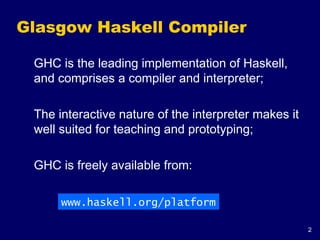
GHC is the leading implementation of Haskell,
and comprises a compiler and interpreter;
The interactive nature of the interpreter makes it
well suited for teaching and prototyping;
GHC is freely available from:
www.haskell.org/platform
3
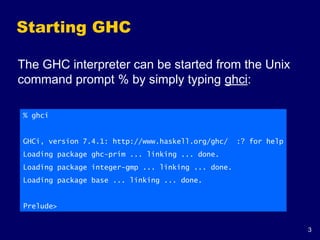
Starting GHC
% ghci
GHCi, version 7.4.1: http://www.haskell.org/ghc/ :? for help
Loading package ghc-prim ... linking ... done.
Loading package integer-gmp ... linking ... done.
Loading package base ... linking ... done.
Prelude>
The GHC interpreter can be started from the Unix
command prompt % by simply typing ghci:
4
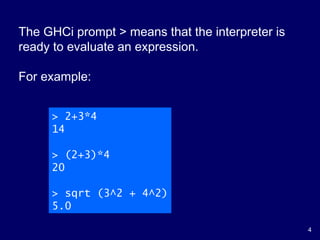
The GHCi prompt > means that the interpreter is
ready to evaluate an expression.
For example:
> 2+3*4
14
> (2+3)*4
20
> sqrt (3^2 + 4^2)
5.0
5
The Standard Prelude
Haskell comes with a large number of standard
library functions. In addition to the familiar
numeric functions such as + and *, the library
also provides many useful functions on lists.
Select the first element of a list:
> head [1,2,3,4,5]
1
6
Remove the first element from a list:
> tail [1,2,3,4,5]
[2,3,4,5]
Select the nth element of a list:
> [1,2,3,4,5] !! 2
3
Select the first n elements of a list:
> take 3 [1,2,3,4,5]
[1,2,3]
7
Remove the first n elements from a list:
> drop 3 [1,2,3,4,5]
[4,5]
Calculate the length of a list:
> length [1,2,3,4,5]
5
Calculate the sum of a list of numbers:
> sum [1,2,3,4,5]
15
8
Calculate the product of a list of numbers:
> product [1,2,3,4,5]
120
Append two lists:
> [1,2,3] ++ [4,5]
[1,2,3,4,5]
Reverse a list:
> reverse [1,2,3,4,5]
[5,4,3,2,1]
9
Function Application
In mathematics, function application is denoted
using parentheses, and multiplication is often
denoted using juxtaposition or space.
f(a,b) + c d
Apply the function f to a and b, and add
the result to the product of c and d.
10
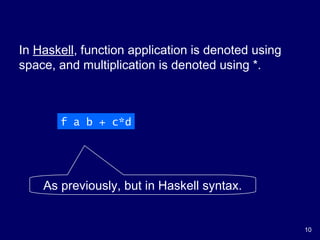
In Haskell, function application is denoted using
space, and multiplication is denoted using *.
f a b + c*d
As previously, but in Haskell syntax.
11
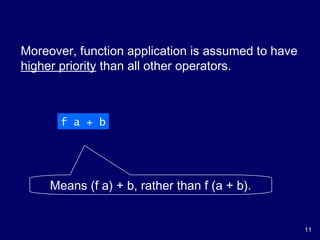
Moreover, function application is assumed to have
higher priority than all other operators.
f a + b
Means (f a) + b, rather than f (a + b).
12
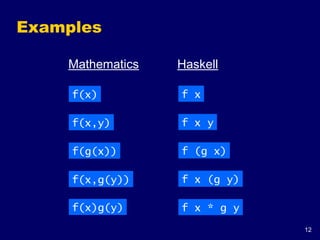
Examples
Mathematics Haskell
f(x)
f(x,y)
f(g(x))
f(x,g(y))
f(x)g(y)
f x
f x y
f (g x)
f x (g y)
f x * g y
13
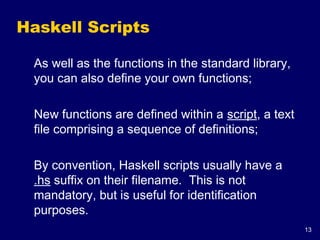
Haskell Scripts
As well as the functions in the standard library,
you can also define your own functions;
New functions are defined within a script, a text
file comprising a sequence of definitions;
By convention, Haskell scripts usually have a
.hs suffix on their filename. This is not
mandatory, but is useful for identification
purposes.
14
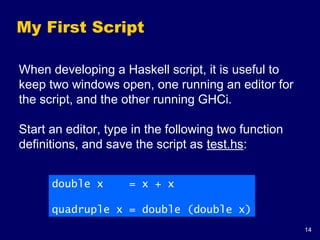
My First Script
double x = x + x
quadruple x = double (double x)
When developing a Haskell script, it is useful to
keep two windows open, one running an editor for
the script, and the other running GHCi.
Start an editor, type in the following two function
definitions, and save the script as test.hs:
15
% ghci test.hs
Leaving the editor open, in another window start up
GHCi with the new script:
> quadruple 10
40
> take (double 2) [1,2,3,4,5,6]
[1,2,3,4]
Now both the standard library and the file test.hs
are loaded, and functions from both can be used:
16
factorial n = product [1..n]
average ns = sum ns `div` length ns
Leaving GHCi open, return to the editor, add the
following two definitions, and resave:
div is enclosed in back quotes, not forward;
x `f` y is just syntactic sugar for f x y.
Note:
17
> :reload
Reading file "test.hs"
> factorial 10
3628800
> average [1,2,3,4,5]
3
GHCi does not automatically detect that the script
has been changed, so a reload command must be
executed before the new definitions can be used:
18
Naming Requirements
Function and argument names must begin with
a lower-case letter. For example:
myFun fun1 arg_2 x’
By convention, list arguments usually have an s
suffix on their name. For example:
xs ns nss
19
The Layout Rule
In a sequence of definitions, each definition must
begin in precisely the same column:
a = 10
b = 20
c = 30
a = 10
b = 20
c = 30
a = 10
b = 20
c = 30
20
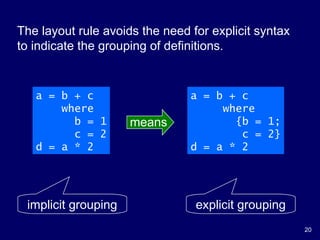
means
The layout rule avoids the need for explicit syntax
to indicate the grouping of definitions.
a = b + c
where
b = 1
c = 2
d = a * 2
a = b + c
where
{b = 1;
c = 2}
d = a * 2
implicit grouping explicit grouping
21
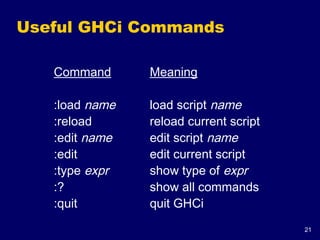
Useful GHCi Commands
Command Meaning
:load name load script name
:reload reload current script
:edit name edit script name
:edit edit current script
:type expr show type of expr
:? show all commands
:quit quit GHCi
22
Exercises
N = a ’div’ length xs
where
a = 10
xs = [1,2,3,4,5]
Try out slides 2-8 and 14-17 using GHCi.
Fix the syntax errors in the program below,
and test your solution using GHCi.
(1)
(2)
23
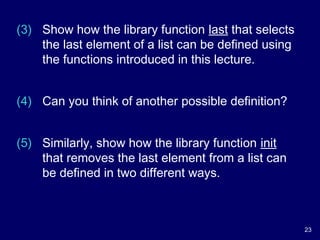
Show how the library function last that selects
the last element of a list can be defined using
the functions introduced in this lecture.
(3)
Similarly, show how the library function init
that removes the last element from a list can
be defined in two different ways.
(5)
Can you think of another possible definition?(4)

Chapter2 Haskell

  • 1.
  • 2.
    2 Glasgow Haskell Compiler GHCis the leading implementation of Haskell, and comprises a compiler and interpreter; The interactive nature of the interpreter makes it well suited for teaching and prototyping; GHC is freely available from: www.haskell.org/platform
  • 3.
    3 Starting GHC % ghci GHCi,version 7.4.1: http://www.haskell.org/ghc/ :? for help Loading package ghc-prim ... linking ... done. Loading package integer-gmp ... linking ... done. Loading package base ... linking ... done. Prelude> The GHC interpreter can be started from the Unix command prompt % by simply typing ghci:
  • 4.
    4 The GHCi prompt> means that the interpreter is ready to evaluate an expression. For example: > 2+3*4 14 > (2+3)*4 20 > sqrt (3^2 + 4^2) 5.0
  • 5.
    5 The Standard Prelude Haskellcomes with a large number of standard library functions. In addition to the familiar numeric functions such as + and *, the library also provides many useful functions on lists. Select the first element of a list: > head [1,2,3,4,5] 1
  • 6.
    6 Remove the firstelement from a list: > tail [1,2,3,4,5] [2,3,4,5] Select the nth element of a list: > [1,2,3,4,5] !! 2 3 Select the first n elements of a list: > take 3 [1,2,3,4,5] [1,2,3]
  • 7.
    7 Remove the firstn elements from a list: > drop 3 [1,2,3,4,5] [4,5] Calculate the length of a list: > length [1,2,3,4,5] 5 Calculate the sum of a list of numbers: > sum [1,2,3,4,5] 15
  • 8.
    8 Calculate the productof a list of numbers: > product [1,2,3,4,5] 120 Append two lists: > [1,2,3] ++ [4,5] [1,2,3,4,5] Reverse a list: > reverse [1,2,3,4,5] [5,4,3,2,1]
  • 9.
    9 Function Application In mathematics,function application is denoted using parentheses, and multiplication is often denoted using juxtaposition or space. f(a,b) + c d Apply the function f to a and b, and add the result to the product of c and d.
  • 10.
    10 In Haskell, functionapplication is denoted using space, and multiplication is denoted using *. f a b + c*d As previously, but in Haskell syntax.
  • 11.
    11 Moreover, function applicationis assumed to have higher priority than all other operators. f a + b Means (f a) + b, rather than f (a + b).
  • 12.
  • 13.
    13 Haskell Scripts As wellas the functions in the standard library, you can also define your own functions; New functions are defined within a script, a text file comprising a sequence of definitions; By convention, Haskell scripts usually have a .hs suffix on their filename. This is not mandatory, but is useful for identification purposes.
  • 14.
    14 My First Script doublex = x + x quadruple x = double (double x) When developing a Haskell script, it is useful to keep two windows open, one running an editor for the script, and the other running GHCi. Start an editor, type in the following two function definitions, and save the script as test.hs:
  • 15.
    15 % ghci test.hs Leavingthe editor open, in another window start up GHCi with the new script: > quadruple 10 40 > take (double 2) [1,2,3,4,5,6] [1,2,3,4] Now both the standard library and the file test.hs are loaded, and functions from both can be used:
  • 16.
    16 factorial n =product [1..n] average ns = sum ns `div` length ns Leaving GHCi open, return to the editor, add the following two definitions, and resave: div is enclosed in back quotes, not forward; x `f` y is just syntactic sugar for f x y. Note:
  • 17.
    17 > :reload Reading file"test.hs" > factorial 10 3628800 > average [1,2,3,4,5] 3 GHCi does not automatically detect that the script has been changed, so a reload command must be executed before the new definitions can be used:
  • 18.
    18 Naming Requirements Function andargument names must begin with a lower-case letter. For example: myFun fun1 arg_2 x’ By convention, list arguments usually have an s suffix on their name. For example: xs ns nss
  • 19.
    19 The Layout Rule Ina sequence of definitions, each definition must begin in precisely the same column: a = 10 b = 20 c = 30 a = 10 b = 20 c = 30 a = 10 b = 20 c = 30
  • 20.
    20 means The layout ruleavoids the need for explicit syntax to indicate the grouping of definitions. a = b + c where b = 1 c = 2 d = a * 2 a = b + c where {b = 1; c = 2} d = a * 2 implicit grouping explicit grouping
  • 21.
    21 Useful GHCi Commands CommandMeaning :load name load script name :reload reload current script :edit name edit script name :edit edit current script :type expr show type of expr :? show all commands :quit quit GHCi
  • 22.
    22 Exercises N = a’div’ length xs where a = 10 xs = [1,2,3,4,5] Try out slides 2-8 and 14-17 using GHCi. Fix the syntax errors in the program below, and test your solution using GHCi. (1) (2)
  • 23.
    23 Show how thelibrary function last that selects the last element of a list can be defined using the functions introduced in this lecture. (3) Similarly, show how the library function init that removes the last element from a list can be defined in two different ways. (5) Can you think of another possible definition?(4)