Introduction to Powers of 10
Topics Covered in This Chapter:
I-1: Scientific Notation
I-2: Engineering Notation and Metric Prefixes
I-3: Converting between Metric Prefixes
I-4: Addition and Subtraction Involving
Powers of 10 Notation
© 2007 The McGraw-Hill Companies, Inc. All rights reserved.
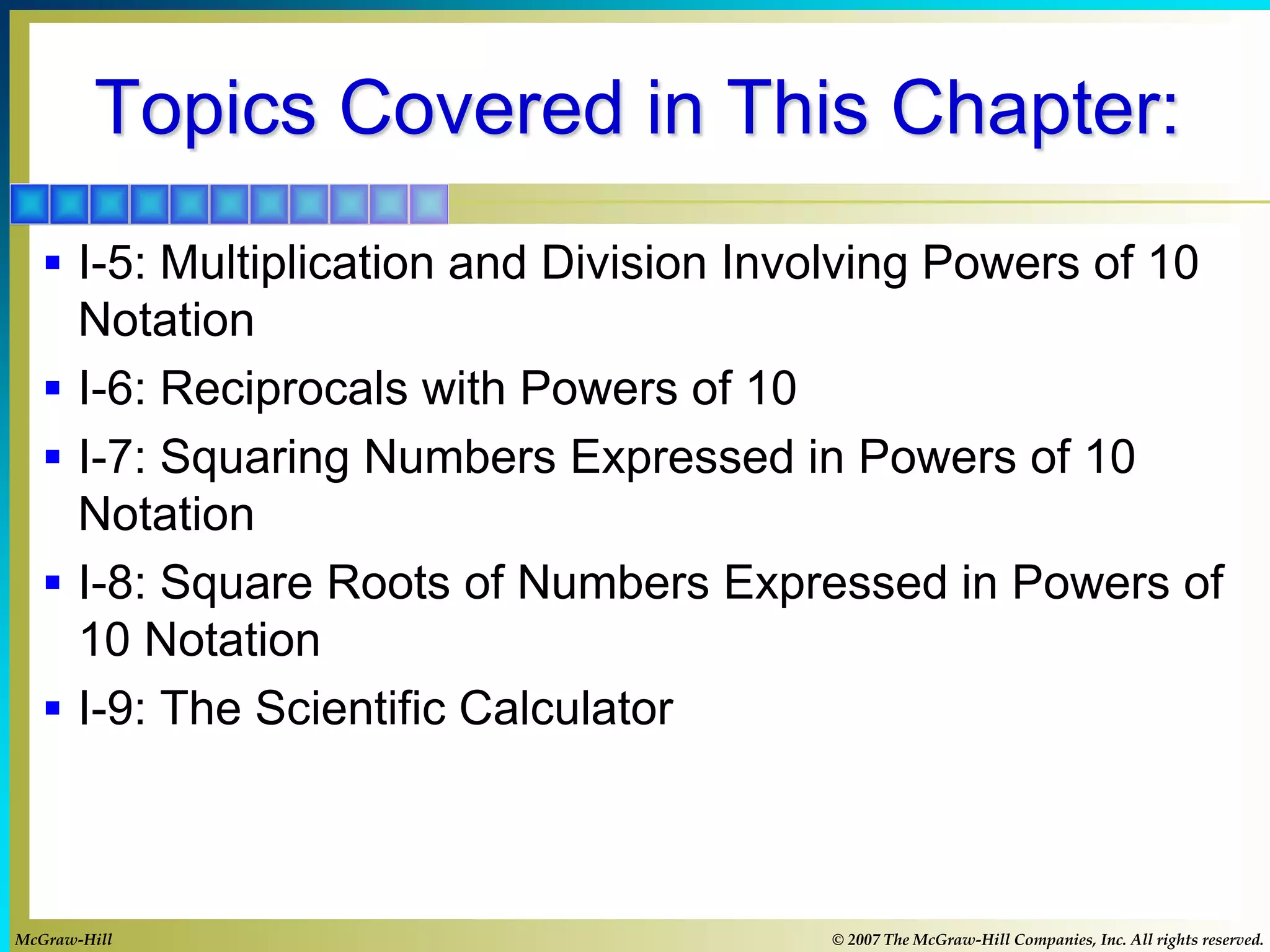
Topics Covered in This Chapter:
 I-5: Multiplication and Division Involving Powers of 10
Notation
 I-6: Reciprocals with Powers of 10
 I-7: Squaring Numbers Expressed in Powers of 10
Notation
 I-8: Square Roots of Numbers Expressed in Powers of
10 Notation
 I-9: The Scientific Calculator
McGraw-Hill © 2007 The McGraw-Hill Companies, Inc. All rights reserved.
Introduction to Powers of 10
 Electrical quantities are typically very large or very
small.
 Typical examples of values encountered in electronics
are 2,200,000 ohms and 0.0000025 amperes.
 Powers of 10 notation enables us to work with these
very large and small quantities efficiently.
 Two common forms of powers of 10 notation are:
 Scientific notation
 Engineering notation
Introduction to Powers of 10
 The use of engineering notation is more common than
scientific notation in electronics.
 The powers of 10 used in engineering notation can be
replaced with a corresponding metric prefix.
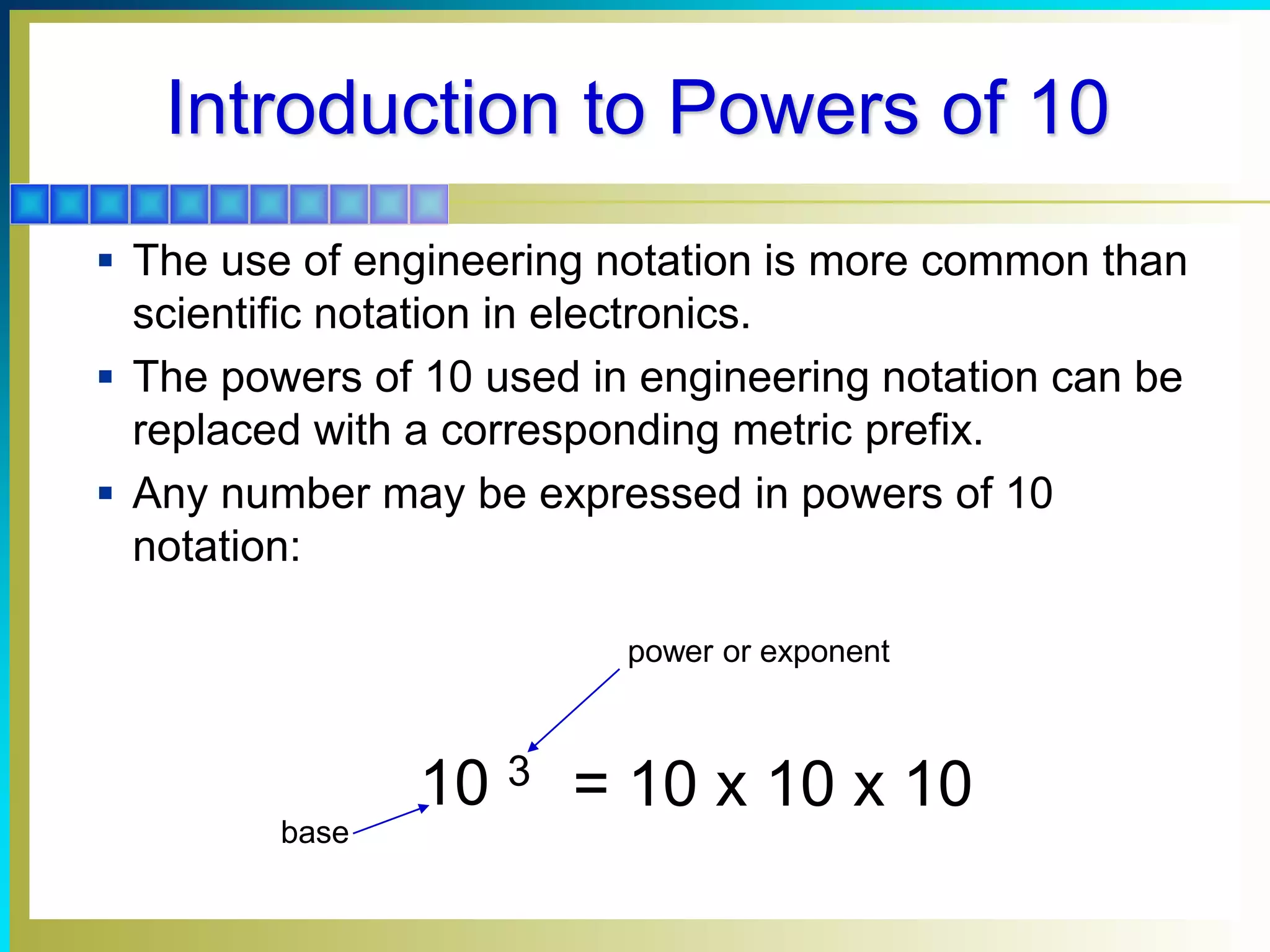
 Any number may be expressed in powers of 10
notation:
= 10 x 10 x 10
10 3
power or exponent
base
I-1: Scientific Notation
 Positive exponents indicate numbers greater than 1.
 Negative exponents indicate numbers less than 1.
 Any number raised to the zero power is 1: 100 = 1.
 Any number raised to the power of 1 equals itself:
101=10.
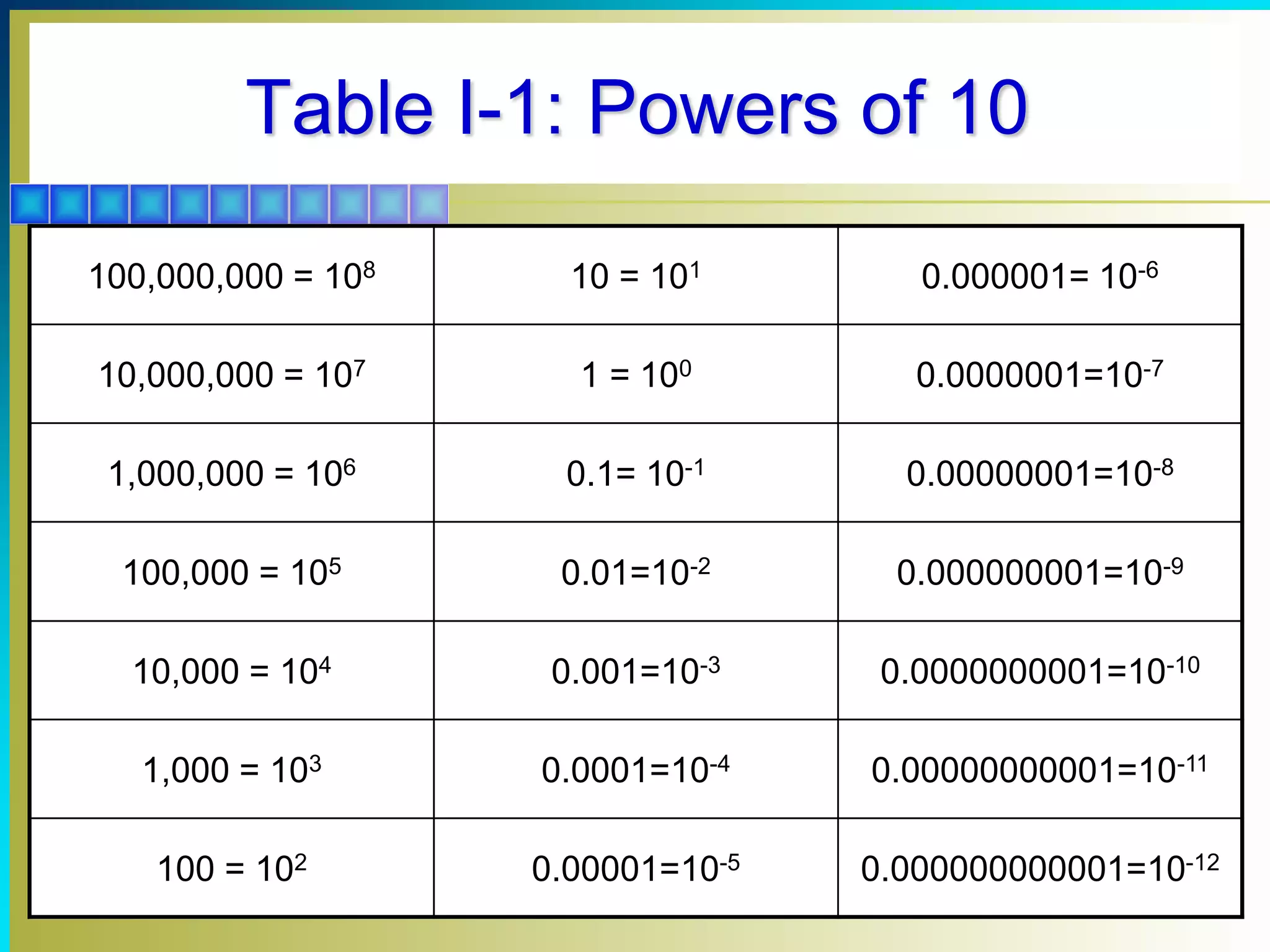
Table I-1: Powers of 10
100,000,000 = 108 10 = 101 0.000001= 10-6
10,000,000 = 107 1 = 100 0.0000001=10-7
1,000,000 = 106 0.1= 10-1 0.00000001=10-8
100,000 = 105 0.01=10-2 0.000000001=10-9
10,000 = 104 0.001=10-3 0.0000000001=10-10
1,000 = 103 0.0001=10-4 0.00000000001=10-11
100 = 102 0.00001=10-5 0.000000000001=10-12
I-1: Scientific Notation
 Expressing a Number in Scientific Notation
 Scientific notation is a form of powers of 10 notation that
expresses a number between 1 and 10 times a power
of 10.
 The power of 10 indicates the placement of the decimal
point.
3,900 = 3900.0
= 3.9 x 10³ decimal point moved
3 places to the left.
0.0000056 = 5.6 x 10⁻⁶ decimal point moved
6 places to the right.
I-1: Scientific Notation
 When expressing a number in scientific notation,
remember the following rules:
 Rule 1: Express the number as a number between 1
and 10 times a power of 10.
 Rule 2: If the decimal point is moved to the left in the
original number, make the power of 10 positive. If the
decimal point is moved to the right in the original
number, make the power of 10 negative.
 Rule 3: The power of 10 always equals the number
of places the decimal point has been shifted to the
left or right in the original number.
Knowledge Check
 Express the following numbers in scientific notation
 76,300,000
 0.000342
I-1: Scientific Notation
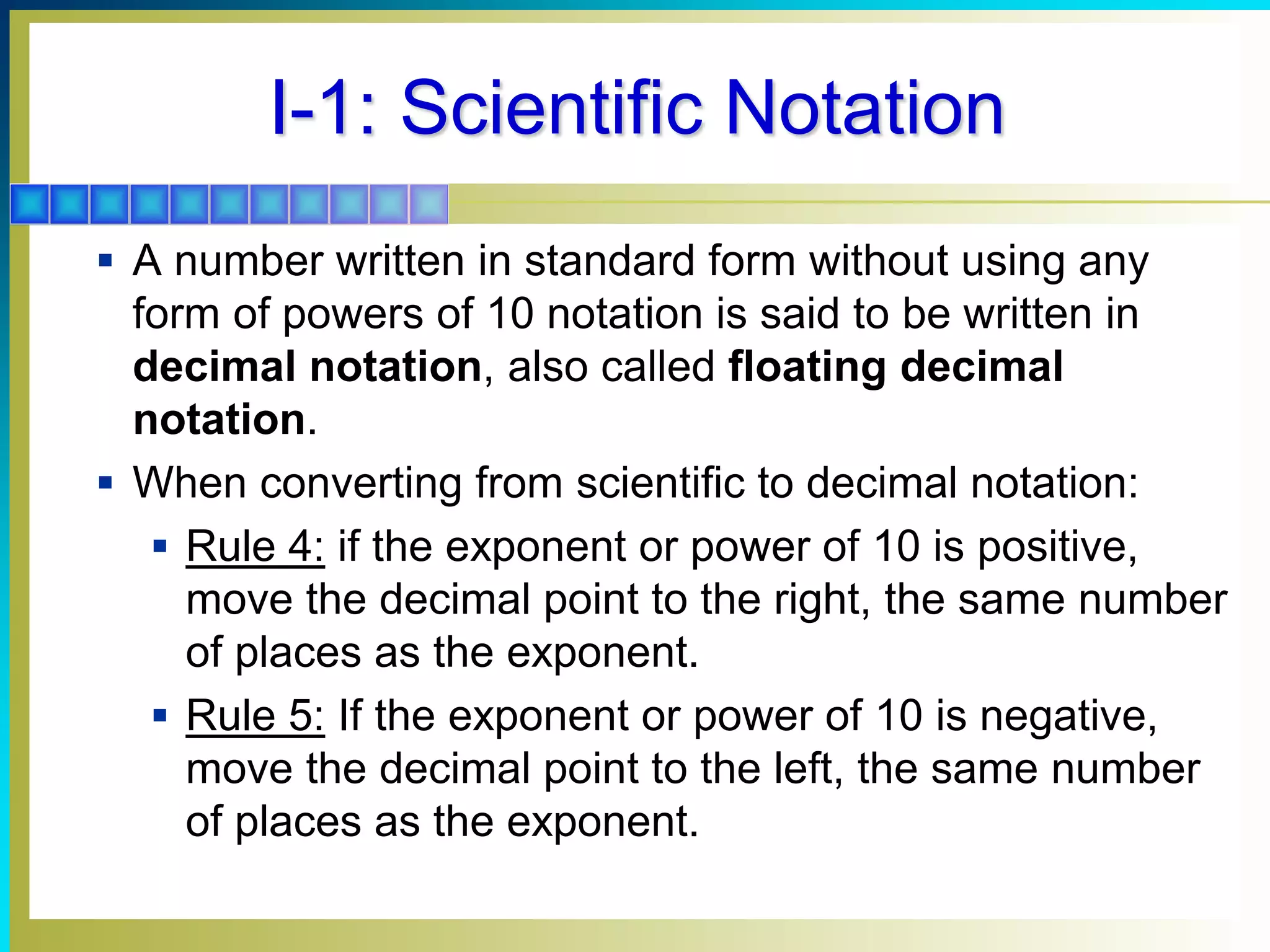
 A number written in standard form without using any
form of powers of 10 notation is said to be written in
decimal notation, also called floating decimal
notation.
 When converting from scientific to decimal notation:
 Rule 4: if the exponent or power of 10 is positive,
move the decimal point to the right, the same number
of places as the exponent.
 Rule 5: If the exponent or power of 10 is negative,
move the decimal point to the left, the same number
of places as the exponent.
Knowledge Check
 Convert the following numbers into decimal notation
 2.75 x 10⁻⁵
 8.41 x 10⁴
 4.6 x 10⁻⁷
I-2: Engineering Notation
and Metric Prefixes
 Engineering notation is similar to scientific notation,
except that the numerical coefficient is between 1 and
1000 and the exponent is always a multiple of 3.
27,000 = 2.7 x 104
= 27 x 103
scientific notation
engineering notation
.00047 = 4.7 x 10 -4
= 470 x 10-6
scientific notation
engineering notation
I-2: Engineering Notation
and Metric Prefixes
 When expressing a number in engineering notation,
remember:
 Rule 6: Express the original number in scientific
notation first. If the power if 10 is a multiple of 3, the
number appears the same in both scientific and
engineering notation.
 Rule 7: If the original number expressed in scientific
notation does not use a power of 10 that is a multiple
of 3, the power of 10 must be either increased or
decreased until it is a multiple of 3. Adjust the
decimal point in the numerical part of the expression
to compensate for the change in the power of 10.
I-2: Engineering Notation
and Metric Prefixes
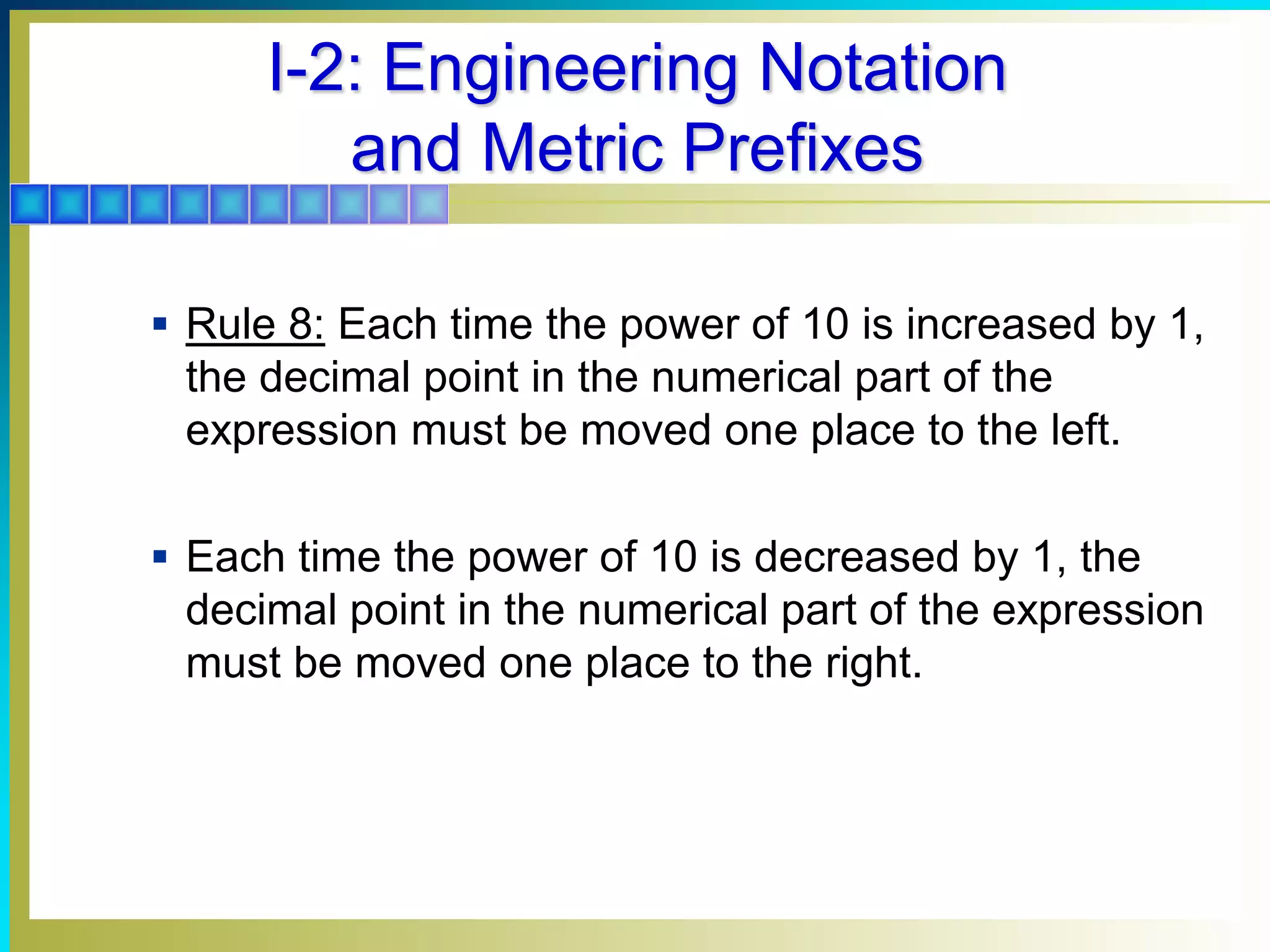
 Rule 8: Each time the power of 10 is increased by 1,
the decimal point in the numerical part of the
expression must be moved one place to the left.
 Each time the power of 10 is decreased by 1, the
decimal point in the numerical part of the expression
must be moved one place to the right.
I-2: Engineering Notation
and Metric Prefixes
 Metric Prefixes
 The metric prefixes represent powers of 10 that are
multiples of 3.
 Once a number is expressed in engineering notation, its
power of 10 can be replaced with its metric prefix.
1,000,000 Ω = 1.0 x 10⁶ Ω
= 1.0 Mega Ω
= 1.0 MΩ
I-2: Engineering Notation
and Metric Prefixes
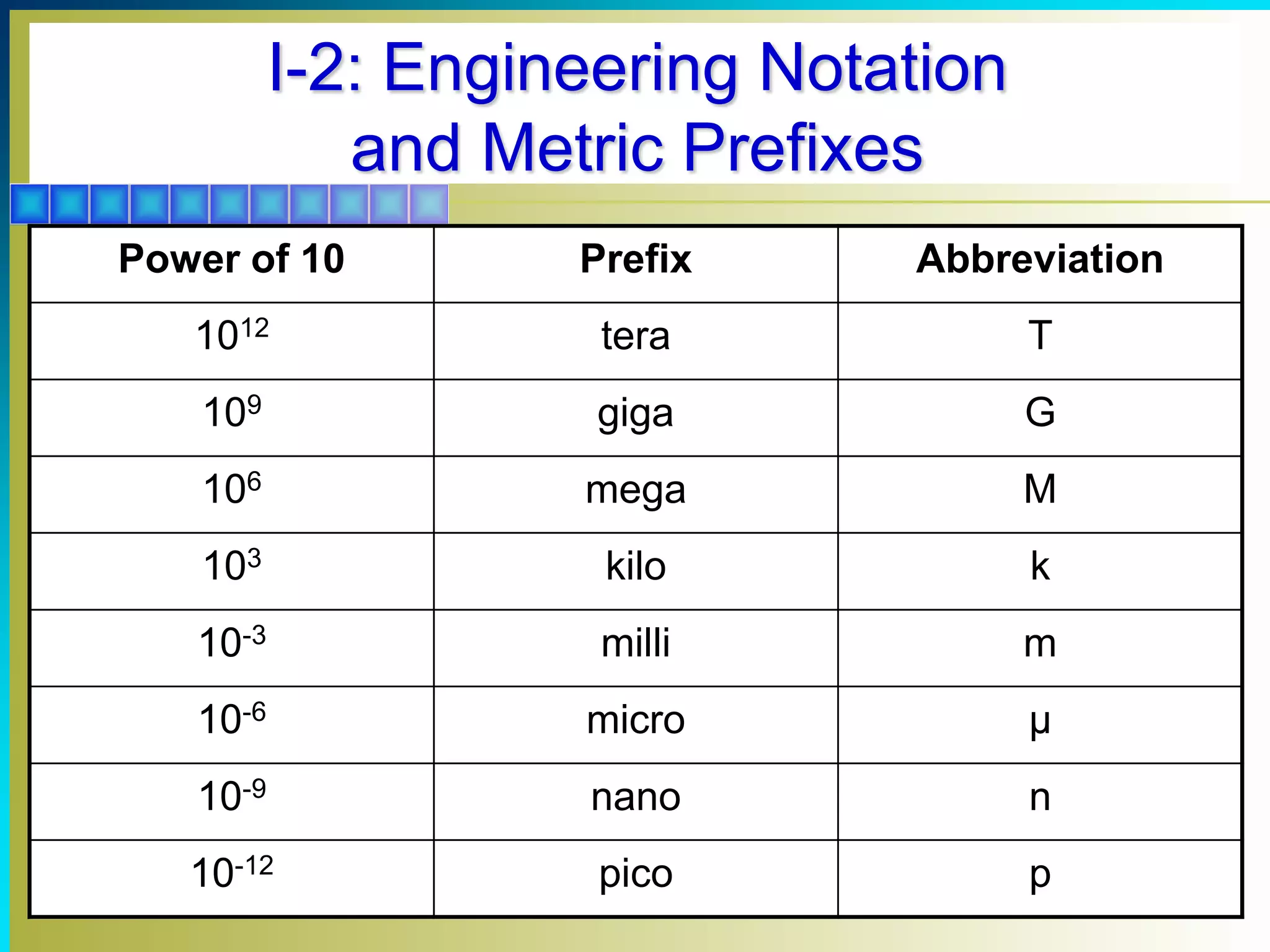
Power of 10 Prefix Abbreviation
1012 tera T
109 giga G
106 mega M
103 kilo k
10-3 milli m
10-6 micro μ
10-9 nano n
10-12 pico p
Knowledge Check
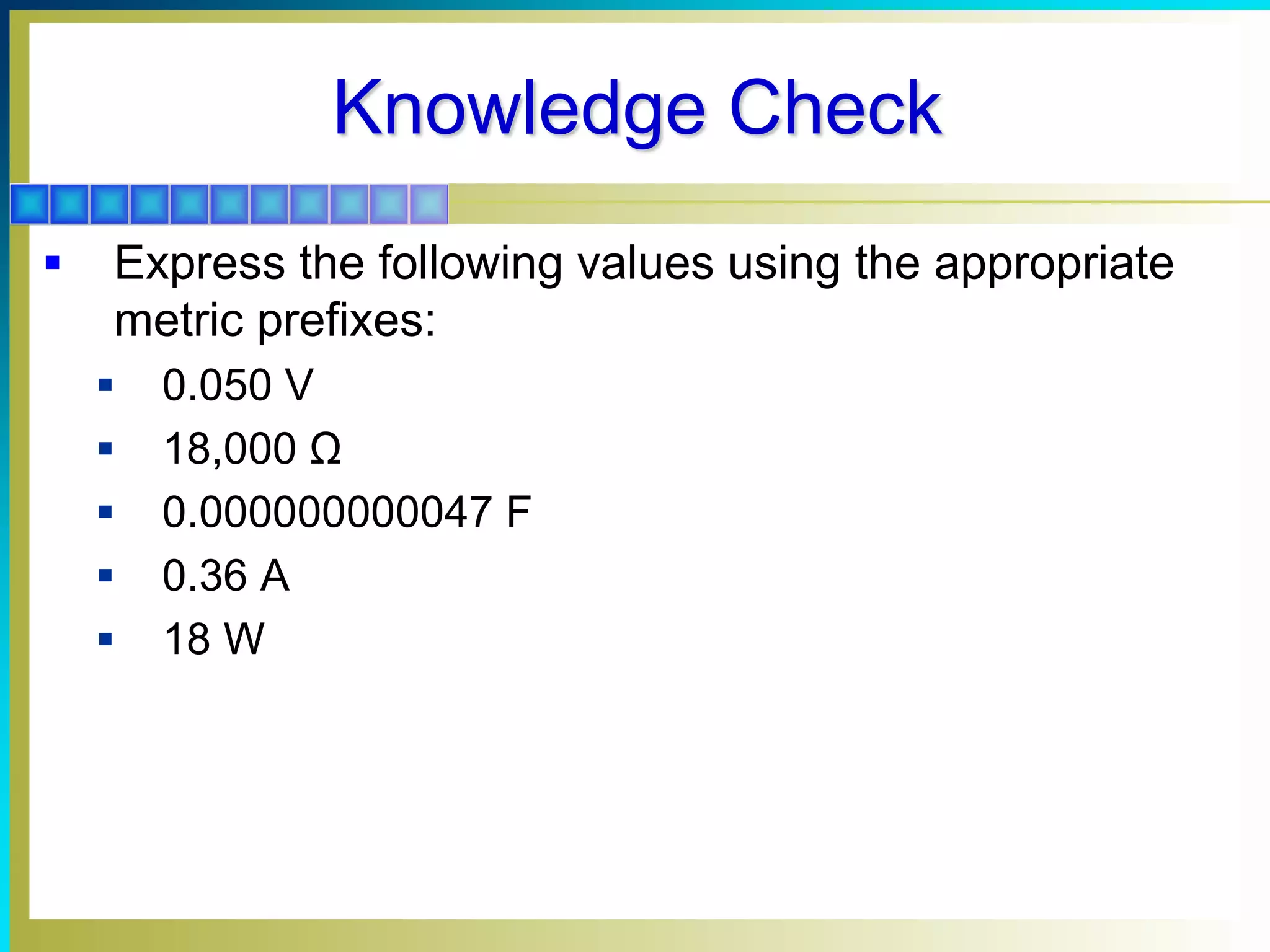
 Express the following values using the appropriate
metric prefixes:
 0.050 V
 18,000 Ω
 0.000000000047 F
 0.36 A
 18 W
I-3: Converting between
Metric Prefixes
 Converting from one metric prefix to another is a
change in the power of 10.
 When the power of 10 is changed, the numerical part of
the expression must also change so the value of the
original number stays the same. Make the following
conversion:
2700 kΩ to MΩ:
2700 x 103 Ω to 2.7 x 10⁶Ω:
2.7 x 10⁶Ω
2.7 MΩ
Example
 Convert 45 mA to μA
 Recall that prefix milli (m) corresponds to 10-3, and
 recall that prefix micro (μ) corresponds to 10-6
 Since 10-6 is less that 10-3 by a factor of 1000 (103), then
 numerical part of the expression must be increased by
the same factor
 Therefore,
45 mA = 45,000 μA
I-3: Converting between
Metric Prefixes
Rule 9: When converting from a larger metric prefix
to a smaller one, increase the numerical part of the
expression by the same factor that the metric prefix
has been decreased.
Conversely, when converting from a smaller metric
prefix to a larger one, decrease the numerical part
of the expression by the same factor that the metric
prefix has been increased.
Base-10 Place-value Chart
Knowledge Check
 Convert 2.2 MΩ to kΩ
 Convert 47,000 pF to nF
 Convert 2500 μA to mA
 Convert 6.25 mW to μW
I-4: Addition and Subtraction Involving
Powers of 10 Notation
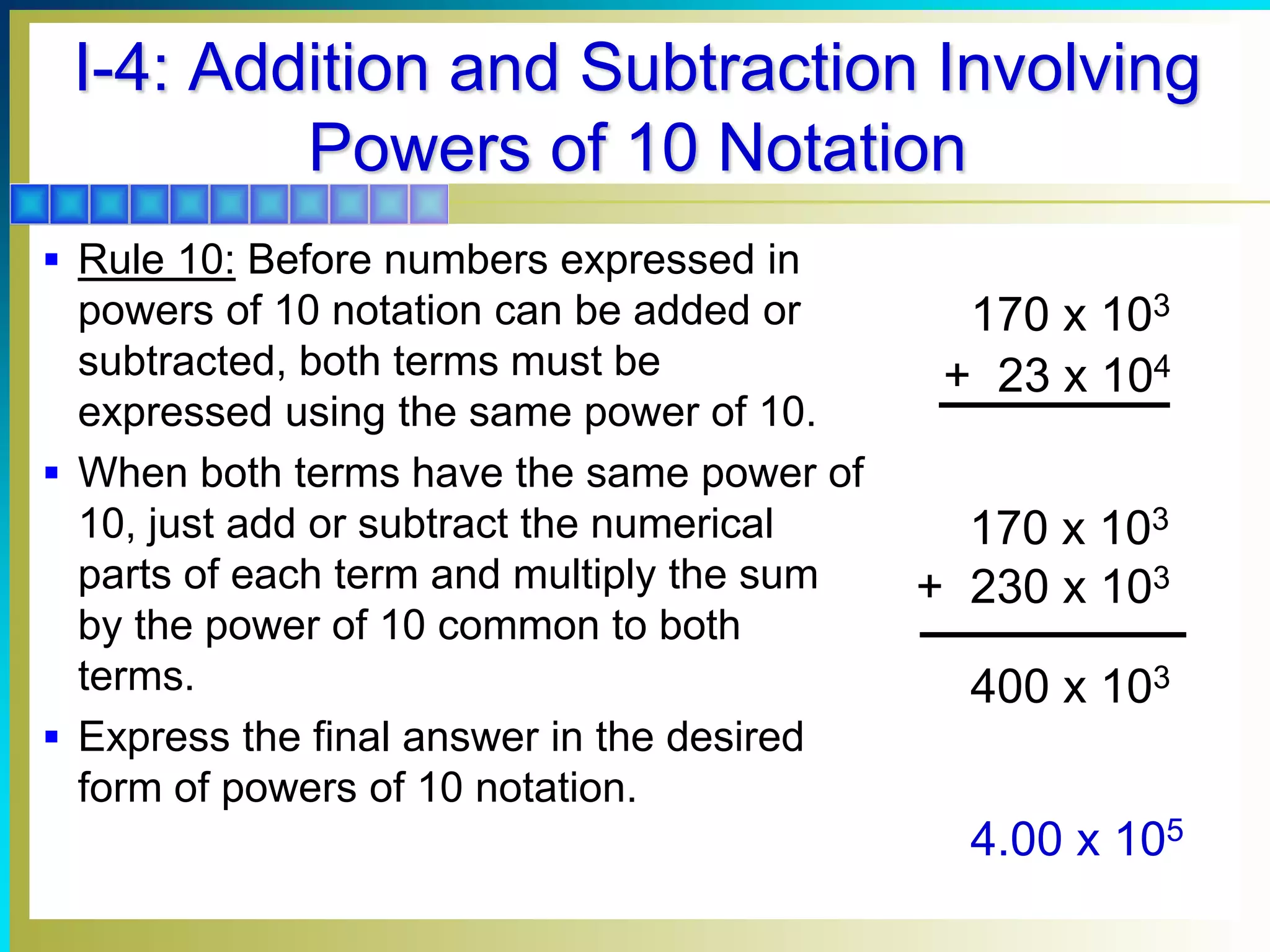
 Rule 10: Before numbers expressed in
powers of 10 notation can be added or
subtracted, both terms must be
expressed using the same power of 10.
 When both terms have the same power of
10, just add or subtract the numerical
parts of each term and multiply the sum
by the power of 10 common to both
terms.
 Express the final answer in the desired
form of powers of 10 notation.
4.00 x 10⁵
170 x 103
+ 23 x 104
400 x 103
170 x 103
+ 230 x 103
Knowledge Check
 Perform the following operations and express your
answer in scientific notation:
 (15 x 102) + (6.0 x 10⁴)
 (550 x 10-3) – (250 x 10-4)
I-5: Multiplication and Division Involving
Powers of 10 Notation
 Rule 11: When multiplying
numbers expressed in powers
of 10 notation, multiply the
numerical parts and powers of
10 separately.
 When multiplying powers of 10,
simply add the exponents to
obtain the new power of 10.
 Express the final answer in the
desired form of powers of 10
notation.
(3 x 106) x (150 x 102)
3 x150 = 450
106 x 102 = 10 6+2 = 108
450 x 108
4.5 x 10¹⁰
I-5: Multiplication and Division Involving
Powers of 10 Notation
 Rule 12: When dividing numbers
expressed in powers of 10
notation, divide the numerical
parts and powers of 10
separately.
 When dividing powers of 10,
subtract the power of 10 in the
denominator from the power of 10
in the numerator.
 Express the final answer in the
desired form of powers of 10
notation.
(5.0 x 10⁷) / (2.0 x 10⁴)
5 / 2 = 2.5
107 / 104 = 10 7-4 = 103
2.5 x 10³
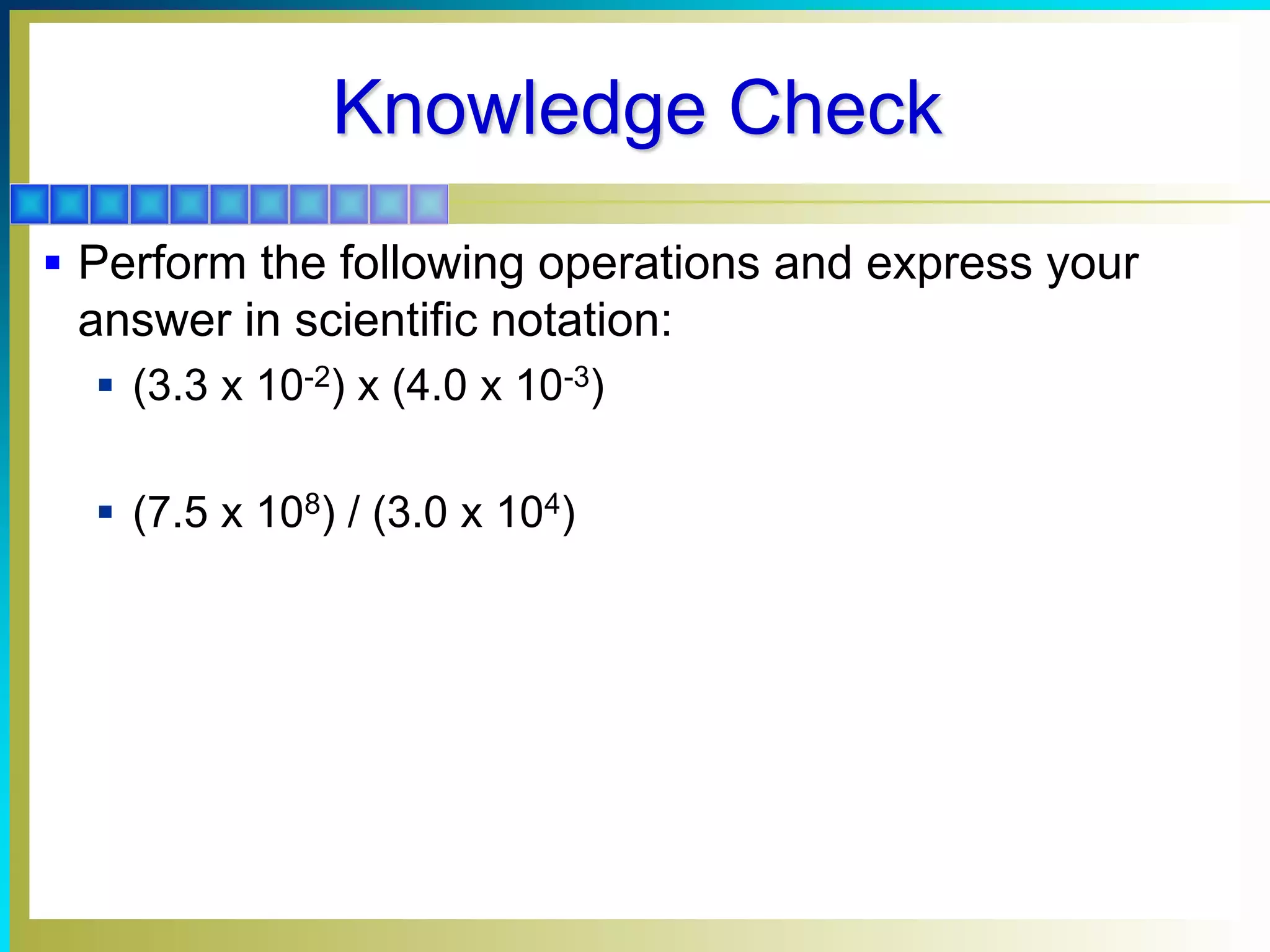
Knowledge Check
 Perform the following operations and express your
answer in scientific notation:
 (3.3 x 10-2) x (4.0 x 10-3)
 (7.5 x 10⁸) / (3.0 x 10⁴)
I-6: Reciprocals with Powers of 10
 Taking the reciprocal of a power of 10 is a special
case of division using powers of 10.
 The 1 in the numerator = 100.
 Rule 13: When taking the reciprocal of a power of
10, simply change the sign of the exponent or
power of 10.
 Reciprocal of 105 = 100-5 10-5
= =
=
1
105
100
105
I-7: Squaring Numbers Expressed in
Powers of 10 Notation
 Rule 14: To square a
number expressed in
powers of 10 notation,
square the numerical part of
the expression and double
the power of 10.
 Express the answer in the
desired form of powers of
10 notation.
(3.0 x 10⁴ )2
3.02 = 9.0
(104)2 = (10 4 x 2) = 108
9.0 x 10⁸
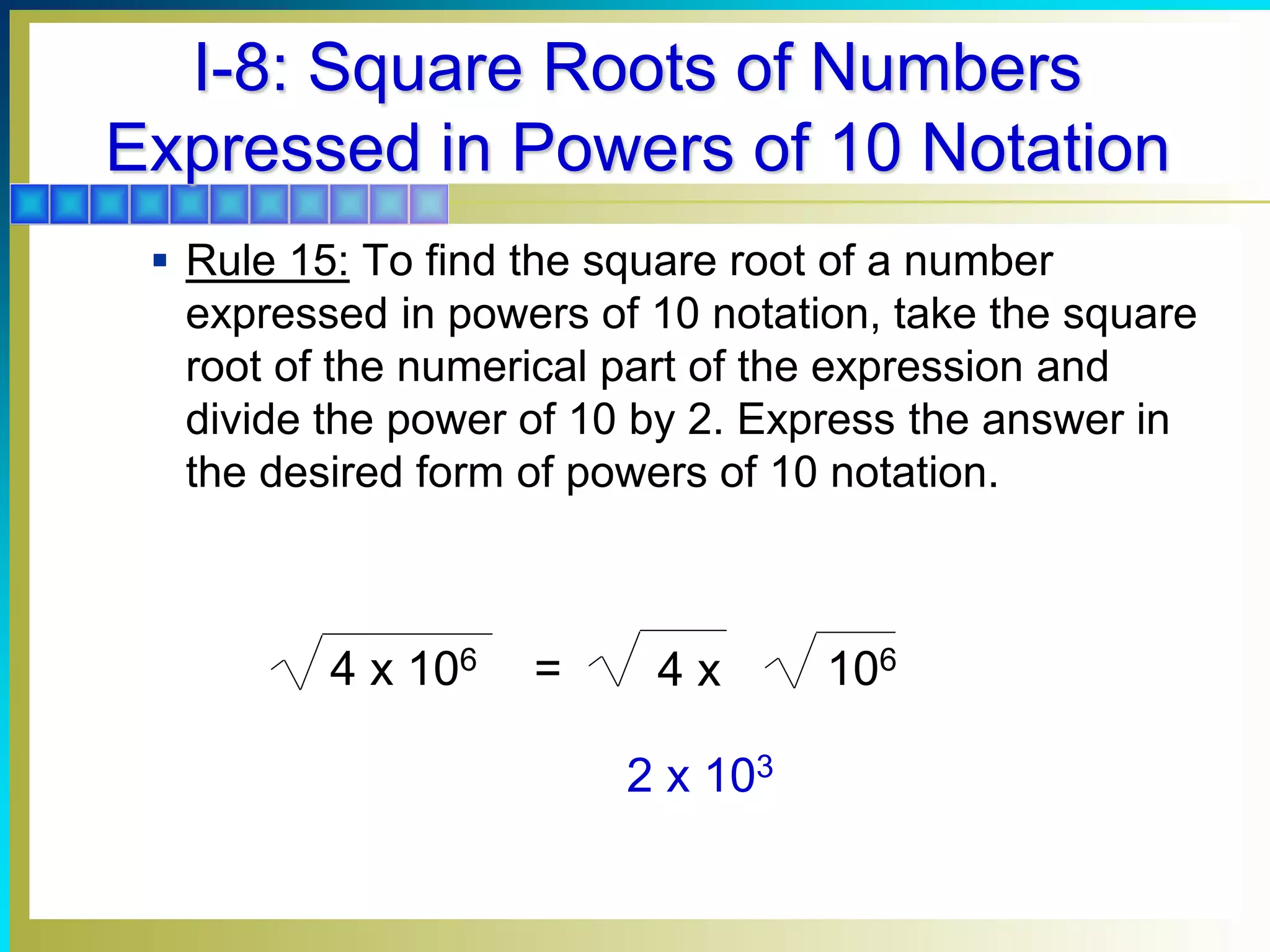
I-8: Square Roots of Numbers
Expressed in Powers of 10 Notation
 Rule 15: To find the square root of a number
expressed in powers of 10 notation, take the square
root of the numerical part of the expression and
divide the power of 10 by 2. Express the answer in
the desired form of powers of 10 notation.
2 x 103
=
4 x 10⁶ 4 x 10⁶
I-9: The Scientific Calculator
 Select a calculator capable of performing all the
mathematical functions and operations necessary in
electronics.
 Choose one that can store and retrieve mathematical
results from one or more memory locations.
 Read the calculator’s instructions carefully.

Chapter00.ppt

  • 1.
    Introduction to Powersof 10 Topics Covered in This Chapter: I-1: Scientific Notation I-2: Engineering Notation and Metric Prefixes I-3: Converting between Metric Prefixes I-4: Addition and Subtraction Involving Powers of 10 Notation © 2007 The McGraw-Hill Companies, Inc. All rights reserved.
  • 2.
    Topics Covered inThis Chapter:  I-5: Multiplication and Division Involving Powers of 10 Notation  I-6: Reciprocals with Powers of 10  I-7: Squaring Numbers Expressed in Powers of 10 Notation  I-8: Square Roots of Numbers Expressed in Powers of 10 Notation  I-9: The Scientific Calculator McGraw-Hill © 2007 The McGraw-Hill Companies, Inc. All rights reserved.
  • 3.
    Introduction to Powersof 10  Electrical quantities are typically very large or very small.  Typical examples of values encountered in electronics are 2,200,000 ohms and 0.0000025 amperes.  Powers of 10 notation enables us to work with these very large and small quantities efficiently.  Two common forms of powers of 10 notation are:  Scientific notation  Engineering notation
  • 4.
    Introduction to Powersof 10  The use of engineering notation is more common than scientific notation in electronics.  The powers of 10 used in engineering notation can be replaced with a corresponding metric prefix.  Any number may be expressed in powers of 10 notation: = 10 x 10 x 10 10 3 power or exponent base
  • 5.
    I-1: Scientific Notation Positive exponents indicate numbers greater than 1.  Negative exponents indicate numbers less than 1.  Any number raised to the zero power is 1: 100 = 1.  Any number raised to the power of 1 equals itself: 101=10.
  • 6.
    Table I-1: Powersof 10 100,000,000 = 108 10 = 101 0.000001= 10-6 10,000,000 = 107 1 = 100 0.0000001=10-7 1,000,000 = 106 0.1= 10-1 0.00000001=10-8 100,000 = 105 0.01=10-2 0.000000001=10-9 10,000 = 104 0.001=10-3 0.0000000001=10-10 1,000 = 103 0.0001=10-4 0.00000000001=10-11 100 = 102 0.00001=10-5 0.000000000001=10-12
  • 7.
    I-1: Scientific Notation Expressing a Number in Scientific Notation  Scientific notation is a form of powers of 10 notation that expresses a number between 1 and 10 times a power of 10.  The power of 10 indicates the placement of the decimal point. 3,900 = 3900.0 = 3.9 x 10³ decimal point moved 3 places to the left. 0.0000056 = 5.6 x 10⁻⁶ decimal point moved 6 places to the right.
  • 8.
    I-1: Scientific Notation When expressing a number in scientific notation, remember the following rules:  Rule 1: Express the number as a number between 1 and 10 times a power of 10.  Rule 2: If the decimal point is moved to the left in the original number, make the power of 10 positive. If the decimal point is moved to the right in the original number, make the power of 10 negative.  Rule 3: The power of 10 always equals the number of places the decimal point has been shifted to the left or right in the original number.
  • 9.
    Knowledge Check  Expressthe following numbers in scientific notation  76,300,000  0.000342
  • 10.
    I-1: Scientific Notation A number written in standard form without using any form of powers of 10 notation is said to be written in decimal notation, also called floating decimal notation.  When converting from scientific to decimal notation:  Rule 4: if the exponent or power of 10 is positive, move the decimal point to the right, the same number of places as the exponent.  Rule 5: If the exponent or power of 10 is negative, move the decimal point to the left, the same number of places as the exponent.
  • 11.
    Knowledge Check  Convertthe following numbers into decimal notation  2.75 x 10⁻⁵  8.41 x 10⁴  4.6 x 10⁻⁷
  • 12.
    I-2: Engineering Notation andMetric Prefixes  Engineering notation is similar to scientific notation, except that the numerical coefficient is between 1 and 1000 and the exponent is always a multiple of 3. 27,000 = 2.7 x 104 = 27 x 103 scientific notation engineering notation .00047 = 4.7 x 10 -4 = 470 x 10-6 scientific notation engineering notation
  • 13.
    I-2: Engineering Notation andMetric Prefixes  When expressing a number in engineering notation, remember:  Rule 6: Express the original number in scientific notation first. If the power if 10 is a multiple of 3, the number appears the same in both scientific and engineering notation.  Rule 7: If the original number expressed in scientific notation does not use a power of 10 that is a multiple of 3, the power of 10 must be either increased or decreased until it is a multiple of 3. Adjust the decimal point in the numerical part of the expression to compensate for the change in the power of 10.
  • 14.
    I-2: Engineering Notation andMetric Prefixes  Rule 8: Each time the power of 10 is increased by 1, the decimal point in the numerical part of the expression must be moved one place to the left.  Each time the power of 10 is decreased by 1, the decimal point in the numerical part of the expression must be moved one place to the right.
  • 15.
    I-2: Engineering Notation andMetric Prefixes  Metric Prefixes  The metric prefixes represent powers of 10 that are multiples of 3.  Once a number is expressed in engineering notation, its power of 10 can be replaced with its metric prefix. 1,000,000 Ω = 1.0 x 10⁶ Ω = 1.0 Mega Ω = 1.0 MΩ
  • 16.
    I-2: Engineering Notation andMetric Prefixes Power of 10 Prefix Abbreviation 1012 tera T 109 giga G 106 mega M 103 kilo k 10-3 milli m 10-6 micro μ 10-9 nano n 10-12 pico p
  • 17.
    Knowledge Check  Expressthe following values using the appropriate metric prefixes:  0.050 V  18,000 Ω  0.000000000047 F  0.36 A  18 W
  • 18.
    I-3: Converting between MetricPrefixes  Converting from one metric prefix to another is a change in the power of 10.  When the power of 10 is changed, the numerical part of the expression must also change so the value of the original number stays the same. Make the following conversion: 2700 kΩ to MΩ: 2700 x 103 Ω to 2.7 x 10⁶Ω: 2.7 x 10⁶Ω 2.7 MΩ
  • 19.
    Example  Convert 45mA to μA  Recall that prefix milli (m) corresponds to 10-3, and  recall that prefix micro (μ) corresponds to 10-6  Since 10-6 is less that 10-3 by a factor of 1000 (103), then  numerical part of the expression must be increased by the same factor  Therefore, 45 mA = 45,000 μA
  • 20.
    I-3: Converting between MetricPrefixes Rule 9: When converting from a larger metric prefix to a smaller one, increase the numerical part of the expression by the same factor that the metric prefix has been decreased. Conversely, when converting from a smaller metric prefix to a larger one, decrease the numerical part of the expression by the same factor that the metric prefix has been increased.
  • 21.
  • 22.
    Knowledge Check  Convert2.2 MΩ to kΩ  Convert 47,000 pF to nF  Convert 2500 μA to mA  Convert 6.25 mW to μW
  • 23.
    I-4: Addition andSubtraction Involving Powers of 10 Notation  Rule 10: Before numbers expressed in powers of 10 notation can be added or subtracted, both terms must be expressed using the same power of 10.  When both terms have the same power of 10, just add or subtract the numerical parts of each term and multiply the sum by the power of 10 common to both terms.  Express the final answer in the desired form of powers of 10 notation. 4.00 x 10⁵ 170 x 103 + 23 x 104 400 x 103 170 x 103 + 230 x 103
  • 24.
    Knowledge Check  Performthe following operations and express your answer in scientific notation:  (15 x 102) + (6.0 x 10⁴)  (550 x 10-3) – (250 x 10-4)
  • 25.
    I-5: Multiplication andDivision Involving Powers of 10 Notation  Rule 11: When multiplying numbers expressed in powers of 10 notation, multiply the numerical parts and powers of 10 separately.  When multiplying powers of 10, simply add the exponents to obtain the new power of 10.  Express the final answer in the desired form of powers of 10 notation. (3 x 106) x (150 x 102) 3 x150 = 450 106 x 102 = 10 6+2 = 108 450 x 108 4.5 x 10¹⁰
  • 26.
    I-5: Multiplication andDivision Involving Powers of 10 Notation  Rule 12: When dividing numbers expressed in powers of 10 notation, divide the numerical parts and powers of 10 separately.  When dividing powers of 10, subtract the power of 10 in the denominator from the power of 10 in the numerator.  Express the final answer in the desired form of powers of 10 notation. (5.0 x 10⁷) / (2.0 x 10⁴) 5 / 2 = 2.5 107 / 104 = 10 7-4 = 103 2.5 x 10³
  • 27.
    Knowledge Check  Performthe following operations and express your answer in scientific notation:  (3.3 x 10-2) x (4.0 x 10-3)  (7.5 x 10⁸) / (3.0 x 10⁴)
  • 28.
    I-6: Reciprocals withPowers of 10  Taking the reciprocal of a power of 10 is a special case of division using powers of 10.  The 1 in the numerator = 100.  Rule 13: When taking the reciprocal of a power of 10, simply change the sign of the exponent or power of 10.  Reciprocal of 105 = 100-5 10-5 = = = 1 105 100 105
  • 29.
    I-7: Squaring NumbersExpressed in Powers of 10 Notation  Rule 14: To square a number expressed in powers of 10 notation, square the numerical part of the expression and double the power of 10.  Express the answer in the desired form of powers of 10 notation. (3.0 x 10⁴ )2 3.02 = 9.0 (104)2 = (10 4 x 2) = 108 9.0 x 10⁸
  • 30.
    I-8: Square Rootsof Numbers Expressed in Powers of 10 Notation  Rule 15: To find the square root of a number expressed in powers of 10 notation, take the square root of the numerical part of the expression and divide the power of 10 by 2. Express the answer in the desired form of powers of 10 notation. 2 x 103 = 4 x 10⁶ 4 x 10⁶
  • 31.
    I-9: The ScientificCalculator  Select a calculator capable of performing all the mathematical functions and operations necessary in electronics.  Choose one that can store and retrieve mathematical results from one or more memory locations.  Read the calculator’s instructions carefully.