CHAPTER III
AED 615
Fall 2006
Dr. Franklin
Chapter Overview
• Chapter III is your thesis or project
“recipe”.
• You describe the steps you took to conduct
your research or designed your project.
• How detailed should it be?
• The reader should have enough
information that he/she could replicate
your research with the same or similar
population and arrive at the same results.
Re-Introduce the Reader
• What is it again you are doing?
– Purpose statement
– Objective
– A paragraph or two.
• If the reader is interested in your
methodology, he/she does not have to go
back and forth through Chapter I to revisit
the purpose and objectives.
Operational Framework
• A visual representation of your steps to
complete your research.
• Construct a flow-chart with labels.
• Make it a “figure” for your document.
• Follow APA style for formatting a “figure”.
• Be sure to have a narrative of your
Operational Framework.
• Tell the reader what occurs at each step.
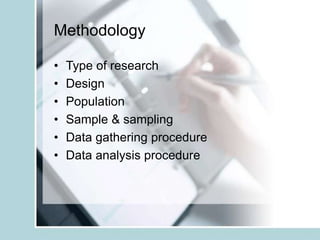
Methodology
• Type of research
• Design
• Population
• Sample & sampling
• Data gathering procedure
• Data analysis procedure
Type of Research of Project
• Descriptive
• Experimental
• Historical
• Qualititative
• Project (Curriculum design)
Design
• Survey
• Interrelationships studies
• Developmental studies
• Experimental studies
Surveys
• School surveys (ie. Teachers, students,
administrators, etc.)
• Job analysis
• Documentary analysis
• Public opinion surveys
• Community surveys
Interrelationships
• Case studies
• Causal comparative
• Correlational studies
Developmental Studies
• Growth studies
• Trend studies
• Model or system development
Experimental Studies
• True experimental designs
• Quasi-experimental designs
• Pre-experimental designs
Data Gathering Procedures
• Instrument development
• Instrument description
• Validity
• Reliability
• How will you get the information?
– Self-administered survey questionnaire
• Mailed
• On-line
• Ask in person
• Ask over the phone
Data Gathering Procedures
– Interview
• Face to face
• Open-ended
• Follow-up questions
– Observation (Ethnographic)
• Watching
• Listening
• Recording
• Non-participatory
Instrument Validation
• Does the instrument measure the
constructs we intend to measure?
• Is the instrument reliable?
– If we retest the subjects with the same
instrument over a period of time (with no
treatment in between), will they respond the
same?
– Is there inter-item reliability?
Instrument Validation
• Is the instrument valid?
• Does it measure what you want it to
measure?
Population
• Describe the subjects of your study.
• What characteristics do they share that
includes them in your population of
interest?
• Will you include all members of the
population in your study? (Census).
• What is the total number? (N)
Sampling
• Is the size of our population so big that a census
is too costly, or will take too much time?
• Sample the population
– Random
– Stratification
– Proportional
– Clusters
– Purposive
• Sample must be representative of the population
Response Rate
• How many participants responded to your
survey?
– Early vs late respondents
– Respondents vs non-respondents
– Controlling for non-response error
• Reporting your response rate
Data Analysis Procedures
• Statistical procedures (ie. use of SAS,
SPSS, or another analysis software
program)
• Descriptive
• Inferential
• Qualitative – transcription of interviews
(coding, categorizing, etc.)
• Use of specialized procedures

Chapter Three of Your Thesis.ppt

  • 1.
    CHAPTER III AED 615 Fall2006 Dr. Franklin
  • 2.
    Chapter Overview • ChapterIII is your thesis or project “recipe”. • You describe the steps you took to conduct your research or designed your project. • How detailed should it be? • The reader should have enough information that he/she could replicate your research with the same or similar population and arrive at the same results.
  • 3.
    Re-Introduce the Reader •What is it again you are doing? – Purpose statement – Objective – A paragraph or two. • If the reader is interested in your methodology, he/she does not have to go back and forth through Chapter I to revisit the purpose and objectives.
  • 4.
    Operational Framework • Avisual representation of your steps to complete your research. • Construct a flow-chart with labels. • Make it a “figure” for your document. • Follow APA style for formatting a “figure”. • Be sure to have a narrative of your Operational Framework. • Tell the reader what occurs at each step.
  • 5.
    Methodology • Type ofresearch • Design • Population • Sample & sampling • Data gathering procedure • Data analysis procedure
  • 6.
    Type of Researchof Project • Descriptive • Experimental • Historical • Qualititative • Project (Curriculum design)
  • 7.
    Design • Survey • Interrelationshipsstudies • Developmental studies • Experimental studies
  • 8.
    Surveys • School surveys(ie. Teachers, students, administrators, etc.) • Job analysis • Documentary analysis • Public opinion surveys • Community surveys
  • 9.
    Interrelationships • Case studies •Causal comparative • Correlational studies
  • 10.
    Developmental Studies • Growthstudies • Trend studies • Model or system development
  • 11.
    Experimental Studies • Trueexperimental designs • Quasi-experimental designs • Pre-experimental designs
  • 12.
    Data Gathering Procedures •Instrument development • Instrument description • Validity • Reliability • How will you get the information? – Self-administered survey questionnaire • Mailed • On-line • Ask in person • Ask over the phone
  • 13.
    Data Gathering Procedures –Interview • Face to face • Open-ended • Follow-up questions – Observation (Ethnographic) • Watching • Listening • Recording • Non-participatory
  • 14.
    Instrument Validation • Doesthe instrument measure the constructs we intend to measure? • Is the instrument reliable? – If we retest the subjects with the same instrument over a period of time (with no treatment in between), will they respond the same? – Is there inter-item reliability?
  • 15.
    Instrument Validation • Isthe instrument valid? • Does it measure what you want it to measure?
  • 16.
    Population • Describe thesubjects of your study. • What characteristics do they share that includes them in your population of interest? • Will you include all members of the population in your study? (Census). • What is the total number? (N)
  • 17.
    Sampling • Is thesize of our population so big that a census is too costly, or will take too much time? • Sample the population – Random – Stratification – Proportional – Clusters – Purposive • Sample must be representative of the population
  • 18.
    Response Rate • Howmany participants responded to your survey? – Early vs late respondents – Respondents vs non-respondents – Controlling for non-response error • Reporting your response rate
  • 19.
    Data Analysis Procedures •Statistical procedures (ie. use of SAS, SPSS, or another analysis software program) • Descriptive • Inferential • Qualitative – transcription of interviews (coding, categorizing, etc.) • Use of specialized procedures