Human Abilities 1
Understanding the user
Fall 2002 CS/PSY 6750 2
Agenda
• Human capabilities
− Senses
− Information processing (next time)
− Motor systems
• Project part 1
Fall 2002 CS/PSY 6750 3
Human Capabilities
• Why do we care? (better design!)
• Want to improve user performance
• Knowing the user informs the design
− Senses
− Information processing systems
− Physical responding
Time and effort expended
to complete tasks
Fall 2002 CS/PSY 6750 4
Overview
I. Senses
A. Vision
B. Hearing
C. Touch
D. Smell?
III. Motor system
II. Information processing
A. Perceptual
B. Cognitive
1. Memory
a. Short term
b. Medium term
c. Long term
2. Processes
a. Selective attention
b. Learning
c. Problem solving
d. Language
C. Motor system
TODAY’S
CLASS
NEXT
CLASS
Fall 2002 CS/PSY 6750 5
I. Senses
• Sight, hearing, touch important for current
HCI
− smell, taste ???
• Abilities and limitations
affect design
Fall 2002 CS/PSY 6750 6
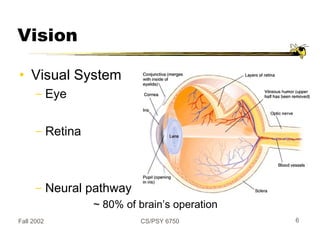
Vision
• Visual System
− Eye
− Retina
− Neural pathway
~ 80% of brain’s operation
Fall 2002 CS/PSY 6750 7
Visual Abilities
• Sensitivity
− luminance: 10-6
~107
mL (see notes)
• Acuity
− detection, alignment,
recognition (visual angle)
− retinal position: fovea has best acuity
• Movement
− tracking, reading, vibrations
• Note: Vision decreases with age
• Implications (??)
− Font size & location depends on task
− Much done by context & grouping
Fall 2002 CS/PSY 6750 8
Color
• Sensory response to electromagnetic
radiation in the spectrum between
wavelengths 0.4 - 0.7 micrometers
0.5
visible
10-1
10-6
105
108
gamma ultraviolet microwave tv
Fall 2002 CS/PSY 6750 9
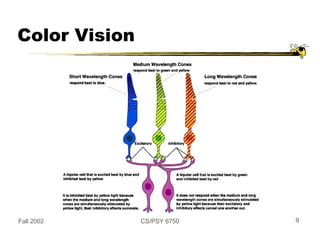
Color Vision
Fall 2002 CS/PSY 6750 10
Color Vision
• Color & the retina
− 380 (blue) ~ 770nm (red)
− Problems with cones or ganglion cells causes
problems with color perception
− (Not really “color blindness”)
8% males, 0.5% females
• Implications (??)
− Avoid saturated colors
− Color coding should be redundant when possible
Fall 2002 CS/PSY 6750 11
Hearing
• Capabilities (best-case scenario)
− pitch - frequency (20 - 20,000 Hz)
− loudness - amplitude (30 - 100dB)
− location (5° source & stream separation)
− timbre - type of sound (lots of instruments)
• Often take for granted how good it is
(disk whirring)
• Implications (??)
Fall 2002 CS/PSY 6750 12
Touch
• Three main sensations handled
by different types of receptors:
− Pressure (normal)
− Intense pressure (heat/pain)
− Temperature (hot/cold)
• Sensitivity, Dexterity,
Flexibility, Speed
• Where important?
− Mouse, Other I/O, VR, surgery
Fall 2002 CS/PSY 6750 13
III. Motor System
• Capabilities
− Range of movement, reach, speed,
strength, dexterity, accuracy
• Often cause of errors
− Wrong button
− Double-click vs. single click
• Principles
− Feedback is important
− Minimize eye movement
Fall 2002 CS/PSY 6750 14
Contest

Chapter iii. human abils1

  • 1.
  • 2.
    Fall 2002 CS/PSY6750 2 Agenda • Human capabilities − Senses − Information processing (next time) − Motor systems • Project part 1
  • 3.
    Fall 2002 CS/PSY6750 3 Human Capabilities • Why do we care? (better design!) • Want to improve user performance • Knowing the user informs the design − Senses − Information processing systems − Physical responding Time and effort expended to complete tasks
  • 4.
    Fall 2002 CS/PSY6750 4 Overview I. Senses A. Vision B. Hearing C. Touch D. Smell? III. Motor system II. Information processing A. Perceptual B. Cognitive 1. Memory a. Short term b. Medium term c. Long term 2. Processes a. Selective attention b. Learning c. Problem solving d. Language C. Motor system TODAY’S CLASS NEXT CLASS
  • 5.
    Fall 2002 CS/PSY6750 5 I. Senses • Sight, hearing, touch important for current HCI − smell, taste ??? • Abilities and limitations affect design
  • 6.
    Fall 2002 CS/PSY6750 6 Vision • Visual System − Eye − Retina − Neural pathway ~ 80% of brain’s operation
  • 7.
    Fall 2002 CS/PSY6750 7 Visual Abilities • Sensitivity − luminance: 10-6 ~107 mL (see notes) • Acuity − detection, alignment, recognition (visual angle) − retinal position: fovea has best acuity • Movement − tracking, reading, vibrations • Note: Vision decreases with age • Implications (??) − Font size & location depends on task − Much done by context & grouping
  • 8.
    Fall 2002 CS/PSY6750 8 Color • Sensory response to electromagnetic radiation in the spectrum between wavelengths 0.4 - 0.7 micrometers 0.5 visible 10-1 10-6 105 108 gamma ultraviolet microwave tv
  • 9.
    Fall 2002 CS/PSY6750 9 Color Vision
  • 10.
    Fall 2002 CS/PSY6750 10 Color Vision • Color & the retina − 380 (blue) ~ 770nm (red) − Problems with cones or ganglion cells causes problems with color perception − (Not really “color blindness”) 8% males, 0.5% females • Implications (??) − Avoid saturated colors − Color coding should be redundant when possible
  • 11.
    Fall 2002 CS/PSY6750 11 Hearing • Capabilities (best-case scenario) − pitch - frequency (20 - 20,000 Hz) − loudness - amplitude (30 - 100dB) − location (5° source & stream separation) − timbre - type of sound (lots of instruments) • Often take for granted how good it is (disk whirring) • Implications (??)
  • 12.
    Fall 2002 CS/PSY6750 12 Touch • Three main sensations handled by different types of receptors: − Pressure (normal) − Intense pressure (heat/pain) − Temperature (hot/cold) • Sensitivity, Dexterity, Flexibility, Speed • Where important? − Mouse, Other I/O, VR, surgery
  • 13.
    Fall 2002 CS/PSY6750 13 III. Motor System • Capabilities − Range of movement, reach, speed, strength, dexterity, accuracy • Often cause of errors − Wrong button − Double-click vs. single click • Principles − Feedback is important − Minimize eye movement
  • 14.
    Fall 2002 CS/PSY6750 14 Contest

Editor's Notes

  • #8 Useful Luminance range for vision: 10-6 ~ 107 milliLamberts Note: Absolute threshold 10-6 comfortable reading: 1~100 mL) colorless vision 10-6 ~ 10-1 mL color vision 1 ~ 107mL Acuity is better in fovea (center) poorer in periphery