CHAPTER 8
INDEX
MODEL
MARIBEL V. VILLAVERDE
MBA 511 Investment Management
CHAPTER OVERVIEW
• Advantages of Single-factor model
• Risk decomposition
• Systematic vs firm specific
• Single Index & its estimation
• Optimal Risky Portfolio in the index
model
• Index model vs Markowitz procedure
EMERGENCE TO SINGLE INDEX MODEL
• 1952 “harry markowitz” published portfolio selection model that
maximized a portfolio’s return for a given level of risk
• This model required the estimation of:
Expected returns for each security
Variances for each security
A covariance matrix (calculated the covariance between each possible
pair or securities w/in the portfolio based on historical data through a
scenario analysis.
 The Input List of Markowitz Model
 To perform the necessary calculations, you need the following
data pieces for a portfolio with N assets.
N estimates of returns
N estimates of variances
(N2 - N)/2 estimates of co variances
 A 50 asset portfolio requires:
(N2 - N)/2
=2500-50
=2,450/2
=1,225 estimate of covariances
=1,325 total estimates
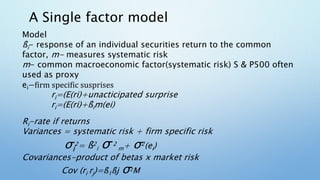
A Single factor model
Model
ßi- response of an individual securities return to the common
factor, m- measures systematic risk
m- common macroeconomic factor(systematic risk) S & P500 often
used as proxy
ei−firm specific susprises
ri=(E(ri)+unacticipated surprise
ri=(E(ri)+ßim(ei)
Ri-rate if returns
Variances = systematic risk + firm specific risk
σi
2= ß2
i σ 2
m+ σ2(ei)
Covariances-product of betas x market risk
Cov (ri rj)=ß1ßj σ2M
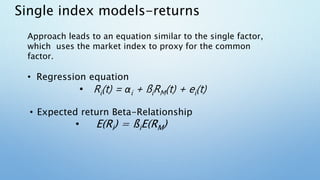
Single index models-returns
Approach leads to an equation similar to the single factor,
which uses the market index to proxy for the common
factor.
• Regression equation
• Ri(t) = αi + ßiRM(t) + ei(t)
• Expected return Beta-Relationship
• E(Ri) = ßiE(RM)
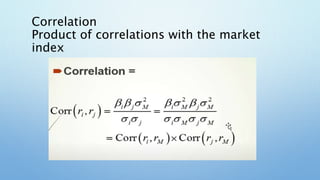
Correlation
Product of correlations with the market
index
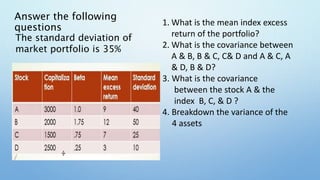
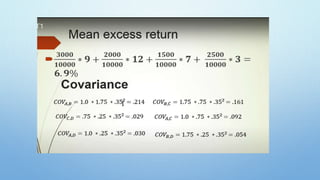
Answer the following
questions
1. What is the mean index excess
return of the portfolio?
2. What is the covariance between
A & B, B & C, C& D and A & C, A
& D, B & D?
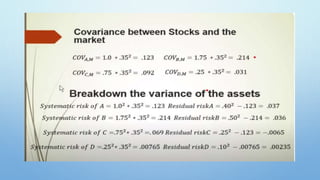
3. What is the covariance
between the stock A & the
index B, C, & D ?
4. Breakdown the variance of the
4 assets
The standard deviation of
market portfolio is 35%
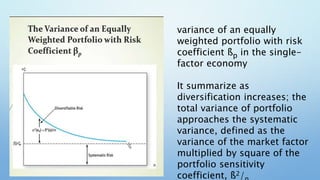
variance of an equally
weighted portfolio with risk
coefficient ßp in the single-
factor economy
It summarize as
diversification increases; the
total variance of portfolio
approaches the systematic
variance, defined as the
variance of the market factor
multiplied by square of the
portfolio sensitivity
coefficient, ß2/
THANK YOU

Chapter 8 Index Model, Index Model, Index Model

  • 1.
    CHAPTER 8 INDEX MODEL MARIBEL V.VILLAVERDE MBA 511 Investment Management
  • 2.
    CHAPTER OVERVIEW • Advantagesof Single-factor model • Risk decomposition • Systematic vs firm specific • Single Index & its estimation • Optimal Risky Portfolio in the index model • Index model vs Markowitz procedure
  • 3.
    EMERGENCE TO SINGLEINDEX MODEL • 1952 “harry markowitz” published portfolio selection model that maximized a portfolio’s return for a given level of risk • This model required the estimation of: Expected returns for each security Variances for each security A covariance matrix (calculated the covariance between each possible pair or securities w/in the portfolio based on historical data through a scenario analysis.
  • 4.
     The InputList of Markowitz Model  To perform the necessary calculations, you need the following data pieces for a portfolio with N assets. N estimates of returns N estimates of variances (N2 - N)/2 estimates of co variances  A 50 asset portfolio requires: (N2 - N)/2 =2500-50 =2,450/2 =1,225 estimate of covariances =1,325 total estimates
  • 5.
    A Single factormodel Model ßi- response of an individual securities return to the common factor, m- measures systematic risk m- common macroeconomic factor(systematic risk) S & P500 often used as proxy ei−firm specific susprises ri=(E(ri)+unacticipated surprise ri=(E(ri)+ßim(ei) Ri-rate if returns Variances = systematic risk + firm specific risk σi 2= ß2 i σ 2 m+ σ2(ei) Covariances-product of betas x market risk Cov (ri rj)=ß1ßj σ2M
  • 6.
    Single index models-returns Approachleads to an equation similar to the single factor, which uses the market index to proxy for the common factor. • Regression equation • Ri(t) = αi + ßiRM(t) + ei(t) • Expected return Beta-Relationship • E(Ri) = ßiE(RM)
  • 7.
  • 8.
    Answer the following questions 1.What is the mean index excess return of the portfolio? 2. What is the covariance between A & B, B & C, C& D and A & C, A & D, B & D? 3. What is the covariance between the stock A & the index B, C, & D ? 4. Breakdown the variance of the 4 assets The standard deviation of market portfolio is 35%
  • 12.
    variance of anequally weighted portfolio with risk coefficient ßp in the single- factor economy It summarize as diversification increases; the total variance of portfolio approaches the systematic variance, defined as the variance of the market factor multiplied by square of the portfolio sensitivity coefficient, ß2/
  • 13.