Cell Structure and Organelles
2 Types of Eukaryotic Cells Plant Cell Animal Cell
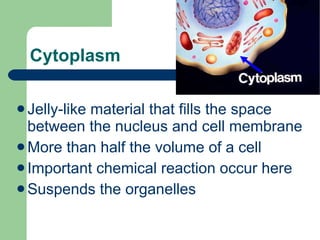
Cytoplasm Jelly-like material that fills the space between the nucleus and cell membrane More than half the volume of a cell Important chemical reaction occur here Suspends the organelles
Cytoplasm and Cytokeleton Prokaryotes- all chemical processes of the cell take place in the cytoplasm. Eukaryotes- all chemical processes of the cell take place within organelles in the cytoplasm.
Cytoskeleton Network of thin, fibrous elements that act as a scaffold to provide support for organelles Helps maintain cell shape (like tent poles) Constantly changing structure
Cytoskeleton: composed of Microtubules – thin,  hollow  cylinders made of protein Microfilaments – thin,  solid  protein fibers
Organelle Function Plant, Animal or Both Cell Wall Supports and protects the cell Plant Centrioles Important for cell division Animal  Chloroplast Contains chlorophyll where photosynthesis takes place Plant Cilia Aid in movement and feeding Animal Cytoskeleton Framework for the cell within cytoplasm Both
Rough Endoplasmic Reticulum Packages and delivers proteins Both Smooth  Endoplasmic Reticulum Makes lipids; breaks down toxins.  Lacks ribosomes Both Flagella Aids in movement and feeding Both Golgi apparatus Modifies and packages proteins  Both Lysosome Breaks down excess/worn down substance Animal
Mitochondria Makes energy available.  Powerhouse of the cell. Both Nucleus Control center of the cell Both Nucleolus  Produces ribosomes Both Plasma Membrane Boundary that controls movement of substances in and out of the cell Both Ribosome Site in protein synthesis Both Vacuole Place to store materials and wast products. Plant-1 big Animal-few small
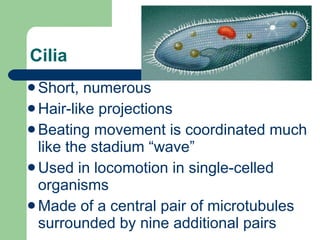
Cilia Short, numerous Hair-like projections Beating movement is coordinated much like the stadium “wave” Used in locomotion in single-celled organisms Made of a central pair of microtubules surrounded by nine additional pairs
Flagella Longer projections Whip-like motion Not as numerous as cilia Used in locomotion in single-celled organisms Made of central pair of microtubules and surrounded by nine additional pairs
Organelles video clip
 
 
Similarities between plant cells and animal cells Both have a cell membrane surrounding the cytoplasm Both have a nucleus Both contain mitochondria
Differences between plant cells and animal cells Animal cells Plant cells Relatively smaller in size Irregular shape No cell wall Relatively larger in size Regular shape Cell wall present
Differences between Plant Cells and Animal Cells Animal cells Plant cells Vacuole small or absent Glycogen as food storage Nucleus at the center Large central vacuole Starch as food storage Nucleus near cell wall
Cellular Organization Unicellular Multicellular Tissue Organs Organ system Organism

Chapter 7 3

  • 1.
  • 2.
    2 Types ofEukaryotic Cells Plant Cell Animal Cell
  • 3.
    Cytoplasm Jelly-like materialthat fills the space between the nucleus and cell membrane More than half the volume of a cell Important chemical reaction occur here Suspends the organelles
  • 4.
    Cytoplasm and CytokeletonProkaryotes- all chemical processes of the cell take place in the cytoplasm. Eukaryotes- all chemical processes of the cell take place within organelles in the cytoplasm.
  • 5.
    Cytoskeleton Network ofthin, fibrous elements that act as a scaffold to provide support for organelles Helps maintain cell shape (like tent poles) Constantly changing structure
  • 6.
    Cytoskeleton: composed ofMicrotubules – thin, hollow cylinders made of protein Microfilaments – thin, solid protein fibers
  • 7.
    Organelle Function Plant,Animal or Both Cell Wall Supports and protects the cell Plant Centrioles Important for cell division Animal Chloroplast Contains chlorophyll where photosynthesis takes place Plant Cilia Aid in movement and feeding Animal Cytoskeleton Framework for the cell within cytoplasm Both
  • 8.
    Rough Endoplasmic ReticulumPackages and delivers proteins Both Smooth Endoplasmic Reticulum Makes lipids; breaks down toxins. Lacks ribosomes Both Flagella Aids in movement and feeding Both Golgi apparatus Modifies and packages proteins Both Lysosome Breaks down excess/worn down substance Animal
  • 9.
    Mitochondria Makes energyavailable. Powerhouse of the cell. Both Nucleus Control center of the cell Both Nucleolus Produces ribosomes Both Plasma Membrane Boundary that controls movement of substances in and out of the cell Both Ribosome Site in protein synthesis Both Vacuole Place to store materials and wast products. Plant-1 big Animal-few small
  • 10.
    Cilia Short, numerousHair-like projections Beating movement is coordinated much like the stadium “wave” Used in locomotion in single-celled organisms Made of a central pair of microtubules surrounded by nine additional pairs
  • 11.
    Flagella Longer projectionsWhip-like motion Not as numerous as cilia Used in locomotion in single-celled organisms Made of central pair of microtubules and surrounded by nine additional pairs
  • 13.
  • 14.
  • 15.
  • 16.
    Similarities between plantcells and animal cells Both have a cell membrane surrounding the cytoplasm Both have a nucleus Both contain mitochondria
  • 17.
    Differences between plantcells and animal cells Animal cells Plant cells Relatively smaller in size Irregular shape No cell wall Relatively larger in size Regular shape Cell wall present
  • 18.
    Differences between PlantCells and Animal Cells Animal cells Plant cells Vacuole small or absent Glycogen as food storage Nucleus at the center Large central vacuole Starch as food storage Nucleus near cell wall
  • 19.
    Cellular Organization UnicellularMulticellular Tissue Organs Organ system Organism