CHAPTER 6:
ANALYSING PROPERTY
LOSS EXPOSURES
ELYAELYANA BT SHAFEE
NURUL ZETA BT ABU SAMAH
NURZATI ALYANI BT MOHD ASHARI
RAJA KHAIRUN NURFARHANNA BT RAJA HAMZAH
IDENTIFYING AND ANALYSING LOSS
EXPOSURES
A loss exposures is a set of circumstances
that presents a possibility of loss, whether or
not it actually takes place.
 Element of property loss exposures:
- the value exposed to loss
- the peril causing the loss
- the potential financial impact of the loss

TYPES OF PROPERTY AND VALUES
EXPOSED TO LOSS
i. Real property
ii. Personal property
- tangible property
- intangible property
iii. Non-owned property
i. Real Property


Structures that intended to be permanently
attached to the land.
a) Unimproved land
 Real estate excluding all permanent property
improvements.
 Classified separately because values are
tough to determine and perils that can cause
damage are distinctive or unusual.
 Not covered by insurance.
b)

Buildings and other structures
 Loss exposure depends on the type of
construction, occupancy and location of
property.
 Potential loss exposures includes:
i. values of building and structures directly
exposed to loss.
ii. Income lost until damaged property is
repaired or replaced.
 These exposures are almost always
insurable.
ii. Personal Property


Includes all property other than real property.
Categorized as tangible or intangible.

Tangible property
 Property that has physical form.
 Money and securities;
• All
types
of
monetary
asset.
(e.g:
cash, securities and notes)
• Loss exposure varies between size of
business.
• Biggest lost exposure is theft.

a)


Accounts receivable;
• Paper or other means on which account
receivable are recorded is subject to physical
damage, destruction or removal of possession.
• Loss
potential
can
be
reduced
by
implementing loss control methods.
 Inventory;
• Defined as raw material, good in progress and
finished goods.
• Loss
exposures
include
perils
of
transportation, fluctuation of values and when
the time supplier suffer loss and unable to
deliver.


Furniture, equipment and supplies;
• It consists of many separate pieces and
relatively low value and frequently shift from
one location to another.
• Thus it is impractical to focus on one item for
precise valuation and it is difficult to keep and
accurate inventory.
• May then lead to risk management problem.


Machinery;
• It subject to depreciation and obsolescence
and can be very costly to reproduce.
• Loss exposures usually caused by breakdown
of machinery which will resulted in additional
loss consequences.
• Example is damage to power, heating, cooling
and lighting system.
• It also subject to unique perils such as
technological advances.
• It is usually uninsurable.


Computer equipment;
• It includes software, hardware, data in the
system and discs, cards or tapes on which it
is recorded.
• It requires special environmental control
system such as separate temperature and
humidity control. (e.g: magnetic tape)
• Other loss potential is from computer fraud
and obsolescence.


Valuable papers, books and documents;
• It includes maps, books, drawings and other
documents.
• It creates special loss exposure because they
are small, light and easily destroyed or lost.
• It also can be difficult to value and
reproducing it is time consuming and may
lose income or incur additional expense.


Mobile property;
• It consists of cars, aircraft, boats and other
mobile machinery.
• Exposed to special hazards arise from
transportation.
• Collision is a major cause of loss.
• Mobile property is usually insurable.
ii.

b) Intangible property
 It includes goodwill, copyrights, patent,
trademark, trade names, leases and
leasehold interest, licenses and trade
secrets.
 They are difficult to recognize and value.
 Some intangible asset exposures are
insurable and some are not.
iii.


Non-owned Property:

Have less obvious of losses than losses by damage to
owned property. Non-owned property include:
 Bailed property:
 Dry cleaner or laundry and warehouse operators
have on their premises property of customers which
they are not legally responsible.
 Leased property:
 The terms of the lease agreement usually determine
who is responsible for losses. But some leases
require tenants to pay for repairs towards damage on
premises.
 Property on consignment:
 Between distributors and retailers should be spelled
out in a contract of the responsibility for losses.
PERILS CAUSING PROPERTY
LOSSES


There are an infinite number of perils that can
destroy or damage property.
 Many perils for which insurance is readily
available but many causes of loss that are
excluded from insurance coverage such as
explosion as a human peril.
 A peril covered by insurance policy is defined in
the policy to include only what the insurer
intends to cover.



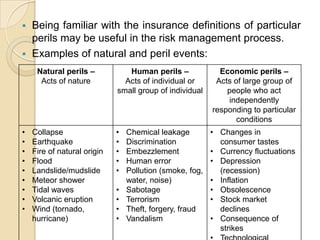
Being familiar with the insurance definitions of particular
perils may be useful in the risk management process.
Examples of natural and peril events:
Natural perils –
Acts of nature

•
•
•
•
•
•
•
•
•

Collapse
Earthquake
Fire of natural origin
Flood
Landslide/mudslide
Meteor shower
Tidal waves
Volcanic eruption
Wind (tornado,
hurricane)

Human perils –
Acts of individual or
small group of individual

Economic perils –
Acts of large group of
people who act
independently
responding to particular
conditions

•
•
•
•
•

• Changes in
consumer tastes
• Currency fluctuations
• Depression
(recession)
• Inflation
• Obsolescence
• Stock market
declines
• Consequence of
strikes

•
•
•
•

Chemical leakage
Discrimination
Embezzlement
Human error
Pollution (smoke, fog,
water, noise)
Sabotage
Terrorism
Theft, forgery, fraud
Vandalism
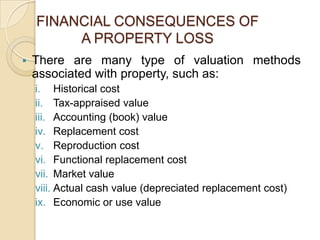
FINANCIAL CONSEQUENCES OF
A PROPERTY LOSS


There are many type of valuation methods
associated with property, such as:
i. Historical cost
ii. Tax-appraised value
iii. Accounting (book) value
iv. Replacement cost
v. Reproduction cost
vi. Functional replacement cost
vii. Market value
viii. Actual cash value (depreciated replacement cost)
ix. Economic or use value
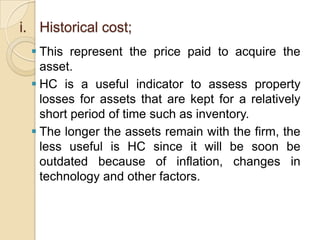
i. Historical cost;
 This represent the price paid to acquire the
asset.
 HC is a useful indicator to assess property
losses for assets that are kept for a relatively
short period of time such as inventory.
 The longer the assets remain with the firm, the
less useful is HC since it will be soon be
outdated because of inflation, changes in
technology and other factors.
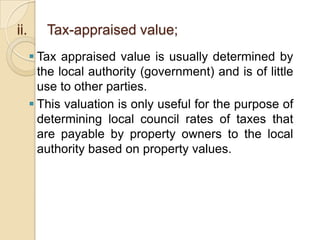
ii.

Tax-appraised value;
 Tax appraised value is usually determined by
the local authority (government) and is of little
use to other parties.
 This valuation is only useful for the purpose of
determining local council rates of taxes that
are payable by property owners to the local
authority based on property values.
iii.

Accounting (book) value;

 Book value is HC less the accumulated
depreciation.
 Accumulated depreciation is an estimation of
the decline in the value of the asset over its
useful life, and is determined using
accounting assumptions.
 However, book value will not represent the
current value of the asset and may
sometimes be revised.
iv.

Replacement cost;

 RC is one of the most useful measures of
assessing the property loss exposure.
 RC is the amount required to replace a
lost, damaged or destroyed asset
 For buildings, the replacement cost may be
determined by:
 Quotations or bids by contractors or valuers
 Using construction price index
 Using square foot construction cost and then
extrapolating in for the entire building
 For personal property, the replacement cost
may be determined by:
 Begins with an inventory that owns or uses
at each of its facilities
 Once developed, personal property falls into
number of broad classifications
 Method of establishing the RC of items in
each broad category
 Normally the process performed on
computers which can be easily brought up
to date with current prices as needed
v.

Reproduction cost;
 Some assets cannot be replaced with assets
that readily available in the market. Instead
they have to be replicated or reproduced.
 For example documents, maps, paintings
 Reproduction cost represents the cost of
reproducing the assets using the same
material, artistry and other expertise
comparable to that used in the original
vi.

Functional Replacement Cost;

 For certain specific assets, RC may not be
suitable simply because the asset to be
replaced is no longer available.
 Example mobile phones
 FRC is an assessment based on the RC of a
different model of asset but which is capable
of performing the same function as the old
one.
vii. Market value;
 The market price represents the price to be
paid between a willing seller and a willing
buyer in an arm’s length transaction.
 However, in certain cases, market value may
be difficult to assess in the absence of a
secondary market for such assets.
viii. Actual Cash Value
(Depreciated Replacement Cost);


The actual cash value is replacement cost
less its depreciation.
• The depreciation may be calculated on a
different basis than that used for accounting
purposes.
• Can be applied to real or personal property.
ix.


Economic or Use Value

For valuing items of property based on the
value of the future income stream attributable
to that item of property.
 Not affected by cost of an item or expenses
that will incurred.
TECHNIQUES TO IDENTIFY
PROPERTY LOSS
EXPOSURES
Standardized questionnaire;
 Thorough survey/questionnaire to identify items
of tangible property whether real or personal.
 Provide indications of intangible property

i.

Loss Histories;
 Know the amounts, causes of losses.
 Helpful in analysing loss exposures as a basis
for forecasting the frequency and effective
control of an organisation’s future actual loss.
 Good predictor for future losses.

ii.
Financial statements and underlying records;
 Identify loss by referring organization’s income
statement.
 Focus on revenue section

iii.

Other records and documents;
 Minutes of board meeting can reveal plan to
acquire or dispose.
 Records, memorandum or correspondence may
reveal property exposures for example from
purchasing and maintenance department.

iv.
Flowcharts;
 Extend beyond an organization, encompassing
suppliers and customers and the routes to them.
 Suggest the importance:
i. Suppliers’ and customers’ properties
ii. Transportation bottlenecks
iii. Key role of an organization’s vehicles

v.
Personal Inspections;
 May discover assets that are not identified on
any balance sheet or flowchart or find any
reported assets no longer exist but yet to be
removed from records.

vi.

Consultation with experts within and outside
the organization;
 Discussion with front line
 Supervisors and middle managers may have
alternative assets give better serve.
 Experts outside can determine the replacements
cost of assets.
vii.
THE END

Chapter 6 - Risk Management

  • 1.
  • 2.
    ELYAELYANA BT SHAFEE NURULZETA BT ABU SAMAH NURZATI ALYANI BT MOHD ASHARI RAJA KHAIRUN NURFARHANNA BT RAJA HAMZAH
  • 3.
    IDENTIFYING AND ANALYSINGLOSS EXPOSURES A loss exposures is a set of circumstances that presents a possibility of loss, whether or not it actually takes place.  Element of property loss exposures: - the value exposed to loss - the peril causing the loss - the potential financial impact of the loss 
  • 4.
    TYPES OF PROPERTYAND VALUES EXPOSED TO LOSS i. Real property ii. Personal property - tangible property - intangible property iii. Non-owned property
  • 5.
    i. Real Property  Structuresthat intended to be permanently attached to the land. a) Unimproved land  Real estate excluding all permanent property improvements.  Classified separately because values are tough to determine and perils that can cause damage are distinctive or unusual.  Not covered by insurance.
  • 6.
    b) Buildings and otherstructures  Loss exposure depends on the type of construction, occupancy and location of property.  Potential loss exposures includes: i. values of building and structures directly exposed to loss. ii. Income lost until damaged property is repaired or replaced.  These exposures are almost always insurable.
  • 7.
    ii. Personal Property  Includesall property other than real property. Categorized as tangible or intangible. Tangible property  Property that has physical form.  Money and securities; • All types of monetary asset. (e.g: cash, securities and notes) • Loss exposure varies between size of business. • Biggest lost exposure is theft. a)
  • 8.
     Accounts receivable; • Paperor other means on which account receivable are recorded is subject to physical damage, destruction or removal of possession. • Loss potential can be reduced by implementing loss control methods.  Inventory; • Defined as raw material, good in progress and finished goods. • Loss exposures include perils of transportation, fluctuation of values and when the time supplier suffer loss and unable to deliver.
  • 9.
     Furniture, equipment andsupplies; • It consists of many separate pieces and relatively low value and frequently shift from one location to another. • Thus it is impractical to focus on one item for precise valuation and it is difficult to keep and accurate inventory. • May then lead to risk management problem.
  • 10.
     Machinery; • It subjectto depreciation and obsolescence and can be very costly to reproduce. • Loss exposures usually caused by breakdown of machinery which will resulted in additional loss consequences. • Example is damage to power, heating, cooling and lighting system. • It also subject to unique perils such as technological advances. • It is usually uninsurable.

  • 11.
     Computer equipment; • Itincludes software, hardware, data in the system and discs, cards or tapes on which it is recorded. • It requires special environmental control system such as separate temperature and humidity control. (e.g: magnetic tape) • Other loss potential is from computer fraud and obsolescence.
  • 12.
     Valuable papers, booksand documents; • It includes maps, books, drawings and other documents. • It creates special loss exposure because they are small, light and easily destroyed or lost. • It also can be difficult to value and reproducing it is time consuming and may lose income or incur additional expense.
  • 13.
     Mobile property; • Itconsists of cars, aircraft, boats and other mobile machinery. • Exposed to special hazards arise from transportation. • Collision is a major cause of loss. • Mobile property is usually insurable.
  • 14.
    ii. b) Intangible property It includes goodwill, copyrights, patent, trademark, trade names, leases and leasehold interest, licenses and trade secrets.  They are difficult to recognize and value.  Some intangible asset exposures are insurable and some are not.
  • 15.
    iii.  Non-owned Property: Have lessobvious of losses than losses by damage to owned property. Non-owned property include:  Bailed property:  Dry cleaner or laundry and warehouse operators have on their premises property of customers which they are not legally responsible.  Leased property:  The terms of the lease agreement usually determine who is responsible for losses. But some leases require tenants to pay for repairs towards damage on premises.  Property on consignment:  Between distributors and retailers should be spelled out in a contract of the responsibility for losses.
  • 16.
    PERILS CAUSING PROPERTY LOSSES  Thereare an infinite number of perils that can destroy or damage property.  Many perils for which insurance is readily available but many causes of loss that are excluded from insurance coverage such as explosion as a human peril.  A peril covered by insurance policy is defined in the policy to include only what the insurer intends to cover.
  • 17.
      Being familiar withthe insurance definitions of particular perils may be useful in the risk management process. Examples of natural and peril events: Natural perils – Acts of nature • • • • • • • • • Collapse Earthquake Fire of natural origin Flood Landslide/mudslide Meteor shower Tidal waves Volcanic eruption Wind (tornado, hurricane) Human perils – Acts of individual or small group of individual Economic perils – Acts of large group of people who act independently responding to particular conditions • • • • • • Changes in consumer tastes • Currency fluctuations • Depression (recession) • Inflation • Obsolescence • Stock market declines • Consequence of strikes • • • • Chemical leakage Discrimination Embezzlement Human error Pollution (smoke, fog, water, noise) Sabotage Terrorism Theft, forgery, fraud Vandalism
  • 18.
    FINANCIAL CONSEQUENCES OF APROPERTY LOSS  There are many type of valuation methods associated with property, such as: i. Historical cost ii. Tax-appraised value iii. Accounting (book) value iv. Replacement cost v. Reproduction cost vi. Functional replacement cost vii. Market value viii. Actual cash value (depreciated replacement cost) ix. Economic or use value
  • 19.
    i. Historical cost; This represent the price paid to acquire the asset.  HC is a useful indicator to assess property losses for assets that are kept for a relatively short period of time such as inventory.  The longer the assets remain with the firm, the less useful is HC since it will be soon be outdated because of inflation, changes in technology and other factors.
  • 20.
    ii. Tax-appraised value;  Taxappraised value is usually determined by the local authority (government) and is of little use to other parties.  This valuation is only useful for the purpose of determining local council rates of taxes that are payable by property owners to the local authority based on property values.
  • 21.
    iii. Accounting (book) value; Book value is HC less the accumulated depreciation.  Accumulated depreciation is an estimation of the decline in the value of the asset over its useful life, and is determined using accounting assumptions.  However, book value will not represent the current value of the asset and may sometimes be revised.
  • 22.
    iv. Replacement cost;  RCis one of the most useful measures of assessing the property loss exposure.  RC is the amount required to replace a lost, damaged or destroyed asset  For buildings, the replacement cost may be determined by:  Quotations or bids by contractors or valuers  Using construction price index  Using square foot construction cost and then extrapolating in for the entire building
  • 23.
     For personalproperty, the replacement cost may be determined by:  Begins with an inventory that owns or uses at each of its facilities  Once developed, personal property falls into number of broad classifications  Method of establishing the RC of items in each broad category  Normally the process performed on computers which can be easily brought up to date with current prices as needed
  • 24.
    v. Reproduction cost;  Someassets cannot be replaced with assets that readily available in the market. Instead they have to be replicated or reproduced.  For example documents, maps, paintings  Reproduction cost represents the cost of reproducing the assets using the same material, artistry and other expertise comparable to that used in the original
  • 25.
    vi. Functional Replacement Cost; For certain specific assets, RC may not be suitable simply because the asset to be replaced is no longer available.  Example mobile phones  FRC is an assessment based on the RC of a different model of asset but which is capable of performing the same function as the old one.
  • 26.
    vii. Market value; The market price represents the price to be paid between a willing seller and a willing buyer in an arm’s length transaction.  However, in certain cases, market value may be difficult to assess in the absence of a secondary market for such assets.
  • 27.
    viii. Actual CashValue (Depreciated Replacement Cost);  The actual cash value is replacement cost less its depreciation. • The depreciation may be calculated on a different basis than that used for accounting purposes. • Can be applied to real or personal property.
  • 28.
    ix.  Economic or UseValue For valuing items of property based on the value of the future income stream attributable to that item of property.  Not affected by cost of an item or expenses that will incurred.
  • 29.
  • 30.
    Standardized questionnaire;  Thoroughsurvey/questionnaire to identify items of tangible property whether real or personal.  Provide indications of intangible property i. Loss Histories;  Know the amounts, causes of losses.  Helpful in analysing loss exposures as a basis for forecasting the frequency and effective control of an organisation’s future actual loss.  Good predictor for future losses. ii.
  • 31.
    Financial statements andunderlying records;  Identify loss by referring organization’s income statement.  Focus on revenue section iii. Other records and documents;  Minutes of board meeting can reveal plan to acquire or dispose.  Records, memorandum or correspondence may reveal property exposures for example from purchasing and maintenance department. iv.
  • 32.
    Flowcharts;  Extend beyondan organization, encompassing suppliers and customers and the routes to them.  Suggest the importance: i. Suppliers’ and customers’ properties ii. Transportation bottlenecks iii. Key role of an organization’s vehicles v.
  • 33.
    Personal Inspections;  Maydiscover assets that are not identified on any balance sheet or flowchart or find any reported assets no longer exist but yet to be removed from records. vi. Consultation with experts within and outside the organization;  Discussion with front line  Supervisors and middle managers may have alternative assets give better serve.  Experts outside can determine the replacements cost of assets. vii.
  • 34.