Valuation & Dilapidation
PRAJWAL / PIYUSH / SOHAN / RAKSHITH / JNANESH / CHIRAG
-Valuation and Dilapidation: Definitions
-Physical and Economic life of buildings.
-Introduction to Valuation, essential
characteristics, classifications and purpose of
classifications.
-Methods of valuation, standard rent and cost
of construction.
-Architect’s role in preparation of valuation and
dilapidation reports and certifications
Valuation
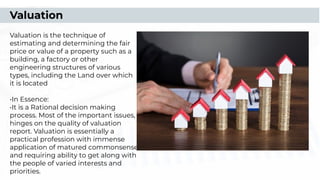
Valuation is the technique of
estimating and determining the fair
price or value of a property such as a
building, a factory or other
engineering structures of various
types, including the Land over which
it is located
•In Essence:
•It is a Rational decision making
process. Most of the important issues,
hinges on the quality of valuation
report. Valuation is essentially a
practical profession with immense
application of matured commonsense
and requiring ability to get along with
the people of varied interests and
priorities.
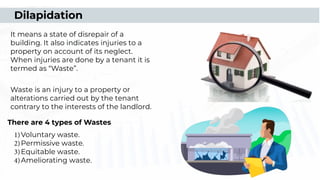
It means a state of disrepair of a
building. It also indicates injuries to a
property on account of its neglect.
When injuries are done by a tenant it is
termed as “Waste”.
Waste is an injury to a property or
alterations carried out by the tenant
contrary to the interests of the landlord.
Dilapidation
1)Voluntary waste.
2)Permissive waste.
3)Equitable waste.
4)Ameliorating waste.
There are 4 types of Wastes
Permissive waste means, neglecting the essential
repairs to a building & thus allowing the building to pass
into a state of disrepair. Most of the properties in India are
let-out on a monthly tenant basis and the responsibility
of the repairs in such cases are on the Owners of the
building, thus the burden of permissive Waste is thrown
on the Landlords whereas the tenants are liable for
Voluntary waste to the property. The owner of the
building finds it difficult to carry out the repairs due to
Types of Wastes
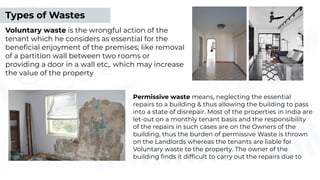
Voluntary waste is the wrongful action of the
tenant which he considers as essential for the
beneficial enjoyment of the premises; like removal
of a partition wall between two rooms or
providing a door in a wall etc,. which may increase
the value of the property
1)Rents of the old buildings are pegged or freezed at a level of a pertinent years rates say
1960s or 1970s and are economically hard pressed.
2)Increased size of family in the occupied property has resulted in more Wear & Tear of
the building. As such the urgent repairs remain un attended & go on increasing till the
building reaches a dilapidated stage. The building at this stage requires RE-
Construction.
Ameliorative waste refers to
modifications that increase the value of
property made by a tenant who failed
to obtain the landowner or future
interest holder’s permission.
Types of Wastes
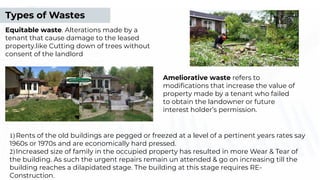
Equitable waste. Alterations made by a
tenant that cause damage to the leased
property.like Cutting down of trees without
consent of the landlord
Dilapidation Report
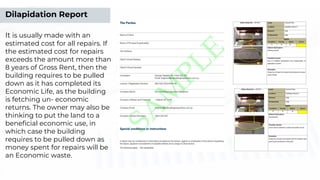
It is usually made with an
estimated cost for all repairs. If
the estimated cost for repairs
exceeds the amount more than
8 years of Gross Rent, then the
building requires to be pulled
down as it has completed its
Economic Life, as the building
is fetching un- economic
returns. The owner may also be
thinking to put the land to a
beneficial economic use, in
which case the building
requires to be pulled down as
money spent for repairs will be
an Economic waste.
• The useful or economic existence of all classes of buildings, in the modern day conditions, is
constantly shortening (many reasons exist) A methodical system should be adopted by which
provision may be made for addressing this contingency. Some Buildings, when they have been
erected have not survived a period of remunerative existence, and in some instances extensive
remodeling operations have been required to prolong their economic existence.
• It has also been observed that the more prominent and valuable the site, the earlier is the
date at which the process of reconstitution will be due. It is upon such sites, that the most
extensive and elaborate buildings are often erected.
• The Economic Life of a property, is the estimated period that a fixed asset (building) will
provide benefits to the building Owner, for a specified period depending upon its Use-age
value & Popularity of its location & materials of construction. It is usually less than the physical
life of an asset because an asset continues to have physical life, despite inefficiency and
obsolescence. Depreciation expense is typically based on the economic life.
* The Economic life also reflects the remaining period for which real estate improvements are
expected to generate more income than operating expenses cost.
Physical & Economic life of Properties
In its legal conception
property is the right to
possess, use and dispose of a
thing. Technically therefore
property is not the thing
itself but the right to, or
interest in it. Practically
however the thing itself is
also termed property
Real property, sometimes called 'real estate' refers to ownership of
land and things attached to it. Personal property, refers to everything
else; movable objects, such as computers, cars, jewelry, and
sandwiches, or intangible rights, such as stocks and shares
Property
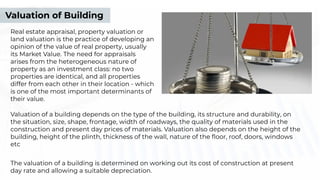
Valuation of Building
Real estate appraisal, property valuation or
land valuation is the practice of developing an
opinion of the value of real property, usually
its Market Value. The need for appraisals
arises from the heterogeneous nature of
property as an investment class: no two
properties are identical, and all properties
differ from each other in their location - which
is one of the most important determinants of
their value.
Valuation of a building depends on the type of the building, its structure and durability, on
the situation, size, shape, frontage, width of roadways, the quality of materials used in the
construction and present day prices of materials. Valuation also depends on the height of the
building, height of the plinth, thickness of the wall, nature of the floor, roof, doors, windows
etc
The valuation of a building is determined on working out its cost of construction at present
day rate and allowing a suitable depreciation.
1.Demand & Supply: The factors that have an impact on the market value of a property are.
demand and supply forces operating in the market, type of property, quality of construction,
the local infrastructure available and maintenance of the property as well as that of the
premises
2.Layout, Layout of premises and ancillary costs too are given importance in a property
valuation. The layout of the premises in terms of optimum space utilization in an efficient
manner helps the premises notch up valuable points. Ancillary costs of holding the
premises like society outgoing for maintenance of the building, municipal taxes, etc would
also determine the marketability of the premises.
3.Location; Another prime determining factor, when it comes to property valuation, is the
location or setting of the property. The valuation of an apartment or independent house,
which is set near to the bustling market or office area can be quite high than that placed in
a remote area.
Essential characteristics
4. Safety & Security; Safety and security of the apartment is another factor which is
closely
looked upon in the present times. With incidents of robberies, burglary or theft
increasing day in and day out, people are shifting base straight away. Today, a
property located in or near the riot prone area has lower rates, even if it is in the best
of location and filled with all the modern conveniences and amenities:
5. Other Factors, Additional factors, such as plush green surroundings, good quality
roads nearby, civic amenities like safe drinking water and systematic drainage
system add to the valuation of the property. Good connectivity of the property with
the bus depot, railway station and airport is equally important and adds to the face
value of the apartment or house.
Essential characteristics
Market Value: Market value is the most commonly used valuation classification. It
represents the estimated price that a property would sell for on the open market,
assuming a willing buyer and seller, and reasonable exposure to the market.
Market value considers factors such as location, size, condition, and comparable
sales.
Cost Approach: The cost approach estimates the value of a property based on the
cost to replace or reproduce it, considering the current construction costs and
deducting depreciation. This approach is often used for new or unique properties
where comparable sales are scarce or when valuing specific improvements on a
property.
Income Approach: The income approach is primarily used for income-producing
properties, such as commercial buildings or rental properties. It estimates the value
based on the property's income potential and the expected rate of return for
investors. This approach typically involves analyzing the net operating income
(NOI) and applying a capitalization rate or using discounted cash flow (DCF)
analysis.
Valuation classifications
Comparative Approach: The comparative approach, also known as the sales comparison
approach, determines the value of a property by comparing it to similar properties that have
recently sold in the same area. This approach relies on the principle of substitution, assuming that
a buyer would pay no more for a property than the cost of acquiring a comparable substitute
property.
Investment Value: Investment value focuses on the worth of a property to a particular investor or
user, taking into account their specific investment goals, risk tolerance, and return expectations. It
may differ from market value due to individual preferences and circumstances.
Insurable Value: Insurable value represents the cost to replace or rebuild a property in the event of
a total loss due to fire, natural disaster, or other covered risks. Insurable value considers the
construction costs, materials, and labor required to replicate the property.
Assessed Value: Assessed value is the value assigned to a property by a government authority for
taxation purposes. It is often determined based on a percentage of the property's market value
and may involve different assessment methods used by local taxing authorities.
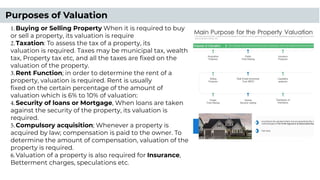
1.Buying or Selling Property When it is required to buy
or sell a property, its valuation is require
2.Taxation: To assess the tax of a property, its
valuation is required. Taxes may be municipal tax, wealth
tax, Property tax etc, and all the taxes are fixed on the
valuation of the property.
3.Rent Function; in order to determine the rent of a
property, valuation is required. Rent is usually
fixed on the certain percentage of the amount of
valuation which is 6% to 10% of valuation:
4.Security of loans or Mortgage, When loans are taken
against the security of the property, its valuation is
required.
5.Compulsory acquisition; Whenever a property is
acquired by law; compensation is paid to the owner. To
determine the amount of compensation, valuation of the
property is required.
6.Valuation of a property is also required for Insurance,
Betterment charges, speculations etc.
Purposes of Valuation
The purpose of valuation classifications is to provide a structured framework for
determining the value of a property based on specific criteria or purposes. These
classifications serve several important purposes:
Standardization: Valuation classifications provide a standardized approach to assessing
the value of real estate. They establish consistent methodologies and criteria that
appraisers, real estate professionals, and investors can follow, ensuring a level of uniformity
and comparability in property valuations.
Guidance for Appraisers: Valuation classifications offer guidance and methodologies to
professional appraisers, helping them conduct comprehensive and objective evaluations of
properties. By following established classifications, appraisers can ensure their valuations
are thorough, accurate, and reliable.
Market Transparency: Valuation classifications contribute to market transparency by
providing a common language and framework for property valuation. Buyers, sellers,
investors, and other market participants can better understand and compare the values of
different properties, facilitating informed decision-making.
Purpose of valuation Classifications
Risk Assessment: Valuation classifications help assess the risks associated with real estate
investments. By considering factors such as location, condition, income potential, and market
trends, investors can evaluate the potential returns and risks of a property. Different
classifications may be used based on the investment strategy and risk tolerance of the investor.
Regulatory and Tax Compliance: Valuation classifications are essential for regulatory and tax
compliance purposes. Governments and tax authorities often rely on property valuations to
determine property taxes, assess tax liabilities, or enforce regulations. Properly classifying and
valuing properties helps ensure compliance with applicable laws and regulations.
Financial Reporting: Valuation classifications play a crucial role in financial reporting for real
estate companies and investors. Accurate and reliable property valuations are necessary for
financial statements, loan applications, portfolio management, and investment analysis.
Dispute Resolution: Valuation classifications provide a framework for resolving disputes related
to property values. In cases of disagreements between buyers and sellers, landlords and
tenants, or during legal proceedings, established valuation classifications can serve as a
reference point for determining fair and equitable values.
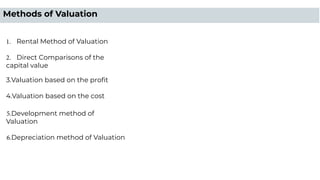
1. Rental Method of Valuation
2. Direct Comparisons of the
capital value
3.Valuation based on the profit
4.Valuation based on the cost
5.Development method of
Valuation
6.Depreciation method of Valuation
Methods of Valuation
"Standard rent" refers to the
typical or customary rent that
is charged for a particular type
of property in a specific
location. It is often used as a
benchmark or reference point
for determining the fair and
reasonable rental value of a
property. Standard rent can
vary based on factors such as
the location, size, condition,
amenities, and market demand
for rental properties in a given
area.
Standard rent
The "cost of construction" refers to
the expenses associated with building
or constructing a property. It includes
the cost of materials, labor, permits,
architectural and engineering fees,
contractor fees, and other expenses
incurred during the construction
process. The cost of construction is a
significant factor in determining the
value of a property, particularly when
using the cost approach in property
valuation.
Cost of construction
Valuation Reports:
Site Inspection:
Architects can conduct detailed site inspections to assess the condition, functionality, and
overall quality of a property. They examine various aspects, such as structural integrity, design
features, building materials, and any visible defects or damages.
Measurement and Documentation:
Architects can accurately measure the dimensions of the property, including floor areas, room
sizes, and other relevant details. This information is crucial for determining the value of the
property.
Analysis of Design and Construction Quality:
Architects can evaluate the architectural design and construction quality of a property. They
assess factors such as the building's aesthetics, layout, spatial planning, materials used, and
adherence to relevant codes and regulations.
Comparative Analysis: Architects can compare the property in question with similar
properties in the market to establish its relative value. They consider factors like location,
amenities, access to transportation, and overall market demand.
Architect's Role in Reports
Dilapidation Reports:
Building Assessment:
Architects inspect the property to identify any existing defects, damages, or maintenance issues.
They assess elements such as the building's structure, façade, roofing, flooring, electrical systems,
plumbing, and other relevant components.
Documentation and Photography:
Architects document the condition of the property using photographs, written descriptions, and
drawings as necessary. This documentation serves as evidence to support the dilapidation report.
Report Compilation:
Architects prepare a comprehensive dilapidation report that outlines the identified defects,
damages, or areas requiring maintenance. The report may include recommendations for
remedial actions, estimated costs, and priorities for addressing the issues.
Certifications:
Compliance Assessment:
Architects can assess whether a property complies with relevant building codes, regulations, and
safety standards. They review architectural plans, construction documents, and conduct
inspections to verify compliance.
Certification Documentation:
Based on their assessment, architects can provide certifications confirming compliance with
specific requirements. For example, they may certify that a building meets accessibility
standards, fire safety regulations, or sustainable design criteria.
Collaboration with Other Professionals:
Architects often collaborate with other professionals, such as structural engineers, electrical
consultants, or sustainability experts, to ensure comprehensive certification. They coordinate
efforts and gather necessary documentation from these experts to support the certification
process.
THANK YOU

Valuation

  • 1.
    Valuation & Dilapidation PRAJWAL/ PIYUSH / SOHAN / RAKSHITH / JNANESH / CHIRAG
  • 2.
    -Valuation and Dilapidation:Definitions -Physical and Economic life of buildings. -Introduction to Valuation, essential characteristics, classifications and purpose of classifications. -Methods of valuation, standard rent and cost of construction. -Architect’s role in preparation of valuation and dilapidation reports and certifications
  • 3.
    Valuation Valuation is thetechnique of estimating and determining the fair price or value of a property such as a building, a factory or other engineering structures of various types, including the Land over which it is located •In Essence: •It is a Rational decision making process. Most of the important issues, hinges on the quality of valuation report. Valuation is essentially a practical profession with immense application of matured commonsense and requiring ability to get along with the people of varied interests and priorities.
  • 4.
    It means astate of disrepair of a building. It also indicates injuries to a property on account of its neglect. When injuries are done by a tenant it is termed as “Waste”. Waste is an injury to a property or alterations carried out by the tenant contrary to the interests of the landlord. Dilapidation 1)Voluntary waste. 2)Permissive waste. 3)Equitable waste. 4)Ameliorating waste. There are 4 types of Wastes
  • 5.
    Permissive waste means,neglecting the essential repairs to a building & thus allowing the building to pass into a state of disrepair. Most of the properties in India are let-out on a monthly tenant basis and the responsibility of the repairs in such cases are on the Owners of the building, thus the burden of permissive Waste is thrown on the Landlords whereas the tenants are liable for Voluntary waste to the property. The owner of the building finds it difficult to carry out the repairs due to Types of Wastes Voluntary waste is the wrongful action of the tenant which he considers as essential for the beneficial enjoyment of the premises; like removal of a partition wall between two rooms or providing a door in a wall etc,. which may increase the value of the property
  • 6.
    1)Rents of theold buildings are pegged or freezed at a level of a pertinent years rates say 1960s or 1970s and are economically hard pressed. 2)Increased size of family in the occupied property has resulted in more Wear & Tear of the building. As such the urgent repairs remain un attended & go on increasing till the building reaches a dilapidated stage. The building at this stage requires RE- Construction. Ameliorative waste refers to modifications that increase the value of property made by a tenant who failed to obtain the landowner or future interest holder’s permission. Types of Wastes Equitable waste. Alterations made by a tenant that cause damage to the leased property.like Cutting down of trees without consent of the landlord
  • 7.
    Dilapidation Report It isusually made with an estimated cost for all repairs. If the estimated cost for repairs exceeds the amount more than 8 years of Gross Rent, then the building requires to be pulled down as it has completed its Economic Life, as the building is fetching un- economic returns. The owner may also be thinking to put the land to a beneficial economic use, in which case the building requires to be pulled down as money spent for repairs will be an Economic waste.
  • 8.
    • The usefulor economic existence of all classes of buildings, in the modern day conditions, is constantly shortening (many reasons exist) A methodical system should be adopted by which provision may be made for addressing this contingency. Some Buildings, when they have been erected have not survived a period of remunerative existence, and in some instances extensive remodeling operations have been required to prolong their economic existence. • It has also been observed that the more prominent and valuable the site, the earlier is the date at which the process of reconstitution will be due. It is upon such sites, that the most extensive and elaborate buildings are often erected. • The Economic Life of a property, is the estimated period that a fixed asset (building) will provide benefits to the building Owner, for a specified period depending upon its Use-age value & Popularity of its location & materials of construction. It is usually less than the physical life of an asset because an asset continues to have physical life, despite inefficiency and obsolescence. Depreciation expense is typically based on the economic life. * The Economic life also reflects the remaining period for which real estate improvements are expected to generate more income than operating expenses cost. Physical & Economic life of Properties
  • 9.
    In its legalconception property is the right to possess, use and dispose of a thing. Technically therefore property is not the thing itself but the right to, or interest in it. Practically however the thing itself is also termed property Real property, sometimes called 'real estate' refers to ownership of land and things attached to it. Personal property, refers to everything else; movable objects, such as computers, cars, jewelry, and sandwiches, or intangible rights, such as stocks and shares Property
  • 10.
    Valuation of Building Realestate appraisal, property valuation or land valuation is the practice of developing an opinion of the value of real property, usually its Market Value. The need for appraisals arises from the heterogeneous nature of property as an investment class: no two properties are identical, and all properties differ from each other in their location - which is one of the most important determinants of their value. Valuation of a building depends on the type of the building, its structure and durability, on the situation, size, shape, frontage, width of roadways, the quality of materials used in the construction and present day prices of materials. Valuation also depends on the height of the building, height of the plinth, thickness of the wall, nature of the floor, roof, doors, windows etc The valuation of a building is determined on working out its cost of construction at present day rate and allowing a suitable depreciation.
  • 11.
    1.Demand & Supply:The factors that have an impact on the market value of a property are. demand and supply forces operating in the market, type of property, quality of construction, the local infrastructure available and maintenance of the property as well as that of the premises 2.Layout, Layout of premises and ancillary costs too are given importance in a property valuation. The layout of the premises in terms of optimum space utilization in an efficient manner helps the premises notch up valuable points. Ancillary costs of holding the premises like society outgoing for maintenance of the building, municipal taxes, etc would also determine the marketability of the premises. 3.Location; Another prime determining factor, when it comes to property valuation, is the location or setting of the property. The valuation of an apartment or independent house, which is set near to the bustling market or office area can be quite high than that placed in a remote area. Essential characteristics
  • 12.
    4. Safety &Security; Safety and security of the apartment is another factor which is closely looked upon in the present times. With incidents of robberies, burglary or theft increasing day in and day out, people are shifting base straight away. Today, a property located in or near the riot prone area has lower rates, even if it is in the best of location and filled with all the modern conveniences and amenities: 5. Other Factors, Additional factors, such as plush green surroundings, good quality roads nearby, civic amenities like safe drinking water and systematic drainage system add to the valuation of the property. Good connectivity of the property with the bus depot, railway station and airport is equally important and adds to the face value of the apartment or house. Essential characteristics
  • 13.
    Market Value: Marketvalue is the most commonly used valuation classification. It represents the estimated price that a property would sell for on the open market, assuming a willing buyer and seller, and reasonable exposure to the market. Market value considers factors such as location, size, condition, and comparable sales. Cost Approach: The cost approach estimates the value of a property based on the cost to replace or reproduce it, considering the current construction costs and deducting depreciation. This approach is often used for new or unique properties where comparable sales are scarce or when valuing specific improvements on a property. Income Approach: The income approach is primarily used for income-producing properties, such as commercial buildings or rental properties. It estimates the value based on the property's income potential and the expected rate of return for investors. This approach typically involves analyzing the net operating income (NOI) and applying a capitalization rate or using discounted cash flow (DCF) analysis. Valuation classifications
  • 14.
    Valuation classifications Comparative Approach:The comparative approach, also known as the sales comparison approach, determines the value of a property by comparing it to similar properties that have recently sold in the same area. This approach relies on the principle of substitution, assuming that a buyer would pay no more for a property than the cost of acquiring a comparable substitute property. Investment Value: Investment value focuses on the worth of a property to a particular investor or user, taking into account their specific investment goals, risk tolerance, and return expectations. It may differ from market value due to individual preferences and circumstances. Insurable Value: Insurable value represents the cost to replace or rebuild a property in the event of a total loss due to fire, natural disaster, or other covered risks. Insurable value considers the construction costs, materials, and labor required to replicate the property. Assessed Value: Assessed value is the value assigned to a property by a government authority for taxation purposes. It is often determined based on a percentage of the property's market value and may involve different assessment methods used by local taxing authorities.
  • 15.
    1.Buying or SellingProperty When it is required to buy or sell a property, its valuation is require 2.Taxation: To assess the tax of a property, its valuation is required. Taxes may be municipal tax, wealth tax, Property tax etc, and all the taxes are fixed on the valuation of the property. 3.Rent Function; in order to determine the rent of a property, valuation is required. Rent is usually fixed on the certain percentage of the amount of valuation which is 6% to 10% of valuation: 4.Security of loans or Mortgage, When loans are taken against the security of the property, its valuation is required. 5.Compulsory acquisition; Whenever a property is acquired by law; compensation is paid to the owner. To determine the amount of compensation, valuation of the property is required. 6.Valuation of a property is also required for Insurance, Betterment charges, speculations etc. Purposes of Valuation
  • 16.
    The purpose ofvaluation classifications is to provide a structured framework for determining the value of a property based on specific criteria or purposes. These classifications serve several important purposes: Standardization: Valuation classifications provide a standardized approach to assessing the value of real estate. They establish consistent methodologies and criteria that appraisers, real estate professionals, and investors can follow, ensuring a level of uniformity and comparability in property valuations. Guidance for Appraisers: Valuation classifications offer guidance and methodologies to professional appraisers, helping them conduct comprehensive and objective evaluations of properties. By following established classifications, appraisers can ensure their valuations are thorough, accurate, and reliable. Market Transparency: Valuation classifications contribute to market transparency by providing a common language and framework for property valuation. Buyers, sellers, investors, and other market participants can better understand and compare the values of different properties, facilitating informed decision-making. Purpose of valuation Classifications
  • 17.
    Purpose of valuationClassifications Risk Assessment: Valuation classifications help assess the risks associated with real estate investments. By considering factors such as location, condition, income potential, and market trends, investors can evaluate the potential returns and risks of a property. Different classifications may be used based on the investment strategy and risk tolerance of the investor. Regulatory and Tax Compliance: Valuation classifications are essential for regulatory and tax compliance purposes. Governments and tax authorities often rely on property valuations to determine property taxes, assess tax liabilities, or enforce regulations. Properly classifying and valuing properties helps ensure compliance with applicable laws and regulations. Financial Reporting: Valuation classifications play a crucial role in financial reporting for real estate companies and investors. Accurate and reliable property valuations are necessary for financial statements, loan applications, portfolio management, and investment analysis. Dispute Resolution: Valuation classifications provide a framework for resolving disputes related to property values. In cases of disagreements between buyers and sellers, landlords and tenants, or during legal proceedings, established valuation classifications can serve as a reference point for determining fair and equitable values.
  • 18.
    1. Rental Methodof Valuation 2. Direct Comparisons of the capital value 3.Valuation based on the profit 4.Valuation based on the cost 5.Development method of Valuation 6.Depreciation method of Valuation Methods of Valuation
  • 19.
    "Standard rent" refersto the typical or customary rent that is charged for a particular type of property in a specific location. It is often used as a benchmark or reference point for determining the fair and reasonable rental value of a property. Standard rent can vary based on factors such as the location, size, condition, amenities, and market demand for rental properties in a given area. Standard rent
  • 20.
    The "cost ofconstruction" refers to the expenses associated with building or constructing a property. It includes the cost of materials, labor, permits, architectural and engineering fees, contractor fees, and other expenses incurred during the construction process. The cost of construction is a significant factor in determining the value of a property, particularly when using the cost approach in property valuation. Cost of construction
  • 21.
    Valuation Reports: Site Inspection: Architectscan conduct detailed site inspections to assess the condition, functionality, and overall quality of a property. They examine various aspects, such as structural integrity, design features, building materials, and any visible defects or damages. Measurement and Documentation: Architects can accurately measure the dimensions of the property, including floor areas, room sizes, and other relevant details. This information is crucial for determining the value of the property. Analysis of Design and Construction Quality: Architects can evaluate the architectural design and construction quality of a property. They assess factors such as the building's aesthetics, layout, spatial planning, materials used, and adherence to relevant codes and regulations. Comparative Analysis: Architects can compare the property in question with similar properties in the market to establish its relative value. They consider factors like location, amenities, access to transportation, and overall market demand. Architect's Role in Reports
  • 22.
    Architect's Role inReports Dilapidation Reports: Building Assessment: Architects inspect the property to identify any existing defects, damages, or maintenance issues. They assess elements such as the building's structure, façade, roofing, flooring, electrical systems, plumbing, and other relevant components. Documentation and Photography: Architects document the condition of the property using photographs, written descriptions, and drawings as necessary. This documentation serves as evidence to support the dilapidation report. Report Compilation: Architects prepare a comprehensive dilapidation report that outlines the identified defects, damages, or areas requiring maintenance. The report may include recommendations for remedial actions, estimated costs, and priorities for addressing the issues.
  • 23.
    Certifications: Compliance Assessment: Architects canassess whether a property complies with relevant building codes, regulations, and safety standards. They review architectural plans, construction documents, and conduct inspections to verify compliance. Certification Documentation: Based on their assessment, architects can provide certifications confirming compliance with specific requirements. For example, they may certify that a building meets accessibility standards, fire safety regulations, or sustainable design criteria. Collaboration with Other Professionals: Architects often collaborate with other professionals, such as structural engineers, electrical consultants, or sustainability experts, to ensure comprehensive certification. They coordinate efforts and gather necessary documentation from these experts to support the certification process.
  • 24.