3/10/2021
1
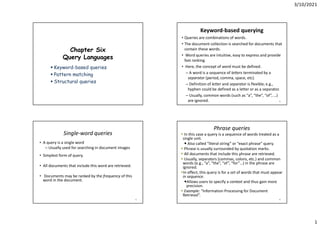
Chapter Six
Query Languages
 Keyword-based queries
 Pattern matching
 Structural queries
Keyword-based querying
• Queries are combinations of words.
• The document collection is searched for documents that
contain these words.
• Word queries are intuitive, easy to express and provide
fast ranking.
• Here, the concept of word must be defined.
– A word is a sequence of letters terminated by a
separator (period, comma, space, etc).
– Definition of letter and separator is flexible; e.g.,
hyphen could be defined as a letter or as a separator.
– Usually, common words (such as “a”, “the”, “of”, …)
are ignored. 2
Single-word queries
• A query is a single word
– Usually used for searching in document images
• Simplest form of query.
• All documents that include this word are retrieved.
• Documents may be ranked by the frequency of this
word in the document.
3
Phrase queries
 In this case a query is a sequence of words treated as a
single unit.
 Also called “literal string” or “exact phrase” query.
 Phrase is usually surrounded by quotation marks.
 All documents that include this phrase are retrieved.
 Usually, separators (commas, colons, etc.) and common
words (e.g., “a”, “the”, “of”, “for”…) in the phrase are
ignored.
In effect, this query is for a set of words that must appear
in sequence.
Allows users to specify a context and thus gain more
precision.
 Example: “Information Processing for Document
Retrieval”.
4
3/10/2021
2
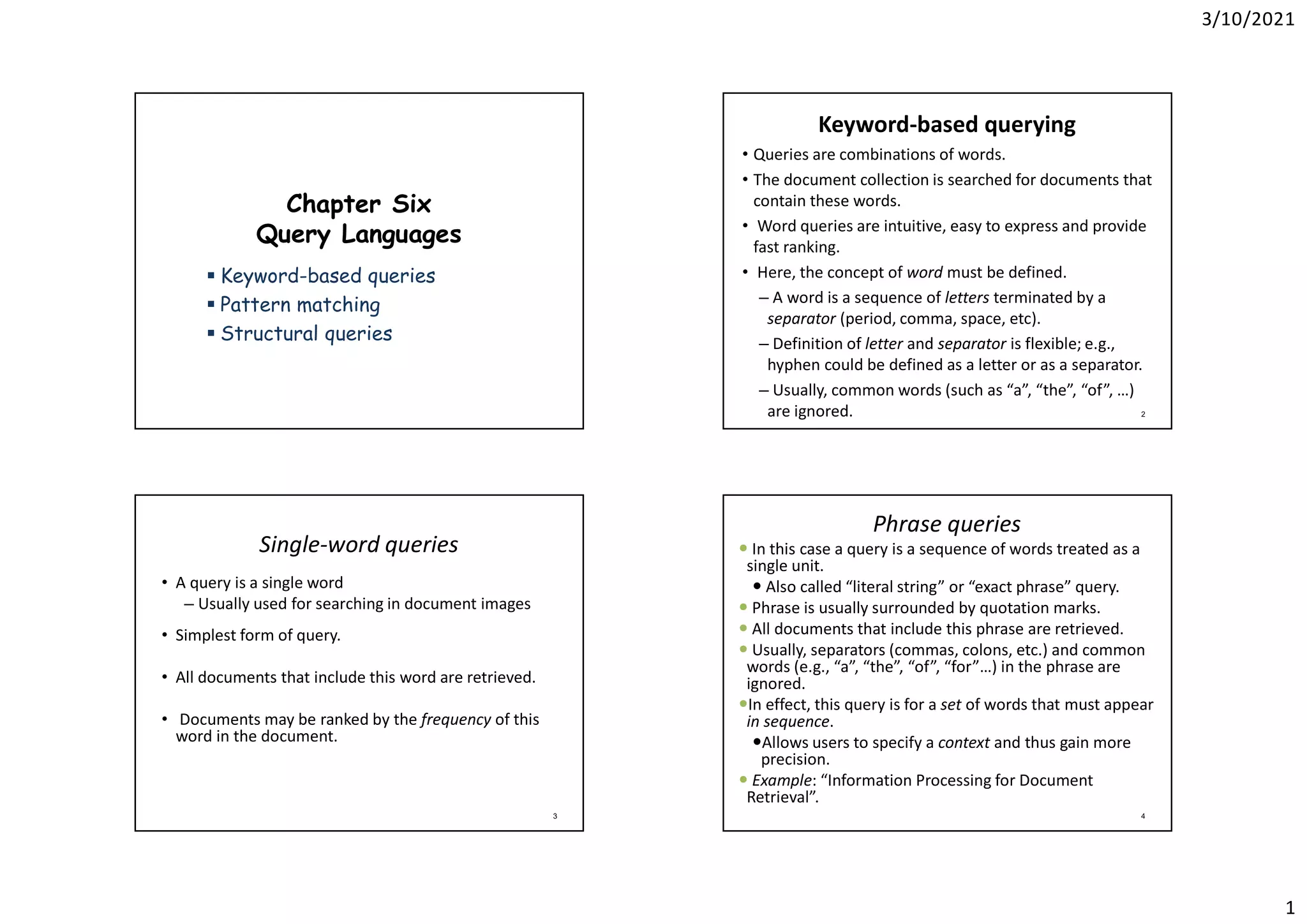
Multiple-word queries
•In this case a query is a set of words (or phrases).
•Two options: A document is retrieved if it includes
–any of the query words, or
–each of the query words.
•Documents are ranked by the number of query words they
contain:
– A document containing n query words is ranked higher
than a document containing m < n query words.
– Documents are ranked in decreasing order:
•those containing all the query words are ranked at the top, only one query
word at bottom.
–Frequency counts may be used to break ties among
documents that contain the same query words.
–Example: what is the result for the query “Red Bird” ? 5
Proximity queries
•Restrict the distance within a document between two
search terms.
•Important for large documents in which the two search
words may appear in different contexts.
•Proximity specifications limit the acceptable occurrences
and hence increase the precision of the search.
•General Format: Word1 within m units of Word2.
–Unit may be character, word, paragraph, etc.
•Examples:
–Information within 5 words of Retrieval:
Finds documents that discuss “Information Processing for
Document Retrieval” but not “Information Processing and
Searching for Relevant Document Retrieval”.
–Nuclear within 0 paragraphs of science:
Finds documents that discuss “Nuclear” and “science” in
the same paragraph.
6
Boolean queries
•Based on concepts from logic: AND, OR, NOT
–It describes the information needed by relating
multiple words with Boolean operators.
•Operators: AND, OR, NOT
•Semantics: For each query word w a corresponding set
Dw is constructed that includes the documents that
contain w.
•The Boolean expression is then interpreted as an
expression on the corresponding document sets with
corresponding set operators:
–AND: Finds only documents containing all of the
specified words or phrases.
–OR: Finds documents containing at least one of the
specified words or phrases.
–NOT: Excludes documents containing the specified
word or phrase.
7
Boolean Queries
• Precedence: Order of operations
– NOT, AND, OR
– use parentheses to override precedence
– process left-to-right among operators with the
same precedence.
• Truth Table
P Q NOT P P AND Q P OR Q
0 0 TRUE FALSE FALSE
0 1 TRUE FALSE TRUE
1 0 FALSE FALSE TRUE
1 1 FALSE TRUE TRUE
8
3/10/2021
3
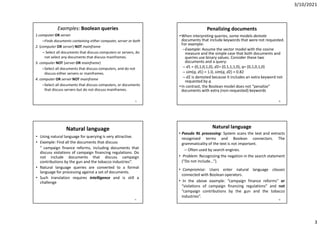
Examples: Boolean queries
1.computer OR server
–Finds documents containing either computer, server or both
2. (computer OR server) NOT mainframe
– Select all documents that discuss computers or servers, do
not select any documents that discuss mainframes.
3. computer NOT (server OR mainframe)
–Select all documents that discuss computers, and do not
discuss either servers or mainframes.
4. computer OR server NOT mainframe
–Select all documents that discuss computers, or documents
that discuss servers but do not discuss mainframes.
9
Penalizing documents
•When interpreting queries, some models demote
documents that include keywords that were not requested.
For example:
–Example: Assume the vector model with the cosine
measure and the simple case that both documents and
queries use binary values. Consider these two
documents and a query:
– d1 = (0,1,0,1,0), d2= (0,1,1,1,0), q= (0,1,0,1,0)
– sim(q, d1) = 1.0, sim(q, d2) = 0.82
– d2 is demoted because it includes an extra keyword not
requested by q.
•In contrast, the Boolean model does not “penalize”
documents with extra (non-requested) keywords
10
Natural language
• Using natural language for querying is very attractive.
• Example: Find all the documents that discuss
“ campaign finance reforms, including documents that
discuss violations of campaign financing regulations. Do
not include documents that discuss campaign
contributions by the gun and the tobacco industries”.
• Natural language queries are converted to a formal
language for processing against a set of documents.
• Such translation requires intelligence and is still a
challenge
11
Natural language
• Pseudo NL processing: System scans the text and extracts
recognized terms and Boolean connectors. The
grammaticality of the text is not important.
– Often used by search engines.
• Problem: Recognizing the negation in the search statement
(“Do not include...”).
• Compromise: Users enter natural language clauses
connected with Boolean operators.
• In the above example: “campaign finance reforms” or
“violations of campaign financing regulations" and not
“campaign contributions by the gun and the tobacco
industries”.
12
3/10/2021
4
13
Thank you

Chapter 6 Query Language .pdf

  • 1.
    3/10/2021 1 Chapter Six Query Languages Keyword-based queries  Pattern matching  Structural queries Keyword-based querying • Queries are combinations of words. • The document collection is searched for documents that contain these words. • Word queries are intuitive, easy to express and provide fast ranking. • Here, the concept of word must be defined. – A word is a sequence of letters terminated by a separator (period, comma, space, etc). – Definition of letter and separator is flexible; e.g., hyphen could be defined as a letter or as a separator. – Usually, common words (such as “a”, “the”, “of”, …) are ignored. 2 Single-word queries • A query is a single word – Usually used for searching in document images • Simplest form of query. • All documents that include this word are retrieved. • Documents may be ranked by the frequency of this word in the document. 3 Phrase queries  In this case a query is a sequence of words treated as a single unit.  Also called “literal string” or “exact phrase” query.  Phrase is usually surrounded by quotation marks.  All documents that include this phrase are retrieved.  Usually, separators (commas, colons, etc.) and common words (e.g., “a”, “the”, “of”, “for”…) in the phrase are ignored. In effect, this query is for a set of words that must appear in sequence. Allows users to specify a context and thus gain more precision.  Example: “Information Processing for Document Retrieval”. 4
  • 2.
    3/10/2021 2 Multiple-word queries •In thiscase a query is a set of words (or phrases). •Two options: A document is retrieved if it includes –any of the query words, or –each of the query words. •Documents are ranked by the number of query words they contain: – A document containing n query words is ranked higher than a document containing m < n query words. – Documents are ranked in decreasing order: •those containing all the query words are ranked at the top, only one query word at bottom. –Frequency counts may be used to break ties among documents that contain the same query words. –Example: what is the result for the query “Red Bird” ? 5 Proximity queries •Restrict the distance within a document between two search terms. •Important for large documents in which the two search words may appear in different contexts. •Proximity specifications limit the acceptable occurrences and hence increase the precision of the search. •General Format: Word1 within m units of Word2. –Unit may be character, word, paragraph, etc. •Examples: –Information within 5 words of Retrieval: Finds documents that discuss “Information Processing for Document Retrieval” but not “Information Processing and Searching for Relevant Document Retrieval”. –Nuclear within 0 paragraphs of science: Finds documents that discuss “Nuclear” and “science” in the same paragraph. 6 Boolean queries •Based on concepts from logic: AND, OR, NOT –It describes the information needed by relating multiple words with Boolean operators. •Operators: AND, OR, NOT •Semantics: For each query word w a corresponding set Dw is constructed that includes the documents that contain w. •The Boolean expression is then interpreted as an expression on the corresponding document sets with corresponding set operators: –AND: Finds only documents containing all of the specified words or phrases. –OR: Finds documents containing at least one of the specified words or phrases. –NOT: Excludes documents containing the specified word or phrase. 7 Boolean Queries • Precedence: Order of operations – NOT, AND, OR – use parentheses to override precedence – process left-to-right among operators with the same precedence. • Truth Table P Q NOT P P AND Q P OR Q 0 0 TRUE FALSE FALSE 0 1 TRUE FALSE TRUE 1 0 FALSE FALSE TRUE 1 1 FALSE TRUE TRUE 8
  • 3.
    3/10/2021 3 Examples: Boolean queries 1.computerOR server –Finds documents containing either computer, server or both 2. (computer OR server) NOT mainframe – Select all documents that discuss computers or servers, do not select any documents that discuss mainframes. 3. computer NOT (server OR mainframe) –Select all documents that discuss computers, and do not discuss either servers or mainframes. 4. computer OR server NOT mainframe –Select all documents that discuss computers, or documents that discuss servers but do not discuss mainframes. 9 Penalizing documents •When interpreting queries, some models demote documents that include keywords that were not requested. For example: –Example: Assume the vector model with the cosine measure and the simple case that both documents and queries use binary values. Consider these two documents and a query: – d1 = (0,1,0,1,0), d2= (0,1,1,1,0), q= (0,1,0,1,0) – sim(q, d1) = 1.0, sim(q, d2) = 0.82 – d2 is demoted because it includes an extra keyword not requested by q. •In contrast, the Boolean model does not “penalize” documents with extra (non-requested) keywords 10 Natural language • Using natural language for querying is very attractive. • Example: Find all the documents that discuss “ campaign finance reforms, including documents that discuss violations of campaign financing regulations. Do not include documents that discuss campaign contributions by the gun and the tobacco industries”. • Natural language queries are converted to a formal language for processing against a set of documents. • Such translation requires intelligence and is still a challenge 11 Natural language • Pseudo NL processing: System scans the text and extracts recognized terms and Boolean connectors. The grammaticality of the text is not important. – Often used by search engines. • Problem: Recognizing the negation in the search statement (“Do not include...”). • Compromise: Users enter natural language clauses connected with Boolean operators. • In the above example: “campaign finance reforms” or “violations of campaign financing regulations" and not “campaign contributions by the gun and the tobacco industries”. 12
  • 4.