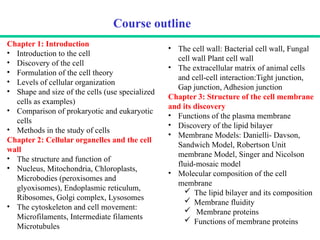
Chapter 1: Introduction
•Introduction to the cell
• Discovery of the cell
• Formulation of the cell theory
• Levels of cellular organization
• Shape and size of the cells (use specialized
cells as examples)
• Comparison of prokaryotic and eukaryotic
cells
• Methods in the study of cells
Chapter 2: Cellular organelles and the cell
wall
• The structure and function of
• Nucleus, Mitochondria, Chloroplasts,
Microbodies (peroxisomes and
glyoxisomes), Endoplasmic reticulum,
Ribosomes, Golgi complex, Lysosomes
• The cytoskeleton and cell movement:
Microfilaments, Intermediate filaments
Microtubules
• The cell wall: Bacterial cell wall, Fungal
cell wall Plant cell wall
• The extracellular matrix of animal cells
and cell-cell interaction:Tight junction,
Gap junction, Adhesion junction
Chapter 3: Structure of the cell membrane
and its discovery
• Functions of the plasma membrane
• Discovery of the lipid bilayer
• Membrane Models: Danielli- Davson,
Sandwich Model, Robertson Unit
membrane Model, Singer and Nicolson
fluid-mosaic model
• Molecular composition of the cell
membrane
The lipid bilayer and its composition
Membrane fluidity
Membrane proteins
Functions of membrane proteins
Course outline
3.
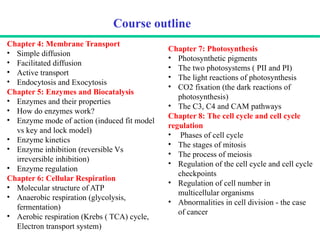
Chapter 4: MembraneTransport
• Simple diffusion
• Facilitated diffusion
• Active transport
• Endocytosis and Exocytosis
Chapter 5: Enzymes and Biocatalysis
• Enzymes and their properties
• How do enzymes work?
• Enzyme mode of action (induced fit model
vs key and lock model)
• Enzyme kinetics
• Enzyme inhibition (reversible Vs
irreversible inhibition)
• Enzyme regulation
Chapter 6: Cellular Respiration
• Molecular structure of ATP
• Anaerobic respiration (glycolysis,
fermentation)
• Aerobic respiration (Krebs ( TCA) cycle,
Electron transport system)
Chapter 7: Photosynthesis
• Photosynthetic pigments
• The two photosystems ( PII and PI)
• The light reactions of photosynthesis
• CO2 fixation (the dark reactions of
photosynthesis)
• The C3, C4 and CAM pathways
Chapter 8: The cell cycle and cell cycle
regulation
• Phases of cell cycle
• The stages of mitosis
• The process of meiosis
• Regulation of the cell cycle and cell cycle
checkpoints
• Regulation of cell number in
multicellular organisms
• Abnormalities in cell division - the case
of cancer
Course outline
4.
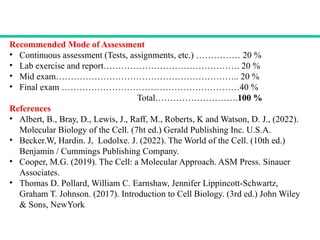
Recommended Mode ofAssessment
• Continuous assessment (Tests, assignments, etc.) …………… 20 %
• Lab exercise and report………………………………………. 20 %
• Mid exam…………………………………………………….. 20 %
• Final exam ……………………………………………………40 %
Total……………………….100 %
References
• Albert, B., Bray, D., Lewis, J., Raff, M., Roberts, K and Watson, D. J., (2022).
Molecular Biology of the Cell. (7ht ed.) Gerald Publishing Inc. U.S.A.
• Becker.W, Hardin. J, Lodolxe. J. (2022). The World of the Cell. (10th ed.)
Benjamin / Cummings Publishing Company.
• Cooper, M.G. (2019). The Cell: a Molecular Approach. ASM Press. Sinauer
Associates.
• Thomas D. Pollard, William C. Earnshaw, Jennifer Lippincott-Schwartz,
Graham T. Johnson. (2017). Introduction to Cell Biology. (3rd ed.) John Wiley
& Sons, NewYork
5.
Ever to Excel!
5
ChapterOne: Introduction
What is a cell?
Cell is the smallest basic, structural and functional unit of life
responsible for all life’s processes.
the lowest level of structure capable of performing all activities of
life.
What exactly is life?
Life defies simple definition
Living systems are the most complex chemical systems on
earth and can not be defined objectively
Life is rather recognized by what living things do
Some of the common properties and processes associated with life
are the following:
www.hu.edu.et
6.
1. Complex organization:Cells are highly complex and organized
• Cellular processes are highly regulated.
Cell activities can be remarkably precise, as DNA duplication has
error rate <1 mistake every 10,000,000 nucleotides incorporated,
and most errors quickly fixed by elaborate repair mechanism that
recognizes defect.
Each level of structure in cells has a great level of consistency from
cell-to-cell. E.g. organelles have a particular shape and location in
all individuals of species.
• Complex organisms are highly organized assemblies of specialized
cells(Cell-tissue-organ-system-organism)
• Cells from different species share a similar structure, composition,
and metabolic features.
www.hu.edu.et Ever to Excel!
6
Basic Properties of Cells….
7.
2. Cells Possessa Genetic Program and the Means to Use It
Information for building an organism is encoded in genes (constructed
from DNA) and packaged into a set of chromosomes within the cell
nucleus.
Genes store information and instructions for:
Constructing cellular structures
Running cellular activities
Gene molecular structure allows for changes in genetic information
(mutations) that lead to variation among individuals and forms the
basis of biological evolution.
www.hu.edu.et 7 Ever to Excel!
Basic Properties of Cells….
8.
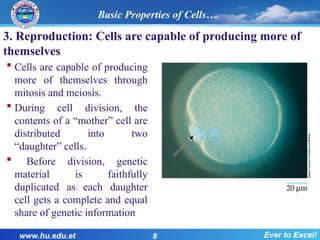
3. Reproduction: Cellsare capable of producing more of
themselves
Cells are capable of producing
more of themselves through
mitosis and meiosis.
During cell division, the
contents of a “mother” cell are
distributed into two
“daughter” cells.
Before division, genetic
material is faithfully
duplicated as each daughter
cell gets a complete and equal
share of genetic information
www.hu.edu.et 8 Ever to Excel!
Basic Properties of Cells….
9.
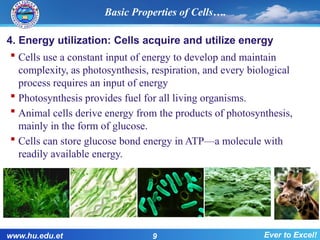
4. Energy utilization:Cells acquire and utilize energy
Cells use a constant input of energy to develop and maintain
complexity, as photosynthesis, respiration, and every biological
process requires an input of energy
Photosynthesis provides fuel for all living organisms.
Animal cells derive energy from the products of photosynthesis,
mainly in the form of glucose.
Cells can store glucose bond energy in ATP—a molecule with
readily available energy.
www.hu.edu.et 9 Ever to Excel!
Basic Properties of Cells….
10.
Basic Properties ofCells….
5. Metabolism. Cells Carry Out a Variety of Chemical
Reactions
Cells function like miniaturized chemical plants.
A bacterial cell is capable of hundreds of different chemical
transformations.
Virtually all chemical changes that take place in cells require
enzymes to increase the rate at which a chemical reaction occurs.
The sum total of the chemical reactions in a cell represents that
cell’s metabolism.
www.hu.edu.et 10 Ever to Excel!
11.
6. Cells Engagein Mechanical Activities
Cells are very active, they can:
transport materials,
assemble and disassemble structures, and
sometimes move itself from one site to another.
Activities are based on dynamic, mechanical changes within cells,
many of which are initiated by changes in the shape of “motor”
proteins.
Basic Properties of Cells….
www.hu.edu.et 11 Ever to Excel!
12.
7. Irritability: Cellsare able to respond to stimuli
Whether organisms are uni- or multicellular they have receptors that
sense the environment and initiate responses
Cells in plants or animals are covered with receptors that interact
with substances in the environment.
Hormones, growth factors, extracellular materials, and substances
on the surfaces of other cells can interact with these receptors.
Cells may respond to stimuli by
Altering their metabolic activities.
Preparing for cell division.
Moving from one place to another.
Even committing suicide.
Basic Properties of Cells….
www.hu.edu.et 12 Ever to Excel!
13.
8. Homeostasis: Cellsare capable of self-regulation
Cells are protected from dangerous fluctuations in composition and
behaviour.
If anything happens within or to an organism that affects its normal
state, processes to restore the normal state begin
Maintaining a complex, ordered state requires constant regulation.
The regulation of an organism’s internal conditions to maintain life is
called homeostasis
The importance of regulatory mechanisms is most evident when they
break down.
Failure of cells to correct errors in DNA replication may lead to
debilitating mutations.
Breakdown in growth-control safeguards may lead to cancer cells
and maybe death of the whole organism.
Basic Properties of Cells….
www.hu.edu.et 13 Ever to Excel!
14.
9. Evolution: CellsEvolve
It is presumed that cells evolved from some type of precellular life
form, which, in turn, evolved from nonliving organic molecules that
were present in the primordial seas
Cells share many features, including a common genetic code, a
plasma membrane, and ribosomes.
According to a principle of modern biology, all living organisms
evolved from a single, common ancestral cell that lived more than
three billion years ago.
This ancient cell is often referred to as the last universal common
ancestor (or LUCA).
Basic Properties of Cells….
www.hu.edu.et 14 Ever to Excel!
15.
Class Activity (3min)
1.List the fundamental properties shared by all cells. Describe the
importance of each of these properties.
2. What is the source of energy that supports life on Earth? How is
this energy passed from one organism to the next?
3. Which of the following is NOT a feature shared by all cells?
A. plasma membrane with similar chemical construction
B. genetic information encoded in DNA nucleotides
C. shared metabolic pathways
D. division of cells into nucleus and cytoplasm
E. similar energy storing chemicals such as ATP
Ever to Excel!
16.
Cells can varyenormously in size, shape and function
Cell size
Cells vary greatly in size ranging from less than 1 micrometer to
200 micrometers.
Why are most cells so small?
The size of a cell is directly related to its level of activity and the
rate that molecules move across its membranes.
In order to stay alive, a cell must have a constant supply of
nutrients, oxygen, and other molecules. It must also be able to get
rid of carbon dioxide and other waste products that are harmful to
it.
Substances can’t get to the center, or out of the center of the cell
fast enough if it’s too big.
The larger a cell becomes, the more difficult it is to satisfy these
requirements; consequently, most cells are very small.
Size, shape and functions of cells
www.hu.edu.et Ever to Excel!
16
17.
Advantages of beingsmall:
Small cells have large surface to volume ratio,
Support greater nutrient exchange per unit cell volume
Tend to grwo faster than larger cell
There is a mathematical relationship between the surface area and
volume of a cell referred to as the surface area-to-volume ratio.
www.hu.edu.et Ever to Excel!
17
18.
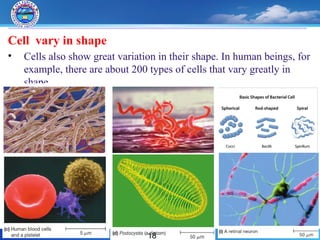
Cell vary inshape
• Cells also show great variation in their shape. In human beings, for
example, there are about 200 types of cells that vary greatly in
shape
18
19.
Ever to Excel!
19
Cellsare also enormously diverse in their chemical
requirements.
• Some require oxygen to live (aerobes); for others, oxygen is
deadly(anaerobes), and still others live with or without oxygen
(facultative anaerobes).
• Some cells use carbon dioxide (CO2), sunlight, and water as their
raw materials for making their food (producers); others need a
complex mixture of molecules produced by other cells
(Consumers).
These differences in size, shape, and chemical requirements often
reflect differences in cell function.
• In a multicellular organism, there is a division of labor among cells
some cells are specialized factories for the production of particular
substances, such as hormones, starch, fat, latex, or pigments.
www.hu.edu.et
20.
Ever to Excel!
20
Criticalthinking questions
1. Why are cells almost always microscopic?
2. Prokaryotic cells are generally smaller than eukaryotic cells and
have no membrane-bound organelles, which act to transport
some materials around the cell and compartmentalize certain
cellular processes. Why do prokaryotic cells not require such
membrane-bound organelles?
3. Why are viruses not considered by most biologists to be living
organisms?
www.hu.edu.et
21.
Brief history ofcell biology
Cell biology is a branch of biology focused on the study of cell structure
and function, on how cells form and divide, and how they differentiate
and specialize.
• The story of cell biology started to unfold more than 300 years ago, as
European scientists began to focus their crude microscopes on a variety of
biological materials ranging from tree bark to bacteria to human sperm
What made cell discovery possible?
Microscopes allowed cell visualization
• Cells were discovered in 1665 by Robert Hooke after the invention of the
microscope
He observed and sketched a network of tiny boxlike compartments
that reminded him of a honeycomb and called these little compartments
cells, from the Latin word cellulae, meaning “little room.”
He thought that cells only existed in plants and fungi
www.hu.edu.et 21 Ever to Excel!
22.
Brief history ofcell biology....
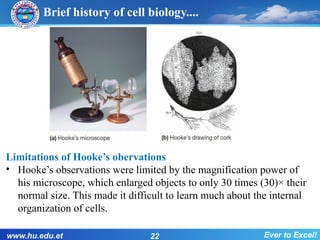
Limitations of Hooke’s obervations
• Hooke’s observations were limited by the magnification power of
his microscope, which enlarged objects to only 30 times (30)× their
normal size. This made it difficult to learn much about the internal
organization of cells.
www.hu.edu.et 22 Ever to Excel!
23.
Ever to Excel!
23
Discoveryof the cell ….
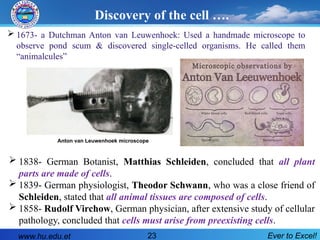
1673- a Dutchman Anton van Leuwenhoek: Used a handmade microscope to
observe pond scum & discovered single-celled organisms. He called them
“animalcules”
www.hu.edu.et
Anton van Leuwenhoek microscope
1838- German Botanist, Matthias Schleiden, concluded that all plant
parts are made of cells.
1839- German physiologist, Theodor Schwann, who was a close friend of
Schleiden, stated that all animal tissues are composed of cells.
1858- Rudolf Virchow, German physician, after extensive study of cellular
pathology, concluded that cells must arise from preexisting cells.
24.
Ever to Excel!
24
The3 Basic Components of the Cell Theory
All organisms are composed of one or more cells. (Schleiden &
Schwann)(1838-39)
The cell is the basic unit of life in all living things. (Schleiden
& Schwann)(1838-39)
All cells are produced by the division of preexisting cells.
(Virchow)(1858)
Discovery of the cell and formulation ….
www.hu.edu.et
25.
Ever to Excel!
25
Exercise(5min)
1. Who was the first person to name what he thought were single
cells?
2. Who was the first scientist to examine and describe living cells?
3. What are the three components of cell theory?
www.hu.edu.et



![Ch_5_Agri Biotech.pdfpy5;y]]']we[l[5tt=[l[t;t[](https://cdn.slidesharecdn.com/ss_thumbnails/ch5agribiotech-250225152434-2d8e7718-thumbnail.jpg?width=640&height=640&fit=bounds)
![4_5958421195031319849.pptpe[e[];/[;wql,dmx](https://cdn.slidesharecdn.com/ss_thumbnails/45958421195031319849-250225152329-349fbdd2-thumbnail.jpg?width=640&height=640&fit=bounds)


![Polymer [ बहुलक ] Chemistry Notes PDF - Irfanullah Mehar - JJ Sir Chemistry.pdf](https://cdn.slidesharecdn.com/ss_thumbnails/polymerchemistrynotespdf-irfanullahmehar-jjsirchemistry-260210172118-3f9b37f7-thumbnail.jpg?width=640&height=640&fit=bounds)


