GLOBAL INDUSTRIES Chapter 5 Lecture 1
Global Industries Borders are blurred Among nations Between competitors & collaborators Between and among industries Industries are permeable
Industries are Described and Classified in Myriad Ways By industry type: product or service By value: high value-added to low value-added By durability: consumer durable (autos) or nondurable (shampoo) By cyclical use: used all the time or just in particular seasons Whatever the classification, a commonality among industries is that all are increasingly global
Ways to Examine an Industry and its Global Characteristics amount of industry factors shaped outside domestic markets a high industry trade ratio (Porter, 1980) ranging from about 30 to 55% (see Roth and Morrison, 1990, footnote 2) percentage of a firm's sales derived from abroad according to whether they are  multidomestic simple global integrated global  fully global ( Makhija, Kim, and Williamson, 1997)
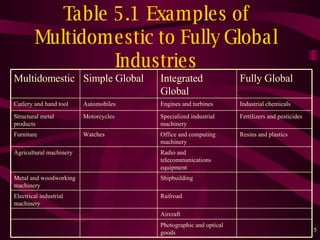
Table 5.1 Examples of Multidomestic to Fully Global Industries Photographic and optical goods Aircraft Railroad Electrical industrial machinery Shipbuilding Metal and woodworking machinery Radio and telecommunications equipment Agricultural machinery Resins and plastics Office and computing machinery Watches Furniture Fertilizers and pesticides Specialized industrial machinery Motorcycles Structural metal products Industrial chemicals Engines and turbines Automobiles Cutlery and hand tool Fully Global Integrated Global Simple Global Multidomestic
Ways that Industries Alter  Convergence Disintermediation Integration consolidation via mergers and acquisitions alliances forging new links with buyers and suppliers Contraction  Dissolution
Sources of Industry Change Outside the industry—borrowing from other industries Inside the industry—keeping up with what other firms are doing
For Global Enterprises A main question in any industry, but especially global ones is: What are the sources of organizational advantage?
Concepts of Strategy T he idea at the industry level is to generate a business strategy that creates a sustainable organizational advantage Within industries, businesses usually pursue one of three approaches vis - à - vis competitors (this is guided by industry norms and firm enterprise and corporate strategies) Compete Collaborate They do both simultaneously
Strategy In the Post w ar period, business scholars began to examine strategies of businesses How do businesses compete? How and why are they successful? Looks at the big picture of how companies and industries operate Draws from many disciplines
Five Major Ways that Organizations use to Identify a Distinctive Advantage Industry analysis Diagnosing industry globalization Anticipating the future Revolutionizing the industry Reshaping the organization
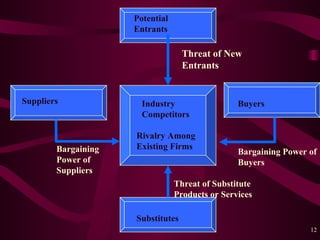
Potential Entrants Buyers Substitutes Suppliers Industry Competitors Threat of New Entrants Bargaining Power of Buyers Threat of Substitute Products or Services Bargaining Power of Suppliers Rivalry Among Existing Firms
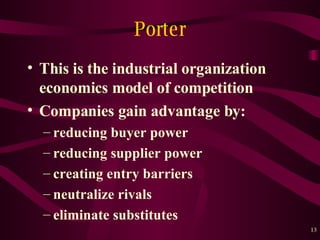
Porter This is the industrial organization economics model of competition Companies gain advantage by: reducing buyer power reducing supplier power creating entry barriers neutralize rivals eliminate substitutes
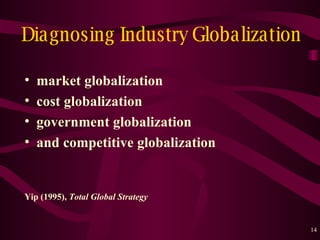
Diagnosing Industry Globalization market globalization cost globalization government globalization and competitive globalization Yip (1995),  Total Global Strategy
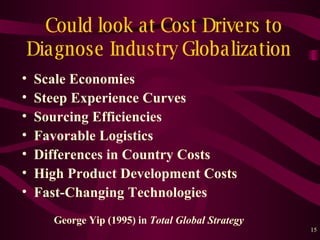
Could look at Cost Drivers to Diagnose Industry Globalization  Scale Economies Steep Experience Curves Sourcing Efficiencies Favorable Logistics Differences in Country Costs High Product Development Costs Fast-Changing Technologies George Yip (1995) in  Total Global Strategy
Perspectives on the Future The trick is to see the future before it arrives (Hamel and Prahalad) The challenge for managers is to look ahead and assess what the firm needs to do to  be an industry leader in the future — to anticipate
How Can We See the Future? Devote time and intellectual energy to understanding forces shaping the future Factors that shape your future are those we study when we study globalization
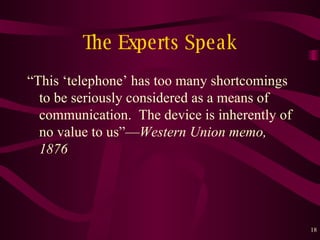
The Experts Speak “This ‘telephone’ has too many shortcomings to be seriously considered as a means of communication.  The device is inherently of no value to us” — Western Union memo, 1876
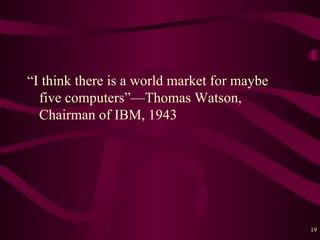
“I think there is a world market for maybe five computers” — Thomas Watson, Chairman of IBM, 1943
“A cookie store is a bad idea.  Besides, the market research reports say America likes crispy cookies, not soft and chewy cookies like you make.” — Response to Debbie Fields’ idea of starting Mrs. Fields’ Cookies
“ The concept is interesting and well-formed, but in order to earn better than a  ‘ C,’ the idea must be feasible” — A Yale University management professor in response to Fred Smith’s paper proposing reliable overnight delivery service — Smith later founded Federal Express
What Does the Future Hold? Consider any given industry
As a Manager, Anticipating the Future Requires Intellectual capacity and will Equality of participants Time  c ommitment Willingness to cope with complexity Foresight Creativity and imagination
Intellectual Capacity Unlike factors of capital, equipment, raw materials, etc . , the organization does not own, control, and cannot monopolize intellect Intellect is owned by individuals
Intellect Unleashed With  Trust Empowerment Teams Encouragement
Revolutionizing the Industry Re-conceive a product or service Redefine a market space Redraw industry boundaries Hamel, 1996
Sustainable Advantage Can Come From Processes Structures People Or combinations of them
Process Examples Core Competencies Learning Strategy Worldwide integration Multilocal strategy
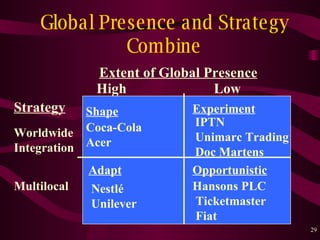
Extent of Global Presence High Low Strategy Worldwide Integration Multilocal Shape Coca-Cola Acer   Experiment IPTN  Unimarc Trading  Doc Martens Adapt Nestl é   Unilever Hansons PLC  Ticketmaster  Fiat Opportunistic Global Presence and Strategy Combine
Structure Examples Networks Hybrids Combining hierarchies and flat organizations Alliances
People Examples Superior employees Managing diversity Organizational Culture Human resource development
Achieving Sustainable Advantage Through People High wages — you get what you pay for Incentive pay — shared gains Information sharing Cross-utilization and -training Long-term perspective An overarching philosophy Jeffrey Pfeffer (1994)
Is it Nations or Companies that Should Compete? Globalists think that nations must be involved with businesses to keep important ones in their own nations. This is encouraged by things like: World Competitiveness Reports   Determinants of National Competitiveness — Porter’s Competitive Diamond of Availability of productive factors Demand Proximity of reported or support industries Firm strategy, structure, rivalry consistent with national norms Institutionalists believe businesses compete more than nations National focus on competitiveness reinforces belief in “winners” and “losers” Encourages a sense of zero sum opportunities; leads to bad economic policies (Krugman, 1994) One nation’s prosperity need not come from another’s opportunities (Turner, 2001)

Chapter 5 Lecture 1 Global Industries

  • 1.
  • 2.
    Global Industries Bordersare blurred Among nations Between competitors & collaborators Between and among industries Industries are permeable
  • 3.
    Industries are Describedand Classified in Myriad Ways By industry type: product or service By value: high value-added to low value-added By durability: consumer durable (autos) or nondurable (shampoo) By cyclical use: used all the time or just in particular seasons Whatever the classification, a commonality among industries is that all are increasingly global
  • 4.
    Ways to Examinean Industry and its Global Characteristics amount of industry factors shaped outside domestic markets a high industry trade ratio (Porter, 1980) ranging from about 30 to 55% (see Roth and Morrison, 1990, footnote 2) percentage of a firm's sales derived from abroad according to whether they are multidomestic simple global integrated global fully global ( Makhija, Kim, and Williamson, 1997)
  • 5.
    Table 5.1 Examplesof Multidomestic to Fully Global Industries Photographic and optical goods Aircraft Railroad Electrical industrial machinery Shipbuilding Metal and woodworking machinery Radio and telecommunications equipment Agricultural machinery Resins and plastics Office and computing machinery Watches Furniture Fertilizers and pesticides Specialized industrial machinery Motorcycles Structural metal products Industrial chemicals Engines and turbines Automobiles Cutlery and hand tool Fully Global Integrated Global Simple Global Multidomestic
  • 6.
    Ways that IndustriesAlter Convergence Disintermediation Integration consolidation via mergers and acquisitions alliances forging new links with buyers and suppliers Contraction Dissolution
  • 7.
    Sources of IndustryChange Outside the industry—borrowing from other industries Inside the industry—keeping up with what other firms are doing
  • 8.
    For Global EnterprisesA main question in any industry, but especially global ones is: What are the sources of organizational advantage?
  • 9.
    Concepts of StrategyT he idea at the industry level is to generate a business strategy that creates a sustainable organizational advantage Within industries, businesses usually pursue one of three approaches vis - à - vis competitors (this is guided by industry norms and firm enterprise and corporate strategies) Compete Collaborate They do both simultaneously
  • 10.
    Strategy In thePost w ar period, business scholars began to examine strategies of businesses How do businesses compete? How and why are they successful? Looks at the big picture of how companies and industries operate Draws from many disciplines
  • 11.
    Five Major Waysthat Organizations use to Identify a Distinctive Advantage Industry analysis Diagnosing industry globalization Anticipating the future Revolutionizing the industry Reshaping the organization
  • 12.
    Potential Entrants BuyersSubstitutes Suppliers Industry Competitors Threat of New Entrants Bargaining Power of Buyers Threat of Substitute Products or Services Bargaining Power of Suppliers Rivalry Among Existing Firms
  • 13.
    Porter This isthe industrial organization economics model of competition Companies gain advantage by: reducing buyer power reducing supplier power creating entry barriers neutralize rivals eliminate substitutes
  • 14.
    Diagnosing Industry Globalizationmarket globalization cost globalization government globalization and competitive globalization Yip (1995), Total Global Strategy
  • 15.
    Could look atCost Drivers to Diagnose Industry Globalization Scale Economies Steep Experience Curves Sourcing Efficiencies Favorable Logistics Differences in Country Costs High Product Development Costs Fast-Changing Technologies George Yip (1995) in Total Global Strategy
  • 16.
    Perspectives on theFuture The trick is to see the future before it arrives (Hamel and Prahalad) The challenge for managers is to look ahead and assess what the firm needs to do to be an industry leader in the future — to anticipate
  • 17.
    How Can WeSee the Future? Devote time and intellectual energy to understanding forces shaping the future Factors that shape your future are those we study when we study globalization
  • 18.
    The Experts Speak“This ‘telephone’ has too many shortcomings to be seriously considered as a means of communication. The device is inherently of no value to us” — Western Union memo, 1876
  • 19.
    “I think thereis a world market for maybe five computers” — Thomas Watson, Chairman of IBM, 1943
  • 20.
    “A cookie storeis a bad idea. Besides, the market research reports say America likes crispy cookies, not soft and chewy cookies like you make.” — Response to Debbie Fields’ idea of starting Mrs. Fields’ Cookies
  • 21.
    “ The conceptis interesting and well-formed, but in order to earn better than a ‘ C,’ the idea must be feasible” — A Yale University management professor in response to Fred Smith’s paper proposing reliable overnight delivery service — Smith later founded Federal Express
  • 22.
    What Does theFuture Hold? Consider any given industry
  • 23.
    As a Manager,Anticipating the Future Requires Intellectual capacity and will Equality of participants Time c ommitment Willingness to cope with complexity Foresight Creativity and imagination
  • 24.
    Intellectual Capacity Unlikefactors of capital, equipment, raw materials, etc . , the organization does not own, control, and cannot monopolize intellect Intellect is owned by individuals
  • 25.
    Intellect Unleashed With Trust Empowerment Teams Encouragement
  • 26.
    Revolutionizing the IndustryRe-conceive a product or service Redefine a market space Redraw industry boundaries Hamel, 1996
  • 27.
    Sustainable Advantage CanCome From Processes Structures People Or combinations of them
  • 28.
    Process Examples CoreCompetencies Learning Strategy Worldwide integration Multilocal strategy
  • 29.
    Extent of GlobalPresence High Low Strategy Worldwide Integration Multilocal Shape Coca-Cola Acer Experiment IPTN Unimarc Trading Doc Martens Adapt Nestl é Unilever Hansons PLC Ticketmaster Fiat Opportunistic Global Presence and Strategy Combine
  • 30.
    Structure Examples NetworksHybrids Combining hierarchies and flat organizations Alliances
  • 31.
    People Examples Superioremployees Managing diversity Organizational Culture Human resource development
  • 32.
    Achieving Sustainable AdvantageThrough People High wages — you get what you pay for Incentive pay — shared gains Information sharing Cross-utilization and -training Long-term perspective An overarching philosophy Jeffrey Pfeffer (1994)
  • 33.
    Is it Nationsor Companies that Should Compete? Globalists think that nations must be involved with businesses to keep important ones in their own nations. This is encouraged by things like: World Competitiveness Reports Determinants of National Competitiveness — Porter’s Competitive Diamond of Availability of productive factors Demand Proximity of reported or support industries Firm strategy, structure, rivalry consistent with national norms Institutionalists believe businesses compete more than nations National focus on competitiveness reinforces belief in “winners” and “losers” Encourages a sense of zero sum opportunities; leads to bad economic policies (Krugman, 1994) One nation’s prosperity need not come from another’s opportunities (Turner, 2001)

Editor's Notes

  • #2 TEACHING OBJECTIVES: describe perspectives on strategy; provide historical background on strategic management; examine tools in use by organizational strategists We study many firms in global industries to observe businesses cross all kinds of borders– national and internal — to create or participate in global industries. Banking, electronics, hotels, insurance, soap, telecommunications, tobacco to name a few. And look at which firms are leaders in these industries: Where once industry leaders were primarily U . S . firms — or at least they were so far as we knew — now we see that names we don't recognize like St. Gobain, Fleming, Bertelsmann, and Groupe des Caisses, Cemex, Nomura also are global leaders in industries that produce revenues numbering in the billions. Smaller industries also are global, e.g., the 2.5 billion stereo speaker industry; the 9.2 billion hair weave industry; the $92.9b women’s apparel industry; the gummi candy industry, and more. In the Pacific Northwest of the U . S . alone, we have a $2 billion dollar french fry industry! Many industries now are global, and with freer trade, more industries will go global in the coming years. As industries go global, they illustrate (next slide)