Chapter4
WORKATTITUDES
AND
LEADERSHIP
Leadership is the ability to
make others act in unity and in
an organized manner towards
the attainment of group goals.
ATTITUDES
Santos 1996
 is a manifestation of how one communicates his or her moods to others.
 When you are optimistic and anticipate successful encounters.
 When you are pessimistic and expect the worst.
 Attitude is a mindset.
POSITIVE AND NEGATIVE ATTITUDES
Positive attitudes are manifested in the form of desirable traits
that attract sympathy, admiration or emulation from others.
These includes, among others, industry, honesty, love for
work, humor and cooperation.
Negative attitudes are those that others generally shun or
dislike such as laziness, being troublesome and corrupt.
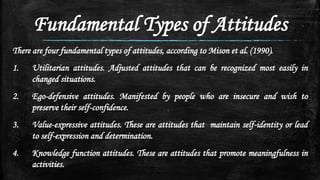
Fundamental Types of Attitudes
There are four fundamental types of attitudes, according to Mison et al. (1990).
1. Utilitarian attitudes. Adjusted attitudes that can be recognized most easily in
changed situations.
2. Ego-defensive attitudes. Manifested by people who are insecure and wish to
preserve their self-confidence.
3. Value-expressive attitudes. These are attitudes that maintain self-identity or lead
to self-expression and determination.
4. Knowledge function attitudes. These are attitudes that promote meaningfulness in
activities.
Work Attitudes
“Working well is part of the culture of excellence that results in
greater productivity”
Sir William C. Van Horne (1843-1915) held;
“The man who feels no enthusiasm for his work will never
accomplish anything worthwhile.”
is what a person should do and must do
regularly, gainfully, and purposefully.
is a basic to human existence.
WORK
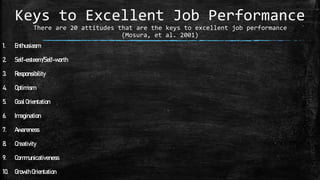
1. Enthusiasm
2. Self-esteem/Self-worth
3. Responsibility
4. Optimism
5. GoalOrientation
6. Imagination
7. Awareness
8. Creativity
9. Communicativeness
10. GrowthOrientation
Keys to Excellent Job Performance
There are 20 attitudes that are the keys to excellent job performance
(Mosura, et al. 2001)
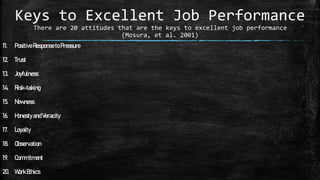
11. PositiveResponsetoPressure
12. Trust
13. Joyfulness
14. Risk-taking
15. Newness
16. HonestyandVeracity
17. Loyalty
18. Observation
19. Commitment
20. WorkEthics
Keys to Excellent Job Performance
There are 20 attitudes that are the keys to excellent job performance
(Mosura, et al. 2001)
Restructuring Our Attitude
Our attitude is predisposed by our culture, the
wider society to which the individuals belong, and by
primary groups, as well as by other factors in the
physical environment.
Values changes with our attitudes. We can
restructure or have some form of attitude renewal or
adjustment through change of values.
Philosophy says:
“If you take life too seriously, it will pull you down.”
Filipino says:
“Kung may hirap, may ginhawa; kung may dilim, may
liwanag”, “Tawanan mo ang ‘yong problema.”
The following are practical ways to
cultivate positive attitudes:
 Think about the goodness of God’s creations. “All things are
created by God. God is good. All things are good.”
 Mentally optimize your strengths.
 Feel good about life and enjoy it. “Living life to the fullest,” as the
bible states means being able to see the beauty of life and savor
its blessing.
Tips on Attitude Renewal
Six practical guidelines towards attitude
transformation are worth considering.
1. Understand yourself.
2. Appreciate yourself for having positive attitudes.
3. Recognize and avoid negative attitudes.
4. Understand your challenges.
5. Choose which positive attitude can best meet your challenge.
6. Reward yourself for every success.
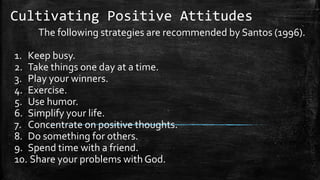
Cultivating Positive Attitudes
The following strategies are recommended by Santos (1996).
1. Keep busy.
2. Take things one day at a time.
3. Play your winners.
4. Exercise.
5. Use humor.
6. Simplify your life.
7. Concentrate on positive thoughts.
8. Do something for others.
9. Spend time with a friend.
10. Share your problems with God.
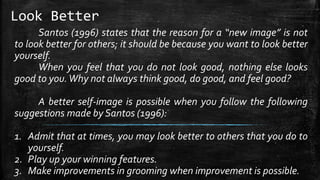
Look Better
Santos (1996) states that the reason for a “new image” is not
to look better for others; it should be because you want to look better
yourself.
When you feel that you do not look good, nothing else looks
good to you.Why not always think good, do good, and feel good?
A better self-image is possible when you follow the following
suggestions made by Santos (1996):
1. Admit that at times, you may look better to others that you do to
yourself.
2. Play up your winning features.
3. Make improvements in grooming when improvement is possible.
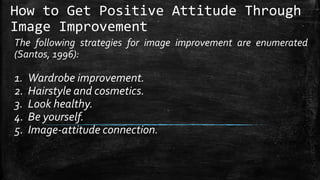
How to Get Positive Attitude Through
Image Improvement
The following strategies for image improvement are enumerated
(Santos, 1996):
1. Wardrobe improvement.
2. Hairstyle and cosmetics.
3. Look healthy.
4. Be yourself.
5. Image-attitude connection.
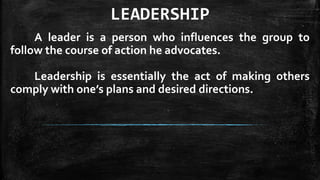
LEADERSHIP
A leader is a person who influences the group to
follow the course of action he advocates.
Leadership is essentially the act of making others
comply with one’s plans and desired directions.
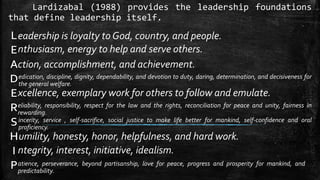
Lardizabal (1988) provides the leadership foundations
that define leadership itself.
eadership is loyalty to God, country, and people.
nthusiasm, energy to help and serve others.
ction, accomplishment, and achievement.
edication, discipline, dignity, dependability, and devotion to duty, daring, determination, and decisiveness for
the general welfare.
xcellence, exemplary work for others to follow and emulate.
eliability, responsibility, respect for the law and the rights, reconciliation for peace and unity, fairness in
rewarding.
incerity, service , self-sacrifice, social justice to make life better for mankind, self-confidence and oral
proficiency.
umility, honesty, honor, helpfulness, and hard work.
ntegrity, interest, initiative, idealism.
atience, perseverance, beyond partisanship, love for peace, progress and prosperity for mankind, and
predictability.
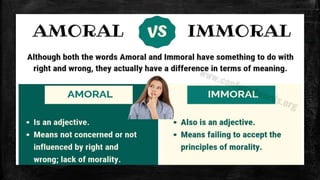
Amoral
Amoral appears in the late 1800s. The prefix a- means "not" or
"without," as in atypical or asymptomatic. The dictionary definition
of amoral is "having or showing no concern about whether behavior
is morally right or wrong"—compendiously, "without morals."
For example, an infant, unlearned in what is right and wrong, is
amoral; someone who lacks the mental ability to understand right
or wrong due to illness might be described as amoral. These are
illustrative examples, however; amoral can be used to describe any
person, or his or her actions, who is aware of what is right and
wrong but does wrong anyway and responds indifferently about it.
Amoral Actions
Amoral:Without Morals
Their behavior is not based on what is right or wrong; they
may not even know the difference.
Example of amoral in a sentence include: Babies' biting
behavior is often amoral, as they don't know that biting is wrong.
Amoral Actions
are those actions which stand neutral in relation to the norms
of morality. These acts may be good or bad, depending on the
purpose of the doer of the act.
For example:
Dating your loved one as a way of showing your love to him or her
is good, but dating during class hours is bad.
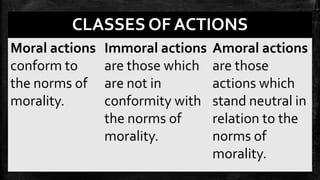
CLASSES OF ACTIONS
Moral actions
conform to
the norms of
morality.
Immoral actions
are those which
are not in
conformity with
the norms of
morality.
Amoral actions
are those
actions which
stand neutral in
relation to the
norms of
morality.
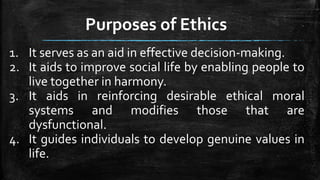
Purposes of Ethics
1. It serves as an aid in effective decision-making.
2. It aids to improve social life by enabling people to
live together in harmony.
3. It aids in reinforcing desirable ethical moral
systems and modifies those that are
dysfunctional.
4. It guides individuals to develop genuine values in
life.
Thank you for Listening!
Instructor: FritzilAnne P. Narciso

Chapter 4.pptx

  • 1.
  • 2.
    Leadership is theability to make others act in unity and in an organized manner towards the attainment of group goals.
  • 3.
    ATTITUDES Santos 1996  isa manifestation of how one communicates his or her moods to others.  When you are optimistic and anticipate successful encounters.  When you are pessimistic and expect the worst.  Attitude is a mindset.
  • 4.
    POSITIVE AND NEGATIVEATTITUDES Positive attitudes are manifested in the form of desirable traits that attract sympathy, admiration or emulation from others. These includes, among others, industry, honesty, love for work, humor and cooperation. Negative attitudes are those that others generally shun or dislike such as laziness, being troublesome and corrupt.
  • 5.
    Fundamental Types ofAttitudes There are four fundamental types of attitudes, according to Mison et al. (1990). 1. Utilitarian attitudes. Adjusted attitudes that can be recognized most easily in changed situations. 2. Ego-defensive attitudes. Manifested by people who are insecure and wish to preserve their self-confidence. 3. Value-expressive attitudes. These are attitudes that maintain self-identity or lead to self-expression and determination. 4. Knowledge function attitudes. These are attitudes that promote meaningfulness in activities.
  • 6.
    Work Attitudes “Working wellis part of the culture of excellence that results in greater productivity” Sir William C. Van Horne (1843-1915) held; “The man who feels no enthusiasm for his work will never accomplish anything worthwhile.”
  • 7.
    is what aperson should do and must do regularly, gainfully, and purposefully. is a basic to human existence. WORK
  • 8.
    1. Enthusiasm 2. Self-esteem/Self-worth 3.Responsibility 4. Optimism 5. GoalOrientation 6. Imagination 7. Awareness 8. Creativity 9. Communicativeness 10. GrowthOrientation Keys to Excellent Job Performance There are 20 attitudes that are the keys to excellent job performance (Mosura, et al. 2001)
  • 9.
    11. PositiveResponsetoPressure 12. Trust 13.Joyfulness 14. Risk-taking 15. Newness 16. HonestyandVeracity 17. Loyalty 18. Observation 19. Commitment 20. WorkEthics Keys to Excellent Job Performance There are 20 attitudes that are the keys to excellent job performance (Mosura, et al. 2001)
  • 10.
    Restructuring Our Attitude Ourattitude is predisposed by our culture, the wider society to which the individuals belong, and by primary groups, as well as by other factors in the physical environment. Values changes with our attitudes. We can restructure or have some form of attitude renewal or adjustment through change of values.
  • 11.
    Philosophy says: “If youtake life too seriously, it will pull you down.” Filipino says: “Kung may hirap, may ginhawa; kung may dilim, may liwanag”, “Tawanan mo ang ‘yong problema.”
  • 12.
    The following arepractical ways to cultivate positive attitudes:  Think about the goodness of God’s creations. “All things are created by God. God is good. All things are good.”  Mentally optimize your strengths.  Feel good about life and enjoy it. “Living life to the fullest,” as the bible states means being able to see the beauty of life and savor its blessing.
  • 13.
    Tips on AttitudeRenewal Six practical guidelines towards attitude transformation are worth considering. 1. Understand yourself. 2. Appreciate yourself for having positive attitudes. 3. Recognize and avoid negative attitudes. 4. Understand your challenges. 5. Choose which positive attitude can best meet your challenge. 6. Reward yourself for every success.
  • 14.
    Cultivating Positive Attitudes Thefollowing strategies are recommended by Santos (1996). 1. Keep busy. 2. Take things one day at a time. 3. Play your winners. 4. Exercise. 5. Use humor. 6. Simplify your life. 7. Concentrate on positive thoughts. 8. Do something for others. 9. Spend time with a friend. 10. Share your problems with God.
  • 15.
    Look Better Santos (1996)states that the reason for a “new image” is not to look better for others; it should be because you want to look better yourself. When you feel that you do not look good, nothing else looks good to you.Why not always think good, do good, and feel good? A better self-image is possible when you follow the following suggestions made by Santos (1996): 1. Admit that at times, you may look better to others that you do to yourself. 2. Play up your winning features. 3. Make improvements in grooming when improvement is possible.
  • 16.
    How to GetPositive Attitude Through Image Improvement The following strategies for image improvement are enumerated (Santos, 1996): 1. Wardrobe improvement. 2. Hairstyle and cosmetics. 3. Look healthy. 4. Be yourself. 5. Image-attitude connection.
  • 17.
    LEADERSHIP A leader isa person who influences the group to follow the course of action he advocates. Leadership is essentially the act of making others comply with one’s plans and desired directions.
  • 18.
    Lardizabal (1988) providesthe leadership foundations that define leadership itself. eadership is loyalty to God, country, and people. nthusiasm, energy to help and serve others. ction, accomplishment, and achievement. edication, discipline, dignity, dependability, and devotion to duty, daring, determination, and decisiveness for the general welfare. xcellence, exemplary work for others to follow and emulate. eliability, responsibility, respect for the law and the rights, reconciliation for peace and unity, fairness in rewarding. incerity, service , self-sacrifice, social justice to make life better for mankind, self-confidence and oral proficiency. umility, honesty, honor, helpfulness, and hard work. ntegrity, interest, initiative, idealism. atience, perseverance, beyond partisanship, love for peace, progress and prosperity for mankind, and predictability.
  • 19.
    Amoral Amoral appears inthe late 1800s. The prefix a- means "not" or "without," as in atypical or asymptomatic. The dictionary definition of amoral is "having or showing no concern about whether behavior is morally right or wrong"—compendiously, "without morals." For example, an infant, unlearned in what is right and wrong, is amoral; someone who lacks the mental ability to understand right or wrong due to illness might be described as amoral. These are illustrative examples, however; amoral can be used to describe any person, or his or her actions, who is aware of what is right and wrong but does wrong anyway and responds indifferently about it.
  • 20.
    Amoral Actions Amoral:Without Morals Theirbehavior is not based on what is right or wrong; they may not even know the difference. Example of amoral in a sentence include: Babies' biting behavior is often amoral, as they don't know that biting is wrong.
  • 21.
    Amoral Actions are thoseactions which stand neutral in relation to the norms of morality. These acts may be good or bad, depending on the purpose of the doer of the act. For example: Dating your loved one as a way of showing your love to him or her is good, but dating during class hours is bad.
  • 23.
    CLASSES OF ACTIONS Moralactions conform to the norms of morality. Immoral actions are those which are not in conformity with the norms of morality. Amoral actions are those actions which stand neutral in relation to the norms of morality.
  • 24.
    Purposes of Ethics 1.It serves as an aid in effective decision-making. 2. It aids to improve social life by enabling people to live together in harmony. 3. It aids in reinforcing desirable ethical moral systems and modifies those that are dysfunctional. 4. It guides individuals to develop genuine values in life.
  • 26.
    Thank you forListening! Instructor: FritzilAnne P. Narciso