Business Law, Sixth Edition
© 2019 BVT Publishing. All rights reserved.
S-1
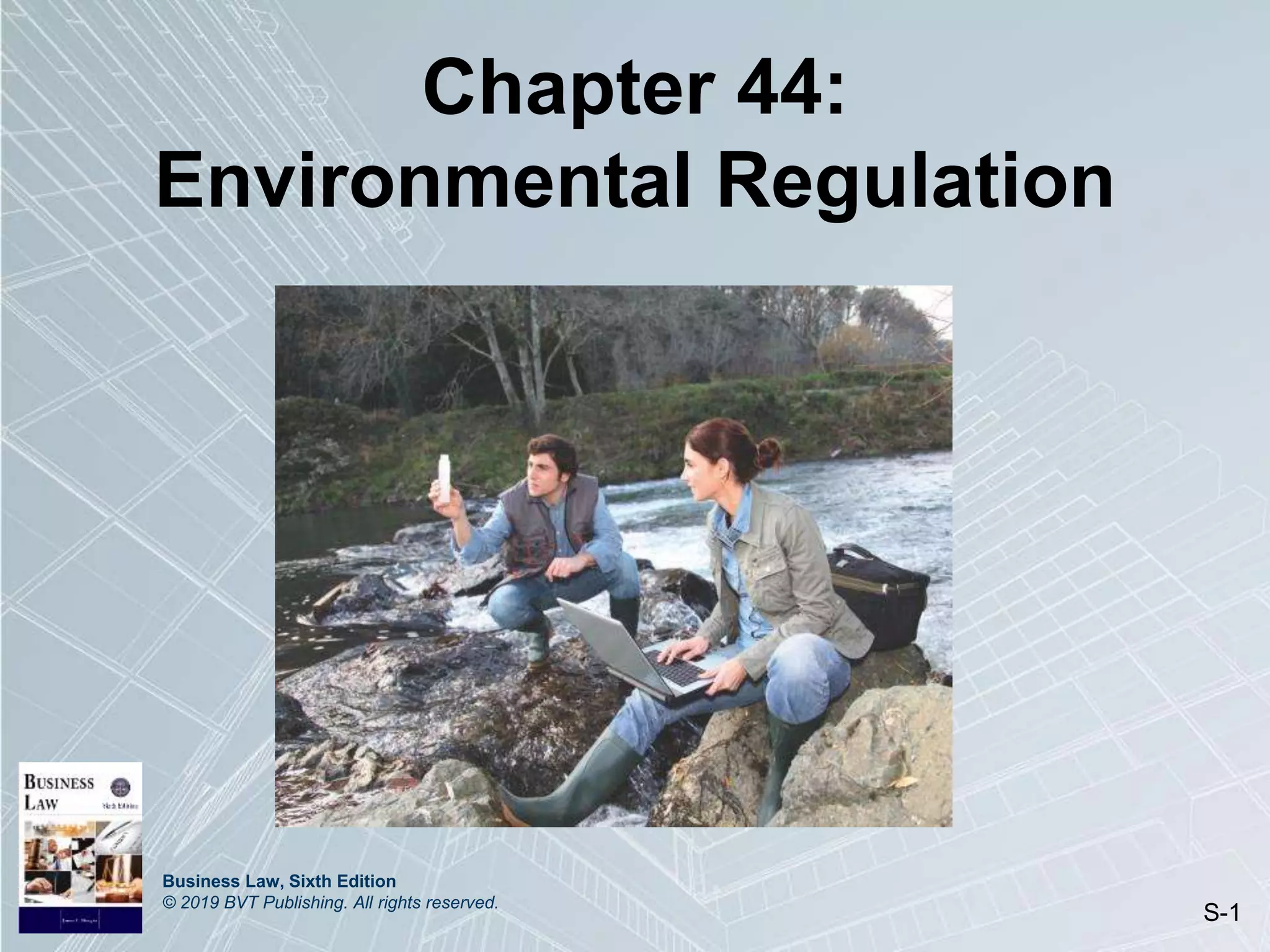
Chapter 44:
Environmental Regulation
Business Law, Sixth Edition
© 2019 BVT Publishing. All rights reserved.
S-2
Learning Objectives
• Explain the National Environmental Policy
Act.
• Recognize environmental regulatory
agencies.
• Understand the regulation of air pollution.
• Understand the regulation of water pollution.
• Discuss waste management.
• Describe the Toxic Substances Control Act.
Business Law, Sixth Edition
© 2019 BVT Publishing. All rights reserved.
S-3
44.0 In the News
Trump Aims To 'Eliminate' Clean Water Rule
http://bvtlab.com/68QM7
President Trump revokes the “Waters of the United
States” executive action that allowed the EPA to
regulate any amount of water on private property.
Trump wants the EPA to make sure “waters are kept
free from pollution, while at the same time promoting
economic growth, minimizing regulatory uncertainty,”
and respecting the role of states and Congress.
• What are the provisions of the Clean Water Act?
• Debate Trump’s revocation of Obama’s executive
order.
Business Law, Sixth Edition
© 2019 BVT Publishing. All rights reserved.
S-4
44.1a Business, Law, and the
Environment: An Overview
• Public Nuisance
• Action brought by the government, usually to
stop or prevent pollution, where there is an
actual or potential loss of a right to use or
enjoy property
• Congress has enacted statutes aimed at
protecting our physical environment.
• Citizen interest groups have considerable
power to enforce environmental policy.
Business Law, Sixth Edition
© 2019 BVT Publishing. All rights reserved.
S-5
42.2a National Environmental Policy Act
The federal government is entrusted with the
responsibility of ensuring that successive
generations can enjoy the environment.
• Requires an EIS for every major federal action
that significantly affects environment
– Describe the environmental impact of action.
– Present adverse effects on the environment.
– Discuss alternative actions that could be taken.
– Provide short- and long-term impacts
– List any irreversible impacts on the environment .
Business Law, Sixth Edition
© 2019 BVT Publishing. All rights reserved.
S-6
44.2b Regulatory Agencies
• Environmental Protection Agency (EPA)
– Administers federal law and implements
federal policy regarding:
oPollution of air and water
oDisposal of solid waste and toxic substances
oUse of pesticides and radiation
• Other federal agencies
• State and local regulatory agencies
Business Law, Sixth Edition
© 2019 BVT Publishing. All rights reserved.
S-7
44.3 Air Pollution
• Air Pollution Regulatory Principles
– The Clean Air Act
oNational ambient air quality standards
oEach state is to create a state
implementation plan.
oAmended to address toxic pollutants
• Enforcement of the Clean Air Act
• Current Issues in Air Pollution Control
Business Law, Sixth Edition
© 2019 BVT Publishing. All rights reserved.
S-8
44.3c Critical Thinking
CASE: Coalition
Petitioners challenge all EPA rules, arguing that
they are based on improper constructions of the
CAA and are otherwise arbitrary and capricious.
• How much deference did the Court give the EPA to
establish regulations in the area of greenhouse
gases?
• Do you believe greenhouse gases were a concern
of Congress when it debated and passed the Clean
Air Act? Does the Court’s rationale suggest the
intent of Congress?
Business Law, Sixth Edition
© 2019 BVT Publishing. All rights reserved.
S-9
44.4a Water Pollution Regulatory
Principles
• Clean Water Act
– Makes water clean enough for swimming and
other recreational uses
– Protects fish and wildlife from water pollutants
– Eliminates the discharge of pollutants
– Impacts only navigable waters
• Permitting process
• Non-point source pollution does not fall
within the purview of Clean Water Act.
Business Law, Sixth Edition
© 2019 BVT Publishing. All rights reserved.
S-10
44.4a Critical Thinking
CASE: Colvin
The case interprets the Clean Water Act, finding
that the Salton Sea is a body of navigable water.
• What factor associated with the Salton Sea most
influenced the court to find that the Salton Sea is a
body of “navigable water” under provisions of the
Clean Water Act?
• Why do you believe the court found it irrelevant that
the defendant dumped the waste on the ground?
Business Law, Sixth Edition
© 2019 BVT Publishing. All rights reserved.
S-11
44.4b Enforcement of the
Clean Water Act
• The government or a private party can
sue under this federal legislation.
• Criminal penalties
– Negligent violation
– Knowing violation
Business Law, Sixth Edition
© 2019 BVT Publishing. All rights reserved.
S-12
44.5 Waste Management
Solid Waste
• Solid Waste Disposal Act
Hazardous and Toxic Waste
• Resource Conservation and Recovery Act
• Federal Superfund Law
Business Law, Sixth Edition
© 2019 BVT Publishing. All rights reserved.
S-13
44.5b Critical Thinking
CASE: Timmons
The question is whether defendants can be
shielded from liability under the Act through the
innocent landowner defense.
• In order to successfully assert the innocent
landowner defense, what must be proven?
• Why was the defendant unable to use the innocent
landowner defense?
Business Law, Sixth Edition
© 2019 BVT Publishing. All rights reserved.
S-14
44.6 Toxic Substances
The Toxic Substances Control Act
• The EPA is charged with the responsibility
of identifying toxic substances .
• Toxics are generally defined as substances
known to be poisonous to humans.
• The EPA must balance the interest of
business and public.

Chapter 44: Enviromental Regulation

  • 1.
    Business Law, SixthEdition © 2019 BVT Publishing. All rights reserved. S-1 Chapter 44: Environmental Regulation
  • 2.
    Business Law, SixthEdition © 2019 BVT Publishing. All rights reserved. S-2 Learning Objectives • Explain the National Environmental Policy Act. • Recognize environmental regulatory agencies. • Understand the regulation of air pollution. • Understand the regulation of water pollution. • Discuss waste management. • Describe the Toxic Substances Control Act.
  • 3.
    Business Law, SixthEdition © 2019 BVT Publishing. All rights reserved. S-3 44.0 In the News Trump Aims To 'Eliminate' Clean Water Rule http://bvtlab.com/68QM7 President Trump revokes the “Waters of the United States” executive action that allowed the EPA to regulate any amount of water on private property. Trump wants the EPA to make sure “waters are kept free from pollution, while at the same time promoting economic growth, minimizing regulatory uncertainty,” and respecting the role of states and Congress. • What are the provisions of the Clean Water Act? • Debate Trump’s revocation of Obama’s executive order.
  • 4.
    Business Law, SixthEdition © 2019 BVT Publishing. All rights reserved. S-4 44.1a Business, Law, and the Environment: An Overview • Public Nuisance • Action brought by the government, usually to stop or prevent pollution, where there is an actual or potential loss of a right to use or enjoy property • Congress has enacted statutes aimed at protecting our physical environment. • Citizen interest groups have considerable power to enforce environmental policy.
  • 5.
    Business Law, SixthEdition © 2019 BVT Publishing. All rights reserved. S-5 42.2a National Environmental Policy Act The federal government is entrusted with the responsibility of ensuring that successive generations can enjoy the environment. • Requires an EIS for every major federal action that significantly affects environment – Describe the environmental impact of action. – Present adverse effects on the environment. – Discuss alternative actions that could be taken. – Provide short- and long-term impacts – List any irreversible impacts on the environment .
  • 6.
    Business Law, SixthEdition © 2019 BVT Publishing. All rights reserved. S-6 44.2b Regulatory Agencies • Environmental Protection Agency (EPA) – Administers federal law and implements federal policy regarding: oPollution of air and water oDisposal of solid waste and toxic substances oUse of pesticides and radiation • Other federal agencies • State and local regulatory agencies
  • 7.
    Business Law, SixthEdition © 2019 BVT Publishing. All rights reserved. S-7 44.3 Air Pollution • Air Pollution Regulatory Principles – The Clean Air Act oNational ambient air quality standards oEach state is to create a state implementation plan. oAmended to address toxic pollutants • Enforcement of the Clean Air Act • Current Issues in Air Pollution Control
  • 8.
    Business Law, SixthEdition © 2019 BVT Publishing. All rights reserved. S-8 44.3c Critical Thinking CASE: Coalition Petitioners challenge all EPA rules, arguing that they are based on improper constructions of the CAA and are otherwise arbitrary and capricious. • How much deference did the Court give the EPA to establish regulations in the area of greenhouse gases? • Do you believe greenhouse gases were a concern of Congress when it debated and passed the Clean Air Act? Does the Court’s rationale suggest the intent of Congress?
  • 9.
    Business Law, SixthEdition © 2019 BVT Publishing. All rights reserved. S-9 44.4a Water Pollution Regulatory Principles • Clean Water Act – Makes water clean enough for swimming and other recreational uses – Protects fish and wildlife from water pollutants – Eliminates the discharge of pollutants – Impacts only navigable waters • Permitting process • Non-point source pollution does not fall within the purview of Clean Water Act.
  • 10.
    Business Law, SixthEdition © 2019 BVT Publishing. All rights reserved. S-10 44.4a Critical Thinking CASE: Colvin The case interprets the Clean Water Act, finding that the Salton Sea is a body of navigable water. • What factor associated with the Salton Sea most influenced the court to find that the Salton Sea is a body of “navigable water” under provisions of the Clean Water Act? • Why do you believe the court found it irrelevant that the defendant dumped the waste on the ground?
  • 11.
    Business Law, SixthEdition © 2019 BVT Publishing. All rights reserved. S-11 44.4b Enforcement of the Clean Water Act • The government or a private party can sue under this federal legislation. • Criminal penalties – Negligent violation – Knowing violation
  • 12.
    Business Law, SixthEdition © 2019 BVT Publishing. All rights reserved. S-12 44.5 Waste Management Solid Waste • Solid Waste Disposal Act Hazardous and Toxic Waste • Resource Conservation and Recovery Act • Federal Superfund Law
  • 13.
    Business Law, SixthEdition © 2019 BVT Publishing. All rights reserved. S-13 44.5b Critical Thinking CASE: Timmons The question is whether defendants can be shielded from liability under the Act through the innocent landowner defense. • In order to successfully assert the innocent landowner defense, what must be proven? • Why was the defendant unable to use the innocent landowner defense?
  • 14.
    Business Law, SixthEdition © 2019 BVT Publishing. All rights reserved. S-14 44.6 Toxic Substances The Toxic Substances Control Act • The EPA is charged with the responsibility of identifying toxic substances . • Toxics are generally defined as substances known to be poisonous to humans. • The EPA must balance the interest of business and public.