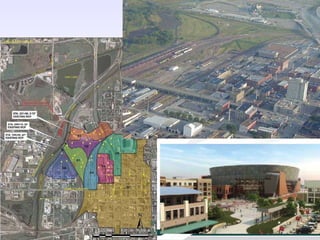
Stormwater Management:  Past, Present and Future Jesse W. Poore, CFM Felsburg Holt & Ullevig IECA Conference – Great Rivers Chapter Omaha, NE October 28, 2010
Presentation Outline The Story of Laws and Litigation The Rules and the Logic Behind Them Permits, Standards, and the MS4s Future
The Laws Set the Storylines 1948 Water Pollution Control Act 1952 and 1955 Amendments 1961 FWPCA Amendments 1965 Water Quality Act 1966 Clean Water Restoration Act 1970 Reorganization Plan # 3 1970 Water Quality Improvement Act
1948 Water Pollution Control Act  1952 and 1955 Amendments P.L. 80-845   : Prepare  plans for eliminating or reducing the pollution  of interstate waters and tributaries and improving the sanitary condition of surface and underground waters.  Plan Goals : improvements necessary to conserve waters for public water supplies, propagation of fish and aquatic life, recreational purposes, and agricultural and industrial  uses .  Funding : construct  treatment plants
1961 FWPCA Amendments P.L. 87-88 : Federal agencies consider during the planning for any reservoir, storage to  regulate stream flow for the purpose of   water quality control .  Funding : Research programs related to determining  effects of pollutants and treatment methods  and to assess water quality in the  Great Lakes .
1965 Water Quality Act States adopt  water quality standards  for  interstate  waters with federal approval. States adopt  implementation plans Little enforceability, little effectiveness
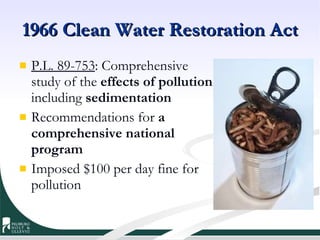
1966 Clean Water Restoration Act P.L. 89-753 : Comprehensive study of the  effects of pollution , including  sedimentation Recommendations for  a comprehensive national program Imposed $100 per day fine for pollution
1970 Reorganization Plan # 3 Created the Environmental Protection Agency (EPA) Identify pollutants.  Trace them through the entire ecological chain, observing and recording changes in form as they occur.  Determine the total exposure of man and his environment.  Examine interactions among forms of pollution.  Identify where in the ecological chain interdiction would be most appropriate.
1970 Water Quality Improvement Act P.L. 91-224 : Prohibitions on discharges of oil and authorization to determine  quantities  of oil which would be harmful. Mandated  development of regulations for substances other than oil . Required  performance standards  for marine sanitation devices.
FWPCA 1972 Amendments P.L. 92-500 : Restore and maintain the chemical, physical, and biological integrity of the Nation's waters.  “ Eliminate  all discharges  of  pollution  into navigable waters by 1985” Extent and complexity of pollution problem far greater than congress could have foreseen
1972 FWPCA Floor Debate Sen. Joseph Montoya (D-NM): “Your committee has placed before you a tough bill. This body and this Nation would not have it be otherwise. Our legislation contains an important  principle of psychology . Men seldom draw the best from themselves unless pressed by circumstances and deadlines. This bill contains  deadlines  and it imposes  rather tough standards  on industry, municipalities, and all other sources of pollution.”
1972 FWPCA Amendments Shift from state to federal standards by introducing  Effluent Limitation Guidelines   Introduction of § 402 –  NPDES Permitting Provisions for pollutant discharge: Point source limits  based on State standards State issuance of  water quality standards Guidelines to evaluate  nonpoint sources Water quality  inventory  requirements Toxic and pretreatment  effluent standards
Important Definitions Point Source Point Source : “Any  discernible, confined and discrete conveyance , including but not limited to any pipe, ditch, channel, tunnel, conduit, well, discrete fissure, container, rolling stock, concentrated animal feeding operation, or vessel or other floating craft, from which pollutants are or may be discharged.”  Term  does not include  agricultural stormwater discharges, return flows from irrigated agriculture.
Important Definitions Discharge of a Pollutant (A) any addition of any  pollutant   to   navigable waters  from any  point source (B) any addition of any  pollutant   to  the waters of the contiguous zone or the ocean from any  point source  other than a vessel or other floating craft.
Important Definitions Pollutant and Pollution Pollutant : “dredged spoil, solid waste, incinerator residue, sewage, garbage, sewage sludge, munitions, chemical wastes, biological materials, radioactive materials, heat, wrecked or discarded equipment, rock, sand, cellar dirt and industrial, municipal, and agricultural waste discharged into water.” Pollution : the man-made or man-induced alteration of the  chemical ,  physical ,  biological , and  radiological   integrity of water . TURBIDITY or VELOCITY?
Regulations Define Game Rules Maryland v. EPA, 530 F.2d 215 Require states to take on federal standards Brown v. EPA, 521 F.2d 827 EPA to compel implementation and enforcement NRDC Inc v. M Costle Administrative feasibility and Technical feasibility American Paper 996 F.2d 346 Narrative terms acceptable for ELGs
1977 Clean Water Act P.L. 95-217 : Development of a  Best Management Practices  Program as part of the state areawide planning program  Procedures for  State assumption  of the regulatory program Updates to Effluent Limitation Guidelines for  conventional pollutants  and priority  toxic pollutants Funding for  national study of urban stormwater  runoff apportioned
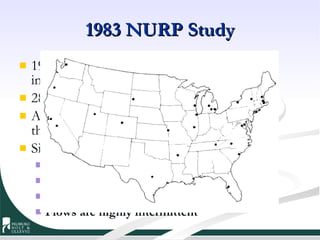
1983 NURP Study 1978-1983 commercial, residential, and light industrial monitoring sponsored by EPA 28 projects located across the country Analyzed eight conventional pollutants and three metals. Significant finding pollutants: Suspended solids – order of magnitude greater COD – comparable to treatment plant Fecals, Hydrocarbons, Metals, Pesticides, PAHs Flows are highly intermittent
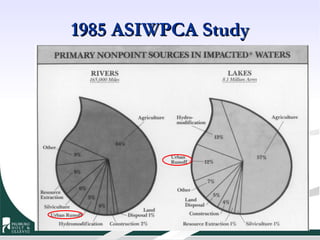
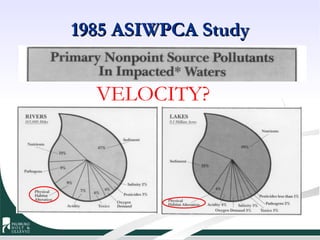
1985 ASIWPCA Study Association of State and Interstate Water Pollution Control Administrators  “ America’s Clean Water, The States’ Nonpoint Source Assessment 1985” Baseline information from 49 states, 3 territories, 3 interstate agencies, and DC.
1985 ASIWPCA Study
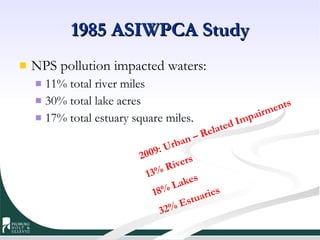
1985 ASIWPCA Study NPS pollution impacted waters: 11% total river miles 30% total lake acres 17% total estuary square miles . 2009: Urban – Related Impairments 13% Rivers 18% Lakes 32% Estuaries
1985 ASIWPCA Study VELOCITY?
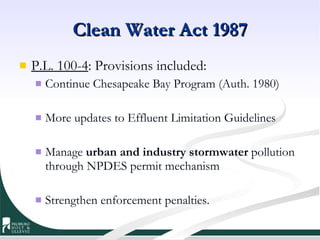
Clean Water Act 1987 P.L. 100-4 : Provisions included:  Continue Chesapeake Bay Program (Auth. 1980) More updates to Effluent Limitation Guidelines Manage  urban and industry stormwater  pollution through NPDES permit mechanism Strengthen enforcement penalties.
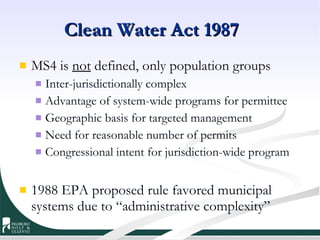
Clean Water Act 1987 Section 402(p) of the Act placed the focus of  urban and industrial stormwater  compliance and enforceability on a permit system for  point source  discharges. Illegal to discharge pollutants from point sources (e.g., industrial plant pipes, sewage treatment plants, or storm sewers) into the nation’s waters without an NPDES permit.
Clean Water Act 1987 MS4 is  not  defined, only population groups Inter-jurisdictionally complex Advantage of system-wide programs for permittee Geographic basis for targeted management Need for reasonable number of permits Congressional intent for jurisdiction-wide program 1988 EPA proposed rule favored municipal systems due to “administrative complexity”
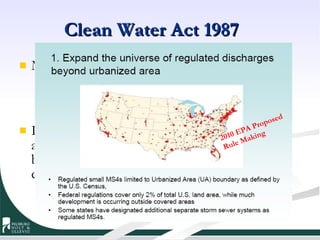
Clean Water Act 1987 MS4 arguments in comments based upon: Geographic differences Climatic differences and variation Institutional differences between systems In the end, “MS4” is a blend of variables that allow EPA and States to define a system that best suits the various political and geographical conditions. Relied on population, census, urbanized areas and pollution sources within those boundaries 2010 EPA Proposed Rule Making
Presentation Outline The Story of Laws and Litigation The Rules and the Logic Behind Them Permits, Standards, and the MS4s Future
Phase I NPDES Regulations Published November 16, 1990 Prohibit the  discharge  of any  pollutant  “ to ”  navigable waters  from a  point source  unless the discharge is authorized by an NPDES permit. NPDES permits required to: Establish controls to  Maximum Extent Practicable (MEP) Prohibit non-stormwater discharges Contain  applicable water quality-based controls
Important Definitions NPDES Permits Issue for the “discharge of any  pollutant , or  combination of pollutants”  … upon condition that such discharge will meet either: All applicable requirements for effluent and water quality based limits, or  such conditions as the Administrator determines are necessary to carry out the provisions of this chapter.
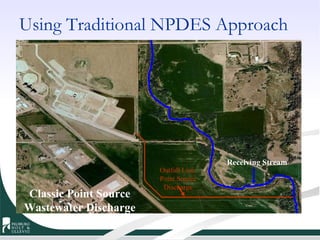
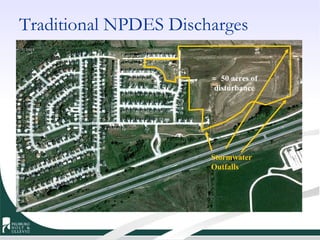
Outfall Line, Point Source Discharge Receiving Stream Classic Point Source Wastewater Discharge Using Traditional NPDES Approach
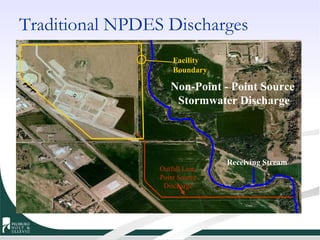
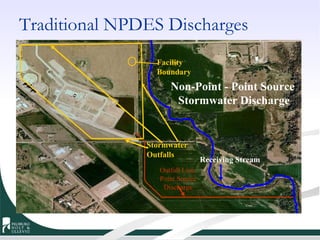
Receiving Stream Facility Boundary Traditional NPDES Discharges Non-Point - Point Source  Stormwater Discharge Outfall Line, Point Source Discharge
Receiving Stream Facility Boundary Non-Point - Point Source  Stormwater Discharge Stormwater Outfalls Traditional NPDES Discharges Outfall Line, Point Source Discharge
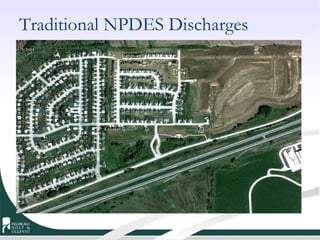
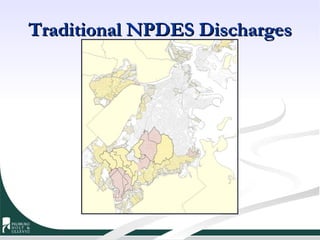
Traditional NPDES Discharges
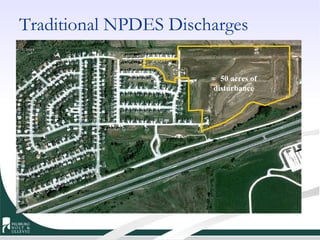
Traditional NPDES Discharges ≈   50 acres of disturbance
Traditional NPDES Discharges ≈   50 acres of disturbance Stormwater Outfalls
Traditional NPDES Discharges
Phase I Final Rule Comments Storm Water Quality Management Plans EPA  disagreed  with the following comments: “ there is no hard criteria upon which to judge the adequacy of programs.” “ there should be a BAT standard for municipal permits.” “ require specific BMPs that permittee must comply with.” CWA only sets types of controls contemplated due to fundamentally different characteristics of municipalities Regulations may include performance standards, guidelines, guidance and management practices
Phase I Final Rule Comments Measures to reduce pollutants in runoff: Pollutants are important, but so is concept of  volume  leaving urban areas during storm events. “ Large intermittent  volumes  of runoff can destroy  aquatic habitat .” Percentage of  paved surfaces  seen as indicator meaning “ pollutant loadings  associated with stormwater runoff increases as  development  progresses” and won’t decrease in the future. 55 FR No. 222 Page 480554 VELOCITY?
Phase II NPDES Regulations Published December 8, 1999  Outlined the Six Minimum Control Measures EPA estimated 5,040 Phase II MS4s Allowed for case-by-case decision making “ significant contributors to water pollution” Unclear how to define “significant” without rigorous monitoring Permits  required  by March 10, 2003
Phase II Additional Permittees May require NPDES Permit when:  storm water controls are needed for the discharge based on  wasteload allocations  that are part of “total maximum daily loads” ( TMDL ) that address the  pollutant(s) of concern
2001 GAO Report to Congress Measurable goals  for the program recommended Guidelines  for consistent and  reliable data , including data on the effects of the program and the costs to these governments Determine whether  program goals  are being met and to identify the costs of the program Assess whether the agency has allocated  sufficient resources  to oversee and monitor the program. 2001 GAO Report to Congress Pg 37
Presentation Outline The Story of Laws and Litigation The Rules and the Logic Behind Them Permits, Standards, and the MS4s Future
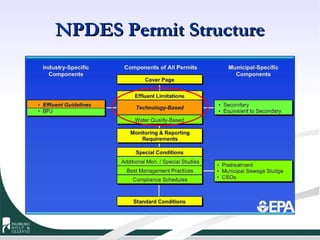
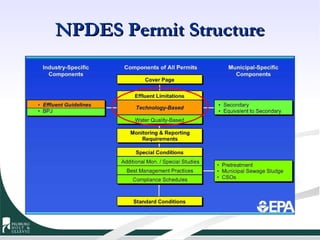
NPDES Permit Structure
Effluent Limitation Guidelines Point source-specific  water pollution control Established by assessment of: Performance of  best pollution control technologies or pollution prevention practices  that are available  Economic achievability of that technology , while considering costs, benefits, and affordability of achieving the reduction in pollutant discharge  http://www.epa.gov/waterscience/guide/industry.html
Effluent Limitation Guidelines For direct discharges, ELGs apply to: Existing facilities: best practicable technology  (BPT),  best available technology  (BAT), or  best conventional pollutant control technology  (BCT);  Newly constructed facilities (new sources) are governed by  new source performance standards  (NSPS).
Effluent Limitation Guidelines Best Practicable Control Technology Currently Available  (BPT) Average of best performance  of facilities within industry of various ages, sizes, processes or common characteristics * Narrative arm  of new Construction ELGs
Effluent Limitation Guidelines Best Available Technology Economically Achievable  (BAT) May be based on effluent reductions attainable through  changes in a facility’s processes and operations . * Numeric arm  of new Construction ELGs 280 NTU limit
Effluent Limitations Guidelines New Source Performance Standards  (NSPS)   Reductions achievable based on best available demonstrated control technology ( no acronym ) Most stringent controls attainable *NSPS  for Construction established equal to existing sources  (BPT and BAT)
Effluent Limitation Guidelines Best Management Practices  (BMP)  Authorize BMPs in NPDES Permits 40 CFR 122.44(k) Control or abate discharge of pollutants when: Numeric effluent limits are infeasible Practices reasonably necessary to achieve effluent limitations and standards or achieve intent of CWA Enforcement of  Maximum Extent Practicable (MEP)  standard at 402 (p)(3)(B)(iii) Over time, will lead to  BPT, BCT, BAT, NSPS
Effluent Limitation Guidelines Storm Water Management for  Construction  Activities: Developing Pollution Prevention Plans and Best Management Practices and Summary Guidance Storm Water Management for  Industrial  Activities, Developing Pollution Prevention Plans and Best Management Practices and Summary Guidance Guidance Manual for Developing  Best Management Practices  (BMPs)
ELG – Legal Precedent Natural Resources Defense Council et al v. Browner  (D.D.C. 89-2980, January 31,  1992 , as amended) – Consent Decree Required EPA to propose effluent guideline regulations and take final action for 20 point source categories.  Required EPA to conduct 11  preliminary studies  to assist in selecting categories for regulation development.
Stormwater ELGs Urban Stormwater BMP Study 1999  Construction and Development 2002  Proposed and  removed  in 2004 Construction and Development 2008  Proposed and  issued  2009 On hold  as of September 2010  Pending review
Maximum Extent Practicable What is MEP? Section 402(p) introduces term under NPDES  Controls that include:  management practices,  control techniques and system, design and engineering methods, and  such other provisions as the Administrator or the State determines appropriate for the control of such pollutants Serious attempt to achieve water quality Has led to a need to justify chosen practices
Phase I MEP Standard MEP is  contrasted  to technology standards of BAT/BCT in Federal Register notice comments and 1994 Clean Water Initiative as more “site-specific and flexible” Guidance: “flexibility in developing permit conditions is encouraged by allowing municipalities to emphasize the controls that best apply to their MS4”  Severity of the impairment Effectiveness of alternative approaches Cost of control measures
Phase I MEP Standard MEP generally emphasizes pollution prevention and source control BMPs primarily (as the first line of defense) MEP considers economics and is generally, but not necessarily, less stringent than BAT MEP is dynamic; defined by the following process over time:   Propose MEP by way of urban runoff management programs Total collective and individual activities conducted becomes their proposal for MEP for overall effort and specific  activities In the absence of a proposal acceptable to the Regional Board, the Regional Board defines MEP 1993 Elizabeth Jennings Memo SWRCB
Phase I MEP Standard Effectiveness : Will the BMPs address a pollutant (or pollutant source) of concern?  Regulatory Compliance : Is the BMP in compliance with storm water regulations as well as other environmental regulations?  Public Acceptance : Does the BMP have public support?  Cost : Will the cost of implementing the BMP have a reasonable relationship to the pollution control benefits to be achieved?  Technical Feasibility : Is the BMP technically feasible considering soils, geography, water resources, etc?  1993 Elizabeth Jennings Memo SWRCB
Phase II MEP Standard NPDES permitting authority may ask the permittee to revise their mix of BMPs, for example, to better reflect the MEP pollution reduction requirement. Iterative process over 2-3 permit terms to achieve water quality standards FR Vol 65 No. 235 Part II(H)(3)(a)(iii)
NPDES Permit Structure
WQBEL Decision Making Process State defines  water quality standards  by segmenting water bodies and classifying the  beneficial uses  of the water bodies. These  water quality goals  associated with  criteria  necessary to achieve/protect them. Beneficial uses can be State or local driven Aquatic life, wildlife propagation, primary or secondary recreation, public/agricultural/industrial water supply, navigation are traditional. 40 CFR 131.2 WQ Standards
WQBEL Decision Making Process Numeric Criteria  have specific concentrations or measures of toxic effect or waterbody health Narrative Criteria  are statements of desired state of a waterbody (i.e. “free from”) Issued for: Aquatic Life Human Health Others (Wildlife, Sediment, other local) Biological Health 40 CFR 131.2 WQ Standards
WQBELs for Stormwater Water Quality Based Effluent Limits can be imposed in an NPDES permit if: A water quality model indicates the anticipated discharge could not achieve water quality standards for the receiving stream, or An impairment has been identified with a TMDL  that has been issued for the receiving water
WQBELs for Stormwater EPA adopted an interim-permitting approach Know urban stormwater runoff is impairing uses Narrative BMPs are acceptable; maybe sufficient Typically lack information to base numeric water quality-based effluent limits  Where data exists, numeric limits are possible Pollutants may not be only thing impacting use Adequate effluent characterization difficult Receiving water exposure assessment difficult 1996 WQBEL for Stormwater Memo
WQBELs for Stormwater EPA adopted an interim-permitting approach Pointed to CSO policy as potential model Presumptive Approach: If the EPA policy (Long Term Control Plan) is met, the effort invested is presumed to be compliant with Water Quality Standards Demonstrative Approach: Permit holder demonstrates controls meet Water Quality Standards 1996 WQBEL for Stormwater Memo
WQBELs for Stormwater EPA adopted an interim-permitting approach Called for improving approaches for monitoring storm water and the potential effects upon water quality Environmental indicators  are designed to be more meaningful monitoring tools that storm water dischargers can use to conduct storm water monitoring Center for Watershed Protection – Impervious Cover Model (ICM) was born out of this call 1996 WQBEL for Stormwater Memo VELOCITY?
Future of the MS4 Permits Higher focus on measurable results and use of software to generate outputs Segregation of performance measures from effectiveness measures Transition to a combination of environmental indicators as surrogates for water quality.
National Research Council Report “ A  straightforward  way to regulate stormwater contributions to waterbody impairment would be to  use flow or a surrogate , like impervious cover, as a measure of stormwater loading ….”  “ Efforts to  reduce stormwater flow will automatically achieve reductions in pollutant loading . Moreover, flow is itself responsible for additional erosion and sedimentation that adversely impacts surface water quality.” 2008 NRC Urban Stormwater Report
Environmental Indicators Water Quality Indicators Water quality pollutant constituent monitoring Toxicity testing Non-point source loadings Exceedance frequencies of water quality standards Sediment contamination Human health criteria
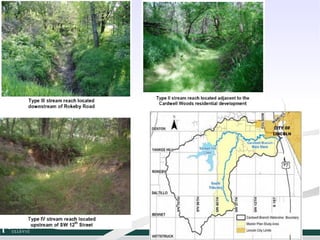
Environmental Indicators Physical and Hydrological Indicators Stream widening/downcutting Physical habitat monitoring Impacted dry weather flows Increased flooding frequency Stream temperature monitoring
Environmental Indicators Biological Indicators Fish assemblage Macro-invertebrate assemblage Single species indicator Composite indicators
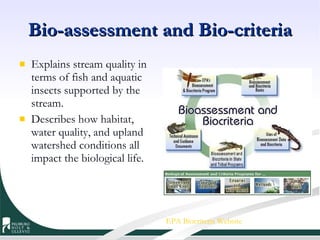
Bio-assessment and Bio-criteria Explains stream quality in terms of fish and aquatic insects supported by the stream. Describes how habitat, water quality, and upland watershed conditions all impact the biological life. EPA Biocriteria Website
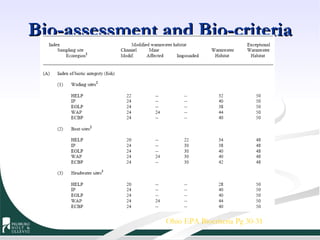
Bio-assessment and Bio-criteria Ohio EPA Biocriteria Pg 30-31
Environmental Indicators Social Indicators Public attitude surveys Industrial/commercial pollution prevention Public involvement and monitoring User perception
Environmental Indicators Programmatic Indicators Number of illicit connections identified/corrected Number of BMPs installed, inspected and maintained Permitting and compliance Growth and development
Environmental Indicators Site Indicators BMP performance monitoring Industrial site compliance monitoring


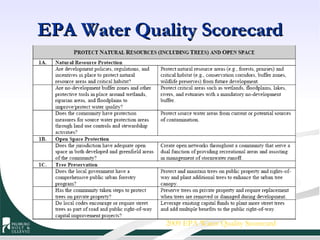
EPA Water Quality Scorecard 2009 EPA Water Quality Scorecard
 
 
Parting “Principle of Psychology” Unless someone like you cares a whole  awful lot, nothing is going to get better.  It's not.  Dr. Seuss ~ The Lorax

Past Present and Future Trends

  • 1.
    Stormwater Management: Past, Present and Future Jesse W. Poore, CFM Felsburg Holt & Ullevig IECA Conference – Great Rivers Chapter Omaha, NE October 28, 2010
  • 2.
    Presentation Outline TheStory of Laws and Litigation The Rules and the Logic Behind Them Permits, Standards, and the MS4s Future
  • 3.
    The Laws Setthe Storylines 1948 Water Pollution Control Act 1952 and 1955 Amendments 1961 FWPCA Amendments 1965 Water Quality Act 1966 Clean Water Restoration Act 1970 Reorganization Plan # 3 1970 Water Quality Improvement Act
  • 4.
    1948 Water PollutionControl Act 1952 and 1955 Amendments P.L. 80-845 : Prepare plans for eliminating or reducing the pollution of interstate waters and tributaries and improving the sanitary condition of surface and underground waters. Plan Goals : improvements necessary to conserve waters for public water supplies, propagation of fish and aquatic life, recreational purposes, and agricultural and industrial uses . Funding : construct treatment plants
  • 5.
    1961 FWPCA AmendmentsP.L. 87-88 : Federal agencies consider during the planning for any reservoir, storage to regulate stream flow for the purpose of water quality control . Funding : Research programs related to determining effects of pollutants and treatment methods and to assess water quality in the Great Lakes .
  • 6.
    1965 Water QualityAct States adopt water quality standards for interstate waters with federal approval. States adopt implementation plans Little enforceability, little effectiveness
  • 7.
    1966 Clean WaterRestoration Act P.L. 89-753 : Comprehensive study of the effects of pollution , including sedimentation Recommendations for a comprehensive national program Imposed $100 per day fine for pollution
  • 8.
    1970 Reorganization Plan# 3 Created the Environmental Protection Agency (EPA) Identify pollutants. Trace them through the entire ecological chain, observing and recording changes in form as they occur. Determine the total exposure of man and his environment. Examine interactions among forms of pollution. Identify where in the ecological chain interdiction would be most appropriate.
  • 9.
    1970 Water QualityImprovement Act P.L. 91-224 : Prohibitions on discharges of oil and authorization to determine quantities of oil which would be harmful. Mandated development of regulations for substances other than oil . Required performance standards for marine sanitation devices.
  • 10.
    FWPCA 1972 AmendmentsP.L. 92-500 : Restore and maintain the chemical, physical, and biological integrity of the Nation's waters. “ Eliminate all discharges of pollution into navigable waters by 1985” Extent and complexity of pollution problem far greater than congress could have foreseen
  • 11.
    1972 FWPCA FloorDebate Sen. Joseph Montoya (D-NM): “Your committee has placed before you a tough bill. This body and this Nation would not have it be otherwise. Our legislation contains an important principle of psychology . Men seldom draw the best from themselves unless pressed by circumstances and deadlines. This bill contains deadlines and it imposes rather tough standards on industry, municipalities, and all other sources of pollution.”
  • 12.
    1972 FWPCA AmendmentsShift from state to federal standards by introducing Effluent Limitation Guidelines Introduction of § 402 – NPDES Permitting Provisions for pollutant discharge: Point source limits based on State standards State issuance of water quality standards Guidelines to evaluate nonpoint sources Water quality inventory requirements Toxic and pretreatment effluent standards
  • 13.
    Important Definitions PointSource Point Source : “Any discernible, confined and discrete conveyance , including but not limited to any pipe, ditch, channel, tunnel, conduit, well, discrete fissure, container, rolling stock, concentrated animal feeding operation, or vessel or other floating craft, from which pollutants are or may be discharged.” Term does not include agricultural stormwater discharges, return flows from irrigated agriculture.
  • 14.
    Important Definitions Dischargeof a Pollutant (A) any addition of any pollutant to navigable waters from any point source (B) any addition of any pollutant to the waters of the contiguous zone or the ocean from any point source other than a vessel or other floating craft.
  • 15.
    Important Definitions Pollutantand Pollution Pollutant : “dredged spoil, solid waste, incinerator residue, sewage, garbage, sewage sludge, munitions, chemical wastes, biological materials, radioactive materials, heat, wrecked or discarded equipment, rock, sand, cellar dirt and industrial, municipal, and agricultural waste discharged into water.” Pollution : the man-made or man-induced alteration of the chemical , physical , biological , and radiological integrity of water . TURBIDITY or VELOCITY?
  • 16.
    Regulations Define GameRules Maryland v. EPA, 530 F.2d 215 Require states to take on federal standards Brown v. EPA, 521 F.2d 827 EPA to compel implementation and enforcement NRDC Inc v. M Costle Administrative feasibility and Technical feasibility American Paper 996 F.2d 346 Narrative terms acceptable for ELGs
  • 17.
    1977 Clean WaterAct P.L. 95-217 : Development of a Best Management Practices Program as part of the state areawide planning program Procedures for State assumption of the regulatory program Updates to Effluent Limitation Guidelines for conventional pollutants and priority toxic pollutants Funding for national study of urban stormwater runoff apportioned
  • 18.
    1983 NURP Study1978-1983 commercial, residential, and light industrial monitoring sponsored by EPA 28 projects located across the country Analyzed eight conventional pollutants and three metals. Significant finding pollutants: Suspended solids – order of magnitude greater COD – comparable to treatment plant Fecals, Hydrocarbons, Metals, Pesticides, PAHs Flows are highly intermittent
  • 19.
    1985 ASIWPCA StudyAssociation of State and Interstate Water Pollution Control Administrators “ America’s Clean Water, The States’ Nonpoint Source Assessment 1985” Baseline information from 49 states, 3 territories, 3 interstate agencies, and DC.
  • 20.
  • 21.
    1985 ASIWPCA StudyNPS pollution impacted waters: 11% total river miles 30% total lake acres 17% total estuary square miles . 2009: Urban – Related Impairments 13% Rivers 18% Lakes 32% Estuaries
  • 22.
  • 23.
    Clean Water Act1987 P.L. 100-4 : Provisions included: Continue Chesapeake Bay Program (Auth. 1980) More updates to Effluent Limitation Guidelines Manage urban and industry stormwater pollution through NPDES permit mechanism Strengthen enforcement penalties.
  • 24.
    Clean Water Act1987 Section 402(p) of the Act placed the focus of urban and industrial stormwater compliance and enforceability on a permit system for point source discharges. Illegal to discharge pollutants from point sources (e.g., industrial plant pipes, sewage treatment plants, or storm sewers) into the nation’s waters without an NPDES permit.
  • 25.
    Clean Water Act1987 MS4 is not defined, only population groups Inter-jurisdictionally complex Advantage of system-wide programs for permittee Geographic basis for targeted management Need for reasonable number of permits Congressional intent for jurisdiction-wide program 1988 EPA proposed rule favored municipal systems due to “administrative complexity”
  • 26.
    Clean Water Act1987 MS4 arguments in comments based upon: Geographic differences Climatic differences and variation Institutional differences between systems In the end, “MS4” is a blend of variables that allow EPA and States to define a system that best suits the various political and geographical conditions. Relied on population, census, urbanized areas and pollution sources within those boundaries 2010 EPA Proposed Rule Making
  • 27.
    Presentation Outline TheStory of Laws and Litigation The Rules and the Logic Behind Them Permits, Standards, and the MS4s Future
  • 28.
    Phase I NPDESRegulations Published November 16, 1990 Prohibit the discharge of any pollutant “ to ” navigable waters from a point source unless the discharge is authorized by an NPDES permit. NPDES permits required to: Establish controls to Maximum Extent Practicable (MEP) Prohibit non-stormwater discharges Contain applicable water quality-based controls
  • 29.
    Important Definitions NPDESPermits Issue for the “discharge of any pollutant , or combination of pollutants” … upon condition that such discharge will meet either: All applicable requirements for effluent and water quality based limits, or such conditions as the Administrator determines are necessary to carry out the provisions of this chapter.
  • 30.
    Outfall Line, PointSource Discharge Receiving Stream Classic Point Source Wastewater Discharge Using Traditional NPDES Approach
  • 31.
    Receiving Stream FacilityBoundary Traditional NPDES Discharges Non-Point - Point Source Stormwater Discharge Outfall Line, Point Source Discharge
  • 32.
    Receiving Stream FacilityBoundary Non-Point - Point Source Stormwater Discharge Stormwater Outfalls Traditional NPDES Discharges Outfall Line, Point Source Discharge
  • 33.
  • 34.
    Traditional NPDES Discharges≈ 50 acres of disturbance
  • 35.
    Traditional NPDES Discharges≈ 50 acres of disturbance Stormwater Outfalls
  • 36.
  • 37.
    Phase I FinalRule Comments Storm Water Quality Management Plans EPA disagreed with the following comments: “ there is no hard criteria upon which to judge the adequacy of programs.” “ there should be a BAT standard for municipal permits.” “ require specific BMPs that permittee must comply with.” CWA only sets types of controls contemplated due to fundamentally different characteristics of municipalities Regulations may include performance standards, guidelines, guidance and management practices
  • 38.
    Phase I FinalRule Comments Measures to reduce pollutants in runoff: Pollutants are important, but so is concept of volume leaving urban areas during storm events. “ Large intermittent volumes of runoff can destroy aquatic habitat .” Percentage of paved surfaces seen as indicator meaning “ pollutant loadings associated with stormwater runoff increases as development progresses” and won’t decrease in the future. 55 FR No. 222 Page 480554 VELOCITY?
  • 39.
    Phase II NPDESRegulations Published December 8, 1999 Outlined the Six Minimum Control Measures EPA estimated 5,040 Phase II MS4s Allowed for case-by-case decision making “ significant contributors to water pollution” Unclear how to define “significant” without rigorous monitoring Permits required by March 10, 2003
  • 40.
    Phase II AdditionalPermittees May require NPDES Permit when: storm water controls are needed for the discharge based on wasteload allocations that are part of “total maximum daily loads” ( TMDL ) that address the pollutant(s) of concern
  • 41.
    2001 GAO Reportto Congress Measurable goals for the program recommended Guidelines for consistent and reliable data , including data on the effects of the program and the costs to these governments Determine whether program goals are being met and to identify the costs of the program Assess whether the agency has allocated sufficient resources to oversee and monitor the program. 2001 GAO Report to Congress Pg 37
  • 42.
    Presentation Outline TheStory of Laws and Litigation The Rules and the Logic Behind Them Permits, Standards, and the MS4s Future
  • 43.
  • 44.
    Effluent Limitation GuidelinesPoint source-specific water pollution control Established by assessment of: Performance of best pollution control technologies or pollution prevention practices that are available Economic achievability of that technology , while considering costs, benefits, and affordability of achieving the reduction in pollutant discharge http://www.epa.gov/waterscience/guide/industry.html
  • 45.
    Effluent Limitation GuidelinesFor direct discharges, ELGs apply to: Existing facilities: best practicable technology (BPT), best available technology (BAT), or best conventional pollutant control technology (BCT); Newly constructed facilities (new sources) are governed by new source performance standards (NSPS).
  • 46.
    Effluent Limitation GuidelinesBest Practicable Control Technology Currently Available (BPT) Average of best performance of facilities within industry of various ages, sizes, processes or common characteristics * Narrative arm of new Construction ELGs
  • 47.
    Effluent Limitation GuidelinesBest Available Technology Economically Achievable (BAT) May be based on effluent reductions attainable through changes in a facility’s processes and operations . * Numeric arm of new Construction ELGs 280 NTU limit
  • 48.
    Effluent Limitations GuidelinesNew Source Performance Standards (NSPS) Reductions achievable based on best available demonstrated control technology ( no acronym ) Most stringent controls attainable *NSPS for Construction established equal to existing sources (BPT and BAT)
  • 49.
    Effluent Limitation GuidelinesBest Management Practices (BMP) Authorize BMPs in NPDES Permits 40 CFR 122.44(k) Control or abate discharge of pollutants when: Numeric effluent limits are infeasible Practices reasonably necessary to achieve effluent limitations and standards or achieve intent of CWA Enforcement of Maximum Extent Practicable (MEP) standard at 402 (p)(3)(B)(iii) Over time, will lead to BPT, BCT, BAT, NSPS
  • 50.
    Effluent Limitation GuidelinesStorm Water Management for Construction Activities: Developing Pollution Prevention Plans and Best Management Practices and Summary Guidance Storm Water Management for Industrial Activities, Developing Pollution Prevention Plans and Best Management Practices and Summary Guidance Guidance Manual for Developing Best Management Practices (BMPs)
  • 51.
    ELG – LegalPrecedent Natural Resources Defense Council et al v. Browner (D.D.C. 89-2980, January 31, 1992 , as amended) – Consent Decree Required EPA to propose effluent guideline regulations and take final action for 20 point source categories. Required EPA to conduct 11 preliminary studies to assist in selecting categories for regulation development.
  • 52.
    Stormwater ELGs UrbanStormwater BMP Study 1999 Construction and Development 2002 Proposed and removed in 2004 Construction and Development 2008 Proposed and issued 2009 On hold as of September 2010 Pending review
  • 53.
    Maximum Extent PracticableWhat is MEP? Section 402(p) introduces term under NPDES Controls that include: management practices, control techniques and system, design and engineering methods, and such other provisions as the Administrator or the State determines appropriate for the control of such pollutants Serious attempt to achieve water quality Has led to a need to justify chosen practices
  • 54.
    Phase I MEPStandard MEP is contrasted to technology standards of BAT/BCT in Federal Register notice comments and 1994 Clean Water Initiative as more “site-specific and flexible” Guidance: “flexibility in developing permit conditions is encouraged by allowing municipalities to emphasize the controls that best apply to their MS4” Severity of the impairment Effectiveness of alternative approaches Cost of control measures
  • 55.
    Phase I MEPStandard MEP generally emphasizes pollution prevention and source control BMPs primarily (as the first line of defense) MEP considers economics and is generally, but not necessarily, less stringent than BAT MEP is dynamic; defined by the following process over time: Propose MEP by way of urban runoff management programs Total collective and individual activities conducted becomes their proposal for MEP for overall effort and specific activities In the absence of a proposal acceptable to the Regional Board, the Regional Board defines MEP 1993 Elizabeth Jennings Memo SWRCB
  • 56.
    Phase I MEPStandard Effectiveness : Will the BMPs address a pollutant (or pollutant source) of concern? Regulatory Compliance : Is the BMP in compliance with storm water regulations as well as other environmental regulations? Public Acceptance : Does the BMP have public support? Cost : Will the cost of implementing the BMP have a reasonable relationship to the pollution control benefits to be achieved? Technical Feasibility : Is the BMP technically feasible considering soils, geography, water resources, etc? 1993 Elizabeth Jennings Memo SWRCB
  • 57.
    Phase II MEPStandard NPDES permitting authority may ask the permittee to revise their mix of BMPs, for example, to better reflect the MEP pollution reduction requirement. Iterative process over 2-3 permit terms to achieve water quality standards FR Vol 65 No. 235 Part II(H)(3)(a)(iii)
  • 58.
  • 59.
    WQBEL Decision MakingProcess State defines water quality standards by segmenting water bodies and classifying the beneficial uses of the water bodies. These water quality goals associated with criteria necessary to achieve/protect them. Beneficial uses can be State or local driven Aquatic life, wildlife propagation, primary or secondary recreation, public/agricultural/industrial water supply, navigation are traditional. 40 CFR 131.2 WQ Standards
  • 60.
    WQBEL Decision MakingProcess Numeric Criteria have specific concentrations or measures of toxic effect or waterbody health Narrative Criteria are statements of desired state of a waterbody (i.e. “free from”) Issued for: Aquatic Life Human Health Others (Wildlife, Sediment, other local) Biological Health 40 CFR 131.2 WQ Standards
  • 61.
    WQBELs for StormwaterWater Quality Based Effluent Limits can be imposed in an NPDES permit if: A water quality model indicates the anticipated discharge could not achieve water quality standards for the receiving stream, or An impairment has been identified with a TMDL that has been issued for the receiving water
  • 62.
    WQBELs for StormwaterEPA adopted an interim-permitting approach Know urban stormwater runoff is impairing uses Narrative BMPs are acceptable; maybe sufficient Typically lack information to base numeric water quality-based effluent limits Where data exists, numeric limits are possible Pollutants may not be only thing impacting use Adequate effluent characterization difficult Receiving water exposure assessment difficult 1996 WQBEL for Stormwater Memo
  • 63.
    WQBELs for StormwaterEPA adopted an interim-permitting approach Pointed to CSO policy as potential model Presumptive Approach: If the EPA policy (Long Term Control Plan) is met, the effort invested is presumed to be compliant with Water Quality Standards Demonstrative Approach: Permit holder demonstrates controls meet Water Quality Standards 1996 WQBEL for Stormwater Memo
  • 64.
    WQBELs for StormwaterEPA adopted an interim-permitting approach Called for improving approaches for monitoring storm water and the potential effects upon water quality Environmental indicators are designed to be more meaningful monitoring tools that storm water dischargers can use to conduct storm water monitoring Center for Watershed Protection – Impervious Cover Model (ICM) was born out of this call 1996 WQBEL for Stormwater Memo VELOCITY?
  • 65.
    Future of theMS4 Permits Higher focus on measurable results and use of software to generate outputs Segregation of performance measures from effectiveness measures Transition to a combination of environmental indicators as surrogates for water quality.
  • 66.
    National Research CouncilReport “ A straightforward way to regulate stormwater contributions to waterbody impairment would be to use flow or a surrogate , like impervious cover, as a measure of stormwater loading ….” “ Efforts to reduce stormwater flow will automatically achieve reductions in pollutant loading . Moreover, flow is itself responsible for additional erosion and sedimentation that adversely impacts surface water quality.” 2008 NRC Urban Stormwater Report
  • 67.
    Environmental Indicators WaterQuality Indicators Water quality pollutant constituent monitoring Toxicity testing Non-point source loadings Exceedance frequencies of water quality standards Sediment contamination Human health criteria
  • 68.
    Environmental Indicators Physicaland Hydrological Indicators Stream widening/downcutting Physical habitat monitoring Impacted dry weather flows Increased flooding frequency Stream temperature monitoring
  • 69.
    Environmental Indicators BiologicalIndicators Fish assemblage Macro-invertebrate assemblage Single species indicator Composite indicators
  • 70.
    Bio-assessment and Bio-criteriaExplains stream quality in terms of fish and aquatic insects supported by the stream. Describes how habitat, water quality, and upland watershed conditions all impact the biological life. EPA Biocriteria Website
  • 71.
    Bio-assessment and Bio-criteriaOhio EPA Biocriteria Pg 30-31
  • 72.
    Environmental Indicators SocialIndicators Public attitude surveys Industrial/commercial pollution prevention Public involvement and monitoring User perception
  • 73.
    Environmental Indicators ProgrammaticIndicators Number of illicit connections identified/corrected Number of BMPs installed, inspected and maintained Permitting and compliance Growth and development
  • 74.
    Environmental Indicators SiteIndicators BMP performance monitoring Industrial site compliance monitoring
  • 75.
  • 76.
  • 77.
  • 78.
    EPA Water QualityScorecard 2009 EPA Water Quality Scorecard
  • 79.
  • 80.
  • 81.
    Parting “Principle ofPsychology” Unless someone like you cares a whole awful lot, nothing is going to get better. It's not. Dr. Seuss ~ The Lorax