Business Law, Sixth Edition
© 2019 BVT Publishing. All rights reserved.
S-1
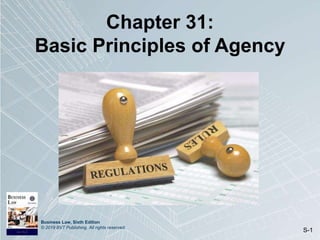
Chapter 31:
Basic Principles of Agency
Business Law, Sixth Edition
© 2019 BVT Publishing. All rights reserved.
S-2
Learning Objectives
• Describe agency law.
• Understand types of principals.
• Understand types of agents.
• Explain duties of an agent.
• Explain duties of a principal.
• Discuss termination of agency by operation
of law.
• Discuss termination of agency by parties’
actions.
Business Law, Sixth Edition
© 2019 BVT Publishing. All rights reserved.
S-3
31.0 In the News
Trump dumped Flynn over ‘trust issue’
http://bvtlab.com/T9d9F
President Trump requested Michael Flynn’s
resignation after a review of his contacts with a
Russian diplomat led Trump to say he could no
longer trust his national security advisor. But the
internal investigation found that Flynn hadn’t
violated the law.
• What kind of agency relationship exists in this case?
• What duties did Flynn owe the President?
• What duties does the presidency owe Flynn?
Business Law, Sixth Edition
© 2019 BVT Publishing. All rights reserved.
S-4
31.1 Agency Law: In General
• Case law has developed most of the
principles applicable to the law of agency.
• Agency issues are usually discussed
within a framework of three parties:
– Principal
– Agent
– Third party
Business Law, Sixth Edition
© 2019 BVT Publishing. All rights reserved.
S-5
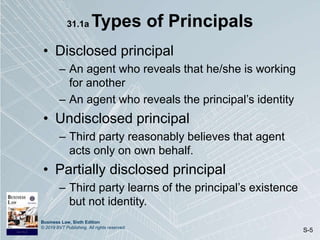
31.1a Types of Principals
• Disclosed principal
– An agent who reveals that he/she is working
for another
– An agent who reveals the principal’s identity
• Undisclosed principal
– Third party reasonably believes that agent
acts only on own behalf.
• Partially disclosed principal
– Third party learns of the principal’s existence
but not identity.
Business Law, Sixth Edition
© 2019 BVT Publishing. All rights reserved.
S-6
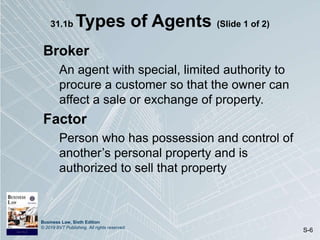
31.1b Types of Agents (Slide 1 of 2)
Broker
An agent with special, limited authority to
procure a customer so that the owner can
affect a sale or exchange of property.
Factor
Person who has possession and control of
another’s personal property and is
authorized to sell that property
Business Law, Sixth Edition
© 2019 BVT Publishing. All rights reserved.
S-7
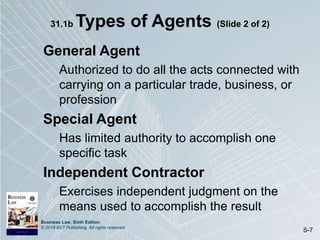
31.1b Types of Agents (Slide 2 of 2)
General Agent
Authorized to do all the acts connected with
carrying on a particular trade, business, or
profession
Special Agent
Has limited authority to accomplish one
specific task
Independent Contractor
Exercises independent judgment on the
means used to accomplish the result
Business Law, Sixth Edition
© 2019 BVT Publishing. All rights reserved.
S-8
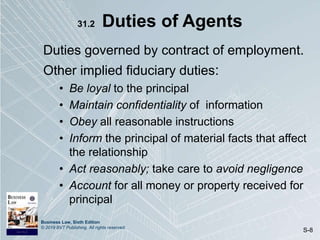
31.2 Duties of Agents
Duties governed by contract of employment.
Other implied fiduciary duties:
• Be loyal to the principal
• Maintain confidentiality of information
• Obey all reasonable instructions
• Inform the principal of material facts that affect
the relationship
• Act reasonably; take care to avoid negligence
• Account for all money or property received for
principal
Business Law, Sixth Edition
© 2019 BVT Publishing. All rights reserved.
S-9
31.2 Critical Thinking
CASE: Lee
Two individuals had a personal and business
relationship over the course of many years.
The court ruled that a fiduciary relationship was
established because Lee relied on Hasson for
emotional, moral, and financial support
sufficient to create a relationship of trust and
confidence.
• What facts did the court use to fashion a
fiduciary relationship?
• Were these facts truly “extraordinary”? Why?
Business Law, Sixth Edition
© 2019 BVT Publishing. All rights reserved.
S-10
31.3 Duties of Principals
• Loyalty and honesty in dealing with the
agents
• Compensation of agents
– If not stated, reasonable value of services
• Reimbursement of agents for their
reasonable expenses
• Indemnification of agents for liability incurred
within the scope of employment
Business Law, Sixth Edition
© 2019 BVT Publishing. All rights reserved.
S-11
31.3d Critical Thinking
Case: Admiral Oriental Line
Involves a suit for reimbursement for
expenses of an agent, American Oriental,
from its principal, the U.S. government.
• Why should the subagent in the case be able to
proceed directly against the principal for
indemnification? Does this approach make logical
sense? Does it make financial sense?
• Does the principal have an ethical duty to
indemnify? Why or why not?
Business Law, Sixth Edition
© 2019 BVT Publishing. All rights reserved.
S-12
31.4 Termination by Operation of Law
Four happenings end the principal-agent
relationship:
• Death of either party
• Insanity of either party
• Bankruptcy of either party under specific
conditions
• Destruction or illegality of the agency’s
subject matter
Business Law, Sixth Edition
© 2019 BVT Publishing. All rights reserved.
S-13
31.5 Termination by Parties’ Actions
Mutual Agreement
• Terms of the principal-agent agreement
- Definite period of time stated in agreement.
- Accomplishment of a certain purpose
• Mutual agreement of the principal and agent
Unilateral Action
• As a general rule, either party has full power to
terminate agreement.
• Breaching party becomes liable for damages
suffered by the other party.

Chapter 31: Basic Principles of Agency

  • 1.
    Business Law, SixthEdition © 2019 BVT Publishing. All rights reserved. S-1 Chapter 31: Basic Principles of Agency
  • 2.
    Business Law, SixthEdition © 2019 BVT Publishing. All rights reserved. S-2 Learning Objectives • Describe agency law. • Understand types of principals. • Understand types of agents. • Explain duties of an agent. • Explain duties of a principal. • Discuss termination of agency by operation of law. • Discuss termination of agency by parties’ actions.
  • 3.
    Business Law, SixthEdition © 2019 BVT Publishing. All rights reserved. S-3 31.0 In the News Trump dumped Flynn over ‘trust issue’ http://bvtlab.com/T9d9F President Trump requested Michael Flynn’s resignation after a review of his contacts with a Russian diplomat led Trump to say he could no longer trust his national security advisor. But the internal investigation found that Flynn hadn’t violated the law. • What kind of agency relationship exists in this case? • What duties did Flynn owe the President? • What duties does the presidency owe Flynn?
  • 4.
    Business Law, SixthEdition © 2019 BVT Publishing. All rights reserved. S-4 31.1 Agency Law: In General • Case law has developed most of the principles applicable to the law of agency. • Agency issues are usually discussed within a framework of three parties: – Principal – Agent – Third party
  • 5.
    Business Law, SixthEdition © 2019 BVT Publishing. All rights reserved. S-5 31.1a Types of Principals • Disclosed principal – An agent who reveals that he/she is working for another – An agent who reveals the principal’s identity • Undisclosed principal – Third party reasonably believes that agent acts only on own behalf. • Partially disclosed principal – Third party learns of the principal’s existence but not identity.
  • 6.
    Business Law, SixthEdition © 2019 BVT Publishing. All rights reserved. S-6 31.1b Types of Agents (Slide 1 of 2) Broker An agent with special, limited authority to procure a customer so that the owner can affect a sale or exchange of property. Factor Person who has possession and control of another’s personal property and is authorized to sell that property
  • 7.
    Business Law, SixthEdition © 2019 BVT Publishing. All rights reserved. S-7 31.1b Types of Agents (Slide 2 of 2) General Agent Authorized to do all the acts connected with carrying on a particular trade, business, or profession Special Agent Has limited authority to accomplish one specific task Independent Contractor Exercises independent judgment on the means used to accomplish the result
  • 8.
    Business Law, SixthEdition © 2019 BVT Publishing. All rights reserved. S-8 31.2 Duties of Agents Duties governed by contract of employment. Other implied fiduciary duties: • Be loyal to the principal • Maintain confidentiality of information • Obey all reasonable instructions • Inform the principal of material facts that affect the relationship • Act reasonably; take care to avoid negligence • Account for all money or property received for principal
  • 9.
    Business Law, SixthEdition © 2019 BVT Publishing. All rights reserved. S-9 31.2 Critical Thinking CASE: Lee Two individuals had a personal and business relationship over the course of many years. The court ruled that a fiduciary relationship was established because Lee relied on Hasson for emotional, moral, and financial support sufficient to create a relationship of trust and confidence. • What facts did the court use to fashion a fiduciary relationship? • Were these facts truly “extraordinary”? Why?
  • 10.
    Business Law, SixthEdition © 2019 BVT Publishing. All rights reserved. S-10 31.3 Duties of Principals • Loyalty and honesty in dealing with the agents • Compensation of agents – If not stated, reasonable value of services • Reimbursement of agents for their reasonable expenses • Indemnification of agents for liability incurred within the scope of employment
  • 11.
    Business Law, SixthEdition © 2019 BVT Publishing. All rights reserved. S-11 31.3d Critical Thinking Case: Admiral Oriental Line Involves a suit for reimbursement for expenses of an agent, American Oriental, from its principal, the U.S. government. • Why should the subagent in the case be able to proceed directly against the principal for indemnification? Does this approach make logical sense? Does it make financial sense? • Does the principal have an ethical duty to indemnify? Why or why not?
  • 12.
    Business Law, SixthEdition © 2019 BVT Publishing. All rights reserved. S-12 31.4 Termination by Operation of Law Four happenings end the principal-agent relationship: • Death of either party • Insanity of either party • Bankruptcy of either party under specific conditions • Destruction or illegality of the agency’s subject matter
  • 13.
    Business Law, SixthEdition © 2019 BVT Publishing. All rights reserved. S-13 31.5 Termination by Parties’ Actions Mutual Agreement • Terms of the principal-agent agreement - Definite period of time stated in agreement. - Accomplishment of a certain purpose • Mutual agreement of the principal and agent Unilateral Action • As a general rule, either party has full power to terminate agreement. • Breaching party becomes liable for damages suffered by the other party.