Learning Outcomes:
0 Define Marketing Planning
0 Explain the role of marketing planning in tourism
  marketing
0 Explain the differences between tactical and strategic
  planning
0 Explain what the mission statement of an
  organisation is
0 Explain the steps involved in strategic marketing
  planning
0 Identify the components of the SPENT analysis
0 Explain the BCG, GEC and Ansoff matrix
0 Describe Porter’s generic strategies
0 Explain the contents of a marketing plan
New Words:
0 Vision – What we can be.. might do..
0 Goal – achieve something- money, service, products
0 Objective – moving a motive to action – help to get to end
  results. WHAT to achieve. SMART
0 Strategies – HOW to get something done
0 Mission statement – there is an end result. (usually just
  one mission) Where the company is going towards
0 Strategic planning – long term meet objectives
0 Tactical Planning – short term meet strategies
Marketing planning
0 We have 3 things that explain the concept of
 marketing planning:
  0 Vision, goal and objectives
  0 Strategies (chosen routes to achieve our goals)
  0 Plans (taking action on how we will move along this
    “route” to achieve goals or targets.

  What does your textbook say about Marketing Planning??
What is Marketing Planning
          then?
0 Middleton & Clarke (2001:190) “analysing strengths
 and weaknesses in current AND prospective markets;
 identifying aims and opportunities; defining
 strategies

0 George, R…. “a tourism company that attempts to
 analyse its existing resources + environment so they
 can use it for future decision-making..”
why do Marketers do
       marketing planning?
For the Marketer:
0 Get the right targets!!! (thus, the right markets and
  segments)
0 Cost effective marketing
0 Look at individual offerings
Why do companies need
     marketing planning?
0 Companies identify objectives – What do they need to
  do, in the market, to achieve goals…
0 Marketing can have an influence on the corporate
  mission statement (it might change if it does not say
  what the market wants to hear)
0 Let the company focus on internal
  strengths/weaknesses - What can internal strengths
  do to better marketing…
0 Forces organization to plan for the future (they now
  more or less know what trends/decisions are taken)
0 Help the company carry out marketing on a day-to-day
  basis – depending on the need in the market
0 Make the company aware of competitors
Strategic vs Tactical
             strategies:
0 They form different parts of the marketing planning
  process
0 They are more or less the same….but…tacticals will
  show how strategics will work..
Tactical marketing planning
0 Over a shorter timescale (2 – 3 years)
0 How they will achieve their strategy
0 What is going to happen
0 Who will make it happen
0 By WHEN will it happen
0 Tactical marketing plans include the 7 P’s; budgets
 and timetables
Strategic planning:
0 How will they meet their objectives – how to
  eventually reach goals/aims
0 How things will happen in the next couple of years
  (usually 3 – 5 years)
0 Analyse the external marketing environment
0 Opportunities or challenges that may arise in the
  medium and long term
The mission statement
0 It is the benefit or DEAL that the company offers to the client
0 It provides a purpose to company staff – why are they here… to
    do what…
0   What the business want to achieve
0   It is BROAD
0   FOCUS on markets
0   Provide INSPIRATION
    0 Remember….The mission statement can change after marketing
      planning…when the company realise that their current mission
      falls on death ears in the market

What can be the MISSION of a tourism organisation?

Mission Statements: Page 86
Marketing Myopia
This is when managers fail to recognise the scope of the
business
0 What can happen if you think your business has LOTS
  of potential when it is not THAT BIG.. And you start
  doing marketing??

0 What can happen if you think you have a medium
 business, but actually you have a HUGE business
 potential, and you start doing marketing?
Marketing Planning process
0 1.Analyse your business.
0 2. Analyse your current market situation, where are
  your business in the market?
0 3. What do the company want to achieve by doing
  marketing planning?
0 4. How will the company get there (how can we
  implement our findings)
0 5. Check effectiveness
Marketing Planning Process
0 Step 1: What is this business about?
The mission statement – setting the goal

Step 2: Where are the business now?
Analysis – analyse market, organization and influences
How do we analyse strong and weaker points and
threats or opportunities in the organization?
Analysis: Analyse Market
0 BCG growth-share matrix: Based on the idea that there
  are a variety of offerings
0GEC analysis
0Porter
0Ansoff
0SPENT – the Macro environment
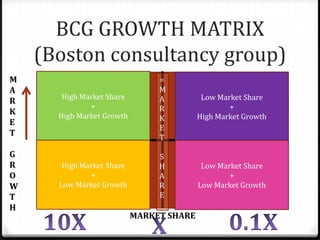
BCG GROWTH MATRIX
    (Boston consultancy group)
M                                   =
A                                   M
        High Market Share           A       Low Market Share
R
                 +                  R               +
K      High Market Growth           K      High is were there is
                                           This Market Growth
E    This is were there is market                 market
                                    E
T             Share x 10            T          Share x 0.1

G         X(market share)           S           5(0.1)=
R       High Market Share           H             0.5
                                            Low Market Share
O              +                    A              +
W      Low Market Growth            R      Low Market Growth
T                                   E
H
                            MARKET SHARE
ICE: BSC GROWTH MATRIX
4 GROUPS:
0 Stars: Market leader offering. Most likely a new
 product/offering. High growth rate and high market share
0 Cash Cows: Leaders in mature market so they have great
 market share; growth rates are slow but support other
 groups
0 Dogs: Weak market share and low growth – so rather sell
 or let go of these offerings
0 Problem Children: High growth markets but low
 market share. Need lot of investments – spend more
 money or let go…
Limitations of BCG matrix:
0 Overall market-share is not known
0 Organization still need to find data of each particular
  business unit
0 It does not take in account the ever changing market
0 Less meaningful in other industries
0 Does not take in account the inter-relationship of
  some offerings (pool + gym…)
ICE: SPENT analysis:
0 S – socio cultural
0 P - political
0 E - economic
0 N - natural
0 T – technology
GEC analysis:
(General Electric Company)
0 Takes in account more factors that the BSC
0 Market attractiveness: Market growth; shares;
  competition; profit;
0 Competitive strengths ( brand, technology;
  distribution)
0 Products/offerings are measured according to Market
  Growth, Shares, Competitiveness and Profit and
  divided into the GEC GRID.
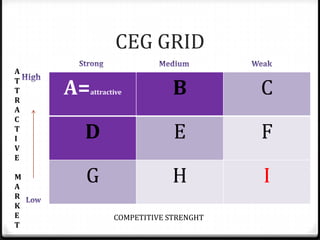
0 A = attractive; I= “in-attractive”
CEG GRID
A

    A=                       B         C
T
T        attractive
R
A
C
T
I    D                       E         F
V
E

M
A
     G                       H         I
R
K
E               COMPETITIVE STRENGHT
T
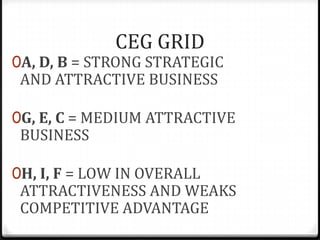
CEG GRID
0A, D, B = STRONG STRATEGIC
 AND ATTRACTIVE BUSINESS

0G, E, C = MEDIUM ATTRACTIVE
 BUSINESS

0H, I, F = LOW IN OVERALL
 ATTRACTIVENESS AND WEAKS
 COMPETITIVE ADVANTAGE
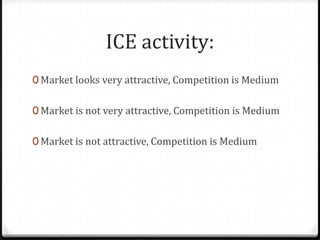
ICE activity:
0 Market looks very attractive, Competition is Medium


0 Market is not very attractive, Competition is Medium


0 Market is not attractive, Competition is Medium
Porter’s generic strategies
0 Porter found that once the marketer has evaluated its
 marketing situation, it can choose from one of 3 alternatives:
      0 Cost leadership; differentiation; Focus
Cost leadership:
                Reduce costs
0 Undercut competition
 Customers go for budget, low cost product

0 Benefits:
 Increase sales + market share
 Profitable in a price-sensitive market
 Earn high profits from high sales
Differentiation:
      “superior” perception
Create a consumer perception that product/offering is
superior to competition
Achieved in the following way:

A product that stands out from the rest (cruise liners)
High standard of service – Sabi Sabi Sands 5* lodge
Strong Brand name – good advertising; customer loyalty
programs
Focus Strategy:
More on segment less on whole
market
Focus more on a segment in the market than the whole
market, then choose differentiation or cost-leadership
strategy

Less resources and more knowledge of market

Benefit:
Specialization + knowledge of segments that are served
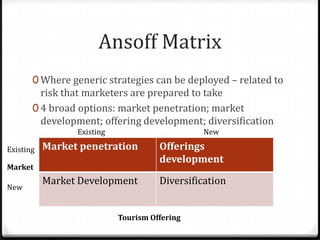
Ansoff Matrix
       0 Where generic strategies can be deployed – related to
         risk that marketers are prepared to take
       0 4 broad options: market penetration; market
         development; offering development; diversification
                 Existing                      New

Existing   Market penetration         Offerings
                                      development
Market
           Market Development         Diversification
New


                            Tourism Offering
Market Penetration:
0 Sell more of a product in an existing market
0 Lowest risk option
0 Try and sell more products and hope to “catch”
 another market
Market Development
0 Look for new markets
0 Sell products in new geographical region
Offering Development
0 New offering in existing market
0 Hotel sells accommodation – now also sells leisure
 facilities
Diversification:
0 New offering + new market
0 Most risky
0 This is ideal to “rejuvenate” a deal that is not growing
 anymore
Marketing Plan:
0 Executive summary
0 Introduction
0 Situation analysis
0 SWOT analysis
0 Marketing Objectives
0 Marketing Strategies
0 Implementation
0 Appendices
Executive Summary:
0 Gives a summary of what the person will find inside
 the marketing plat

0 Only key points or most important points are listed
Introduction
0 Describe the company
0 Market
0 Product/ service
0 Offering or brand and
0 Problems.
Situation Analysis:
0 Internal analysis
0 Customer analysis (who is the customer)
0 Overview (analysis) of company and industry. This
 will include intermediaries and suppliers
SWOT analysis
0 Looking at the environments (SPENT) and you micro
  environment
0 This provides the starting point for strategies
Marketing Objectives:
0 What results you want, when you implement the plan
0 What turnover or market share you will have
0 There can be long term and short term objectives
Marketing Strategies
0 Product offering plan – what is the product/offering
0 Pricing plan – strategies to get things sold
0 Communication plan – how to inform people about the
  product
0 Distribution – how to get the product to the person
0 Physical evidence plan – design of the organisation
0 Internal marketing plan – communicate with employers
0 Relationship marketing plan – How to retain and keep
  customers
Implementation
0 Decision, finance and control
0 What is going to happen
0 Who will do it
0 When to do it
0 How much will it cost


Set the budget using a specific strategy, like:
Affordable method: based on previous year’s budget
% of sales: Based on sales made
Competitive parity: based on competition’s budget
Objective task and method: Marketing tasks are determined
and charged accordingly
Appendices:
0 This include all extra information like data sheets
0 Time tables
0 References

Chapter 4 tourism marketing planning

  • 2.
    Learning Outcomes: 0 DefineMarketing Planning 0 Explain the role of marketing planning in tourism marketing 0 Explain the differences between tactical and strategic planning 0 Explain what the mission statement of an organisation is 0 Explain the steps involved in strategic marketing planning 0 Identify the components of the SPENT analysis 0 Explain the BCG, GEC and Ansoff matrix 0 Describe Porter’s generic strategies 0 Explain the contents of a marketing plan
  • 3.
    New Words: 0 Vision– What we can be.. might do.. 0 Goal – achieve something- money, service, products 0 Objective – moving a motive to action – help to get to end results. WHAT to achieve. SMART 0 Strategies – HOW to get something done 0 Mission statement – there is an end result. (usually just one mission) Where the company is going towards 0 Strategic planning – long term meet objectives 0 Tactical Planning – short term meet strategies
  • 4.
    Marketing planning 0 Wehave 3 things that explain the concept of marketing planning: 0 Vision, goal and objectives 0 Strategies (chosen routes to achieve our goals) 0 Plans (taking action on how we will move along this “route” to achieve goals or targets. What does your textbook say about Marketing Planning??
  • 5.
    What is MarketingPlanning then? 0 Middleton & Clarke (2001:190) “analysing strengths and weaknesses in current AND prospective markets; identifying aims and opportunities; defining strategies 0 George, R…. “a tourism company that attempts to analyse its existing resources + environment so they can use it for future decision-making..”
  • 6.
    why do Marketersdo marketing planning? For the Marketer: 0 Get the right targets!!! (thus, the right markets and segments) 0 Cost effective marketing 0 Look at individual offerings
  • 7.
    Why do companiesneed marketing planning? 0 Companies identify objectives – What do they need to do, in the market, to achieve goals… 0 Marketing can have an influence on the corporate mission statement (it might change if it does not say what the market wants to hear) 0 Let the company focus on internal strengths/weaknesses - What can internal strengths do to better marketing… 0 Forces organization to plan for the future (they now more or less know what trends/decisions are taken) 0 Help the company carry out marketing on a day-to-day basis – depending on the need in the market 0 Make the company aware of competitors
  • 8.
    Strategic vs Tactical strategies: 0 They form different parts of the marketing planning process 0 They are more or less the same….but…tacticals will show how strategics will work..
  • 9.
    Tactical marketing planning 0Over a shorter timescale (2 – 3 years) 0 How they will achieve their strategy 0 What is going to happen 0 Who will make it happen 0 By WHEN will it happen 0 Tactical marketing plans include the 7 P’s; budgets and timetables
  • 10.
    Strategic planning: 0 Howwill they meet their objectives – how to eventually reach goals/aims 0 How things will happen in the next couple of years (usually 3 – 5 years) 0 Analyse the external marketing environment 0 Opportunities or challenges that may arise in the medium and long term
  • 11.
    The mission statement 0It is the benefit or DEAL that the company offers to the client 0 It provides a purpose to company staff – why are they here… to do what… 0 What the business want to achieve 0 It is BROAD 0 FOCUS on markets 0 Provide INSPIRATION 0 Remember….The mission statement can change after marketing planning…when the company realise that their current mission falls on death ears in the market What can be the MISSION of a tourism organisation? Mission Statements: Page 86
  • 12.
    Marketing Myopia This iswhen managers fail to recognise the scope of the business 0 What can happen if you think your business has LOTS of potential when it is not THAT BIG.. And you start doing marketing?? 0 What can happen if you think you have a medium business, but actually you have a HUGE business potential, and you start doing marketing?
  • 13.
    Marketing Planning process 01.Analyse your business. 0 2. Analyse your current market situation, where are your business in the market? 0 3. What do the company want to achieve by doing marketing planning? 0 4. How will the company get there (how can we implement our findings) 0 5. Check effectiveness
  • 14.
    Marketing Planning Process 0Step 1: What is this business about? The mission statement – setting the goal Step 2: Where are the business now? Analysis – analyse market, organization and influences How do we analyse strong and weaker points and threats or opportunities in the organization?
  • 15.
    Analysis: Analyse Market 0BCG growth-share matrix: Based on the idea that there are a variety of offerings 0GEC analysis 0Porter 0Ansoff 0SPENT – the Macro environment
  • 16.
    BCG GROWTH MATRIX (Boston consultancy group) M = A M High Market Share A Low Market Share R + R + K High Market Growth K High is were there is This Market Growth E This is were there is market market E T Share x 10 T Share x 0.1 G X(market share) S 5(0.1)= R High Market Share H 0.5 Low Market Share O + A + W Low Market Growth R Low Market Growth T E H MARKET SHARE
  • 17.
    ICE: BSC GROWTHMATRIX 4 GROUPS: 0 Stars: Market leader offering. Most likely a new product/offering. High growth rate and high market share 0 Cash Cows: Leaders in mature market so they have great market share; growth rates are slow but support other groups 0 Dogs: Weak market share and low growth – so rather sell or let go of these offerings 0 Problem Children: High growth markets but low market share. Need lot of investments – spend more money or let go…
  • 18.
    Limitations of BCGmatrix: 0 Overall market-share is not known 0 Organization still need to find data of each particular business unit 0 It does not take in account the ever changing market 0 Less meaningful in other industries 0 Does not take in account the inter-relationship of some offerings (pool + gym…)
  • 19.
    ICE: SPENT analysis: 0S – socio cultural 0 P - political 0 E - economic 0 N - natural 0 T – technology
  • 20.
    GEC analysis: (General ElectricCompany) 0 Takes in account more factors that the BSC 0 Market attractiveness: Market growth; shares; competition; profit; 0 Competitive strengths ( brand, technology; distribution) 0 Products/offerings are measured according to Market Growth, Shares, Competitiveness and Profit and divided into the GEC GRID. 0 A = attractive; I= “in-attractive”
  • 21.
    CEG GRID A A= B C T T attractive R A C T I D E F V E M A G H I R K E COMPETITIVE STRENGHT T
  • 22.
    CEG GRID 0A, D,B = STRONG STRATEGIC AND ATTRACTIVE BUSINESS 0G, E, C = MEDIUM ATTRACTIVE BUSINESS 0H, I, F = LOW IN OVERALL ATTRACTIVENESS AND WEAKS COMPETITIVE ADVANTAGE
  • 23.
    ICE activity: 0 Marketlooks very attractive, Competition is Medium 0 Market is not very attractive, Competition is Medium 0 Market is not attractive, Competition is Medium
  • 24.
    Porter’s generic strategies 0Porter found that once the marketer has evaluated its marketing situation, it can choose from one of 3 alternatives: 0 Cost leadership; differentiation; Focus
  • 25.
    Cost leadership: Reduce costs 0 Undercut competition Customers go for budget, low cost product 0 Benefits: Increase sales + market share Profitable in a price-sensitive market Earn high profits from high sales
  • 26.
    Differentiation: “superior” perception Create a consumer perception that product/offering is superior to competition Achieved in the following way: A product that stands out from the rest (cruise liners) High standard of service – Sabi Sabi Sands 5* lodge Strong Brand name – good advertising; customer loyalty programs
  • 27.
    Focus Strategy: More onsegment less on whole market Focus more on a segment in the market than the whole market, then choose differentiation or cost-leadership strategy Less resources and more knowledge of market Benefit: Specialization + knowledge of segments that are served
  • 28.
    Ansoff Matrix 0 Where generic strategies can be deployed – related to risk that marketers are prepared to take 0 4 broad options: market penetration; market development; offering development; diversification Existing New Existing Market penetration Offerings development Market Market Development Diversification New Tourism Offering
  • 29.
    Market Penetration: 0 Sellmore of a product in an existing market 0 Lowest risk option 0 Try and sell more products and hope to “catch” another market
  • 30.
    Market Development 0 Lookfor new markets 0 Sell products in new geographical region
  • 31.
    Offering Development 0 Newoffering in existing market 0 Hotel sells accommodation – now also sells leisure facilities
  • 32.
    Diversification: 0 New offering+ new market 0 Most risky 0 This is ideal to “rejuvenate” a deal that is not growing anymore
  • 33.
    Marketing Plan: 0 Executivesummary 0 Introduction 0 Situation analysis 0 SWOT analysis 0 Marketing Objectives 0 Marketing Strategies 0 Implementation 0 Appendices
  • 34.
    Executive Summary: 0 Givesa summary of what the person will find inside the marketing plat 0 Only key points or most important points are listed
  • 35.
    Introduction 0 Describe thecompany 0 Market 0 Product/ service 0 Offering or brand and 0 Problems.
  • 36.
    Situation Analysis: 0 Internalanalysis 0 Customer analysis (who is the customer) 0 Overview (analysis) of company and industry. This will include intermediaries and suppliers
  • 37.
    SWOT analysis 0 Lookingat the environments (SPENT) and you micro environment 0 This provides the starting point for strategies
  • 38.
    Marketing Objectives: 0 Whatresults you want, when you implement the plan 0 What turnover or market share you will have 0 There can be long term and short term objectives
  • 39.
    Marketing Strategies 0 Productoffering plan – what is the product/offering 0 Pricing plan – strategies to get things sold 0 Communication plan – how to inform people about the product 0 Distribution – how to get the product to the person 0 Physical evidence plan – design of the organisation 0 Internal marketing plan – communicate with employers 0 Relationship marketing plan – How to retain and keep customers
  • 40.
    Implementation 0 Decision, financeand control 0 What is going to happen 0 Who will do it 0 When to do it 0 How much will it cost Set the budget using a specific strategy, like: Affordable method: based on previous year’s budget % of sales: Based on sales made Competitive parity: based on competition’s budget Objective task and method: Marketing tasks are determined and charged accordingly
  • 41.
    Appendices: 0 This includeall extra information like data sheets 0 Time tables 0 References