Force.com Additional Database 
Features 
Sujit Kumar 
Zenolocity LLC © 2012 - 2024
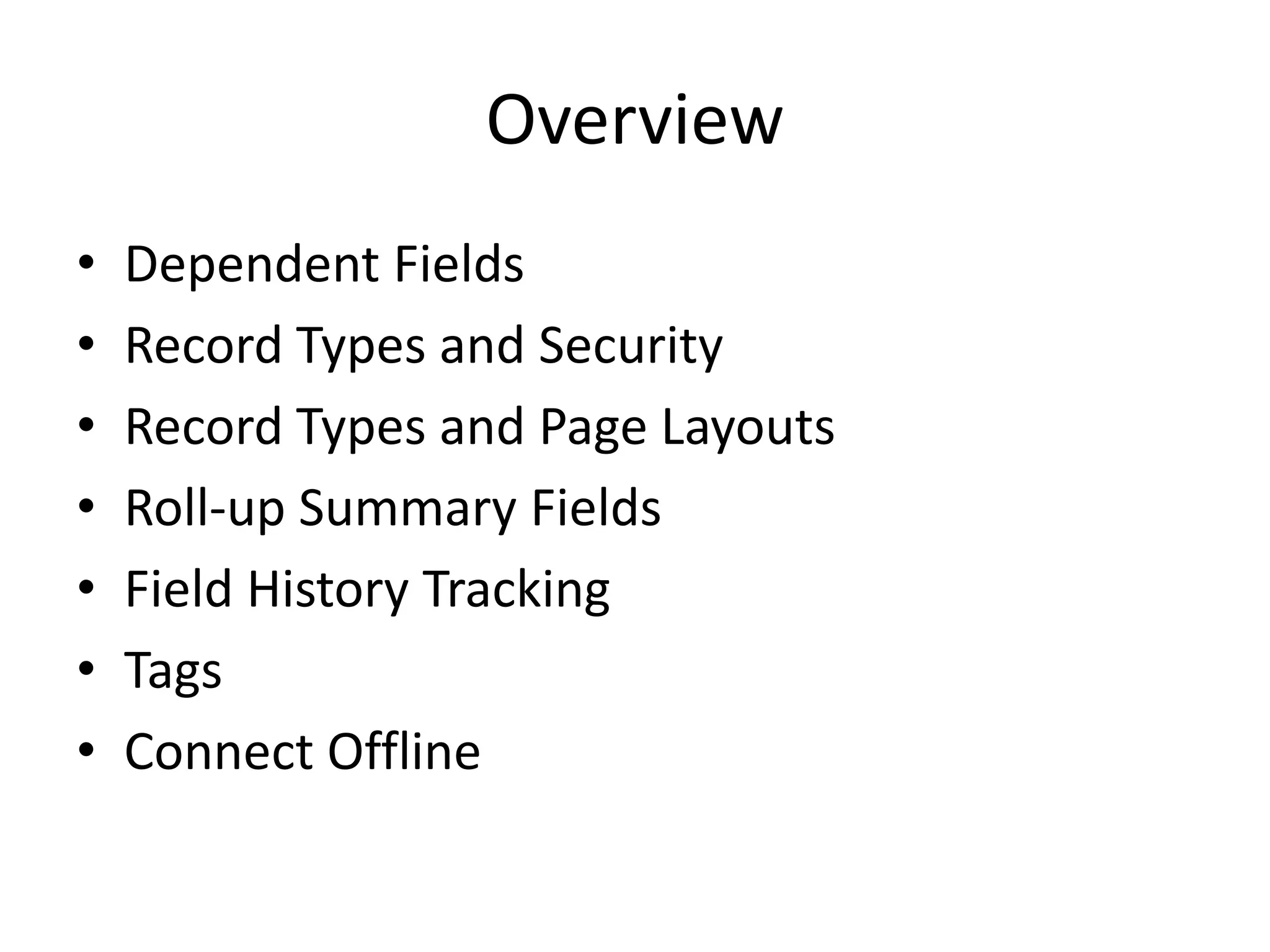
Overview 
• Dependent Fields 
• Record Types and Security 
• Record Types and Page Layouts 
• Roll-up Summary Fields 
• Field History Tracking 
• Tags 
• Connect Offline
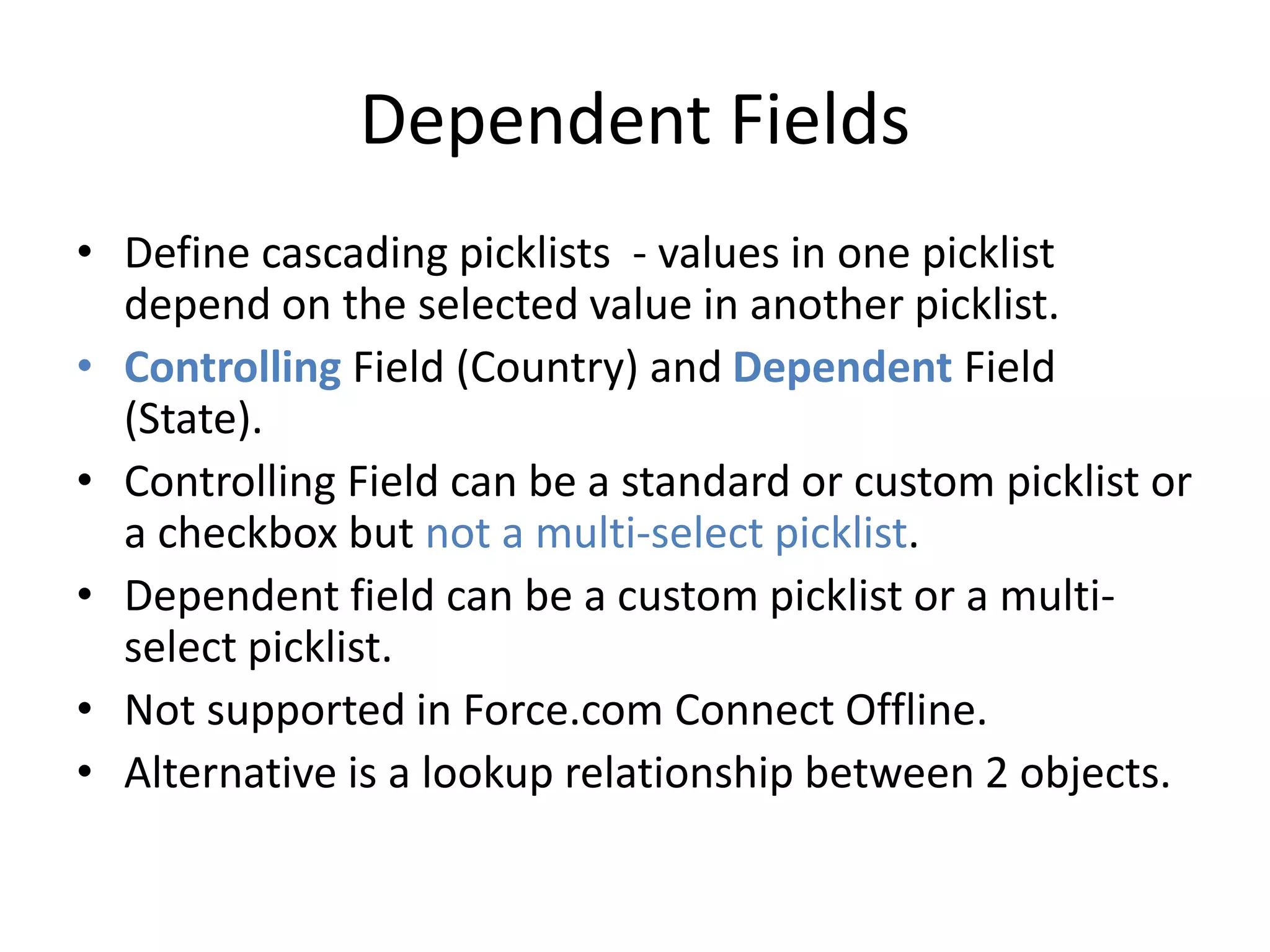
Dependent Fields 
• Define cascading picklists - values in one picklist 
depend on the selected value in another picklist. 
• Controlling Field (Country) and Dependent Field 
(State). 
• Controlling Field can be a standard or custom picklist or 
a checkbox but not a multi-select picklist. 
• Dependent field can be a custom picklist or a multi-select 
picklist. 
• Not supported in Force.com Connect Offline. 
• Alternative is a lookup relationship between 2 objects.
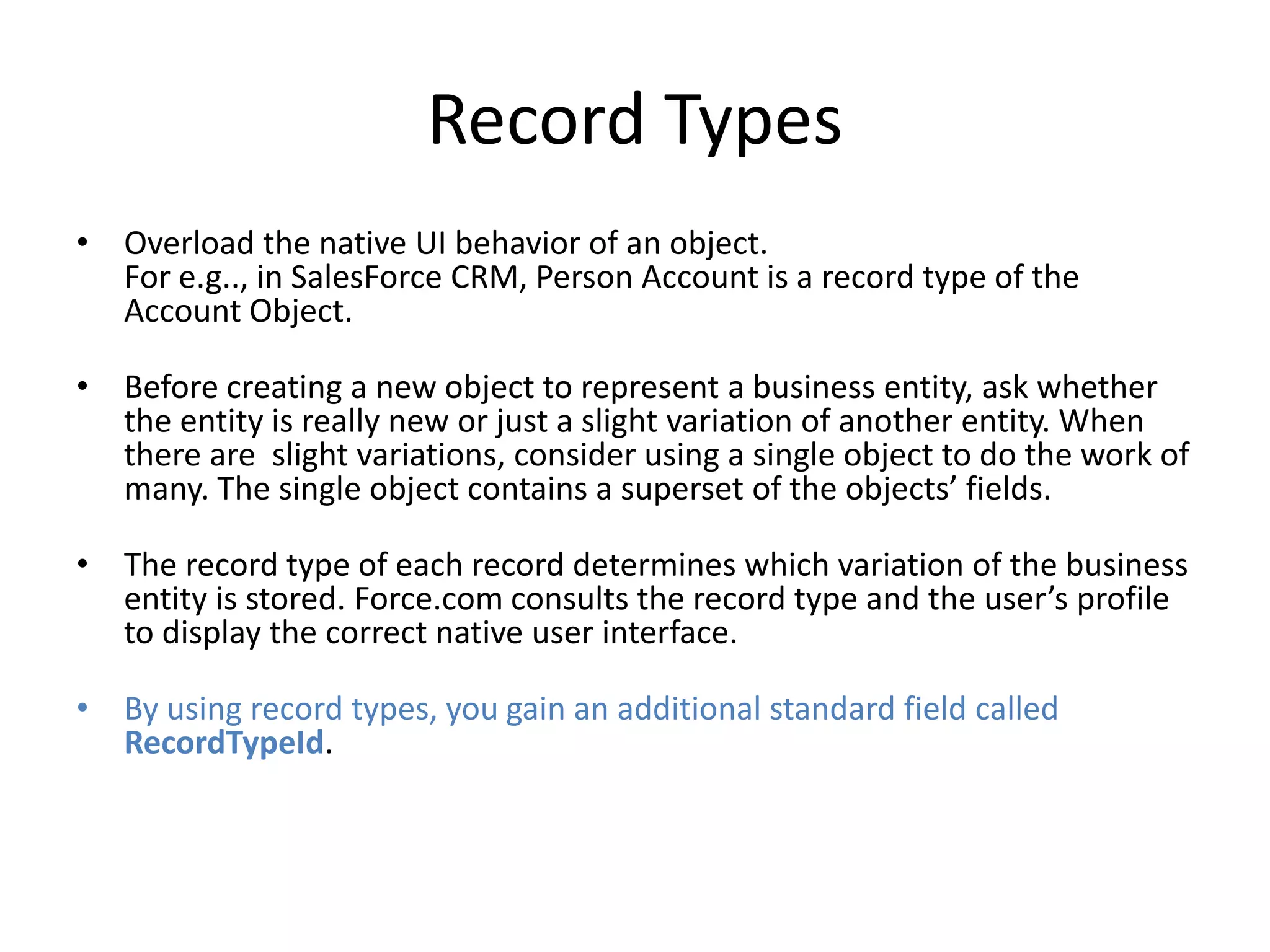
Record Types 
• Overload the native UI behavior of an object. 
For e.g.., in SalesForce CRM, Person Account is a record type of the 
Account Object. 
• Before creating a new object to represent a business entity, ask whether 
the entity is really new or just a slight variation of another entity. When 
there are slight variations, consider using a single object to do the work of 
many. The single object contains a superset of the objects’ fields. 
• The record type of each record determines which variation of the business 
entity is stored. Force.com consults the record type and the user’s profile 
to display the correct native user interface. 
• By using record types, you gain an additional standard field called 
RecordTypeId.
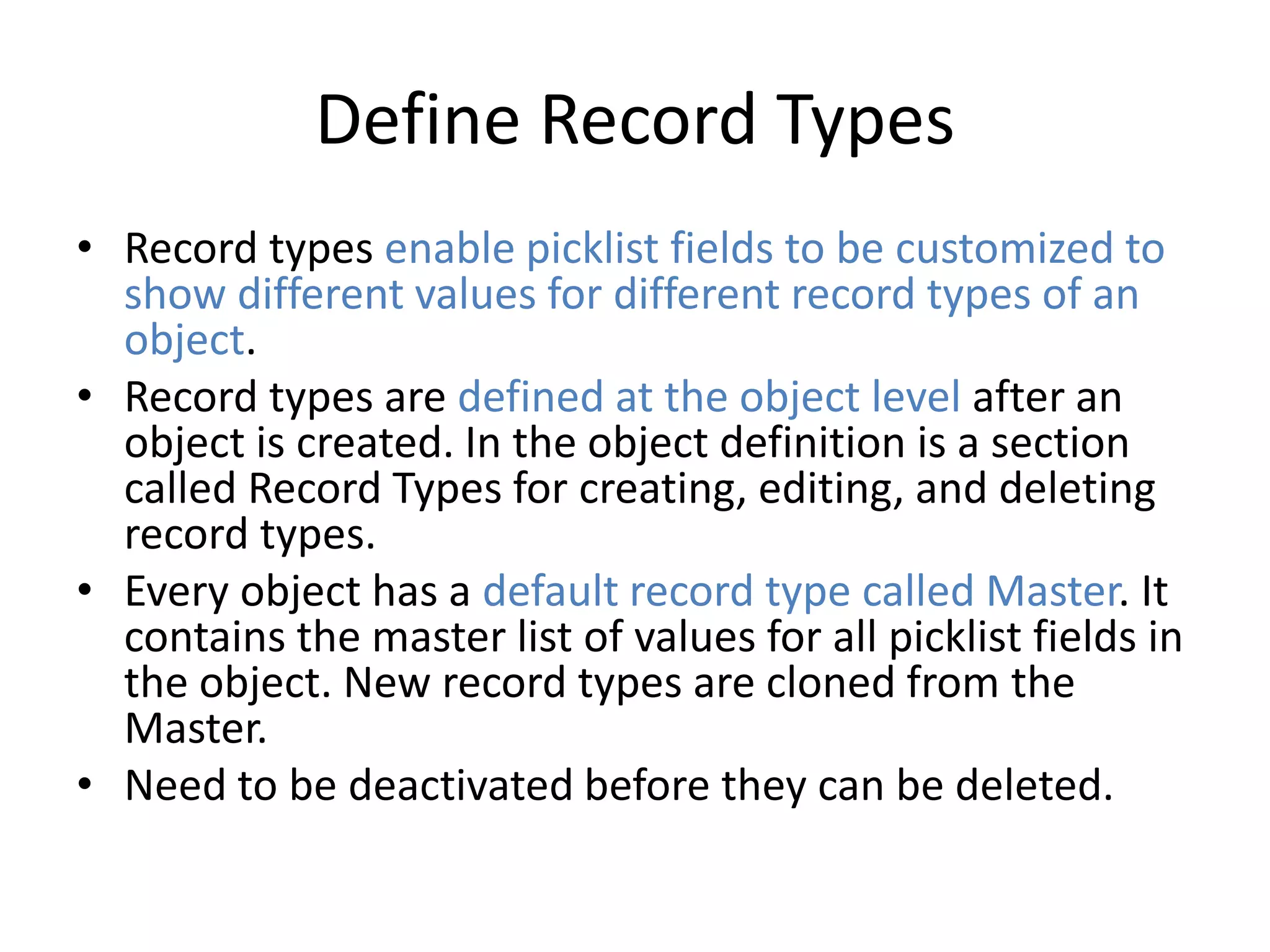
Define Record Types 
• Record types enable picklist fields to be customized to 
show different values for different record types of an 
object. 
• Record types are defined at the object level after an 
object is created. In the object definition is a section 
called Record Types for creating, editing, and deleting 
record types. 
• Every object has a default record type called Master. It 
contains the master list of values for all picklist fields in 
the object. New record types are cloned from the 
Master. 
• Need to be deactivated before they can be deleted.
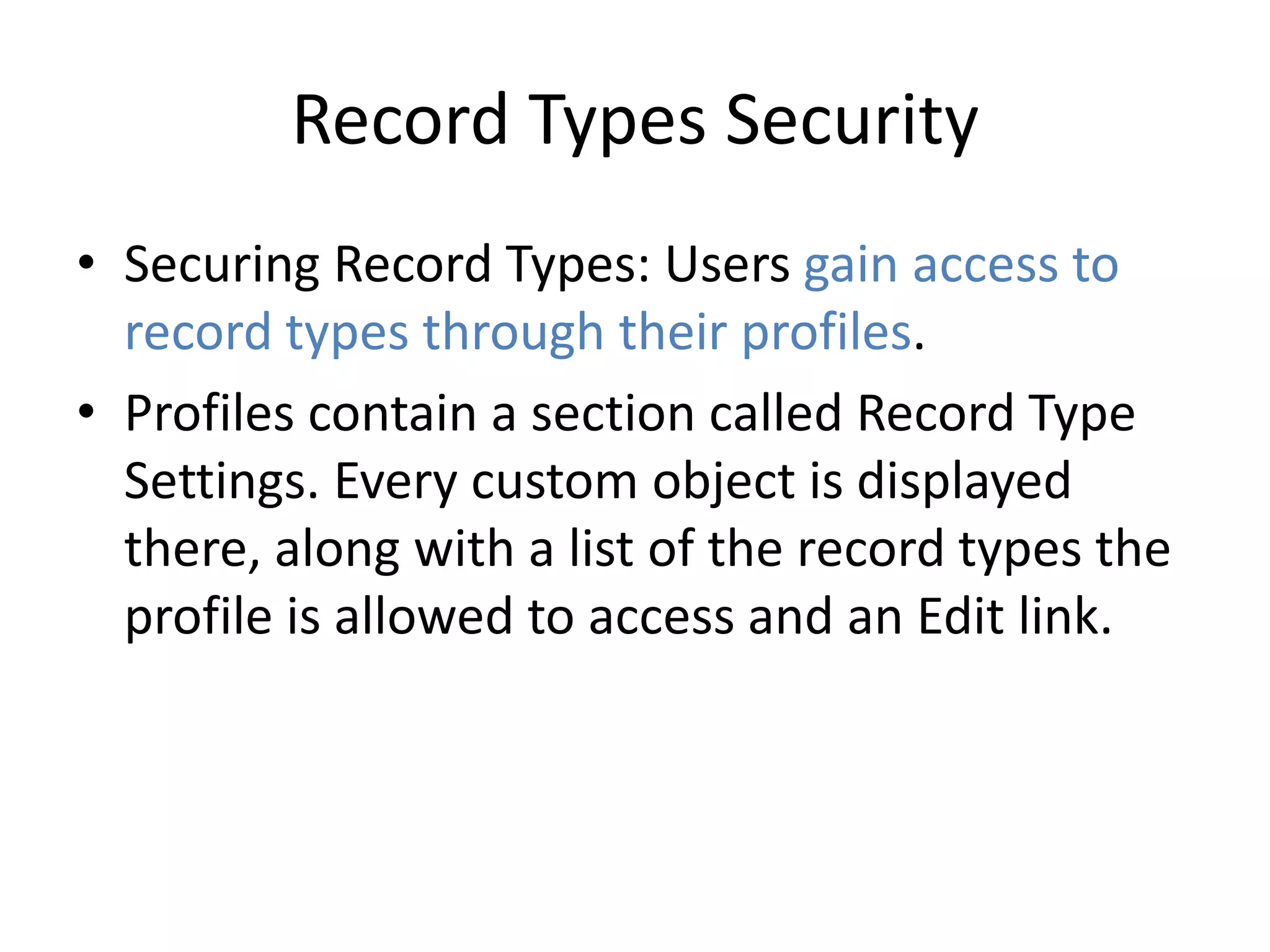
Record Types Security 
• Securing Record Types: Users gain access to 
record types through their profiles. 
• Profiles contain a section called Record Type 
Settings. Every custom object is displayed 
there, along with a list of the record types the 
profile is allowed to access and an Edit link.
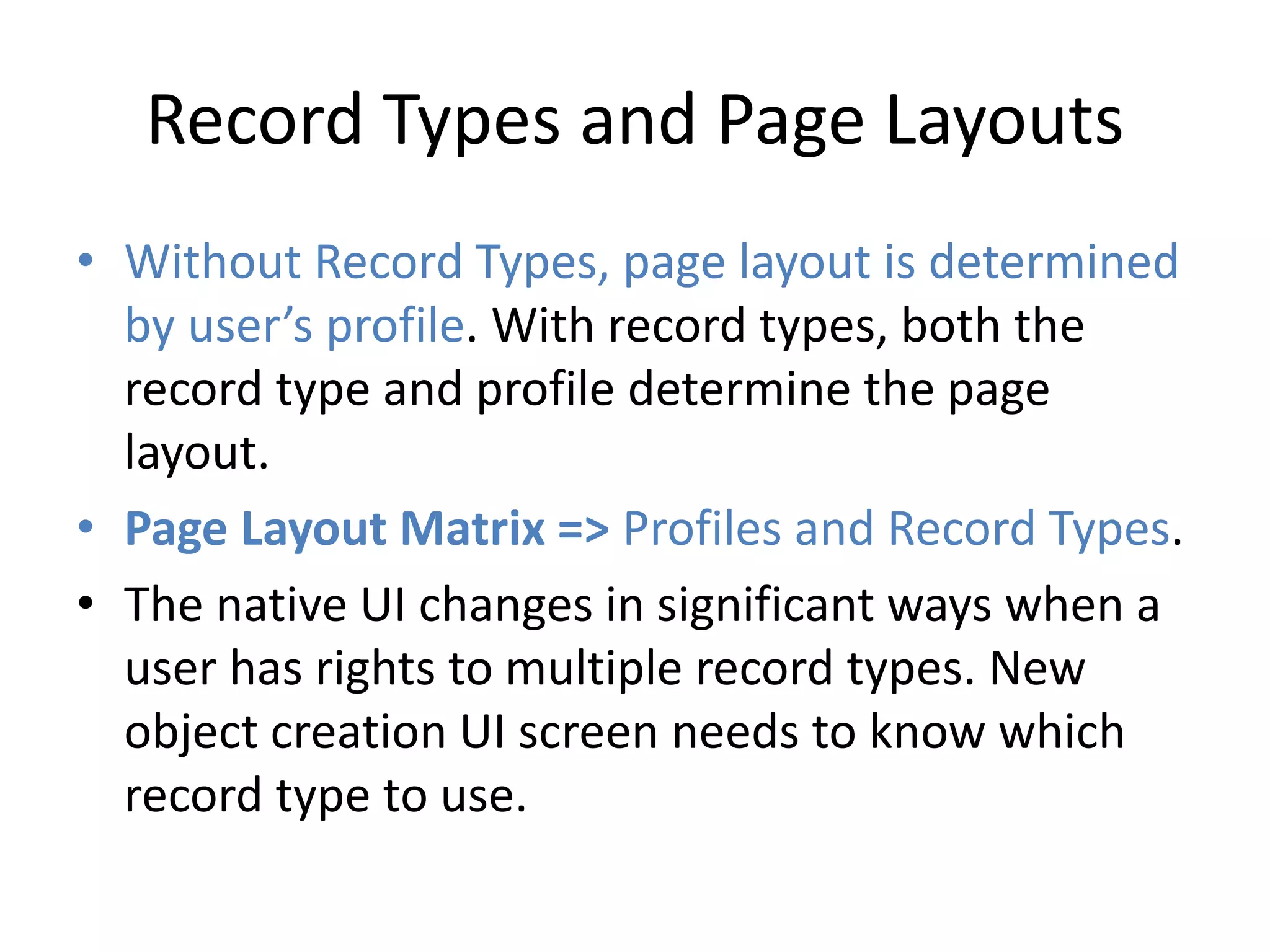
Record Types and Page Layouts 
• Without Record Types, page layout is determined 
by user’s profile. With record types, both the 
record type and profile determine the page 
layout. 
• Page Layout Matrix => Profiles and Record Types. 
• The native UI changes in significant ways when a 
user has rights to multiple record types. New 
object creation UI screen needs to know which 
record type to use.
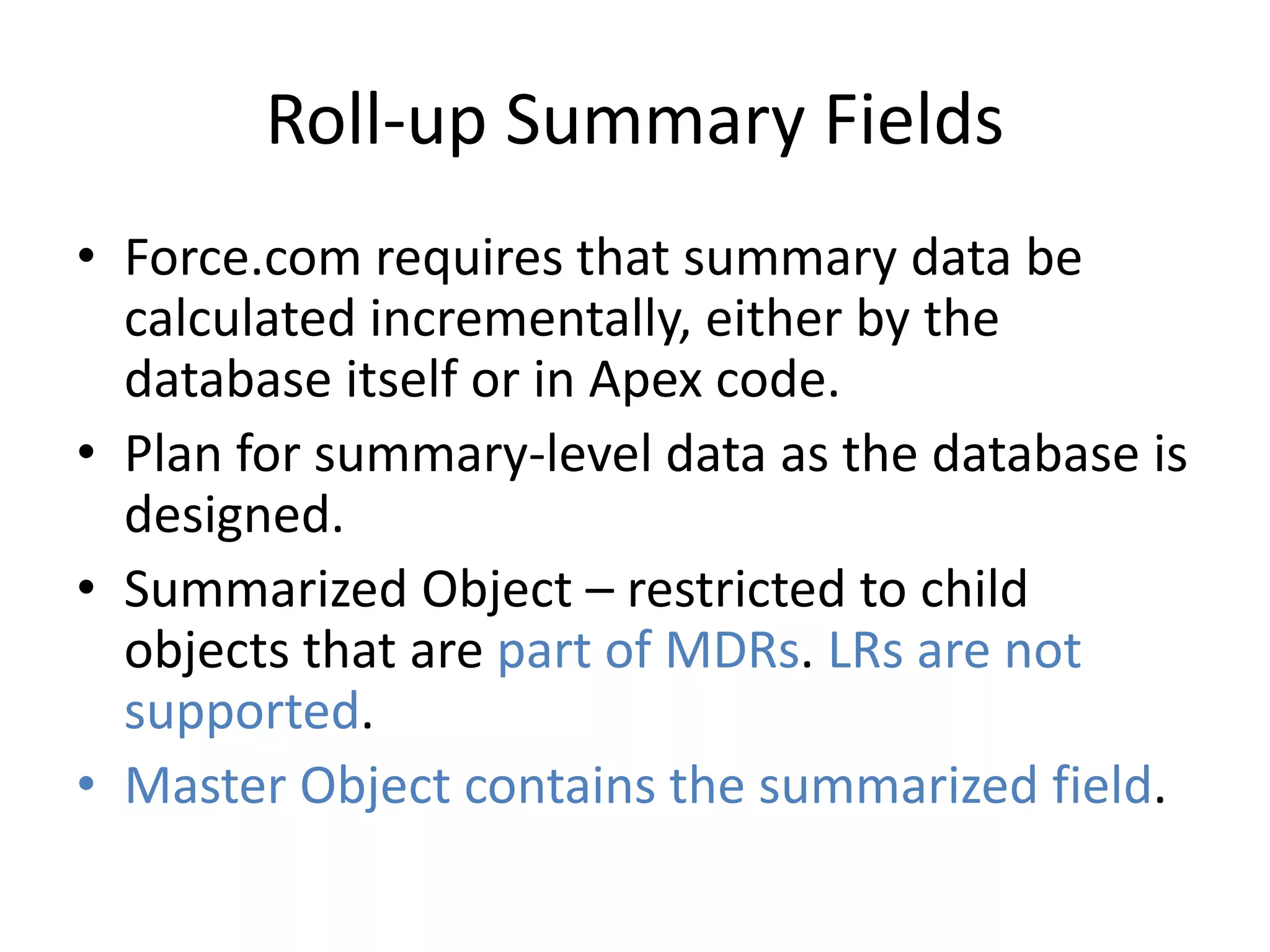
Roll-up Summary Fields 
• Force.com requires that summary data be 
calculated incrementally, either by the 
database itself or in Apex code. 
• Plan for summary-level data as the database is 
designed. 
• Summarized Object – restricted to child 
objects that are part of MDRs. LRs are not 
supported. 
• Master Object contains the summarized field.
Roll-up Summary Fields (contd…) 
• Roll-up Type – count, min, max, sum. 
• Filter Criteria – are additive => they must all 
be satisfied. 
• Summary field calculation starts immediately 
on existing child records. 
• At most 10 roll-up summary fields per object. 
• Cannot convert a MDR to a LR without 
removing the roll-up summary fields.
Field History Tracking 
• Audit trail of 1 or more fields of an object. 
• No one can edit or remove entries in the audit 
trail. 
• Can track up to 25 fields per object. 
• Cannot track history of formula, roll-up 
summary and auto number fields. 
• Selectively choose 1 or more fields to track.
Tags 
• Tags are keywords that users can place on 
records to make them easier to find. 
• Can be private to a specific user or shared 
among all users. 
• Reduce the complexity of object search. 
• disadvantage - search is unstructured. 
• Always strings and cannot be treated as 
numbers or dates.
Connect Offline 
• Read-Write access to data while disconnected. 
• Data synchronized when reconnected. 
• An admin configures this feature for a set of 
users and what data is accessible for offline 
access. 
• Users run a client app on Windows OS.
Connect Offline Configuration 
• Select one or more objects. 
• Set Record Ownership filters. 
• Set Field filters – restrict data on values, filters 
are additive. 
• Set record limits – max # of records for a given 
data set. If no limit is set, default is 5000 
records per object.

SFDC Database Additional Features

  • 1.
    Force.com Additional Database Features Sujit Kumar Zenolocity LLC © 2012 - 2024
  • 2.
    Overview • DependentFields • Record Types and Security • Record Types and Page Layouts • Roll-up Summary Fields • Field History Tracking • Tags • Connect Offline
  • 3.
    Dependent Fields •Define cascading picklists - values in one picklist depend on the selected value in another picklist. • Controlling Field (Country) and Dependent Field (State). • Controlling Field can be a standard or custom picklist or a checkbox but not a multi-select picklist. • Dependent field can be a custom picklist or a multi-select picklist. • Not supported in Force.com Connect Offline. • Alternative is a lookup relationship between 2 objects.
  • 4.
    Record Types •Overload the native UI behavior of an object. For e.g.., in SalesForce CRM, Person Account is a record type of the Account Object. • Before creating a new object to represent a business entity, ask whether the entity is really new or just a slight variation of another entity. When there are slight variations, consider using a single object to do the work of many. The single object contains a superset of the objects’ fields. • The record type of each record determines which variation of the business entity is stored. Force.com consults the record type and the user’s profile to display the correct native user interface. • By using record types, you gain an additional standard field called RecordTypeId.
  • 5.
    Define Record Types • Record types enable picklist fields to be customized to show different values for different record types of an object. • Record types are defined at the object level after an object is created. In the object definition is a section called Record Types for creating, editing, and deleting record types. • Every object has a default record type called Master. It contains the master list of values for all picklist fields in the object. New record types are cloned from the Master. • Need to be deactivated before they can be deleted.
  • 6.
    Record Types Security • Securing Record Types: Users gain access to record types through their profiles. • Profiles contain a section called Record Type Settings. Every custom object is displayed there, along with a list of the record types the profile is allowed to access and an Edit link.
  • 7.
    Record Types andPage Layouts • Without Record Types, page layout is determined by user’s profile. With record types, both the record type and profile determine the page layout. • Page Layout Matrix => Profiles and Record Types. • The native UI changes in significant ways when a user has rights to multiple record types. New object creation UI screen needs to know which record type to use.
  • 8.
    Roll-up Summary Fields • Force.com requires that summary data be calculated incrementally, either by the database itself or in Apex code. • Plan for summary-level data as the database is designed. • Summarized Object – restricted to child objects that are part of MDRs. LRs are not supported. • Master Object contains the summarized field.
  • 9.
    Roll-up Summary Fields(contd…) • Roll-up Type – count, min, max, sum. • Filter Criteria – are additive => they must all be satisfied. • Summary field calculation starts immediately on existing child records. • At most 10 roll-up summary fields per object. • Cannot convert a MDR to a LR without removing the roll-up summary fields.
  • 10.
    Field History Tracking • Audit trail of 1 or more fields of an object. • No one can edit or remove entries in the audit trail. • Can track up to 25 fields per object. • Cannot track history of formula, roll-up summary and auto number fields. • Selectively choose 1 or more fields to track.
  • 11.
    Tags • Tagsare keywords that users can place on records to make them easier to find. • Can be private to a specific user or shared among all users. • Reduce the complexity of object search. • disadvantage - search is unstructured. • Always strings and cannot be treated as numbers or dates.
  • 12.
    Connect Offline •Read-Write access to data while disconnected. • Data synchronized when reconnected. • An admin configures this feature for a set of users and what data is accessible for offline access. • Users run a client app on Windows OS.
  • 13.
    Connect Offline Configuration • Select one or more objects. • Set Record Ownership filters. • Set Field filters – restrict data on values, filters are additive. • Set record limits – max # of records for a given data set. If no limit is set, default is 5000 records per object.