ACADEMIC WRITING
ARGUMENTATIVE ESSAYS


                       1
ARGUMENTATIVE ESSAYS

In this kind of essay, we not only give
information but also present an argument
with the PROS (supporting ideas) and CONS
(opposing ideas) of an argumentative issue.


We should clearly take our stand (agree or
disagree) and write as if we are trying to
persuade the reader that your opinion is
right.
The first step is to choose an argumentative
topic.


The topic should be narrowed down.
For example:
Marijuana should be considered illegal. (too
general)


Selling and using marijuana in public places
should be considered illegal.
The topic should contain an argument.


For example:
We should decide whether we want a bicycle or
a car. (our stand is not clear: do we support
having bicycles or cars?)


If we are adults and want a healthy life, we
 should definitely get a bicycle instead of a car.
It should be a topic that can be adequately
supported. (with statistics, outside source
citations, etc.)


For example:
I feel that writing an argumentative essay is
 definitely a challenging task. (feelings cannot
 be supported; we cannot persuade other
 people)
Before starting writing, it is important to
make a list of PROS and CONS and choose the
most suitable ones among them for
supporting and refuting.


In an argumentative essay, you do not just
give reasons to support your point of view. You
must also discuss the other side’s reasons and
then rebut them.
5 key elements of an argumentative essay:

1. Explanation of the issue.
2. A clear thesis statement.
3. A summary of the opposing arguments.
4. Rebuttals to the opposing arguments.
5. Your own arguments.
   The introductory paragraph contains an
    explanation of the issue, which is a
    necessary part of an argumentative essay.


   The thesis statement states clearly which
    side you are for:

In my opinion, stem cell research should
  receive the full support of our government.
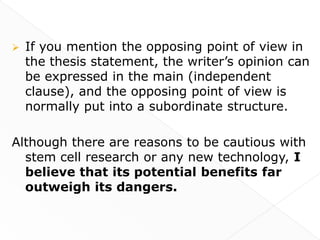
   If you mention the opposing point of view in
    the thesis statement, the writer’s opinion can
    be expressed in the main (independent
    clause), and the opposing point of view is
    normally put into a subordinate structure.

Although there are reasons to be cautious with
  stem cell research or any new technology, I
  believe that its potential benefits far
  outweigh its dangers.
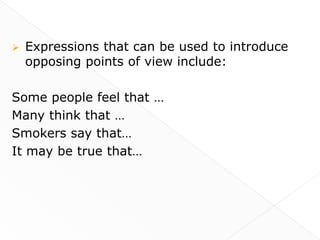
   Expressions that can be used to introduce
    opposing points of view include:

Some people feel that …
Many think that …
Smokers say that…
It may be true that…
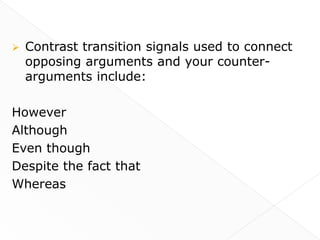
   Contrast transition signals used to connect
    opposing arguments and your counter-
    arguments include:

However
Although
Even though
Despite the fact that
Whereas
THANK YOU

Argumentative essays writing

  • 1.
  • 2.
    ARGUMENTATIVE ESSAYS In thiskind of essay, we not only give information but also present an argument with the PROS (supporting ideas) and CONS (opposing ideas) of an argumentative issue. We should clearly take our stand (agree or disagree) and write as if we are trying to persuade the reader that your opinion is right.
  • 3.
    The first stepis to choose an argumentative topic. The topic should be narrowed down. For example: Marijuana should be considered illegal. (too general) Selling and using marijuana in public places should be considered illegal.
  • 4.
    The topic shouldcontain an argument. For example: We should decide whether we want a bicycle or a car. (our stand is not clear: do we support having bicycles or cars?) If we are adults and want a healthy life, we should definitely get a bicycle instead of a car.
  • 5.
    It should bea topic that can be adequately supported. (with statistics, outside source citations, etc.) For example: I feel that writing an argumentative essay is definitely a challenging task. (feelings cannot be supported; we cannot persuade other people)
  • 6.
    Before starting writing,it is important to make a list of PROS and CONS and choose the most suitable ones among them for supporting and refuting. In an argumentative essay, you do not just give reasons to support your point of view. You must also discuss the other side’s reasons and then rebut them.
  • 7.
    5 key elementsof an argumentative essay: 1. Explanation of the issue. 2. A clear thesis statement. 3. A summary of the opposing arguments. 4. Rebuttals to the opposing arguments. 5. Your own arguments.
  • 8.
    The introductory paragraph contains an explanation of the issue, which is a necessary part of an argumentative essay.  The thesis statement states clearly which side you are for: In my opinion, stem cell research should receive the full support of our government.
  • 9.
    If you mention the opposing point of view in the thesis statement, the writer’s opinion can be expressed in the main (independent clause), and the opposing point of view is normally put into a subordinate structure. Although there are reasons to be cautious with stem cell research or any new technology, I believe that its potential benefits far outweigh its dangers.
  • 10.
    Expressions that can be used to introduce opposing points of view include: Some people feel that … Many think that … Smokers say that… It may be true that…
  • 11.
    Contrast transition signals used to connect opposing arguments and your counter- arguments include: However Although Even though Despite the fact that Whereas
  • 12.