CHAPTER 4: REPRODUCTION


4.1 Sexual and Asexual Reproduction

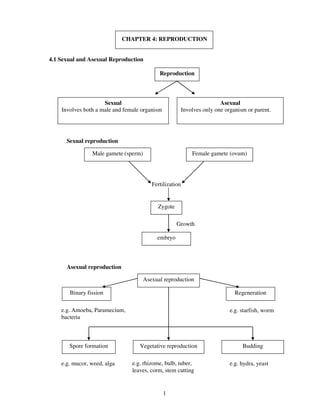
                                            Reproduction


                     Sexual                                          Asexual
    Involves both a male and female organism         Involves only one organism or parent.


      Sexual reproduction

                Male gamete (sperm)                      Female gamete (ovum)


                                         Fertilization


                                           Zygote

                                                    Growth

                                           embryo


      Asexual reproduction

                                      Asexual reproduction

       Binary fission                                                      Regeneration

    e.g. Amoeba, Paramecium,                                             e.g. starfish, worm
    bacteria


       Spore formation             Vegetative reproduction                    Budding

    e.g. mucor, weed, alga      e.g. rhizome, bulb, tuber,               e.g. hydra, yeast
                                leaves, corm, stem cutting


                                               1
4.2 Male And Female Reproduction System


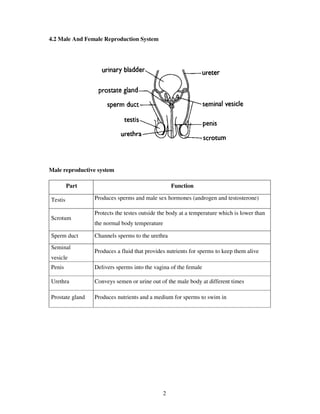
Male reproductive system

         Part                                      Function

Testis           Produces sperms and male sex hormones (androgen and testosterone)

                 Protects the testes outside the body at a temperature which is lower than
Scrotum
                 the normal body temperature

Sperm duct       Channels sperms to the urethra
Seminal
                 Produces a fluid that provides nutrients for sperms to keep them alive
vesicle
Penis            Delivers sperms into the vagina of the female

Urethra          Conveys semen or urine out of the male body at different times

Prostate gland   Produces nutrients and a medium for sperms to swim in


                                               2
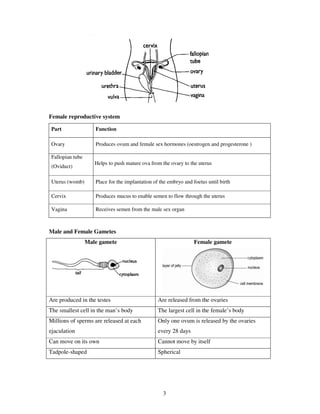
Female reproductive system

 Part                Function

 Ovary               Produces ovum and female sex hormones (oestrogen and progesterone )

 Fallopian tube
                     Helps to push mature ova from the ovary to the uterus
 (Oviduct)

 Uterus (womb)       Place for the implantation of the embryo and foetus until birth

 Cervix              Produces mucus to enable semen to flow through the uterus

 Vagina              Receives semen from the male sex organ


Male and Female Gametes
                  Male gamete                                      Female gamete


Are produced in the testes                        Are released from the ovaries
The smallest cell in the man’s body               The largest cell in the female’s body
Millions of sperms are released at each           Only one ovum is released by the ovaries
ejaculation                                       every 28 days
Can move on its own                               Cannot move by itself
Tadpole-shaped                                    Spherical


                                                    3
Changes in Males and Females during Puberty
                  Males                                           Females
   •   involve the production of male sex          •   involve the production of female sex
       hormones and sperms                             hormones, the release of mature eggs
   •   a change in attitude towards girls          •   a change in attitude towards boys
   •   an enlargement of the penis and the         •   the development of the breasts, the
       growth of beard, chest hair, armpit             growth of pubic and armpit hair
       hair and pubic hair                         •   a rapid increase in height and the
   •   a rapid increase in height, the                 widening of hips
       broadening of the shoulders
   •   the development of body muscles
       and the deepening of the voice


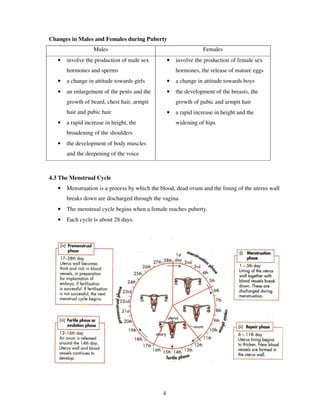
4.3 The Menstrual Cycle
   •   Menstruation is a process by which the blood, dead ovum and the lining of the uterus wall
       breaks down are discharged through the vagina.
   •   The menstrual cycle begins when a female reaches puberty.
   •   Each cycle is about 28 days.


                                               4
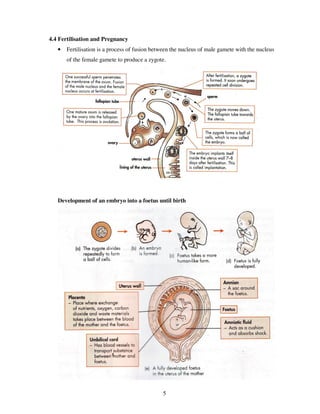
4.4 Fertilisation and Pregnancy
   •   Fertilisation is a process of fusion between the nucleus of male gamete with the nucleus
       of the female gamete to produce a zygote.


   Development of an embryo into a foetus until birth


                                               5
4.5 Importance of Prenatal Care
   •   A balanced diet and nutritious food for the mother is important for proper growth and
       development of the foetus.
       (a) Protein: for the rapid growth of the foetus
       (b) Calcium: for the development of strong bones and teeth
       (c) Iron: to produce haemoglobin in the expectant mother’s blood
   •   Harmful substances such as drugs, alcohol and chemicals in tobacco smoke may cause
       miscarriages and birth defects such as mental retardation and brain damage in the foetus.


4.6 Research in Human Reproduction
   •   Sterility is the inability to reproduce.
   •   The problem of sterility may be overcome by
       (a) taking nutritious food which is rich in vitamins and minerals
       (b) hormone treatments to increase sperm or egg production
       (c) surgery to correct problems such as blocked sperm ducts or blocked fallopian tubes
       (d) in vitro fertilisation
   •   Methods used in birth control
       (a) For males:
               i. Barrier method: use of condoms
               ii. Surgical method: vasectomy
       (b) For females:
               i. Natural method: Rhythm
               ii. Barrier method: use of diaphragm
               iii. Mechanical method: Intrauterine contraceptive device, IUCD
               iv. Hormonal method: use of contraceptive pills
               v. Chemical method: use of spermicides
               vi. Surgical method: ligation


                                                  6
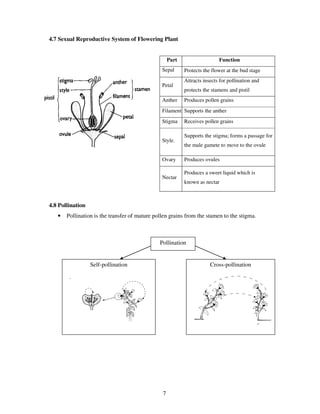
4.7 Sexual Reproductive System of Flowering Plant


                                                    Part                   Function
                                                Sepal      Protects the flower at the bud stage
                                                           Attracts insects for pollination and
                                                Petal
                                                           protects the stamens and pistil
                                                Anther     Produces pollen grains
                                                Filament Supports the anther
                                                Stigma     Receives pollen grains

                                                           Supports the stigma; forms a passage for
                                                Style.
                                                           the male gamete to move to the ovule

                                                Ovary      Produces ovules

                                                           Produces a sweet liquid which is
                                                Nectar
                                                           known as nectar


4.8 Pollination
   •   Pollination is the transfer of mature pollen grains from the stamen to the stigma.


                                               Pollination


                  Self-pollination                                     Cross-pollination


                                                7
4.9 Development of Fruits and Seeds In Plants


                                                          After fertilization:
                                                               (a) the ovary develop into a fruit.
                                                               (b) the ovule develop into a seed.
                                                               (c) the sepals, petals, stamens,
                                                                   style and stigma wither and fall
                                                                   off.


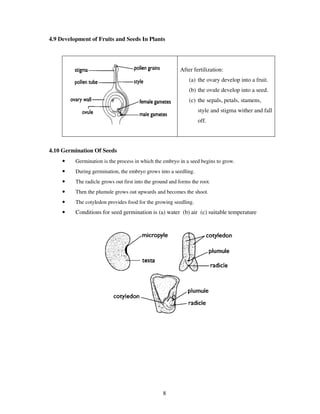
4.10 Germination Of Seeds
     •    Germination is the process in which the embryo in a seed begins to grow.
     •    During germination, the embryo grows into a seedling.
     •    The radicle grows out first into the ground and forms the root.
     •    Then the plumule grows out upwards and becomes the shoot.
     •    The cotyledon provides food for the growing seedling.
     •    Conditions for seed germination is (a) water (b) air (c) suitable temperature


                                                  8
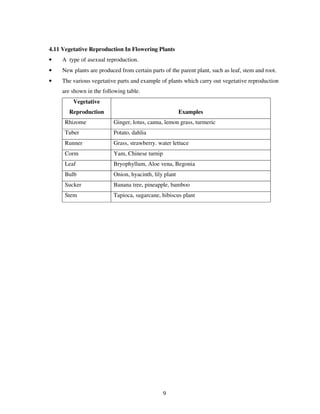
4.11 Vegetative Reproduction In Flowering Plants
•    A type of asexual reproduction.
•    New plants are produced from certain parts of the parent plant, such as leaf, stem and root.
•    The various vegetative parts and example of plants which carry out vegetative reproduction
     are shown in the following table.
         Vegetative
       Reproduction                                      Examples
      Rhizome              Ginger, lotus, canna, lemon grass, turmeric
      Tuber                Potato, dahlia
      Runner               Grass, strawberry. water lettuce
      Corm                 Yam, Chinese turnip
      Leaf                 Bryophyllum, Aloe vena, Begonia
      Bulb                 Onion, hyacinth, lily plant
      Sucker               Banana tree, pineapple, bamboo
      Stem                 Tapioca, sugarcane, hibiscus plant


                                                 9

Chapter 4

  • 1.
    CHAPTER 4: REPRODUCTION 4.1Sexual and Asexual Reproduction Reproduction Sexual Asexual Involves both a male and female organism Involves only one organism or parent. Sexual reproduction Male gamete (sperm) Female gamete (ovum) Fertilization Zygote Growth embryo Asexual reproduction Asexual reproduction Binary fission Regeneration e.g. Amoeba, Paramecium, e.g. starfish, worm bacteria Spore formation Vegetative reproduction Budding e.g. mucor, weed, alga e.g. rhizome, bulb, tuber, e.g. hydra, yeast leaves, corm, stem cutting 1
  • 2.
    4.2 Male AndFemale Reproduction System Male reproductive system Part Function Testis Produces sperms and male sex hormones (androgen and testosterone) Protects the testes outside the body at a temperature which is lower than Scrotum the normal body temperature Sperm duct Channels sperms to the urethra Seminal Produces a fluid that provides nutrients for sperms to keep them alive vesicle Penis Delivers sperms into the vagina of the female Urethra Conveys semen or urine out of the male body at different times Prostate gland Produces nutrients and a medium for sperms to swim in 2
  • 3.
    Female reproductive system Part Function Ovary Produces ovum and female sex hormones (oestrogen and progesterone ) Fallopian tube Helps to push mature ova from the ovary to the uterus (Oviduct) Uterus (womb) Place for the implantation of the embryo and foetus until birth Cervix Produces mucus to enable semen to flow through the uterus Vagina Receives semen from the male sex organ Male and Female Gametes Male gamete Female gamete Are produced in the testes Are released from the ovaries The smallest cell in the man’s body The largest cell in the female’s body Millions of sperms are released at each Only one ovum is released by the ovaries ejaculation every 28 days Can move on its own Cannot move by itself Tadpole-shaped Spherical 3
  • 4.
    Changes in Malesand Females during Puberty Males Females • involve the production of male sex • involve the production of female sex hormones and sperms hormones, the release of mature eggs • a change in attitude towards girls • a change in attitude towards boys • an enlargement of the penis and the • the development of the breasts, the growth of beard, chest hair, armpit growth of pubic and armpit hair hair and pubic hair • a rapid increase in height and the • a rapid increase in height, the widening of hips broadening of the shoulders • the development of body muscles and the deepening of the voice 4.3 The Menstrual Cycle • Menstruation is a process by which the blood, dead ovum and the lining of the uterus wall breaks down are discharged through the vagina. • The menstrual cycle begins when a female reaches puberty. • Each cycle is about 28 days. 4
  • 5.
    4.4 Fertilisation andPregnancy • Fertilisation is a process of fusion between the nucleus of male gamete with the nucleus of the female gamete to produce a zygote. Development of an embryo into a foetus until birth 5
  • 6.
    4.5 Importance ofPrenatal Care • A balanced diet and nutritious food for the mother is important for proper growth and development of the foetus. (a) Protein: for the rapid growth of the foetus (b) Calcium: for the development of strong bones and teeth (c) Iron: to produce haemoglobin in the expectant mother’s blood • Harmful substances such as drugs, alcohol and chemicals in tobacco smoke may cause miscarriages and birth defects such as mental retardation and brain damage in the foetus. 4.6 Research in Human Reproduction • Sterility is the inability to reproduce. • The problem of sterility may be overcome by (a) taking nutritious food which is rich in vitamins and minerals (b) hormone treatments to increase sperm or egg production (c) surgery to correct problems such as blocked sperm ducts or blocked fallopian tubes (d) in vitro fertilisation • Methods used in birth control (a) For males: i. Barrier method: use of condoms ii. Surgical method: vasectomy (b) For females: i. Natural method: Rhythm ii. Barrier method: use of diaphragm iii. Mechanical method: Intrauterine contraceptive device, IUCD iv. Hormonal method: use of contraceptive pills v. Chemical method: use of spermicides vi. Surgical method: ligation 6
  • 7.
    4.7 Sexual ReproductiveSystem of Flowering Plant Part Function Sepal Protects the flower at the bud stage Attracts insects for pollination and Petal protects the stamens and pistil Anther Produces pollen grains Filament Supports the anther Stigma Receives pollen grains Supports the stigma; forms a passage for Style. the male gamete to move to the ovule Ovary Produces ovules Produces a sweet liquid which is Nectar known as nectar 4.8 Pollination • Pollination is the transfer of mature pollen grains from the stamen to the stigma. Pollination Self-pollination Cross-pollination 7
  • 8.
    4.9 Development ofFruits and Seeds In Plants After fertilization: (a) the ovary develop into a fruit. (b) the ovule develop into a seed. (c) the sepals, petals, stamens, style and stigma wither and fall off. 4.10 Germination Of Seeds • Germination is the process in which the embryo in a seed begins to grow. • During germination, the embryo grows into a seedling. • The radicle grows out first into the ground and forms the root. • Then the plumule grows out upwards and becomes the shoot. • The cotyledon provides food for the growing seedling. • Conditions for seed germination is (a) water (b) air (c) suitable temperature 8
  • 9.
    4.11 Vegetative ReproductionIn Flowering Plants • A type of asexual reproduction. • New plants are produced from certain parts of the parent plant, such as leaf, stem and root. • The various vegetative parts and example of plants which carry out vegetative reproduction are shown in the following table. Vegetative Reproduction Examples Rhizome Ginger, lotus, canna, lemon grass, turmeric Tuber Potato, dahlia Runner Grass, strawberry. water lettuce Corm Yam, Chinese turnip Leaf Bryophyllum, Aloe vena, Begonia Bulb Onion, hyacinth, lily plant Sucker Banana tree, pineapple, bamboo Stem Tapioca, sugarcane, hibiscus plant 9