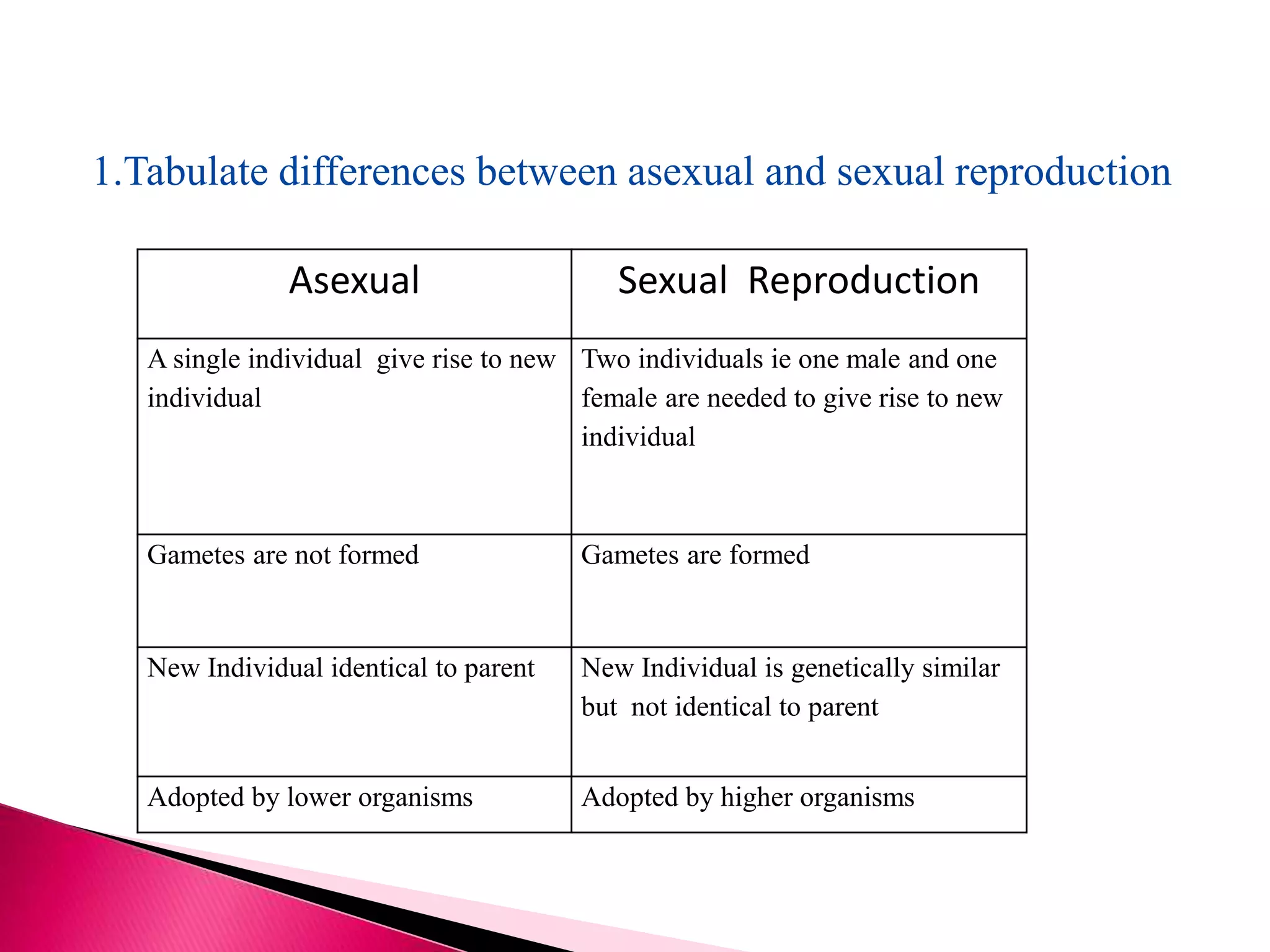
1.Tabulate differences between asexual and sexual reproduction
Asexual Sexual Reproduction
A single individual give rise to new
individual
Two individuals ie one male and one
female are needed to give rise to new
individual
Gametes are not formed Gametes are formed
New Individual identical to parent New Individual is genetically similar
but not identical to parent
Adopted by lower organisms Adopted by higher organisms
2.What is the differences between self pollination and
cross pollination.
Self pollination: It is transfer of pollengrains from the
anther of one flower to the stigma of the same flower
(or) another flower of the same plant.
Cross Pollination: It is the transfer of pollengrains from
the anther of one flower to the stigma of another
flower growing on another plant of the same species.
3.Post – Fertilization events in flower:
i) Sepals, Petals, Stigma, Style and stamen degenerate.
ii) The ovary ripens into fruit
iii) The ovules form seeds
iv) Fertilized egg develops into embryo.
How do Organism Reproduce
4.List two unisexual & Bisexual flower.
Uni sexual flower: Water melon,papaya
Bisexual flower: Rose, Hibiscus
5. Mention function of each of the part
Radicle - Future root
Plumule – Future stem
Cotyledon – Food storage
6.Name the parts A,B and c show in the given diagram and state one
function each.
A
B
C
A – Anther produces pollen grains
B – Style (passage of pollentube)
C – Ovary ( ovary contains ovules. Each ovule has an egg contained in
embryosac. Ovule after fertilization matures into seed)
7a) Identify A,B,C,D in the given diagram and write their names. A
A - stigma B – Pollentube C - Ovary D -Female germ cell A
b) What is pollination? Explain its significance
b)Pollination: Transfer of pollengrains from anther to the stigma of a flower
B
C
D
Significance: Process of pollination leads to fertilization as it brings the male and female
gametes together for fusion.
c) Explain the process of fertilization in flower name the parts of the flower that develop after
fertilization into:
i) Seed ii) Fruit
c)After a pollen fall son a suitable stigma, the pollen tube grows out of the pollen grains and
travels through the style to reach the ovule in the ovary
9. Mention the mode of reproduction used by
Amoeba - Binary fission
Planaria - Regeneration
Hydra - Budding
Spirogyra - Fragmentation
10.What is vegetative propagation? State two advantage and
disadvantage of this method
Vegetative propagation is a mode of asexual reproduction in
which new plants are formed from roots, stem, leaves and
buds of the individual (eg) eyes of potato
Advantages: Off springs are genetically indentical and therefore
useful traits can be preserved. It is a repaid and economical
method
Disadvantages: New characters cannot be introduced. The
disease of the parent plants gets transferred to the off springs
12.Des cribe -Male Reproductive system
 A) Testes: A pair of testes are located inside scrotum which is
present outside the abdominal cavity.scrotum.has a relatively
lower temperature needed for the production of sperms.
 Function of testes:
 Production male germ cells, sperm are formed here.
 Testes release male sex hormone(testosterone). Its function is
to:
 i) Regulate production of sperms
 ii) Bring changes at puberty
b) Vas deferens; It passes sperms from testes upto urethra.
c) Urethra: It is a common passage for both sperms and urine. Its
outer covering is called penis. It is like a fibro muscular long
tube which travels through penis. In women it is short of is
just above vagina.
d) Associated glands: Seminal vesicles and prostate gland add
there secretion to the sperms. This fluid provide nourishment
to sperms and make their transport easy. Sperm along with
secretion of glands form semen.
12. Des cribe-Female Reproductive System
a) Ovary: A pair of ovary is located in both sides of abdomen.
• Female germs cells, eggs are produced here.
 At the time of birth of a girl, thousand of immature eggs are
present in the ovary.
 At the onset of puberty, some of these eggs start maturing.
b) Oviduct or Fallopian tube:
• Receives the egg produced by the ovary and transfer it to the
uterus.
• Fertilisation fusion of gametes take place here.
 Uterus: It is a bag like structure where development of
the foetus take place
• Uterus opens into vagina through cervix.
• The embryo moves down to reach the uterus. The
embedding of the embryo in the thick inner lining of the
uterus is called implantation
• The time period from the development of foetus inside
the uterus till birth is called gestation period. The act of
giving birth to the fully developed foetus at the end of
gestation period is termed as parturition.
13.Define term mensural cycle
 The breakdown and removal of the inner, thick and
soft lining of the uterus along with its blood vessels
in the form of vaginal bleeding is called menstrual
flow or menstruation
14.Define-Reproductive health is all those aspects of general
health which help a person to lead a normal, safe and
satisfying reproductive life.
15.Name Sexually transmitted diseases(STDs) The diseases
which spread by sexual contact from an infected person to a
healthy person. Some common STDs are Gonorrhoea, syphilis
warts, AIDS
 There are different methods which are developed to prevent
and control pregnancy such as mechanical methods, chemical
methods oral pills and surgical methods.
16.Contraception: It is the avoidance of pregnancy, which can be
achieved by preventing the fertilisation of ova
 17.Explain the methods of contraception.
a) Physical barrier
• To prevent union of egg and sperm.
• Use of condoms, cervical caps and diaphragm.
b) Chemical methods
• Use of oral pills.
• These change hormonal balance of body so that eggs are not
released.
• May have side effects.
 Intrauterine contraceptive device (IUCD)
• Copper - T or loop is placed in uterus to prevent pregnancy.
 Surgical methods
• In males the vas deferens is blocked to prevent sperm transfer
called vasectomy.
• In females, the fallopian tube I blocked to prevent egg transfer
called tubectomy

classx how do organism reproduce

  • 2.
    1.Tabulate differences betweenasexual and sexual reproduction Asexual Sexual Reproduction A single individual give rise to new individual Two individuals ie one male and one female are needed to give rise to new individual Gametes are not formed Gametes are formed New Individual identical to parent New Individual is genetically similar but not identical to parent Adopted by lower organisms Adopted by higher organisms
  • 3.
    2.What is thedifferences between self pollination and cross pollination. Self pollination: It is transfer of pollengrains from the anther of one flower to the stigma of the same flower (or) another flower of the same plant. Cross Pollination: It is the transfer of pollengrains from the anther of one flower to the stigma of another flower growing on another plant of the same species.
  • 4.
    3.Post – Fertilizationevents in flower: i) Sepals, Petals, Stigma, Style and stamen degenerate. ii) The ovary ripens into fruit iii) The ovules form seeds iv) Fertilized egg develops into embryo. How do Organism Reproduce
  • 5.
    4.List two unisexual& Bisexual flower. Uni sexual flower: Water melon,papaya Bisexual flower: Rose, Hibiscus
  • 6.
    5. Mention functionof each of the part Radicle - Future root Plumule – Future stem Cotyledon – Food storage
  • 7.
    6.Name the partsA,B and c show in the given diagram and state one function each. A B C A – Anther produces pollen grains B – Style (passage of pollentube) C – Ovary ( ovary contains ovules. Each ovule has an egg contained in embryosac. Ovule after fertilization matures into seed)
  • 8.
    7a) Identify A,B,C,Din the given diagram and write their names. A A - stigma B – Pollentube C - Ovary D -Female germ cell A b) What is pollination? Explain its significance b)Pollination: Transfer of pollengrains from anther to the stigma of a flower B C D Significance: Process of pollination leads to fertilization as it brings the male and female gametes together for fusion. c) Explain the process of fertilization in flower name the parts of the flower that develop after fertilization into: i) Seed ii) Fruit c)After a pollen fall son a suitable stigma, the pollen tube grows out of the pollen grains and travels through the style to reach the ovule in the ovary
  • 10.
    9. Mention themode of reproduction used by Amoeba - Binary fission Planaria - Regeneration Hydra - Budding Spirogyra - Fragmentation
  • 11.
    10.What is vegetativepropagation? State two advantage and disadvantage of this method Vegetative propagation is a mode of asexual reproduction in which new plants are formed from roots, stem, leaves and buds of the individual (eg) eyes of potato Advantages: Off springs are genetically indentical and therefore useful traits can be preserved. It is a repaid and economical method Disadvantages: New characters cannot be introduced. The disease of the parent plants gets transferred to the off springs
  • 12.
    12.Des cribe -MaleReproductive system  A) Testes: A pair of testes are located inside scrotum which is present outside the abdominal cavity.scrotum.has a relatively lower temperature needed for the production of sperms.  Function of testes:  Production male germ cells, sperm are formed here.  Testes release male sex hormone(testosterone). Its function is to:  i) Regulate production of sperms  ii) Bring changes at puberty
  • 13.
    b) Vas deferens;It passes sperms from testes upto urethra. c) Urethra: It is a common passage for both sperms and urine. Its outer covering is called penis. It is like a fibro muscular long tube which travels through penis. In women it is short of is just above vagina. d) Associated glands: Seminal vesicles and prostate gland add there secretion to the sperms. This fluid provide nourishment to sperms and make their transport easy. Sperm along with secretion of glands form semen.
  • 14.
    12. Des cribe-FemaleReproductive System a) Ovary: A pair of ovary is located in both sides of abdomen. • Female germs cells, eggs are produced here.  At the time of birth of a girl, thousand of immature eggs are present in the ovary.  At the onset of puberty, some of these eggs start maturing. b) Oviduct or Fallopian tube: • Receives the egg produced by the ovary and transfer it to the uterus. • Fertilisation fusion of gametes take place here.
  • 15.
     Uterus: Itis a bag like structure where development of the foetus take place • Uterus opens into vagina through cervix. • The embryo moves down to reach the uterus. The embedding of the embryo in the thick inner lining of the uterus is called implantation • The time period from the development of foetus inside the uterus till birth is called gestation period. The act of giving birth to the fully developed foetus at the end of gestation period is termed as parturition.
  • 16.
    13.Define term mensuralcycle  The breakdown and removal of the inner, thick and soft lining of the uterus along with its blood vessels in the form of vaginal bleeding is called menstrual flow or menstruation
  • 17.
    14.Define-Reproductive health isall those aspects of general health which help a person to lead a normal, safe and satisfying reproductive life. 15.Name Sexually transmitted diseases(STDs) The diseases which spread by sexual contact from an infected person to a healthy person. Some common STDs are Gonorrhoea, syphilis warts, AIDS  There are different methods which are developed to prevent and control pregnancy such as mechanical methods, chemical methods oral pills and surgical methods. 16.Contraception: It is the avoidance of pregnancy, which can be achieved by preventing the fertilisation of ova
  • 18.
     17.Explain themethods of contraception. a) Physical barrier • To prevent union of egg and sperm. • Use of condoms, cervical caps and diaphragm. b) Chemical methods • Use of oral pills. • These change hormonal balance of body so that eggs are not released. • May have side effects.
  • 19.
     Intrauterine contraceptivedevice (IUCD) • Copper - T or loop is placed in uterus to prevent pregnancy.  Surgical methods • In males the vas deferens is blocked to prevent sperm transfer called vasectomy. • In females, the fallopian tube I blocked to prevent egg transfer called tubectomy