Nutrition
For Healthy Living
Fifth Edition
Wendy J. Schiff, MS,
RDN
See separate PowerPoint slides for all figures and tables pre-inserted into PowerPoint without notes.
©McGraw-Hill Education. All rights reserved. Authorized only for instructor use in the classroom. No reproduction or further distribution permitted without the prior written consent of McGraw-Hill Education.
©McGraw-Hill Education
Chapter 3
Planning Nutritious Diets
Lecture Outline
©McGraw-Hill Education
Quiz Yourself
True or False1
1. According to the latest U.S. Department of
Agriculture food guide, fruits and vegetables are
combined into one food group. True or false?
2. According to the recommendations of the 2015-2020
Dietary Guidelines for Americans, it is acceptable for
certain adults to consume alcoholic beverages in
moderation. True or false?
3. Last week, Colin didn’t consume the recommended
amount of vitamin C for a couple of days.
Nevertheless, he is unlikely to develop scurvy, the
vitamin C deficiency disease. True or false?
©McGraw-Hill Education
Quiz Yourself
True or False2
4. The Food and Drug Administration develops Dietary
Guidelines for Americans. True or false?
5. The Nutrition Facts panel on a food label provides
information concerning amounts of energy, fiber,
and sodium that are in a serving of the food. True or
false?
©McGraw-Hill Education
How Did You Do?1
1. False According to the latest USDA food guide,
fruits and vegetables are two separate food
groups.
2. True According to the 2015-2020 Dietary
Guidelines for Americans, it is acceptable for
certain adults to consume moderate amounts of
alcoholic beverages.
3. True Consuming less than the recommended
amount of the vitamin for a few days is unlikely to
cause scurvy in a healthy person.
©McGraw-Hill Education
How Did You Do?2
4. False The Food and Drug Administration does
not develop the Dietary Guidelines for
Americans, they are developed by the U.S.
Departments of Health and Human Services and
Agriculture.
5. True The Nutrition Facts panel on a food label
provides information concerning amounts of
energy, fiber, and sodium that are in a serving of
food.
©McGraw-Hill Education
Section 3.1 From Requirements to
Standards
Learning Outcomes
• Explain the difference between a dietary
requirement and a dietary allowance.
• Identify the various dietary standards and explain
how they can be used.
©McGraw-Hill Education
What Is a Nutrient Requirement?
Requirement : smallest amount of a nutrient
that maintains a defined level of nutritional
health
• The required amount is generally enough to cure
or prevent the nutrient’s deficiency disease.
• Many factors influence a person’s nutrient
requirements including age, sex, general health
status, physical activity level, and the use of
medication and drugs.
©McGraw-Hill Education
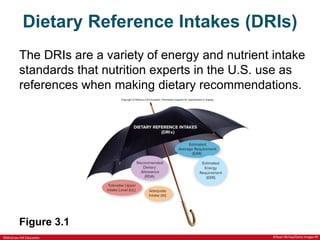
Dietary Reference Intakes (DRIs)
The DRIs are a variety of energy and nutrient intake
standards that nutrition experts in the U.S. use as
references when making dietary recommendations.
Figure 3.1
©Ryan McVay/Getty Images RF
©McGraw-Hill Education
DRIs: Summary1
EAR (Estimated Average Requirement): daily
amount of a nutrient that meets the needs of 50% of
healthy people who are in a particular life stage/sex
group
EER (Estimated Energy Requirement): average
daily energy intake that meets needs of a healthy
person who is maintaining his/her weight
RDA (Recommended Dietary Allowance):
standards for recommended daily intakes of several
nutrients that meet the nutrient needs of nearly all
(approximately 98%) of healthy people
©McGraw-Hill Education
DRIs: Summary2
AI (Adequate Intake): dietary recommendations for
nutrients that scientists do not have enough
information to establish RDA
UL (Tolerable Upper Intake Level [Upper Level]):
highest average amount of a nutrient that is unlikely
to be harmful when consumed daily
©McGraw-Hill Education
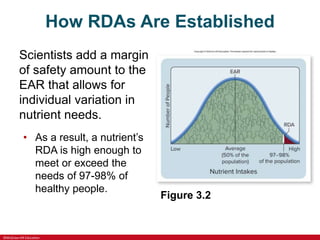
How RDAs Are Established
Scientists add a margin
of safety amount to the
EAR that allows for
individual variation in
nutrient needs.
• As a result, a nutrient’s
RDA is high enough to
meet or exceed the
needs of 97-98% of
healthy people.
Figure 3.2
©McGraw-Hill Education
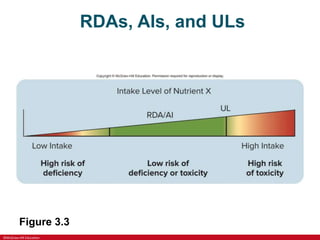
RDAs, AIs, and ULs
Figure 3.3
©McGraw-Hill Education
Applying Nutrient Standards
Nutrient standards are used to:
• Plan nutritious diets for groups of people
• Evaluate nutritional adequacy of population’s
diet*
• Develop certain food products
• Provide standards for nutritional labeling
purposes (Daily Values)
*DRIs are often used to evaluate individual diets.
©McGraw-Hill Education
Section 3.2 Major Food Groups
Learning Outcome
• List major food groups, and identify foods that
are typically classified in each group.
©McGraw-Hill Education
Major Food Groups
In general, foods are grouped according to
natural origins & key nutrients:
Five general groups:
• Grains
• Dairy
• Protein-rich foods
• Fruits
• Vegetables
©McGraw-Hill Education
Grains
This group includes products made from wheat,
rice, and oats.
Primary macronutrients are carbohydrate and
protein.
Refined grain products often undergo:
• Enrichment: replacement of some nutrients that were
lost during processing.
• Enriched grains have specific amounts of iron and 4 B vitamins
added to them.
• Fortification: addition of any nutrient to a food to boost
its level of the nutrient
Whole grains provide more fiber and micronutrients
than refined grains.
©McGraw-Hill Education
Dairy
This group includes milk, and products made
from milk, that retain much of their calcium
content after processing.
Dairy products are excellent sources of
calcium, protein, phosphorus, and riboflavin.
Cream cheese, cream, and butter are NOT
included because they contain little or no
calcium and are high in fat.
©McGraw-Hill Education
Protein-Rich Foods
This group includes beef, pork, lamb, fish,
shellfish, liver, and poultry.
Dry beans & peas, eggs, nuts, and seeds
are included with this group because these
protein-rich foods can substitute for meats.
Protein-rich foods are excellent sources of
iron, zinc, & B vitamins.
©McGraw-Hill Education
Fruits
Includes fresh, dried, frozen, sauced, canned
fruit, and 100% juice
In general, fruits are good sources of
phytochemicals, potassium, folate, and
vitamin C.
Whole or cut-up fruits provide more fiber than
juices.
©McGraw-Hill Education
Vegetables
Includes fresh, cooked, canned, frozen, and
dried/dehydrated vegetables, and 100%
vegetable juice
Some guides include dry beans and peas
with vegetables.
Vegetables are good sources of
micronutrients, fiber, and phytochemicals.
©McGraw-Hill Education
Other Foods
Food guides may have a group for oils.
Oils are often good sources of fat-soluble vitamins.
Some guides group foods that are high in ā€œhealthy
fatsā€ together. Such foods include fatty fish, peanuts,
walnuts, sunflower seeds, avocados, and olives.
Guides may also group foods that are high in empty
calories (added sugars and unhealthy solid fats)
together.
• Solid fats include beef fat, butter fat, stick margarine, and
shortening. Solid fats are sources of ā€œunhealthyā€ saturated
fat.
©McGraw-Hill Education
Section 3.3 Dietary Guidelines
Learning Outcomes
• List at least four overarching guidelines of 2015-
2020 Dietary Guidelines for Americans, and
provide recommendations of each one.
• Identify features of a healthy eating pattern.
• Apply the Dietary Guidelines to improve the
nutritional quality of diets.
©McGraw-Hill Education
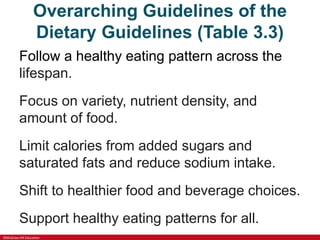
Overarching Guidelines of the
Dietary Guidelines (Table 3.3)
Follow a healthy eating pattern across the
lifespan.
Focus on variety, nutrient density, and
amount of food.
Limit calories from added sugars and
saturated fats and reduce sodium intake.
Shift to healthier food and beverage choices.
Support healthy eating patterns for all.
©McGraw-Hill Education
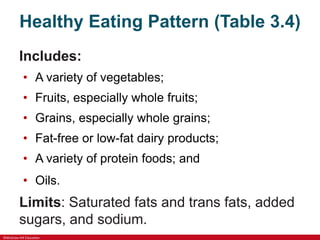
Healthy Eating Pattern (Table 3.4)
Includes:
• A variety of vegetables;
• Fruits, especially whole fruits;
• Grains, especially whole grains;
• Fat-free or low-fat dairy products;
• A variety of protein foods; and
• Oils.
Limits: Saturated fats and trans fats, added
sugars, and sodium.
©McGraw-Hill Education
Focus on Variety, Nutrient Density,
and Amount of Food1
To meet nutrient needs within calorie limits, choose
a variety of nutrient-dense foods from all food
groups and consume recommended amounts.
Consume a variety of vegetables from all
subgroups, including dark green, red, and orange,
legumes (beans and peas), starchy, and other
vegetables.
Consume a variety of fruits, especially whole fruits.
Consume grains, at least half of which are whole
grains.
©McGraw-Hill Education
Focus on Variety, Nutrient Density,
and Amount of Food2
Consume fat-free or low-fat dairy foods, including
milk, yogurt, cheese, and/or fortified soy products.
Eat a variety of protein foods, including seafood,
lean meats and poultry, eggs, legumes, nuts, seeds,
and soy products.
Consume oils or cook with oils.
©McGraw-Hill Education
Limit Calories from Added Sugars and
Saturated Fats and Reduce Sodium Intake
Consume less than 10% of daily calories
from added sugars.
Consume less than 10% of daily calories
from saturated fats.
Consume less than 2300 mg of sodium per
day.
©McGraw-Hill Education
Specific Population Groups
Women who are capable of becoming pregnant, are
pregnant, or are breastfeeding:
• Consume 8 to 12 ounces of seafood per week from a
variety of seafood types.
• Do not eat certain large fish, including shark, swordfish, and king
mackerel (possible sources of toxic methylmercury).
• Consume iron-rich foods or take an iron supplement (if
recommended by qualified health care provider). Iron is a
ā€œnutrient of public health concernā€ for pregnant females.
• Do not consume alcohol.
• To reduce the risk of birth defects, women who are
capable of becoming pregnant should obtain 400 mcg of
folic acid each day.
©McGraw-Hill Education
Selected Messages from the 2015-2020
Dietary Guidelines for Americans
Consume more nutrient-dense vegetables.
Choose lower fat versions of milk, yogurt, and
cheese.
Drink water instead of sugary drinks.
Achieve or maintain a healthy body weight.
See Table 3.5 for additional messages.
©McGraw-Hill Education
Section 3.4 Food Guides
Learning Outcomes
• Use MyPlate to develop nutritionally adequate
daily menus.
• Compare MyPlate with the Exchange System.
©McGraw-Hill Education
MyPlate
Most current U.S. Department of Agriculture
(USDA) food guide is MyPlate
(www.choosemyplate.gov)
• Includes a variety of food, nutrition, and physical
activity resources based on the recommendations
of the Dietary Guidelines
• Focuses on five food groups: fruits, vegetables,
protein foods, grains, and dairy
• No ā€œfats and oilsā€ group is included, but USDA
recognizes that consuming some fat is essential for
good health.
©McGraw-Hill Education
Using MyPlate for Menu Planning
MyPlate has 12 different healthy daily food patterns
that range from 1000 to 3200 kcal.
• Can be individualized
Each daily food pattern has some kilocalories that
remain after all of the recommended nutrient-dense
foods (and fats & oils) are eaten.
• In the 2000 kcal dietary pattern, for example, there are
270 kcal that remain.
• You can ā€œspendā€ your remaining calories by eating foods
that contain a lot of empty calories or more healthy,
nutrient-dense foods.
©McGraw-Hill Education
Other Food Guides
Latin American Diet Pyramid
Mediterranean Diet Pyramid
Asian Diet Pyramid
Eating Well with Canada’s Food Guide
©McGraw-Hill Education
Do Americans Follow Dietary
Recommendations?
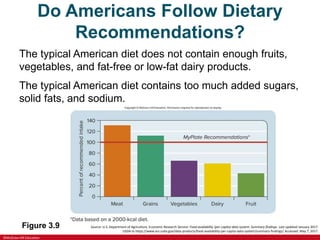
The typical American diet does not contain enough fruits,
vegetables, and fat-free or low-fat dairy products.
The typical American diet contains too much added sugars,
solid fats, and sodium.
Figure 3.9 Source: U.S. Department of Agriculture, Economic Research Service: Food availability (per capita) data system: Summary findings. Last updated January 2017.
USDA to https://www.ers.usda.gov/data-products/food-availability-per-capita-data-system/summary-findings/ Accessed: May 7, 2017.
©McGraw-Hill Education
What Is the Exchange System?
Meal planning technique that categorizes foods
into 3 food groups:
• Carbohydrates
• Meat & meat substitutes
• Fats
Each group has exchange lists for menu planning.
The lists can be useful for people with diabetes or
trying to lose weight.
However, ā€œcarbohydrate countingā€ has become
a more popular menu planning tool than using the
exchange lists.
©McGraw-Hill Education
Section 3.5 Food and Dietary
Supplement Labels
Learning Outcomes
• Use the Nutrition Facts panel to make more
nutritious food choices.
• Identify nutrition-related claims the FDA allows
on food and dietary supplement labels.
©McGraw-Hill Education
Nutrition Facts Panels
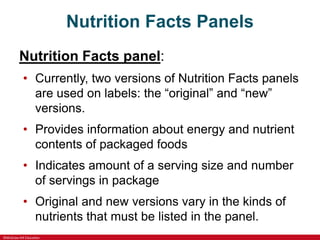
Nutrition Facts panel:
• Currently, two versions of Nutrition Facts panels
are used on labels: the ā€œoriginalā€ and ā€œnewā€
versions.
• Provides information about energy and nutrient
contents of packaged foods
• Indicates amount of a serving size and number
of servings in package
• Original and new versions vary in the kinds of
nutrients that must be listed in the panel.
©McGraw-Hill Education
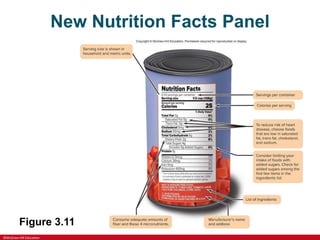
New Nutrition Facts Panel
Figure 3.11
©McGraw-Hill Education
Daily Values (DVs)
A set of nutrient intake standards developed for
labeling purposes (See Appendix B.)
A more simplified and practical set of nutrient
standards than RDAs
The adult DV for a nutrient is based RDA, AI, or
expert recommendations for a 2000 kcal/day diet.
Goals are to obtain at least 100% of the DV for
vitamins, minerals, and fiber each day, and limit
foods high in total fat, saturated fat, added
sugars, and sodium.
©McGraw-Hill Education
Health- and Nutrition-Related Claims
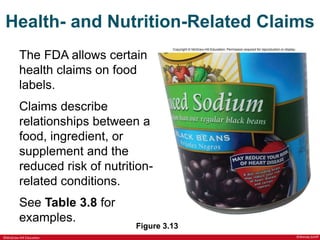
The FDA allows certain
health claims on food
labels.
Claims describe
relationships between a
food, ingredient, or
supplement and the
reduced risk of nutrition-
related conditions.
See Table 3.8 for
examples.
Figure 3.13
©Wendy Schiff
©McGraw-Hill Education
Health Claims
The health claim should:
• Indicate that the product has health benefits when part of
a healthy diet.
• Be complete, easy to understand, and honest.
• Refer to a product that contains 10% or more of the DV
before fortification.
• Be a product intended for people over age 2.
• Use may or might to describe the relationship between
product and disease.
• Not quantify degree of risk reduction.
• Indicate that many factors influence disease.
• See Table 3.8.
©McGraw-Hill Education
Structure/Function Claims
FDA allows certain structure/function claims
such as ā€œcalcium builds bonesā€ or ā€œfiber
maintains bowel regularity.ā€
Manufacturers cannot claim that a nutrient,
food, or dietary supplement prevents or
treats a serious health condition.
©McGraw-Hill Education
Descriptive Labeling Terms
Light or lite — compared to reference food:
• Has at least 1/3 fewer calories
• Contains at least 1/2 the fat of the reference food
• Light can also refer to texture or color.
• See Table 3.9.
As of November 2017, the term ā€œnaturalā€ could
be used on the label, if the food contains no:
• Food colorings,
• Synthetic flavors, and/or
• Other unnatural substances.
©McGraw-Hill Education
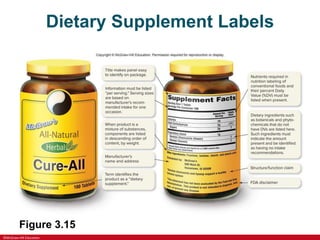
Dietary Supplement Labels
Figure 3.15
©McGraw-Hill Education
Section 3.6 Organic Food
Learning Outcomes
• Explain differences between the production of
organic foods and the production of
conventional foods.
• Discuss the USDA’s three labeling categories for
organic foods.
©McGraw-Hill Education
Organic Foods
Organic foods – produced without use of
antibiotics, hormones, synthetic fertilizers and
pesticides, genetic improvements, or
spoilage-killing radiation
Technical or chemical definition of ā€œorganicā€:
• Describes a substance that contains the element
carbon bonded to hydrogen (another element)
©McGraw-Hill Education
Comparing Farming Systems
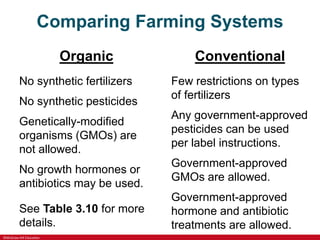
Organic
No synthetic fertilizers
No synthetic pesticides
Genetically-modified
organisms (GMOs) are
not allowed.
No growth hormones or
antibiotics may be used.
See Table 3.10 for more
details.
Conventional
Few restrictions on types
of fertilizers
Any government-approved
pesticides can be used
per label instructions.
Government-approved
GMOs are allowed.
Government-approved
hormone and antibiotic
treatments are allowed.
©McGraw-Hill Education
Organic Labeling Categories
ā€œ100% organicā€ (can use USDA’s organic
seal) contains all certified organic ingredients.
ā€œOrganicā€ (can use USDA’s organic seal)
contains at least 95% certified organic
ingredients
ā€œMade with organicā€¦ā€ (cannot use the
USDA’s organic seal) contains 70 to 95%
certified organic ingredients.
See Table 3.11 for more information.
©McGraw-Hill Education
Section 3.7 Using Dietary Analysis
Software
Learning Outcomes
• Explain why different dietary analysis software
programs may provide different values for energy
and nutrient contents for the same food item.
• Use the U.S. Department of Agriculture’s
websites to estimate the nutritional value of
various foods.
©McGraw-Hill Education
Dietary Analysis Software
Dietary analysis software and websites are
quick and easy tools to determine energy and
nutrient contents in commonly eaten foods.
• Dietary analysis software programs
• USDA website:
• ā€œWhat’s in the Food You Eat Search Toolā€
©McGraw-Hill Education
Section 3.8 Nutrition Matters: The
Melting Pot
Learning Outcomes
• Discuss how various ethnic and religious groups
influence Americans’ dietary patterns.
• Identify religion-based dietary restrictions.
©McGraw-Hill Education
Northwestern European and
Hispanic Influences
Northwestern European Influences
• Includes UK, Scandinavia, & Germany
• Traditional diet: large portions of beef or pork with
potatoes
Hispanic Influences
• Spanish or Mexican ancestry
• Traditional Mexican diet: corn, beans, chili pepper,
avocado, papaya, and pineapple
• See Figure 3.18.
©McGraw-Hill Education
Mediterranean and African Heritage
Influences
Italian or Other Mediterranean Influences
• Traditional diet: pasta and other grains, olive oil,
fish, and nuts
• See Figure 3.19.
African Heritage (Traditional)
• Sweet potato pie, fried chicken, black-eyed
peas, and greens cooked with smoked pork.
©McGraw-Hill Education
Asian and Native American
Influences
Asian Influences
• China, Japan, Vietnam, Thailand, and Korea
• Traditional diet: large amounts of vegetables,
rice, and noodles with small amounts of meat,
fish, or shellfish
• See Figure 3.20.
Native American Influences
• Traditional native foods: wild game and
vegetable crops (corn, tomatoes, and squash)
©McGraw-Hill Education
Religious Influences and
Food Choices
Many religions have extensive rules that
govern food and beverage choices, including
restricted or prohibited items; food preparation
methods; and other food-related practices,
such as fasting.
• See Table 3.12 for some specific dietary rules of
several major religions.

Chapter 3 Planning a Nutritious Diet

  • 1.
    Nutrition For Healthy Living FifthEdition Wendy J. Schiff, MS, RDN See separate PowerPoint slides for all figures and tables pre-inserted into PowerPoint without notes. ©McGraw-Hill Education. All rights reserved. Authorized only for instructor use in the classroom. No reproduction or further distribution permitted without the prior written consent of McGraw-Hill Education.
  • 2.
    ©McGraw-Hill Education Chapter 3 PlanningNutritious Diets Lecture Outline
  • 3.
    Ā©McGraw-Hill Education Quiz Yourself Trueor False1 1. According to the latest U.S. Department of Agriculture food guide, fruits and vegetables are combined into one food group. True or false? 2. According to the recommendations of the 2015-2020 Dietary Guidelines for Americans, it is acceptable for certain adults to consume alcoholic beverages in moderation. True or false? 3. Last week, Colin didn’t consume the recommended amount of vitamin C for a couple of days. Nevertheless, he is unlikely to develop scurvy, the vitamin C deficiency disease. True or false?
  • 4.
    ©McGraw-Hill Education Quiz Yourself Trueor False2 4. The Food and Drug Administration develops Dietary Guidelines for Americans. True or false? 5. The Nutrition Facts panel on a food label provides information concerning amounts of energy, fiber, and sodium that are in a serving of the food. True or false?
  • 5.
    ©McGraw-Hill Education How DidYou Do?1 1. False According to the latest USDA food guide, fruits and vegetables are two separate food groups. 2. True According to the 2015-2020 Dietary Guidelines for Americans, it is acceptable for certain adults to consume moderate amounts of alcoholic beverages. 3. True Consuming less than the recommended amount of the vitamin for a few days is unlikely to cause scurvy in a healthy person.
  • 6.
    ©McGraw-Hill Education How DidYou Do?2 4. False The Food and Drug Administration does not develop the Dietary Guidelines for Americans, they are developed by the U.S. Departments of Health and Human Services and Agriculture. 5. True The Nutrition Facts panel on a food label provides information concerning amounts of energy, fiber, and sodium that are in a serving of food.
  • 7.
    Ā©McGraw-Hill Education Section 3.1From Requirements to Standards Learning Outcomes • Explain the difference between a dietary requirement and a dietary allowance. • Identify the various dietary standards and explain how they can be used.
  • 8.
    Ā©McGraw-Hill Education What Isa Nutrient Requirement? Requirement : smallest amount of a nutrient that maintains a defined level of nutritional health • The required amount is generally enough to cure or prevent the nutrient’s deficiency disease. • Many factors influence a person’s nutrient requirements including age, sex, general health status, physical activity level, and the use of medication and drugs.
  • 9.
    ©McGraw-Hill Education Dietary ReferenceIntakes (DRIs) The DRIs are a variety of energy and nutrient intake standards that nutrition experts in the U.S. use as references when making dietary recommendations. Figure 3.1 ©Ryan McVay/Getty Images RF
  • 10.
    ©McGraw-Hill Education DRIs: Summary1 EAR(Estimated Average Requirement): daily amount of a nutrient that meets the needs of 50% of healthy people who are in a particular life stage/sex group EER (Estimated Energy Requirement): average daily energy intake that meets needs of a healthy person who is maintaining his/her weight RDA (Recommended Dietary Allowance): standards for recommended daily intakes of several nutrients that meet the nutrient needs of nearly all (approximately 98%) of healthy people
  • 11.
    ©McGraw-Hill Education DRIs: Summary2 AI(Adequate Intake): dietary recommendations for nutrients that scientists do not have enough information to establish RDA UL (Tolerable Upper Intake Level [Upper Level]): highest average amount of a nutrient that is unlikely to be harmful when consumed daily
  • 12.
    Ā©McGraw-Hill Education How RDAsAre Established Scientists add a margin of safety amount to the EAR that allows for individual variation in nutrient needs. • As a result, a nutrient’s RDA is high enough to meet or exceed the needs of 97-98% of healthy people. Figure 3.2
  • 13.
  • 14.
    Ā©McGraw-Hill Education Applying NutrientStandards Nutrient standards are used to: • Plan nutritious diets for groups of people • Evaluate nutritional adequacy of population’s diet* • Develop certain food products • Provide standards for nutritional labeling purposes (Daily Values) *DRIs are often used to evaluate individual diets.
  • 15.
    Ā©McGraw-Hill Education Section 3.2Major Food Groups Learning Outcome • List major food groups, and identify foods that are typically classified in each group.
  • 16.
    Ā©McGraw-Hill Education Major FoodGroups In general, foods are grouped according to natural origins & key nutrients: Five general groups: • Grains • Dairy • Protein-rich foods • Fruits • Vegetables
  • 17.
    Ā©McGraw-Hill Education Grains This groupincludes products made from wheat, rice, and oats. Primary macronutrients are carbohydrate and protein. Refined grain products often undergo: • Enrichment: replacement of some nutrients that were lost during processing. • Enriched grains have specific amounts of iron and 4 B vitamins added to them. • Fortification: addition of any nutrient to a food to boost its level of the nutrient Whole grains provide more fiber and micronutrients than refined grains.
  • 18.
    ©McGraw-Hill Education Dairy This groupincludes milk, and products made from milk, that retain much of their calcium content after processing. Dairy products are excellent sources of calcium, protein, phosphorus, and riboflavin. Cream cheese, cream, and butter are NOT included because they contain little or no calcium and are high in fat.
  • 19.
    ©McGraw-Hill Education Protein-Rich Foods Thisgroup includes beef, pork, lamb, fish, shellfish, liver, and poultry. Dry beans & peas, eggs, nuts, and seeds are included with this group because these protein-rich foods can substitute for meats. Protein-rich foods are excellent sources of iron, zinc, & B vitamins.
  • 20.
    ©McGraw-Hill Education Fruits Includes fresh,dried, frozen, sauced, canned fruit, and 100% juice In general, fruits are good sources of phytochemicals, potassium, folate, and vitamin C. Whole or cut-up fruits provide more fiber than juices.
  • 21.
    ©McGraw-Hill Education Vegetables Includes fresh,cooked, canned, frozen, and dried/dehydrated vegetables, and 100% vegetable juice Some guides include dry beans and peas with vegetables. Vegetables are good sources of micronutrients, fiber, and phytochemicals.
  • 22.
    Ā©McGraw-Hill Education Other Foods Foodguides may have a group for oils. Oils are often good sources of fat-soluble vitamins. Some guides group foods that are high in ā€œhealthy fatsā€ together. Such foods include fatty fish, peanuts, walnuts, sunflower seeds, avocados, and olives. Guides may also group foods that are high in empty calories (added sugars and unhealthy solid fats) together. • Solid fats include beef fat, butter fat, stick margarine, and shortening. Solid fats are sources of ā€œunhealthyā€ saturated fat.
  • 23.
    Ā©McGraw-Hill Education Section 3.3Dietary Guidelines Learning Outcomes • List at least four overarching guidelines of 2015- 2020 Dietary Guidelines for Americans, and provide recommendations of each one. • Identify features of a healthy eating pattern. • Apply the Dietary Guidelines to improve the nutritional quality of diets.
  • 24.
    ©McGraw-Hill Education Overarching Guidelinesof the Dietary Guidelines (Table 3.3) Follow a healthy eating pattern across the lifespan. Focus on variety, nutrient density, and amount of food. Limit calories from added sugars and saturated fats and reduce sodium intake. Shift to healthier food and beverage choices. Support healthy eating patterns for all.
  • 25.
    Ā©McGraw-Hill Education Healthy EatingPattern (Table 3.4) Includes: • A variety of vegetables; • Fruits, especially whole fruits; • Grains, especially whole grains; • Fat-free or low-fat dairy products; • A variety of protein foods; and • Oils. Limits: Saturated fats and trans fats, added sugars, and sodium.
  • 26.
    ©McGraw-Hill Education Focus onVariety, Nutrient Density, and Amount of Food1 To meet nutrient needs within calorie limits, choose a variety of nutrient-dense foods from all food groups and consume recommended amounts. Consume a variety of vegetables from all subgroups, including dark green, red, and orange, legumes (beans and peas), starchy, and other vegetables. Consume a variety of fruits, especially whole fruits. Consume grains, at least half of which are whole grains.
  • 27.
    ©McGraw-Hill Education Focus onVariety, Nutrient Density, and Amount of Food2 Consume fat-free or low-fat dairy foods, including milk, yogurt, cheese, and/or fortified soy products. Eat a variety of protein foods, including seafood, lean meats and poultry, eggs, legumes, nuts, seeds, and soy products. Consume oils or cook with oils.
  • 28.
    ©McGraw-Hill Education Limit Caloriesfrom Added Sugars and Saturated Fats and Reduce Sodium Intake Consume less than 10% of daily calories from added sugars. Consume less than 10% of daily calories from saturated fats. Consume less than 2300 mg of sodium per day.
  • 29.
    Ā©McGraw-Hill Education Specific PopulationGroups Women who are capable of becoming pregnant, are pregnant, or are breastfeeding: • Consume 8 to 12 ounces of seafood per week from a variety of seafood types. • Do not eat certain large fish, including shark, swordfish, and king mackerel (possible sources of toxic methylmercury). • Consume iron-rich foods or take an iron supplement (if recommended by qualified health care provider). Iron is a ā€œnutrient of public health concernā€ for pregnant females. • Do not consume alcohol. • To reduce the risk of birth defects, women who are capable of becoming pregnant should obtain 400 mcg of folic acid each day.
  • 30.
    ©McGraw-Hill Education Selected Messagesfrom the 2015-2020 Dietary Guidelines for Americans Consume more nutrient-dense vegetables. Choose lower fat versions of milk, yogurt, and cheese. Drink water instead of sugary drinks. Achieve or maintain a healthy body weight. See Table 3.5 for additional messages.
  • 31.
    Ā©McGraw-Hill Education Section 3.4Food Guides Learning Outcomes • Use MyPlate to develop nutritionally adequate daily menus. • Compare MyPlate with the Exchange System.
  • 32.
    Ā©McGraw-Hill Education MyPlate Most currentU.S. Department of Agriculture (USDA) food guide is MyPlate (www.choosemyplate.gov) • Includes a variety of food, nutrition, and physical activity resources based on the recommendations of the Dietary Guidelines • Focuses on five food groups: fruits, vegetables, protein foods, grains, and dairy • No ā€œfats and oilsā€ group is included, but USDA recognizes that consuming some fat is essential for good health.
  • 33.
    Ā©McGraw-Hill Education Using MyPlatefor Menu Planning MyPlate has 12 different healthy daily food patterns that range from 1000 to 3200 kcal. • Can be individualized Each daily food pattern has some kilocalories that remain after all of the recommended nutrient-dense foods (and fats & oils) are eaten. • In the 2000 kcal dietary pattern, for example, there are 270 kcal that remain. • You can ā€œspendā€ your remaining calories by eating foods that contain a lot of empty calories or more healthy, nutrient-dense foods.
  • 34.
    Ā©McGraw-Hill Education Other FoodGuides Latin American Diet Pyramid Mediterranean Diet Pyramid Asian Diet Pyramid Eating Well with Canada’s Food Guide
  • 35.
    ©McGraw-Hill Education Do AmericansFollow Dietary Recommendations? The typical American diet does not contain enough fruits, vegetables, and fat-free or low-fat dairy products. The typical American diet contains too much added sugars, solid fats, and sodium. Figure 3.9 Source: U.S. Department of Agriculture, Economic Research Service: Food availability (per capita) data system: Summary findings. Last updated January 2017. USDA to https://www.ers.usda.gov/data-products/food-availability-per-capita-data-system/summary-findings/ Accessed: May 7, 2017.
  • 36.
    Ā©McGraw-Hill Education What Isthe Exchange System? Meal planning technique that categorizes foods into 3 food groups: • Carbohydrates • Meat & meat substitutes • Fats Each group has exchange lists for menu planning. The lists can be useful for people with diabetes or trying to lose weight. However, ā€œcarbohydrate countingā€ has become a more popular menu planning tool than using the exchange lists.
  • 37.
    Ā©McGraw-Hill Education Section 3.5Food and Dietary Supplement Labels Learning Outcomes • Use the Nutrition Facts panel to make more nutritious food choices. • Identify nutrition-related claims the FDA allows on food and dietary supplement labels.
  • 38.
    Ā©McGraw-Hill Education Nutrition FactsPanels Nutrition Facts panel: • Currently, two versions of Nutrition Facts panels are used on labels: the ā€œoriginalā€ and ā€œnewā€ versions. • Provides information about energy and nutrient contents of packaged foods • Indicates amount of a serving size and number of servings in package • Original and new versions vary in the kinds of nutrients that must be listed in the panel.
  • 39.
  • 40.
    ©McGraw-Hill Education Daily Values(DVs) A set of nutrient intake standards developed for labeling purposes (See Appendix B.) A more simplified and practical set of nutrient standards than RDAs The adult DV for a nutrient is based RDA, AI, or expert recommendations for a 2000 kcal/day diet. Goals are to obtain at least 100% of the DV for vitamins, minerals, and fiber each day, and limit foods high in total fat, saturated fat, added sugars, and sodium.
  • 41.
    ©McGraw-Hill Education Health- andNutrition-Related Claims The FDA allows certain health claims on food labels. Claims describe relationships between a food, ingredient, or supplement and the reduced risk of nutrition- related conditions. See Table 3.8 for examples. Figure 3.13 ©Wendy Schiff
  • 42.
    Ā©McGraw-Hill Education Health Claims Thehealth claim should: • Indicate that the product has health benefits when part of a healthy diet. • Be complete, easy to understand, and honest. • Refer to a product that contains 10% or more of the DV before fortification. • Be a product intended for people over age 2. • Use may or might to describe the relationship between product and disease. • Not quantify degree of risk reduction. • Indicate that many factors influence disease. • See Table 3.8.
  • 43.
    Ā©McGraw-Hill Education Structure/Function Claims FDAallows certain structure/function claims such as ā€œcalcium builds bonesā€ or ā€œfiber maintains bowel regularity.ā€ Manufacturers cannot claim that a nutrient, food, or dietary supplement prevents or treats a serious health condition.
  • 44.
    Ā©McGraw-Hill Education Descriptive LabelingTerms Light or lite — compared to reference food: • Has at least 1/3 fewer calories • Contains at least 1/2 the fat of the reference food • Light can also refer to texture or color. • See Table 3.9. As of November 2017, the term ā€œnaturalā€ could be used on the label, if the food contains no: • Food colorings, • Synthetic flavors, and/or • Other unnatural substances.
  • 45.
  • 46.
    Ā©McGraw-Hill Education Section 3.6Organic Food Learning Outcomes • Explain differences between the production of organic foods and the production of conventional foods. • Discuss the USDA’s three labeling categories for organic foods.
  • 47.
    Ā©McGraw-Hill Education Organic Foods Organicfoods – produced without use of antibiotics, hormones, synthetic fertilizers and pesticides, genetic improvements, or spoilage-killing radiation Technical or chemical definition of ā€œorganicā€: • Describes a substance that contains the element carbon bonded to hydrogen (another element)
  • 48.
    ©McGraw-Hill Education Comparing FarmingSystems Organic No synthetic fertilizers No synthetic pesticides Genetically-modified organisms (GMOs) are not allowed. No growth hormones or antibiotics may be used. See Table 3.10 for more details. Conventional Few restrictions on types of fertilizers Any government-approved pesticides can be used per label instructions. Government-approved GMOs are allowed. Government-approved hormone and antibiotic treatments are allowed.
  • 49.
    Ā©McGraw-Hill Education Organic LabelingCategories ā€œ100% organicā€ (can use USDA’s organic seal) contains all certified organic ingredients. ā€œOrganicā€ (can use USDA’s organic seal) contains at least 95% certified organic ingredients ā€œMade with organicā€¦ā€ (cannot use the USDA’s organic seal) contains 70 to 95% certified organic ingredients. See Table 3.11 for more information.
  • 50.
    Ā©McGraw-Hill Education Section 3.7Using Dietary Analysis Software Learning Outcomes • Explain why different dietary analysis software programs may provide different values for energy and nutrient contents for the same food item. • Use the U.S. Department of Agriculture’s websites to estimate the nutritional value of various foods.
  • 51.
    Ā©McGraw-Hill Education Dietary AnalysisSoftware Dietary analysis software and websites are quick and easy tools to determine energy and nutrient contents in commonly eaten foods. • Dietary analysis software programs • USDA website: • ā€œWhat’s in the Food You Eat Search Toolā€
  • 52.
    Ā©McGraw-Hill Education Section 3.8Nutrition Matters: The Melting Pot Learning Outcomes • Discuss how various ethnic and religious groups influence Americans’ dietary patterns. • Identify religion-based dietary restrictions.
  • 53.
    Ā©McGraw-Hill Education Northwestern Europeanand Hispanic Influences Northwestern European Influences • Includes UK, Scandinavia, & Germany • Traditional diet: large portions of beef or pork with potatoes Hispanic Influences • Spanish or Mexican ancestry • Traditional Mexican diet: corn, beans, chili pepper, avocado, papaya, and pineapple • See Figure 3.18.
  • 54.
    Ā©McGraw-Hill Education Mediterranean andAfrican Heritage Influences Italian or Other Mediterranean Influences • Traditional diet: pasta and other grains, olive oil, fish, and nuts • See Figure 3.19. African Heritage (Traditional) • Sweet potato pie, fried chicken, black-eyed peas, and greens cooked with smoked pork.
  • 55.
    Ā©McGraw-Hill Education Asian andNative American Influences Asian Influences • China, Japan, Vietnam, Thailand, and Korea • Traditional diet: large amounts of vegetables, rice, and noodles with small amounts of meat, fish, or shellfish • See Figure 3.20. Native American Influences • Traditional native foods: wild game and vegetable crops (corn, tomatoes, and squash)
  • 56.
    Ā©McGraw-Hill Education Religious Influencesand Food Choices Many religions have extensive rules that govern food and beverage choices, including restricted or prohibited items; food preparation methods; and other food-related practices, such as fasting. • See Table 3.12 for some specific dietary rules of several major religions.