Copyright © 2015 Pearson Education, Inc. 5-1
Chapter 3
International Trade
and Factor-Mobility
Theory
Copyright © 2015 Pearson Education, Inc. 5-2
Introduction
Learning Objective:
Understand how different approaches to
international trade theories help policy
makers achieve economic objectives
Copyright © 2015 Pearson Education, Inc. 5-3
Laissez-Faire vs. Intervention
 Trade theory helps answer
 What products should we import and export?
 How much should we trade?
 With whom should we trade?
 Laissez-faire approach
 Free trade theories – absolute advantage and
comparative advantage
 Intervention approach
 Mercantilism and neomercantilism
Copyright © 2015 Pearson Education, Inc. 5-4
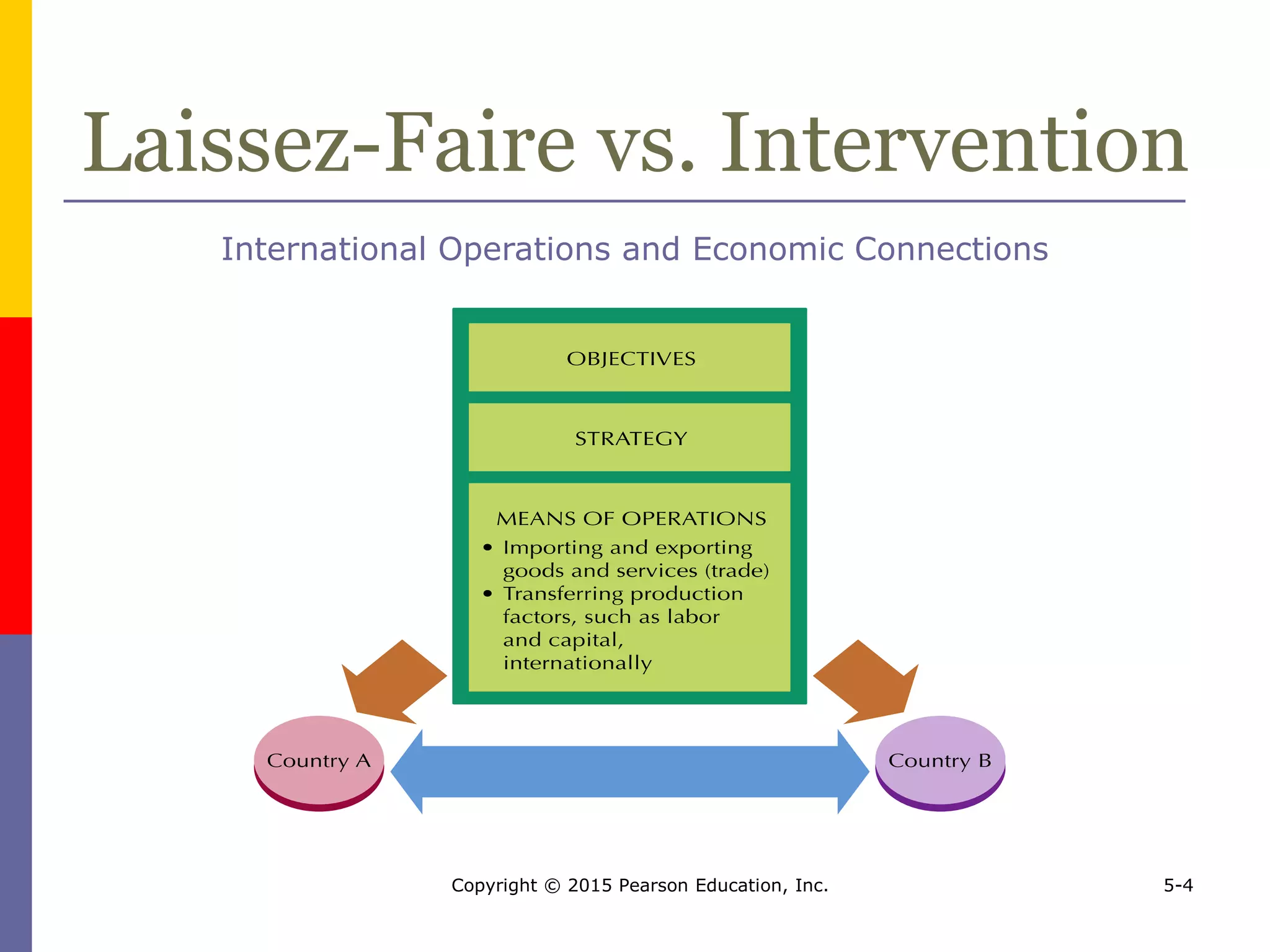
Laissez-Faire vs. Intervention
International Operations and Economic Connections
Copyright © 2015 Pearson Education, Inc. 5-5
Theories of Trade Patterns
 Theories explore
 country size
 factor proportions
 country similarity
 Theories explore trade competitiveness
 Product life cycle
 Diamond of national advantage
Copyright © 2015 Pearson Education, Inc. 5-6
Trade Theories and Business
What Major Trade Theories Do and Don’t Discuss: A Checklist
Copyright © 2015 Pearson Education, Inc. 5-7
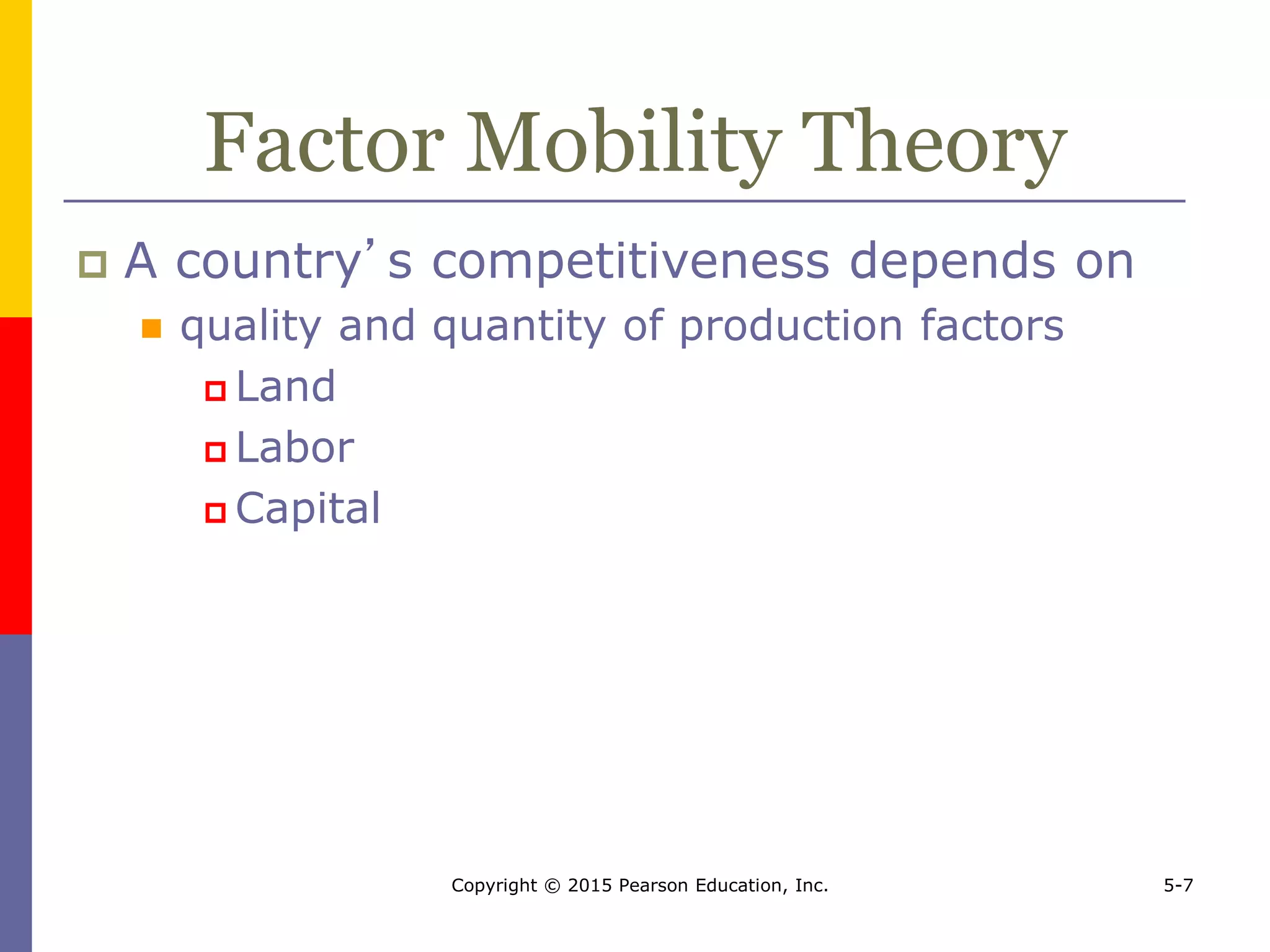
Factor Mobility Theory
 A country’s competitiveness depends on
 quality and quantity of production factors
 Land
 Labor
 Capital
Copyright © 2015 Pearson Education, Inc. 5-8
Interventionist Theories
 Theories that support government
intervention in the flow of trade
 Mercantilism
 Neomercantilism
Copyright © 2015 Pearson Education, Inc. 5-9
Mercantilism
 Mercantilism countries should export
more than they import
 Maintain a favorable balance of trade
 trade surplus
 Avoid an unfavorable balance of trade
 trade deficit
Copyright © 2015 Pearson Education, Inc. 5-10
Neomercantilism
 Neomercantilism run an export surplus
to achieve social or political objectives
Copyright © 2015 Pearson Education, Inc. 5-11
Free Trade Theories
 Two theories that support free trade
 Absolute advantage theory
 Comparative advantage theory
 Market forces should determine trade
 specialization
Copyright © 2015 Pearson Education, Inc. 5-12
Theory of Absolute Advantage
 Theory of absolute advantage
 different countries produce some goods more
efficiently than others
 Free trade brings
 Specialization
 natural advantage
 acquired advantage
 product technology
 process technology
 Greater efficiency
 Higher global output
Copyright © 2015 Pearson Education, Inc. 5-13
Trade Pattern Theories
Learning Objective:
Distinguish factors affecting national trade
patterns
Copyright © 2015 Pearson Education, Inc. 5-14
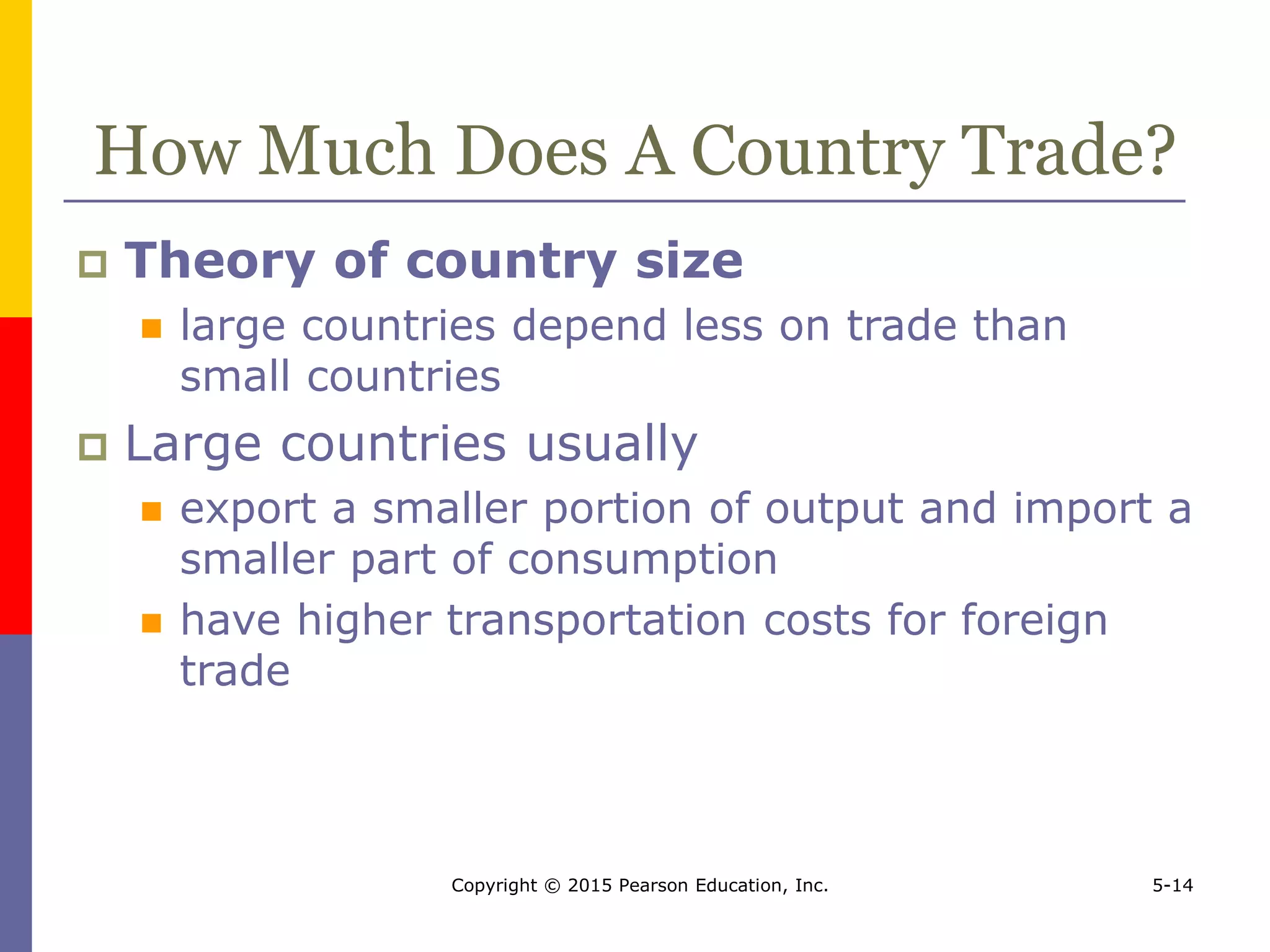
How Much Does A Country Trade?
 Theory of country size
 large countries depend less on trade than
small countries
 Large countries usually
 export a smaller portion of output and import a
smaller part of consumption
 have higher transportation costs for foreign
trade
Copyright © 2015 Pearson Education, Inc. 5-15
What Types of Products Does A
Country Trade?
 Factor proportions theory
 factors in relative abundance are cheaper than
factors that are relatively scarce
 But
 production factors are not homogenous
 labor
 Process technology
 capital versus labor
Copyright © 2015 Pearson Education, Inc. 5-16
What Does A Country Trade?
Worldwide Trade by Major Sectors
Copyright © 2015 Pearson Education, Inc. 5-17
With Whom Do Countries Trade?
 Country similarity theory
 most trade occurs among developed countries
 share similar market characteristics
 produce and consume much more than
developing countries
 Trading partners are affected by
 Cultural similarity
 Political relations between countries
 Distance
Copyright © 2015 Pearson Education, Inc. 5-18
The Statics and
Dynamics of Trade
Learning Objective:
Recognize why a country’s export
capabilities are dynamic
Copyright © 2015 Pearson Education, Inc. 5-19
Product Life Cycle Theory
 The product life cycle theory
 the production location of certain
manufactured products shifts as they go
through their life cycle
 Four stages
 Introduction
 Growth
 Maturity
 Decline
Copyright © 2015 Pearson Education, Inc. 5-20
Product Life Cycle Theory
Life Cycle of the International Product
Copyright © 2015 Pearson Education, Inc. 5-21
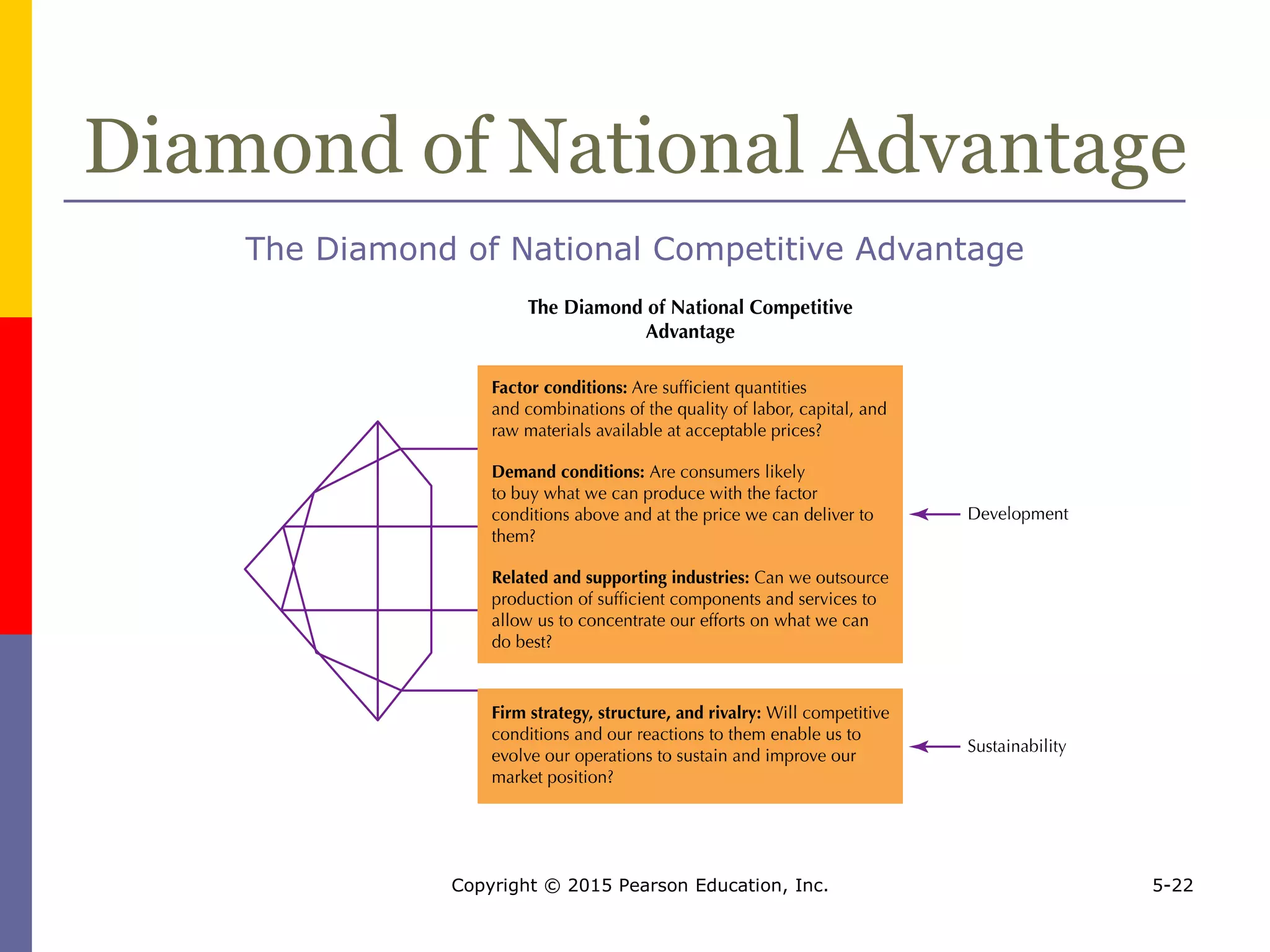
Diamond of National Advantage
 The diamond of national advantage
 Four conditions are important for gaining and
maintaining competitive superiority
 Factor conditions
 Demand conditions
 Related and supporting industries
 Firm strategy, structure, and rivalry
Copyright © 2015 Pearson Education, Inc. 5-22
Diamond of National Advantage
The Diamond of National Competitive Advantage
Copyright © 2015 Pearson Education, Inc. 5-23
Factor Mobility Theory
Learning Objective:
Detect why production factors, especially
labor and capital, move internationally
Copyright © 2015 Pearson Education, Inc. 5-24
Why Production Factors Move
 Factor mobility theory
 focuses on why production factors move, the
effects of that movement on transforming
factor endowments, and the impact of
international factor mobility on world trade
 Capital and labor move internationally to
 gain more income
 flee adverse political situations
Copyright © 2015 Pearson Education, Inc. 5-25
Trade and Factor Mobility
Learning Objective:
Describe the relationship between foreign
trade and international factor mobility
Copyright © 2015 Pearson Education, Inc. 5-26
Trade and Factor Mobility
 There are pressures for the most
abundant factors to move to areas of
scarcity
 The lowest costs occur when trade and
production factors are both mobile
Copyright © 2015 Pearson Education, Inc. 5-27
Trade and Factor Mobility
Unrestricted Trade, Factor Mobility, and the Cost of Tomatoes
Copyright © 2015 Pearson Education, Inc. 5-28
Trade and Factor Mobility
 Factor mobility through foreign investment
often stimulates trade because of
 the need for components
 the parent’s ability to sell complimentary
products
 the need for equipment for subsidiaries

CHAPTER 3 International Trade and Factor-Mobility Theory.ppt

  • 1.
    Copyright © 2015Pearson Education, Inc. 5-1 Chapter 3 International Trade and Factor-Mobility Theory
  • 2.
    Copyright © 2015Pearson Education, Inc. 5-2 Introduction Learning Objective: Understand how different approaches to international trade theories help policy makers achieve economic objectives
  • 3.
    Copyright © 2015Pearson Education, Inc. 5-3 Laissez-Faire vs. Intervention  Trade theory helps answer  What products should we import and export?  How much should we trade?  With whom should we trade?  Laissez-faire approach  Free trade theories – absolute advantage and comparative advantage  Intervention approach  Mercantilism and neomercantilism
  • 4.
    Copyright © 2015Pearson Education, Inc. 5-4 Laissez-Faire vs. Intervention International Operations and Economic Connections
  • 5.
    Copyright © 2015Pearson Education, Inc. 5-5 Theories of Trade Patterns  Theories explore  country size  factor proportions  country similarity  Theories explore trade competitiveness  Product life cycle  Diamond of national advantage
  • 6.
    Copyright © 2015Pearson Education, Inc. 5-6 Trade Theories and Business What Major Trade Theories Do and Don’t Discuss: A Checklist
  • 7.
    Copyright © 2015Pearson Education, Inc. 5-7 Factor Mobility Theory  A country’s competitiveness depends on  quality and quantity of production factors  Land  Labor  Capital
  • 8.
    Copyright © 2015Pearson Education, Inc. 5-8 Interventionist Theories  Theories that support government intervention in the flow of trade  Mercantilism  Neomercantilism
  • 9.
    Copyright © 2015Pearson Education, Inc. 5-9 Mercantilism  Mercantilism countries should export more than they import  Maintain a favorable balance of trade  trade surplus  Avoid an unfavorable balance of trade  trade deficit
  • 10.
    Copyright © 2015Pearson Education, Inc. 5-10 Neomercantilism  Neomercantilism run an export surplus to achieve social or political objectives
  • 11.
    Copyright © 2015Pearson Education, Inc. 5-11 Free Trade Theories  Two theories that support free trade  Absolute advantage theory  Comparative advantage theory  Market forces should determine trade  specialization
  • 12.
    Copyright © 2015Pearson Education, Inc. 5-12 Theory of Absolute Advantage  Theory of absolute advantage  different countries produce some goods more efficiently than others  Free trade brings  Specialization  natural advantage  acquired advantage  product technology  process technology  Greater efficiency  Higher global output
  • 13.
    Copyright © 2015Pearson Education, Inc. 5-13 Trade Pattern Theories Learning Objective: Distinguish factors affecting national trade patterns
  • 14.
    Copyright © 2015Pearson Education, Inc. 5-14 How Much Does A Country Trade?  Theory of country size  large countries depend less on trade than small countries  Large countries usually  export a smaller portion of output and import a smaller part of consumption  have higher transportation costs for foreign trade
  • 15.
    Copyright © 2015Pearson Education, Inc. 5-15 What Types of Products Does A Country Trade?  Factor proportions theory  factors in relative abundance are cheaper than factors that are relatively scarce  But  production factors are not homogenous  labor  Process technology  capital versus labor
  • 16.
    Copyright © 2015Pearson Education, Inc. 5-16 What Does A Country Trade? Worldwide Trade by Major Sectors
  • 17.
    Copyright © 2015Pearson Education, Inc. 5-17 With Whom Do Countries Trade?  Country similarity theory  most trade occurs among developed countries  share similar market characteristics  produce and consume much more than developing countries  Trading partners are affected by  Cultural similarity  Political relations between countries  Distance
  • 18.
    Copyright © 2015Pearson Education, Inc. 5-18 The Statics and Dynamics of Trade Learning Objective: Recognize why a country’s export capabilities are dynamic
  • 19.
    Copyright © 2015Pearson Education, Inc. 5-19 Product Life Cycle Theory  The product life cycle theory  the production location of certain manufactured products shifts as they go through their life cycle  Four stages  Introduction  Growth  Maturity  Decline
  • 20.
    Copyright © 2015Pearson Education, Inc. 5-20 Product Life Cycle Theory Life Cycle of the International Product
  • 21.
    Copyright © 2015Pearson Education, Inc. 5-21 Diamond of National Advantage  The diamond of national advantage  Four conditions are important for gaining and maintaining competitive superiority  Factor conditions  Demand conditions  Related and supporting industries  Firm strategy, structure, and rivalry
  • 22.
    Copyright © 2015Pearson Education, Inc. 5-22 Diamond of National Advantage The Diamond of National Competitive Advantage
  • 23.
    Copyright © 2015Pearson Education, Inc. 5-23 Factor Mobility Theory Learning Objective: Detect why production factors, especially labor and capital, move internationally
  • 24.
    Copyright © 2015Pearson Education, Inc. 5-24 Why Production Factors Move  Factor mobility theory  focuses on why production factors move, the effects of that movement on transforming factor endowments, and the impact of international factor mobility on world trade  Capital and labor move internationally to  gain more income  flee adverse political situations
  • 25.
    Copyright © 2015Pearson Education, Inc. 5-25 Trade and Factor Mobility Learning Objective: Describe the relationship between foreign trade and international factor mobility
  • 26.
    Copyright © 2015Pearson Education, Inc. 5-26 Trade and Factor Mobility  There are pressures for the most abundant factors to move to areas of scarcity  The lowest costs occur when trade and production factors are both mobile
  • 27.
    Copyright © 2015Pearson Education, Inc. 5-27 Trade and Factor Mobility Unrestricted Trade, Factor Mobility, and the Cost of Tomatoes
  • 28.
    Copyright © 2015Pearson Education, Inc. 5-28 Trade and Factor Mobility  Factor mobility through foreign investment often stimulates trade because of  the need for components  the parent’s ability to sell complimentary products  the need for equipment for subsidiaries