Chapter 3
1
Introduction to Artificial Intelligence
Objectives
 After completing this chapter, the students will be able to:
 Explain what artificial intelligence (AI) is
 Explain the types and approaches of AI
 Describe the applications of AI
 List the factors that influenced the advancement of AI
 Understand the relationship between the human’s way of
thinking and AI systems
 Identify AI research focus areas
 Identify real-world AI applications, some platforms, and
tools
2
3
Introduction to AI
3
What is Artificial Intelligence (AI)
 Artificial Intelligence is composed of two words Artificial and
Intelligence.
 Artificial defines "man-made," and intelligence defines "thinking
power", or “the ability to learn and solve problems” hence Artificial
Intelligence means "a man-made thinking power."
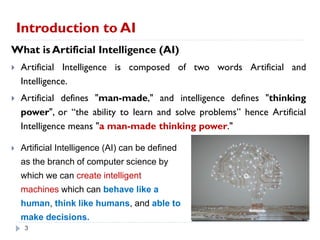
 Artificial Intelligence (AI) can be defined
as the branch of computer science by
which we can create intelligent
machines which can behave like a
human, think like humans, and able to
make decisions.
Cont’d
 Intelligence, is the ability to acquire and apply knowledge.
 Knowledge is the information acquired through experience.
 Experience is the knowledge gained through exposure (training)
 Summing the terms up, we get AI as the “copy of something
natural (i.e., human beings) ‘WHO’ is capable of acquiring and
applying the information it has gained through exposure.”
 AI exists when a machine can have human-based skills such as
learning, reasoning, and problem solving….etc.
 Intelligence is composed of: Reasoning, Learning, Problem
Solving, Perception, Linguistic Intelligence, and etc.
4
Cont’d
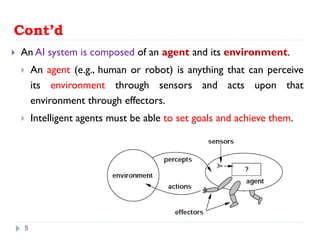
 An AI system is composed of an agent and its environment.
 An agent (e.g., human or robot) is anything that can perceive
its environment through sensors and acts upon that
environment through effectors.
 Intelligent agents must be able to set goals and achieve them.
5
Examples of AI
6
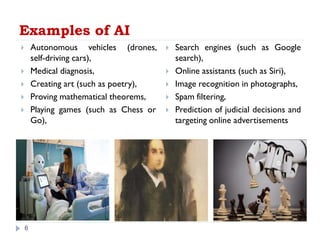
 Autonomous vehicles (drones,
self-driving cars),
 Medical diagnosis,
 Creating art (such as poetry),
 Proving mathematical theorems,
 Playing games (such as Chess or
Go),
 Search engines (such as Google
search),
 Online assistants (such as Siri),
 Image recognition in photographs,
 Spam filtering,
 Prediction of judicial decisions and
targeting online advertisements
Cont’d
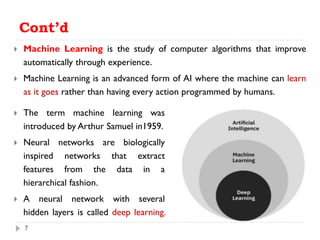
 Machine Learning is the study of computer algorithms that improve
automatically through experience.
 Machine Learning is an advanced form of AI where the machine can learn
as it goes rather than having every action programmed by humans.
7
 The term machine learning was
introduced by Arthur Samuel in1959.
 Neural networks are biologically
inspired networks that extract
features from the data in a
hierarchical fashion.
 A neural network with several
hidden layers is called deep learning.
Why we need AI?
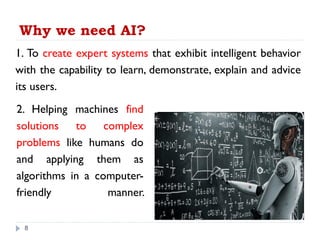
1. To create expert systems that exhibit intelligent behavior
with the capability to learn, demonstrate, explain and advice
its users.
8
2. Helping machines find
solutions to complex
problems like humans do
and applying them as
algorithms in a computer-
friendly manner.
Goals of Artificial Intelligence
The main goals of Artificial Intelligence are:
 Replicate human intelligence
 Solve Knowledge-intensive tasks
 An intelligent connection of perception and action
 Building a machine which can perform tasks that requires
human intelligence such as:
 Proving a theorem, playing chess, plan some surgical
operation, driving a car in traffic…etc.
 Creating some system which can exhibit intelligent
behavior, learn new things by itself, demonstrate, explain,
and can advise to its user.
9
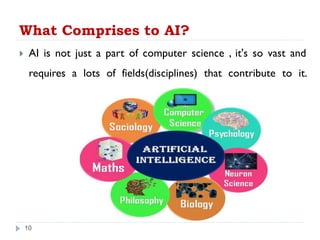
What Comprises to AI?
 AI is not just a part of computer science , it's so vast and
requires a lots of fields(disciplines) that contribute to it.
10
Advantages of Artificial Intelligence
 High Accuracy with fewer errors: AI machines or systems are
prone to fewer errors and high accuracy as it takes decisions as per
pre-experience or information.
 High-Speed: AI systems can be of very high-speed and fast-decision
making,
 High reliability: AI machines are highly reliable and can perform the
same action multiple times with high accuracy.
 Useful for risky areas: AI machines can be helpful in situations such
as defusing a bomb, exploring the ocean floor, where to employ a
human can be risky.
 Digital Assistant: AI can be very useful to provide digital assistant to
the users.
 Useful as a public utility: AI can be very useful for public utilities.
11
Disadvantages of Artificial Intelligence
 High Cost:The hardware and software requirement of AI is very costly.
 Can't think out of the box: AI machines cannot work out of the box,
they only do that work for which they are trained, or programmed.
 No feelings and emotions: AI machines does not have the feeling so it
cannot make any kind of emotional attachment with humans, and may
sometimes be harmful for users if the proper care is not taken.
 Increase dependence on machines: With the increment of technology,
people are getting more dependent on devices and hence they are losing
their mental capabilities.
 No Original Creativity: As humans are so creative and can imagine
some new ideas but still AI machines cannot beat this power of human
intelligence and cannot be creative and imaginative.
12
Reading Assignment
 History of AI
13
Levels of AI
Stage 1 – Rule-Based Systems
 A rule-based system is a system that applies human-made rules to
store, sort and manipulate data. They require a set of facts or source of data,
and a set of rules for manipulating that data.
 The most common uses of AI today fit in this bracket, covering everything
from business software (Robotic Process Automation) and domestic
appliances to aircraft autopilots.
Stage 2–Context Awareness and Retention
➢ Algorithms that develop information about the specific domain they are being
applied in.
➢ They are trained on the knowledge and experience of the best humans, and
their knowledge base can be updated as new situations and queries arise.
➢ Well known applications of this level are chatbots and “roboadvisors”.
14
Cont’d
Stage 3 – Domain-Specific Expertise
 By going beyond the capability of humans, these systems build up
expertise in a specific context taking in massive volumes of information
which they can use for decision making.
 Successful use cases have been seen in cancer diagnosis and the well-
known Google Deepmind’s AlphaGo.
Stage 4 – Reasoning Machines
 These algorithms have some ability to attribute mental states to
themselves and others
 They have a sense of beliefs, intentions, knowledge, and how their
own logic works. This means they could reason or negotiate with
humans and other machines.
 At the moment these algorithms are still in development
13
Cont’d
Stage 5 – Self Aware Systems / Artificial General Intelligence (AGI)
 These systems have human-like intelligence.
 The most commonly portrayed AI in media – however, no such use is
in evidence today.
 It is the goal of many working in AI and some believe it could be
realized already from 2024.
Stage 6 – Artificial Superintelligence (ASI)
 AI algorithms can outsmart even the most intelligent humans in every
domain.
 Examples would include solving problems we have failed to so far, such
as world hunger and dangerous environmental change.
16
Cont’d
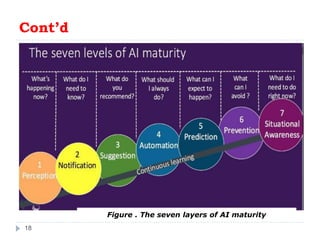
Stage 7 – Singularity andTranscendence.
 This is the idea that development provided by ASI (Stage 6) leads
to a massive expansion in human capability.
 Human augmentation could connect our brains to each
other and to a future successor of the current internet, creating a
“hive mind” that shares ideas, solves problems collectively, and
even gives others access to our dreams as observers or
participants.
 Some proponents of singularity, suggests that we could see it
happen by 2045, but others argues that singularity is impossible
and human consciousness could never be digitized.
17
18
Cont’d
Figure . The seven layers of AI maturity
Types of AI
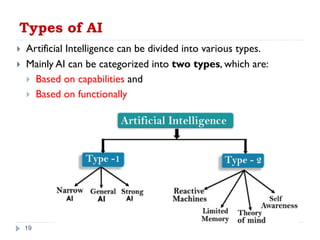
 Artificial Intelligence can be divided into various types.
 Mainly AI can be categorized into two types, which are:
 Based on capabilities and
 Based on functionally
19
A. Based on Capabilities(type-1)
1.Weak AI or Narrow AI:
 Narrow AI is a type of AI which is able to perform a dedicated task
with intelligence. It cannot perform beyond its field.
 It is the most common and currently available type of AI.
 Some Examples of Narrow AI are Google translate, playing chess,
purchasing suggestions on e-commerce sites, self-driving cars, speech
recognition, and image recognition
2. General AI:
 General AI is a type of intelligence that could perform any
intellectual task with efficiency like a human.
 The idea behind the general AI is to make a system that could be
smarter and think like a human on its own.
 Currently, a system which could come under general AI does not
exist.
20
Cont’d
3. Super AI:
 Super AI is a level of Intelligence of Systems at which machines could
surpass human intelligence, and can perform any task better than a
human with cognitive properties.
 This refers to aspects like general wisdom, problem solving and
creativity.
 It is an outcome of general AI.
 Some key characteristics of strong AI includes: the ability to think, to
reason solve the puzzle, make judgments, plan, learn, and
communicate on its own.
 Super AI is still a hypothetical concept of Artificial Intelligence.
21
B. Based on the functionality (type-2)
1. Reactive Machines
 Purely reactive machines are the most basic types of AI.
 Such AI systems do not store memories or past experiences for
future actions.
 These machines only focus on current scenarios and react on it as
per possible best action.
 Google's AlphaGo and IBM's Deep Blue system is an example of
reactive machines.
2. Limited Memory
 Limited memory machines can store past experiences or some
data for short (limited) period of time.
 Self-driving cars are one of the best examples of Limited Memory
systems.
22
Cont’d
3.Theory of Mind
 Theory of Mind AI should understand human emotions, people,
beliefs, and be able to interact socially like humans.
 This type of AI machines is still not developed.
4. Self-Awareness
 Self-awareness AI is the future of Artificial Intelligence.
 These machines will be super intelligent and will have their own
consciousness, sentiments, and self awareness.
 These machines will be smarter than the human mind.
 Self-Awareness AI does not exist in reality and it is a hypothetical
concept.
23
How does human being think ?
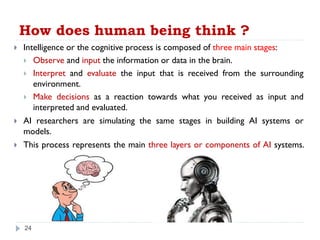
 Intelligence or the cognitive process is composed of three main stages:
 Observe and input the information or data in the brain.
 Interpret and evaluate the input that is received from the surrounding
environment.
 Make decisions as a reaction towards what you received as input and
interpreted and evaluated.
 AI researchers are simulating the same stages in building AI systems or
models.
 This process represents the main three layers or components of AI systems.
24
Mapping human thinking to AI Components
 Because AI is the science of simulating human thinking, it is possible to
map the human thinking stages to the layers or components of AI
systems.
 In the first stage:
 humans acquire information from their surrounding environments
through human senses.
 In AI models, this stage is represented by the sensing layer, which
perceives information from the surrounding environment.
 For example, there are sensing agents such as voice recognition for
sensing voice and visual imaging recognition for sensing images.
 Thus, these agents or sensors take the role of the hearing and sight
senses in humans.
25
Cont’d
 The second stage
 is related to interpreting and evaluating the input data.
 In AI, this stage is represented by the interpretation layer, that is,
reasoning and thinking about the gathered input that is acquired by
the sensing layer.
 The third stage
 is related to taking action or making decisions.
 After evaluating the input data, the interacting layer performs the
necessary tasks.
 Robotic movement control and speech generation are examples of
functions that are implemented in the interacting layer
26
Influencers of artificial intelligence
 Big data: Structured data versus unstructured data
 Advancements in computer processing speed and new chip
architectures
 Cloud computing and APIs
 The emergence of data science
27
Applications of AI
 Following are some sectors which have the application of Artificial
Intelligence:
 Agriculture
 Health
 Business (Emerging market)
 Education
 Finance and E-commerce
 Gaming
 Data Security
 Entertainment
 Social Media …etc.
28
AI tools and Platforms
 AI platforms are defined as some sort of hardware architecture
or software framework (including application frameworks), that
allows the software to run.
 Artificial intelligence (AI) platforms provide users a tool kit to
build intelligent applications.
 These platforms combine intelligent, decision-making algorithms
with data, which enables developers to create a business
solution.
29
Cont’d
 AI has developed a large number of tools to solve the most
difficult problems in computer science, like:
 Search and optimization
 Logic, Probabilistic methods for uncertain reasoning
 Classifiers and statistical learning methods
 Neural networks
 Control theory
 Languages
 The most common artificial intelligence platforms include:
 Microsoft AZURE Machine Learning,
 Google Cloud Prediction API,
 IBM Watson,
 TensorFlow etc.
30
Sample AI Application
31
 Commuting: e.g.. commercial Flights Use an AI Autopilot
 Email: e.g. Spam Filters
 Social Networking: e.g. Facebook - When you upload photos to
Facebook, the service automatically highlights faces and suggests
friends tag.
 Online Shopping: e.g. Recommendations - You see
recommendations for products you’re interested.
 Mobile Use: e.g.Voice-to-Text.
32

Chapter three - Artificial intelligence.pdf

  • 1.
    Chapter 3 1 Introduction toArtificial Intelligence
  • 2.
    Objectives  After completingthis chapter, the students will be able to:  Explain what artificial intelligence (AI) is  Explain the types and approaches of AI  Describe the applications of AI  List the factors that influenced the advancement of AI  Understand the relationship between the human’s way of thinking and AI systems  Identify AI research focus areas  Identify real-world AI applications, some platforms, and tools 2
  • 3.
    3 Introduction to AI 3 Whatis Artificial Intelligence (AI)  Artificial Intelligence is composed of two words Artificial and Intelligence.  Artificial defines "man-made," and intelligence defines "thinking power", or “the ability to learn and solve problems” hence Artificial Intelligence means "a man-made thinking power."  Artificial Intelligence (AI) can be defined as the branch of computer science by which we can create intelligent machines which can behave like a human, think like humans, and able to make decisions.
  • 4.
    Cont’d  Intelligence, isthe ability to acquire and apply knowledge.  Knowledge is the information acquired through experience.  Experience is the knowledge gained through exposure (training)  Summing the terms up, we get AI as the “copy of something natural (i.e., human beings) ‘WHO’ is capable of acquiring and applying the information it has gained through exposure.”  AI exists when a machine can have human-based skills such as learning, reasoning, and problem solving….etc.  Intelligence is composed of: Reasoning, Learning, Problem Solving, Perception, Linguistic Intelligence, and etc. 4
  • 5.
    Cont’d  An AIsystem is composed of an agent and its environment.  An agent (e.g., human or robot) is anything that can perceive its environment through sensors and acts upon that environment through effectors.  Intelligent agents must be able to set goals and achieve them. 5
  • 6.
    Examples of AI 6 Autonomous vehicles (drones, self-driving cars),  Medical diagnosis,  Creating art (such as poetry),  Proving mathematical theorems,  Playing games (such as Chess or Go),  Search engines (such as Google search),  Online assistants (such as Siri),  Image recognition in photographs,  Spam filtering,  Prediction of judicial decisions and targeting online advertisements
  • 7.
    Cont’d  Machine Learningis the study of computer algorithms that improve automatically through experience.  Machine Learning is an advanced form of AI where the machine can learn as it goes rather than having every action programmed by humans. 7  The term machine learning was introduced by Arthur Samuel in1959.  Neural networks are biologically inspired networks that extract features from the data in a hierarchical fashion.  A neural network with several hidden layers is called deep learning.
  • 8.
    Why we needAI? 1. To create expert systems that exhibit intelligent behavior with the capability to learn, demonstrate, explain and advice its users. 8 2. Helping machines find solutions to complex problems like humans do and applying them as algorithms in a computer- friendly manner.
  • 9.
    Goals of ArtificialIntelligence The main goals of Artificial Intelligence are:  Replicate human intelligence  Solve Knowledge-intensive tasks  An intelligent connection of perception and action  Building a machine which can perform tasks that requires human intelligence such as:  Proving a theorem, playing chess, plan some surgical operation, driving a car in traffic…etc.  Creating some system which can exhibit intelligent behavior, learn new things by itself, demonstrate, explain, and can advise to its user. 9
  • 10.
    What Comprises toAI?  AI is not just a part of computer science , it's so vast and requires a lots of fields(disciplines) that contribute to it. 10
  • 11.
    Advantages of ArtificialIntelligence  High Accuracy with fewer errors: AI machines or systems are prone to fewer errors and high accuracy as it takes decisions as per pre-experience or information.  High-Speed: AI systems can be of very high-speed and fast-decision making,  High reliability: AI machines are highly reliable and can perform the same action multiple times with high accuracy.  Useful for risky areas: AI machines can be helpful in situations such as defusing a bomb, exploring the ocean floor, where to employ a human can be risky.  Digital Assistant: AI can be very useful to provide digital assistant to the users.  Useful as a public utility: AI can be very useful for public utilities. 11
  • 12.
    Disadvantages of ArtificialIntelligence  High Cost:The hardware and software requirement of AI is very costly.  Can't think out of the box: AI machines cannot work out of the box, they only do that work for which they are trained, or programmed.  No feelings and emotions: AI machines does not have the feeling so it cannot make any kind of emotional attachment with humans, and may sometimes be harmful for users if the proper care is not taken.  Increase dependence on machines: With the increment of technology, people are getting more dependent on devices and hence they are losing their mental capabilities.  No Original Creativity: As humans are so creative and can imagine some new ideas but still AI machines cannot beat this power of human intelligence and cannot be creative and imaginative. 12
  • 13.
  • 14.
    Levels of AI Stage1 – Rule-Based Systems  A rule-based system is a system that applies human-made rules to store, sort and manipulate data. They require a set of facts or source of data, and a set of rules for manipulating that data.  The most common uses of AI today fit in this bracket, covering everything from business software (Robotic Process Automation) and domestic appliances to aircraft autopilots. Stage 2–Context Awareness and Retention ➢ Algorithms that develop information about the specific domain they are being applied in. ➢ They are trained on the knowledge and experience of the best humans, and their knowledge base can be updated as new situations and queries arise. ➢ Well known applications of this level are chatbots and “roboadvisors”. 14
  • 15.
    Cont’d Stage 3 –Domain-Specific Expertise  By going beyond the capability of humans, these systems build up expertise in a specific context taking in massive volumes of information which they can use for decision making.  Successful use cases have been seen in cancer diagnosis and the well- known Google Deepmind’s AlphaGo. Stage 4 – Reasoning Machines  These algorithms have some ability to attribute mental states to themselves and others  They have a sense of beliefs, intentions, knowledge, and how their own logic works. This means they could reason or negotiate with humans and other machines.  At the moment these algorithms are still in development 13
  • 16.
    Cont’d Stage 5 –Self Aware Systems / Artificial General Intelligence (AGI)  These systems have human-like intelligence.  The most commonly portrayed AI in media – however, no such use is in evidence today.  It is the goal of many working in AI and some believe it could be realized already from 2024. Stage 6 – Artificial Superintelligence (ASI)  AI algorithms can outsmart even the most intelligent humans in every domain.  Examples would include solving problems we have failed to so far, such as world hunger and dangerous environmental change. 16
  • 17.
    Cont’d Stage 7 –Singularity andTranscendence.  This is the idea that development provided by ASI (Stage 6) leads to a massive expansion in human capability.  Human augmentation could connect our brains to each other and to a future successor of the current internet, creating a “hive mind” that shares ideas, solves problems collectively, and even gives others access to our dreams as observers or participants.  Some proponents of singularity, suggests that we could see it happen by 2045, but others argues that singularity is impossible and human consciousness could never be digitized. 17
  • 18.
    18 Cont’d Figure . Theseven layers of AI maturity
  • 19.
    Types of AI Artificial Intelligence can be divided into various types.  Mainly AI can be categorized into two types, which are:  Based on capabilities and  Based on functionally 19
  • 20.
    A. Based onCapabilities(type-1) 1.Weak AI or Narrow AI:  Narrow AI is a type of AI which is able to perform a dedicated task with intelligence. It cannot perform beyond its field.  It is the most common and currently available type of AI.  Some Examples of Narrow AI are Google translate, playing chess, purchasing suggestions on e-commerce sites, self-driving cars, speech recognition, and image recognition 2. General AI:  General AI is a type of intelligence that could perform any intellectual task with efficiency like a human.  The idea behind the general AI is to make a system that could be smarter and think like a human on its own.  Currently, a system which could come under general AI does not exist. 20
  • 21.
    Cont’d 3. Super AI: Super AI is a level of Intelligence of Systems at which machines could surpass human intelligence, and can perform any task better than a human with cognitive properties.  This refers to aspects like general wisdom, problem solving and creativity.  It is an outcome of general AI.  Some key characteristics of strong AI includes: the ability to think, to reason solve the puzzle, make judgments, plan, learn, and communicate on its own.  Super AI is still a hypothetical concept of Artificial Intelligence. 21
  • 22.
    B. Based onthe functionality (type-2) 1. Reactive Machines  Purely reactive machines are the most basic types of AI.  Such AI systems do not store memories or past experiences for future actions.  These machines only focus on current scenarios and react on it as per possible best action.  Google's AlphaGo and IBM's Deep Blue system is an example of reactive machines. 2. Limited Memory  Limited memory machines can store past experiences or some data for short (limited) period of time.  Self-driving cars are one of the best examples of Limited Memory systems. 22
  • 23.
    Cont’d 3.Theory of Mind Theory of Mind AI should understand human emotions, people, beliefs, and be able to interact socially like humans.  This type of AI machines is still not developed. 4. Self-Awareness  Self-awareness AI is the future of Artificial Intelligence.  These machines will be super intelligent and will have their own consciousness, sentiments, and self awareness.  These machines will be smarter than the human mind.  Self-Awareness AI does not exist in reality and it is a hypothetical concept. 23
  • 24.
    How does humanbeing think ?  Intelligence or the cognitive process is composed of three main stages:  Observe and input the information or data in the brain.  Interpret and evaluate the input that is received from the surrounding environment.  Make decisions as a reaction towards what you received as input and interpreted and evaluated.  AI researchers are simulating the same stages in building AI systems or models.  This process represents the main three layers or components of AI systems. 24
  • 25.
    Mapping human thinkingto AI Components  Because AI is the science of simulating human thinking, it is possible to map the human thinking stages to the layers or components of AI systems.  In the first stage:  humans acquire information from their surrounding environments through human senses.  In AI models, this stage is represented by the sensing layer, which perceives information from the surrounding environment.  For example, there are sensing agents such as voice recognition for sensing voice and visual imaging recognition for sensing images.  Thus, these agents or sensors take the role of the hearing and sight senses in humans. 25
  • 26.
    Cont’d  The secondstage  is related to interpreting and evaluating the input data.  In AI, this stage is represented by the interpretation layer, that is, reasoning and thinking about the gathered input that is acquired by the sensing layer.  The third stage  is related to taking action or making decisions.  After evaluating the input data, the interacting layer performs the necessary tasks.  Robotic movement control and speech generation are examples of functions that are implemented in the interacting layer 26
  • 27.
    Influencers of artificialintelligence  Big data: Structured data versus unstructured data  Advancements in computer processing speed and new chip architectures  Cloud computing and APIs  The emergence of data science 27
  • 28.
    Applications of AI Following are some sectors which have the application of Artificial Intelligence:  Agriculture  Health  Business (Emerging market)  Education  Finance and E-commerce  Gaming  Data Security  Entertainment  Social Media …etc. 28
  • 29.
    AI tools andPlatforms  AI platforms are defined as some sort of hardware architecture or software framework (including application frameworks), that allows the software to run.  Artificial intelligence (AI) platforms provide users a tool kit to build intelligent applications.  These platforms combine intelligent, decision-making algorithms with data, which enables developers to create a business solution. 29
  • 30.
    Cont’d  AI hasdeveloped a large number of tools to solve the most difficult problems in computer science, like:  Search and optimization  Logic, Probabilistic methods for uncertain reasoning  Classifiers and statistical learning methods  Neural networks  Control theory  Languages  The most common artificial intelligence platforms include:  Microsoft AZURE Machine Learning,  Google Cloud Prediction API,  IBM Watson,  TensorFlow etc. 30
  • 31.
    Sample AI Application 31 Commuting: e.g.. commercial Flights Use an AI Autopilot  Email: e.g. Spam Filters  Social Networking: e.g. Facebook - When you upload photos to Facebook, the service automatically highlights faces and suggests friends tag.  Online Shopping: e.g. Recommendations - You see recommendations for products you’re interested.  Mobile Use: e.g.Voice-to-Text.
  • 32.