© Cengage Learning 2015
Understanding Food Principles and Preparation • Fifth Edition
AMY BROWN
© Cengage Learning 2015
Frozen Desserts
26
© Cengage Learning 2015
• Ice cream
– Ice cream ingredients
– Low-fat ice cream
– Ice cream as a functional food
– Imitation ice cream
– Gelato
Types of Frozen Desserts
© Cengage Learning 2015
• Frozen yogurt
• Sherbet
• Sorbet
• Water ices
– Popsicles
– Granitas and granités
– Frappés
• Still-frozen desserts
Types of Frozen Desserts (cont’d.)
© Cengage Learning 2015
• Factors affecting quality
– Flavor
– Texture
– Body
• Ice cream shrinks as it ages
• Heat shock
• Overrun
Preparation of Frozen Desserts
© Cengage Learning 2015
Preparation of Frozen Desserts (cont’d.)
© Cengage Learning 2015
Calorie Control: Frozen Desserts
© Cengage Learning 2015
• Factors in mixing and freezing ice cream
– Cooked vs. uncooked ice cream
– Flavorings
– Heating and aging
– Churning and freezing
– Speed of churning/freezing
– Storing and hardening
Preparation of Frozen Desserts (cont’d.)
© Cengage Learning 2015
Preparation of Frozen Desserts (cont’d.)
© Cengage Learning 2015
Preparation of Frozen Desserts (cont’d.)
© Cengage Learning 2015
• Mixing and freezing methods vary for:
– Frozen yogurt
– Sherbet
– Sorbet
• Syrup preparation and churning
– Water ices
– Still-frozen desserts
• What are the food additives in frozen
desserts?
Preparation of Frozen Desserts (cont’d.)
© Cengage Learning 2015
• Factors to consider:
– Changes in texture
– Scooping frozen desserts
Storage of Frozen Desserts
© Cengage Learning 2015
• Frozen desserts have been popular since
the Roman empire
– Commercially frozen treats are probably the
most commonly consumed desserts in North
America
• Be knowledgeable about:
– Types, preparation, and storage of frozen
desserts
Chapter Summary

Chapter 26 - Frozen Desserts

  • 1.
    © Cengage Learning2015 Understanding Food Principles and Preparation • Fifth Edition AMY BROWN © Cengage Learning 2015 Frozen Desserts 26
  • 2.
    © Cengage Learning2015 • Ice cream – Ice cream ingredients – Low-fat ice cream – Ice cream as a functional food – Imitation ice cream – Gelato Types of Frozen Desserts
  • 3.
    © Cengage Learning2015 • Frozen yogurt • Sherbet • Sorbet • Water ices – Popsicles – Granitas and granités – Frappés • Still-frozen desserts Types of Frozen Desserts (cont’d.)
  • 4.
    © Cengage Learning2015 • Factors affecting quality – Flavor – Texture – Body • Ice cream shrinks as it ages • Heat shock • Overrun Preparation of Frozen Desserts
  • 5.
    © Cengage Learning2015 Preparation of Frozen Desserts (cont’d.)
  • 6.
    © Cengage Learning2015 Calorie Control: Frozen Desserts
  • 7.
    © Cengage Learning2015 • Factors in mixing and freezing ice cream – Cooked vs. uncooked ice cream – Flavorings – Heating and aging – Churning and freezing – Speed of churning/freezing – Storing and hardening Preparation of Frozen Desserts (cont’d.)
  • 8.
    © Cengage Learning2015 Preparation of Frozen Desserts (cont’d.)
  • 9.
    © Cengage Learning2015 Preparation of Frozen Desserts (cont’d.)
  • 10.
    © Cengage Learning2015 • Mixing and freezing methods vary for: – Frozen yogurt – Sherbet – Sorbet • Syrup preparation and churning – Water ices – Still-frozen desserts • What are the food additives in frozen desserts? Preparation of Frozen Desserts (cont’d.)
  • 11.
    © Cengage Learning2015 • Factors to consider: – Changes in texture – Scooping frozen desserts Storage of Frozen Desserts
  • 12.
    © Cengage Learning2015 • Frozen desserts have been popular since the Roman empire – Commercially frozen treats are probably the most commonly consumed desserts in North America • Be knowledgeable about: – Types, preparation, and storage of frozen desserts Chapter Summary

Editor's Notes

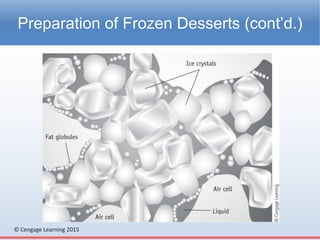
  • #6 Figure 26-5. The structure of ice cream. Ice cream is a foam of air bubbles trapped in frozen liquid. The liquid contains the dissolved sugar and milk solids.
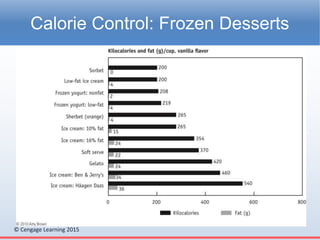
  • #7 Figure 26-4. Kilocalories and fat in frozen desserts (per cup).
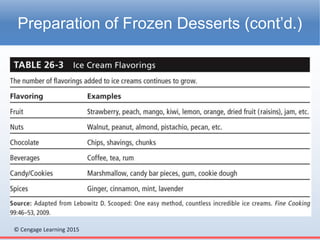
  • #9 Table 26-3. Ice Cream Flavorings
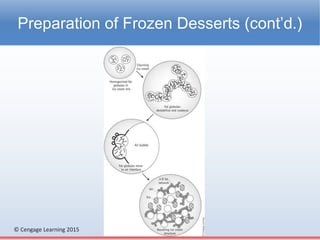
  • #10 Figure 26-8. Restructuring of fat during ice cream churning.