© Cengage Learning 2015
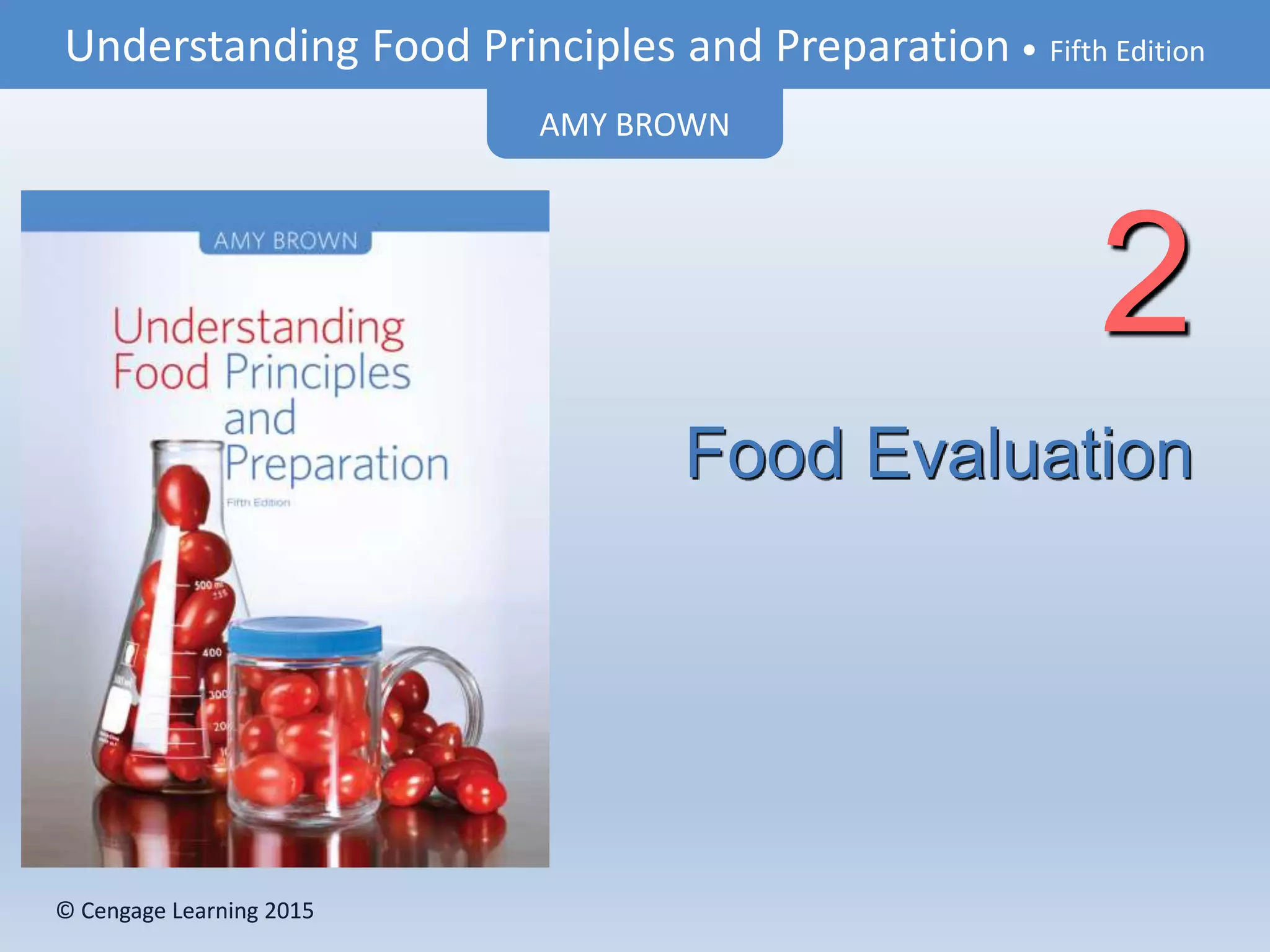
Understanding Food Principles and Preparation • Fifth Edition
AMY BROWN
© Cengage Learning 2015
Food Evaluation
2
© Cengage Learning 2015
• Two types of food evaluation
– Sensory (subjective) tests
– Objective tests
Food Evaluation
© Cengage Learning 2015
• Testing foods involves our perception of
the food (sight, taste, odor, etc.)
• Two main types
– Analytical (effective) tests
– Affective tests
Sensory (Subjective) Evaluation
© Cengage Learning 2015
Sensory Evaluation (cont’d.)
© Cengage Learning 2015
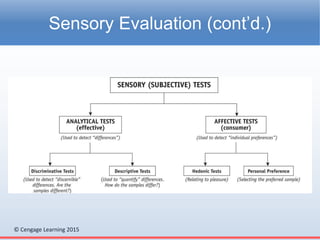
• Analytical (effective) tests
– Detects discernible differences
– More objective than affective tests
– Usually conducted by a trained panel
• Discriminative tests
– Are the products different?
• Descriptive tests
– How are the products different?
Sensory Evaluation (cont’d.)
© Cengage Learning 2015
• Affective tests
– Detects preferences
– Participants asked to rank products or state
whether they like a product or not
– Usually given to untrained consumers
• Hedonic tests
– How much do you like the product?
• Preference tests
– Which product do you prefer?
Sensory Evaluation (cont’d.)
© Cengage Learning 2015
• Elements of sensory evaluation
– Taste panels
• Usually at least five people
• Mixture of gender, age, etc.
– Sample preparation
• Same size samples; same part of food, etc.
Sensory Evaluation (cont’d.)
© Cengage Learning 2015
• Physical and chemical evaluation
• Performed with laboratory equipment, not
humans
• Analyzes content and safety of food
Objective Evaluation
© Cengage Learning 2015
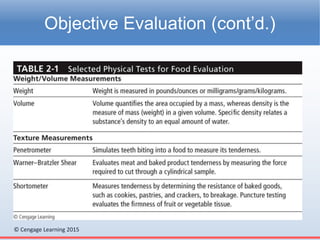
• Physical tests
– Size and shape
– Weight
– Volume
– Density
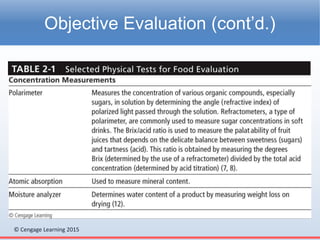
– Moisture
– Texture
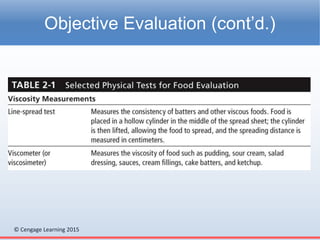
– Viscosity
Objective Evaluation (cont’d.)
© Cengage Learning 2015
Objective Evaluation (cont’d.)
© Cengage Learning 2015
Objective Evaluation (cont’d.)
© Cengage Learning 2015
Objective Evaluation (cont’d.)
© Cengage Learning 2015
Objective Evaluation (cont’d.)
© Cengage Learning 2015
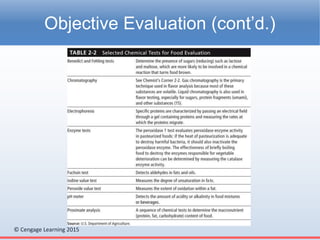
• Chemical tests
– In-house vs. food testing laboratories
– Testing influenced by real-world situations
(i.e., melamine testing)
– Electronic noses
• Detect certain chemicals responsible for aroma
Objective Evaluation (cont’d.)
© Cengage Learning 2015
Objective Evaluation (cont’d.)
© Cengage Learning 2015
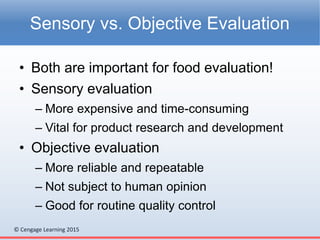
• Both are important for food evaluation!
• Sensory evaluation
– More expensive and time-consuming
– Vital for product research and development
• Objective evaluation
– More reliable and repeatable
– Not subject to human opinion
– Good for routine quality control
Sensory vs. Objective Evaluation
© Cengage Learning 2015
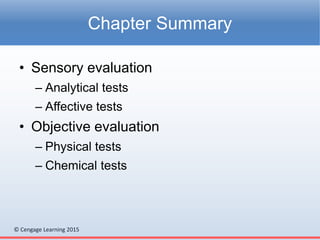
• Sensory evaluation
– Analytical tests
– Affective tests
• Objective evaluation
– Physical tests
– Chemical tests
Chapter Summary

Chapter 2 Food Evaluation

  • 1.
    © Cengage Learning2015 Understanding Food Principles and Preparation • Fifth Edition AMY BROWN © Cengage Learning 2015 Food Evaluation 2
  • 2.
    © Cengage Learning2015 • Two types of food evaluation – Sensory (subjective) tests – Objective tests Food Evaluation
  • 3.
    © Cengage Learning2015 • Testing foods involves our perception of the food (sight, taste, odor, etc.) • Two main types – Analytical (effective) tests – Affective tests Sensory (Subjective) Evaluation
  • 4.
    © Cengage Learning2015 Sensory Evaluation (cont’d.)
  • 5.
    © Cengage Learning2015 • Analytical (effective) tests – Detects discernible differences – More objective than affective tests – Usually conducted by a trained panel • Discriminative tests – Are the products different? • Descriptive tests – How are the products different? Sensory Evaluation (cont’d.)
  • 6.
    © Cengage Learning2015 • Affective tests – Detects preferences – Participants asked to rank products or state whether they like a product or not – Usually given to untrained consumers • Hedonic tests – How much do you like the product? • Preference tests – Which product do you prefer? Sensory Evaluation (cont’d.)
  • 7.
    © Cengage Learning2015 • Elements of sensory evaluation – Taste panels • Usually at least five people • Mixture of gender, age, etc. – Sample preparation • Same size samples; same part of food, etc. Sensory Evaluation (cont’d.)
  • 8.
    © Cengage Learning2015 • Physical and chemical evaluation • Performed with laboratory equipment, not humans • Analyzes content and safety of food Objective Evaluation
  • 9.
    © Cengage Learning2015 • Physical tests – Size and shape – Weight – Volume – Density – Moisture – Texture – Viscosity Objective Evaluation (cont’d.)
  • 10.
    © Cengage Learning2015 Objective Evaluation (cont’d.)
  • 11.
    © Cengage Learning2015 Objective Evaluation (cont’d.)
  • 12.
    © Cengage Learning2015 Objective Evaluation (cont’d.)
  • 13.
    © Cengage Learning2015 Objective Evaluation (cont’d.)
  • 14.
    © Cengage Learning2015 • Chemical tests – In-house vs. food testing laboratories – Testing influenced by real-world situations (i.e., melamine testing) – Electronic noses • Detect certain chemicals responsible for aroma Objective Evaluation (cont’d.)
  • 15.
    © Cengage Learning2015 Objective Evaluation (cont’d.)
  • 16.
    © Cengage Learning2015 • Both are important for food evaluation! • Sensory evaluation – More expensive and time-consuming – Vital for product research and development • Objective evaluation – More reliable and repeatable – Not subject to human opinion – Good for routine quality control Sensory vs. Objective Evaluation
  • 17.
    © Cengage Learning2015 • Sensory evaluation – Analytical tests – Affective tests • Objective evaluation – Physical tests – Chemical tests Chapter Summary

Editor's Notes

  • #2 <insert new textbook cover>
  • #5 Figure 2-1. Summary of subjective tests for food evaluation.
  • #11 Table 2-1. Selected physical tests for food evaluation.
  • #12 Table 2-1. Selected physical tests for food evaluation.
  • #13 Table 2-1. Selected physical tests for food evaluation.
  • #14 Table 2-1. Selected physical tests for food evaluation.
  • #16 Table 2-2. Selected chemical tests for food evaluation.