Copyright ©2016 The Culinary Institute of America. All rights reserved.
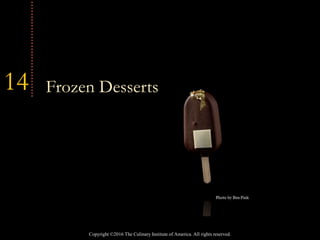
14 Frozen Desserts
Copyright ©2016 The Culinary Institute of America. All rights reserved.
• Basic ingredients: milk, cream, sugar, flavorings, and sometimes
eggs.
• Ice cream bases can be made either with or without eggs.
• Custard ice creams are prepared like a crème anglaise.
• Bases without eggs are prepared by heating cream to incorporate
sugar and other ingredients.
• It is good to age ice cream base for several hours before freezing.
• Churn to “soft-serve” consistency and freeze for several hours
before serving.
CHURNED-FROZEN ICE CREAM
Copyright ©2016 The Culinary Institute of America. All rights reserved.
• Eggs in custard make ice cream smoother, and allows for more
incorporation of air.
• The amount of air incorporated into ice cream is known as
overrun.
• Sugar add sweetness and lowers the freezing point of the base.
– Keeps the ice cream from freezing too hard.
How Ingredients Affect Consistency and Mouthfeel
CHURNED-FROZEN ICE CREAM
(CONT’D)
Copyright ©2016 The Culinary Institute of America. All rights reserved.
• Solids in milk and cream interfere with the formation of ice
crystals.
• For best results, use a mixture of milk and cream to avoid having
too much butterfat.
– Too much fat will result in a grainy mouthfeel.
• Sugar adds sweetness and lowers the freezing point of the base,
keeping the ice cream from freezing too hard.
How Ingredients Affect Consistency and Mouthfeel
(cont’d)
CHURNED-FROZEN ICE CREAM
(CONT’D)
Copyright ©2016 The Culinary Institute of America. All rights reserved.
• Flavorings can be infused into milk and cream as they are
heating.
• Purées, chocolates, and nut pastes can be added to a base after
cooking.
• Low-moisture flavorings can be added to a base without
affecting the texture.
– Praline paste, other nut pastes, and melted chocolate
Adding Flavorings
CHURNED-FROZEN ICE CREAM
(CONT’D)
Copyright ©2016 The Culinary Institute of America. All rights reserved.
• Fruits can be added to ice cream:
– Whole or in chunks
– Folded in as a swirl
– As a flavoring the base
• Fruit should be poached in syrup before being used as garnish,
to prevent it from freezing too hard.
• To flavor a base: omit the milk when making an ice cream base,
age, and blend in enough fruit purée to make up the milk
quantity.
Adding Fruits to Ice Cream
CHURNED-FROZEN ICE CREAM
(CONT’D)
Copyright ©2016 The Culinary Institute of America. All rights reserved.
• In Italian, gelato means “ice cream.”
• Ingredients in gelato are widely contested: milk vs. cream, eggs
vs. none.
• Overrun distinguishes gelato from ice cream:
– Ice cream: between 40 and 60 percent
– Gelato: 20 percent; denser, more compact
• Gelato has a shorter churning time, with less air incorporation.
GELATO
Copyright ©2016 The Culinary Institute of America. All rights reserved.
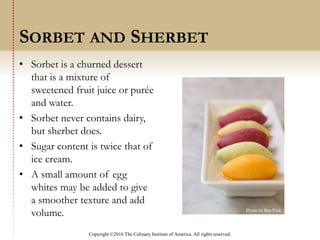
• Sorbet is a churned dessert
that is a mixture of
sweetened fruit juice or purée
and water.
• Sorbet never contains dairy,
but sherbet does.
• Sugar content is twice that of
ice cream.
• A small amount of egg
whites may be added to give
a smoother texture and add
volume.
SORBET AND SHERBET
Copyright ©2016 The Culinary Institute of America. All rights reserved.
• It is essential that the sugar content (density) of the base be the
proper percentage.
• Measured in Baumé and Brix.
– A saccharometer is used to measure Baumé.
– A refractometer is used to measure Brix.
• Most sorbets range in density from 16° to 18° Be or 30° Brix.
• Sherbets contain more sugar but less dairy than ice cream.
Sugar Content
SORBET AND SHERBET
Copyright ©2016 The Culinary Institute of America. All rights reserved.
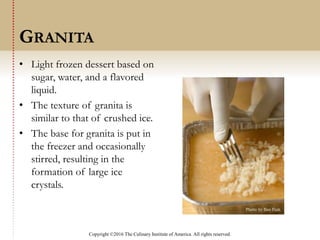
• Light frozen dessert based on
sugar, water, and a flavored
liquid.
• The texture of granita is
similar to that of crushed ice.
• The base for granita is put in
the freezer and occasionally
stirred, resulting in the
formation of large ice
crystals.
GRANITA
Copyright ©2016 The Culinary Institute of America. All rights reserved.
• Frozen desserts can be molded into a wide arrange of shapes
and forms.
• Multiple ice creams and garnishes can be used to add flavors and
textures.
• Ensure that the frozen product is soft enough to spread and
avoid air bubbles.
• Molded frozen desserts must be frozen solid before unmolded.
MOLDED FROZEN DESSERTS
Copyright ©2016 The Culinary Institute of America. All rights reserved.
• The air is incorporated before freezing, rather than during, in the
preparation for a mousse.
• Aerated ingredients, like whipped cream, meringue, or beaten
egg yolks, are folded into a flavored base before being frozen.
• There are three basic types of still-frozen desserts:
– Frozen soufflés (or frozen glacés): served in ramekins
– Parfaits: frozen mousse, served in tall, narrow glasses
– Bombes: pâte à bombe and meringue, molded like a dome
STILL-FROZEN DESSERTS

ch14: frozen desserts.pptx

  • 1.
    Copyright ©2016 TheCulinary Institute of America. All rights reserved. 14 Frozen Desserts
  • 2.
    Copyright ©2016 TheCulinary Institute of America. All rights reserved. • Basic ingredients: milk, cream, sugar, flavorings, and sometimes eggs. • Ice cream bases can be made either with or without eggs. • Custard ice creams are prepared like a crème anglaise. • Bases without eggs are prepared by heating cream to incorporate sugar and other ingredients. • It is good to age ice cream base for several hours before freezing. • Churn to “soft-serve” consistency and freeze for several hours before serving. CHURNED-FROZEN ICE CREAM
  • 3.
    Copyright ©2016 TheCulinary Institute of America. All rights reserved. • Eggs in custard make ice cream smoother, and allows for more incorporation of air. • The amount of air incorporated into ice cream is known as overrun. • Sugar add sweetness and lowers the freezing point of the base. – Keeps the ice cream from freezing too hard. How Ingredients Affect Consistency and Mouthfeel CHURNED-FROZEN ICE CREAM (CONT’D)
  • 4.
    Copyright ©2016 TheCulinary Institute of America. All rights reserved. • Solids in milk and cream interfere with the formation of ice crystals. • For best results, use a mixture of milk and cream to avoid having too much butterfat. – Too much fat will result in a grainy mouthfeel. • Sugar adds sweetness and lowers the freezing point of the base, keeping the ice cream from freezing too hard. How Ingredients Affect Consistency and Mouthfeel (cont’d) CHURNED-FROZEN ICE CREAM (CONT’D)
  • 5.
    Copyright ©2016 TheCulinary Institute of America. All rights reserved. • Flavorings can be infused into milk and cream as they are heating. • Purées, chocolates, and nut pastes can be added to a base after cooking. • Low-moisture flavorings can be added to a base without affecting the texture. – Praline paste, other nut pastes, and melted chocolate Adding Flavorings CHURNED-FROZEN ICE CREAM (CONT’D)
  • 6.
    Copyright ©2016 TheCulinary Institute of America. All rights reserved. • Fruits can be added to ice cream: – Whole or in chunks – Folded in as a swirl – As a flavoring the base • Fruit should be poached in syrup before being used as garnish, to prevent it from freezing too hard. • To flavor a base: omit the milk when making an ice cream base, age, and blend in enough fruit purée to make up the milk quantity. Adding Fruits to Ice Cream CHURNED-FROZEN ICE CREAM (CONT’D)
  • 7.
    Copyright ©2016 TheCulinary Institute of America. All rights reserved. • In Italian, gelato means “ice cream.” • Ingredients in gelato are widely contested: milk vs. cream, eggs vs. none. • Overrun distinguishes gelato from ice cream: – Ice cream: between 40 and 60 percent – Gelato: 20 percent; denser, more compact • Gelato has a shorter churning time, with less air incorporation. GELATO
  • 8.
    Copyright ©2016 TheCulinary Institute of America. All rights reserved. • Sorbet is a churned dessert that is a mixture of sweetened fruit juice or purée and water. • Sorbet never contains dairy, but sherbet does. • Sugar content is twice that of ice cream. • A small amount of egg whites may be added to give a smoother texture and add volume. SORBET AND SHERBET
  • 9.
    Copyright ©2016 TheCulinary Institute of America. All rights reserved. • It is essential that the sugar content (density) of the base be the proper percentage. • Measured in Baumé and Brix. – A saccharometer is used to measure Baumé. – A refractometer is used to measure Brix. • Most sorbets range in density from 16° to 18° Be or 30° Brix. • Sherbets contain more sugar but less dairy than ice cream. Sugar Content SORBET AND SHERBET
  • 10.
    Copyright ©2016 TheCulinary Institute of America. All rights reserved. • Light frozen dessert based on sugar, water, and a flavored liquid. • The texture of granita is similar to that of crushed ice. • The base for granita is put in the freezer and occasionally stirred, resulting in the formation of large ice crystals. GRANITA
  • 11.
    Copyright ©2016 TheCulinary Institute of America. All rights reserved. • Frozen desserts can be molded into a wide arrange of shapes and forms. • Multiple ice creams and garnishes can be used to add flavors and textures. • Ensure that the frozen product is soft enough to spread and avoid air bubbles. • Molded frozen desserts must be frozen solid before unmolded. MOLDED FROZEN DESSERTS
  • 12.
    Copyright ©2016 TheCulinary Institute of America. All rights reserved. • The air is incorporated before freezing, rather than during, in the preparation for a mousse. • Aerated ingredients, like whipped cream, meringue, or beaten egg yolks, are folded into a flavored base before being frozen. • There are three basic types of still-frozen desserts: – Frozen soufflés (or frozen glacés): served in ramekins – Parfaits: frozen mousse, served in tall, narrow glasses – Bombes: pâte à bombe and meringue, molded like a dome STILL-FROZEN DESSERTS

Editor's Notes

  • #2 Learning Objectives Describe the types of churned-frozen ice cream. Explain how ingredients affect the outcome of an ice cream. Describe frozen desserts such as gelato, sorbet, sherbet, and granita. Explain the process for producing molded frozen desserts. Explain the types of still-frozen desserts.
  • #3 - Aging allows the protein network to absorb more of the moisture present in the base, leaving less water available to form ice crystals, resulting in a smoother ice cream.
  • #4  The fat and emulsifiers contributed by the egg yolks and because cooking the proteins present in the eggs binds or holds moisture, interfering with the formation of ice crystals, which results in smaller ice crystals, thus lending a smoother texture to the finished ice cream. Milk powder is often added to ice cream made without eggs. It helps to bind excess liquid in the mixture that would otherwise result in the formation of large ice crystals.
  • #5 - The butterfat content of ice cream ranges from 10 to 14 percent. - Invert sugars such as corn syrup and glucose syrup improve texture and help prevent the formation of large ice crystals.
  • #7  For soft fruits, bring the syrup to a boil, then remove from the heat, add the fruit, cover, and allow to stand until cool. Drain the fruit and chill. Fold the poached fruit into the soft ice cream just as it comes from the machine. For harder fruits, use the same technique but leave the fruit in the syrup for approximately 15 minutes, making sure the temperature is maintained between 160° and 180°F/71° and 82°C. For very strongly flavored fruits such as passion fruit, or fruit concentrates, replace only half of the milk in the formula with the fruit purée. When using a pulpy fruit purée to flavor an ice cream, homogenizing the mixture before freezing will create a better emulsion.
  • #9  If 10 percent of the sugar in a formula is added in the form of corn syrup, a smoother texture will result. Sorbets made with fruit juice as opposed to purée tend to separate. Juices lack the pulp contained in a purée, which helps to sustain the mixture of water, flavorings, and sugar. Chemical stabilizers such as xanthan gum extend suspension, promote air incorporation, even out air bubble distribution, and assure the cohesion of a finished product during storage.
  • #10 When making sorbets or sherbets, remember that the sugar content of most fruits varies according to ripeness. Therefore, it may be necessary to adjust the consistency of the sorbet base by adding more liquid if it is too sweet or more sugar if it is too tart. Let taste be the most important factor.
  • #11 - If there is too much sugar, granita will not freeze. - If there is not enough sugar, it will become too hard.
  • #12 To unmold the dessert, immerse the mold briefly in warm water and wipe dry before unmolding, or gently and quickly warm it over an open flame or using a blowtorch or blow dryer. Invert the dessert onto the plate and gently lift the mold away, being careful not to touch the sides.