Public Policy
Chapter 4
 Public policy consists of government's
choices of actions intended to serve the
public purposes.
Policy Sources
1) The national constitution
 which also govern the procedures by which policies
are adopted.
2) international relations
 Some policies cross national borders, taking the
form of treaties and less formal working agreements
between and among governments
 Administrators play a crucial role in formulating
public policy because of their specialized knowledge
and experience in implementing current policies.
 the higher the administrators stand in the government
hierarchy, the greater will be his or her influence over the
substance of its policy
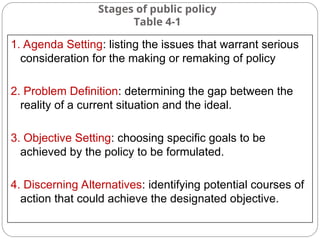
Stages of public policy
Table 4-1
1. Agenda Setting: listing the issues that warrant serious
consideration for the making or remaking of policy
2. Problem Definition: determining the gap between the
reality of a current situation and the ideal.
3. Objective Setting: choosing specific goals to be
achieved by the policy to be formulated.
4. Discerning Alternatives: identifying potential courses of
action that could achieve the designated objective.
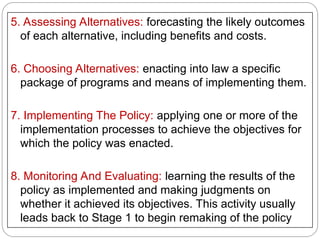
5. Assessing Alternatives: forecasting the likely outcomes
of each alternative, including benefits and costs.
6. Choosing Alternatives: enacting into law a specific
package of programs and means of implementing them.
7. Implementing The Policy: applying one or more of the
implementation processes to achieve the objectives for
which the policy was enacted.
8. Monitoring And Evaluating: learning the results of the
policy as implemented and making judgments on
whether it achieved its objectives. This activity usually
leads back to Stage 1 to begin remaking of the policy
Who has the power in policy making ?
 The essence of power is the ability to prevail in social
conflicts, to secure one's goals in the face of opposition
 Power is a central theme in policymaking and
administration because it determines how governments
distribute advantages and disadvantages among
members of society
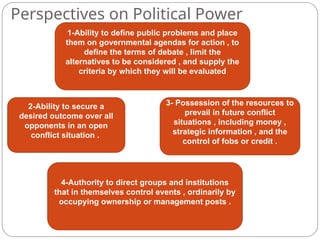
Perspectives on Political Power
1-Ability to define public problems and place
them on governmental agendas for action , to
define the terms of debate , limit the
alternatives to be considered , and supply the
criteria by which they will be evaluated
2-Ability to secure a
desired outcome over all
opponents in an open
conflict situation .
3- Possession of the resources to
prevail in future conflict
situations , including money ,
strategic information , and the
control of fobs or credit .
4-Authority to direct groups and institutions
that in themselves control events , ordinarily by
occupying ownership or management posts .
Beyond Conflicts: Indirect Sources of Power
 An important source of power in policymaking and
administration is legal authority that inheres in an
elective or appointive office.
 This power can be exercised in any of the policy cycle
steps outlined earlier
 Some participants' power, influence, or authority will be
broad and exercised at every step
Administrators' Sources of Power
 The power that public administrators can exert on the
policy cycle depends on three major factors.
1)The more intensively a government agency is already
involved in the issue when it reaches the public agenda,
the greater its administrators' role is likely to be.
2) Administrators have greater power when the issue to
be decided is technologically or organizationally
complex
3) Government administrators can exert power by forming
coalitions with private interests.
 Every current and prospective public program has
beneficiaries, and when they are mobilized, they can
augment the influence administrators bring to bear
Concepts of Political Power Structure
 There are four simplified types of power relationship that
can apply to the national or local levels
1) Elitist: a cohesive grouping of persons in government
agencies, corporations, financial institutions, information
media, and/or foundations who dominate public policy
making and select the top governmental leaders.
2) Pluralist: regular and relatively balanced
competition among groups representing
business, finance, labor, agriculture,
environmentalists, and many other interests,
who bargain over policy choices and
distribute the benefits among themselves.
3) Bureaucratic/technocratic: control of
policy decisions by narrow professional
specialists inside government and in private
organizations, who enjoy a power advantage
over all others in areas of their expertise.
4) Coalitional: control by open and shifting
groupings of persons and organizations with
interest in a given issue: government
agencies, private interest groups,
corporations, legislators, and news media.
Chapter 4.ppt-Public Policy-business administration

Chapter 4.ppt-Public Policy-business administration

  • 1.
  • 2.
     Public policyconsists of government's choices of actions intended to serve the public purposes.
  • 3.
    Policy Sources 1) Thenational constitution  which also govern the procedures by which policies are adopted. 2) international relations  Some policies cross national borders, taking the form of treaties and less formal working agreements between and among governments
  • 4.
     Administrators playa crucial role in formulating public policy because of their specialized knowledge and experience in implementing current policies.  the higher the administrators stand in the government hierarchy, the greater will be his or her influence over the substance of its policy
  • 5.
    Stages of publicpolicy Table 4-1 1. Agenda Setting: listing the issues that warrant serious consideration for the making or remaking of policy 2. Problem Definition: determining the gap between the reality of a current situation and the ideal. 3. Objective Setting: choosing specific goals to be achieved by the policy to be formulated. 4. Discerning Alternatives: identifying potential courses of action that could achieve the designated objective.
  • 6.
    5. Assessing Alternatives:forecasting the likely outcomes of each alternative, including benefits and costs. 6. Choosing Alternatives: enacting into law a specific package of programs and means of implementing them. 7. Implementing The Policy: applying one or more of the implementation processes to achieve the objectives for which the policy was enacted. 8. Monitoring And Evaluating: learning the results of the policy as implemented and making judgments on whether it achieved its objectives. This activity usually leads back to Stage 1 to begin remaking of the policy
  • 7.
    Who has thepower in policy making ?  The essence of power is the ability to prevail in social conflicts, to secure one's goals in the face of opposition  Power is a central theme in policymaking and administration because it determines how governments distribute advantages and disadvantages among members of society
  • 8.
    Perspectives on PoliticalPower 1-Ability to define public problems and place them on governmental agendas for action , to define the terms of debate , limit the alternatives to be considered , and supply the criteria by which they will be evaluated 2-Ability to secure a desired outcome over all opponents in an open conflict situation . 3- Possession of the resources to prevail in future conflict situations , including money , strategic information , and the control of fobs or credit . 4-Authority to direct groups and institutions that in themselves control events , ordinarily by occupying ownership or management posts .
  • 9.
    Beyond Conflicts: IndirectSources of Power  An important source of power in policymaking and administration is legal authority that inheres in an elective or appointive office.  This power can be exercised in any of the policy cycle steps outlined earlier  Some participants' power, influence, or authority will be broad and exercised at every step
  • 10.
    Administrators' Sources ofPower  The power that public administrators can exert on the policy cycle depends on three major factors. 1)The more intensively a government agency is already involved in the issue when it reaches the public agenda, the greater its administrators' role is likely to be. 2) Administrators have greater power when the issue to be decided is technologically or organizationally complex
  • 11.
    3) Government administratorscan exert power by forming coalitions with private interests.  Every current and prospective public program has beneficiaries, and when they are mobilized, they can augment the influence administrators bring to bear
  • 12.
    Concepts of PoliticalPower Structure  There are four simplified types of power relationship that can apply to the national or local levels 1) Elitist: a cohesive grouping of persons in government agencies, corporations, financial institutions, information media, and/or foundations who dominate public policy making and select the top governmental leaders.
  • 13.
    2) Pluralist: regularand relatively balanced competition among groups representing business, finance, labor, agriculture, environmentalists, and many other interests, who bargain over policy choices and distribute the benefits among themselves.
  • 14.
    3) Bureaucratic/technocratic: controlof policy decisions by narrow professional specialists inside government and in private organizations, who enjoy a power advantage over all others in areas of their expertise.
  • 15.
    4) Coalitional: controlby open and shifting groupings of persons and organizations with interest in a given issue: government agencies, private interest groups, corporations, legislators, and news media.