Managing Public
Organizations
Chapter 3
Organizational Design
 The traditional organization chart expresses both the
division of labor within an organization and the structure
of command or control.
 There are several ways to divide work
 Among these were. (1) purpose. (2) Process, (3)
Persons or Things, or (4) Place
Process Charting:
 Process charting is most useful where a
considerable number of clerical or
nonprofessional employees perform the
same general classes of work and follow the
same general sequence of operating steps
System Analysis:
 Any such system receives inputs from its environment,
and then translates these through some sort of
conversion process into outputs that are retuned to
the environment.
 These outputs in turn affect future inputs to the system
through feedback loop.
Reengineering
 The core tenet of reengineering centers on
redesigning work processes and organizational
structures to be in line with agency outcomes.
 Through this technique, they attempt to make public
organizations more flexible and capable of responding
to the dynamic conditions in contemporary society.
Organizational Culture, Organizational
Learning, and Strategic Management:
 organizational culture can be defined as “the
basic pattern of attitudes, beliefs and values
that underlie the organization’s operations”.
 It can be manifested in many ways ,
including,
1. Observed behavioral regularities when people
interact:
 The language they use, the customs and traditions that
evolve, and the rituals they employ in a wide variety of
situations.
2.Group norms:
 The implicit standards and values that evolve in
working groups
3. Espoused values:
 The articulated, publicly announced principles and
values that the group claims to be trying to achieve.
4. Formal philosophy:
 The broad policies and ideological principles that guide
a group’s actions toward stockholders, employees,
customers, and other stakeholders.
5. Rules of the game:
 Implicit rules for getting along in the organizations and
“the ropes” that a newcomer must learn to be an
accepted member
6. Climate:
 The feeling that is conveyed in a group by the physical
layout and the way in which members of the
organization interact with each other.
7. Embodied skills:
 The special competencies group members display in
accomplishing certain tasks
8.Habits of thinking, mental models, and/or linguistic
paradigms:
 The shared cognitive frames that guide the perceptions,
thought, and language used by the members of a group
9. Shared meanings.
 The emergent understandings that are created by
group members as they interact with each other.
10. Integrating symbols
 The ideas, feelings, and images groups develop to
characterize themselves
Building Learning Organizations :
 Five elements contribute to building a learning
organization. Those elements are:
1. Personal Mastery:
 A discipline that connects individual learning, personal
skills, and spiritual growth with organizational learning.
2. Mental models:
 A discipline that links the way in which we view the
world and our assumptions about “how things work”
with innovation and learning
3.Shared Vision:
 A discipline in which an image or idea becomes
transformed into a powerful force that is shared
throughout the organization or group.
4. Team Learning:
 Reflects the capacity of a group of individuals to
engage their respective energies into an integrated
team.
5.Systems Thinking:
 A discipline that shows how human action represents a
systemic, interrelated set of events.
Criteria to Define excellence
 USA adopted eight criteria to define ‘excellence in
local government.
1.Action orientation-- excellent governments identify
problems and deal with them quickly.
2. Closeness to citizens-- Excellent local governments
listen and are sensitive and to public input.
3. Autonomy and entrepreneurship– developing
climates conducive to conceiving ideas and doing new
things to solve problems.
4. Employee orientation-- intensive, pervasive treatment of em­
ployees
as human beings and adults.
5. Values- Defined set of values
6. Mission, goals, and competence-- Excellent local governments
have evaluated their missions based on changing resource levels and
citizen demands.
7. Structure:
 In excellent local governments, bureaucratic structures have been
minimized.
 Organizations have fewer management levels and fewer centralized
support staffs
8. Political Relationships :
 In excellent local governments, managers and policy makers are tuned in
to the political environment
Approaches to Public Management
1)A commitment to values
2) Serving the public
3)Empowerment and shared leadership
4) Pragmatic style
5) A dedication to public service
1)A commitment to values:
 The manager seeks organizational change by
developing a pervasive commitment to the mission and
values of the organization.
2) Serving the public:
 The manager gives priority to service to both clients
and citizens
 that priority is supported by high standards of
performance and accountability
3)Empowerment and shared leadership:
 The manager encourages a high level of participation of
all members of the organization to improve the quality
and productivity of the organization.
4) Pragmatic style:
 Change occurs through a free flowing process
 the manager pursues a wide variety of unexpected
opportunities to move the organization in the desired
direction.
5) A dedication to public service:
 Individuals throughout the organization understand and
appreciate the special character of public service
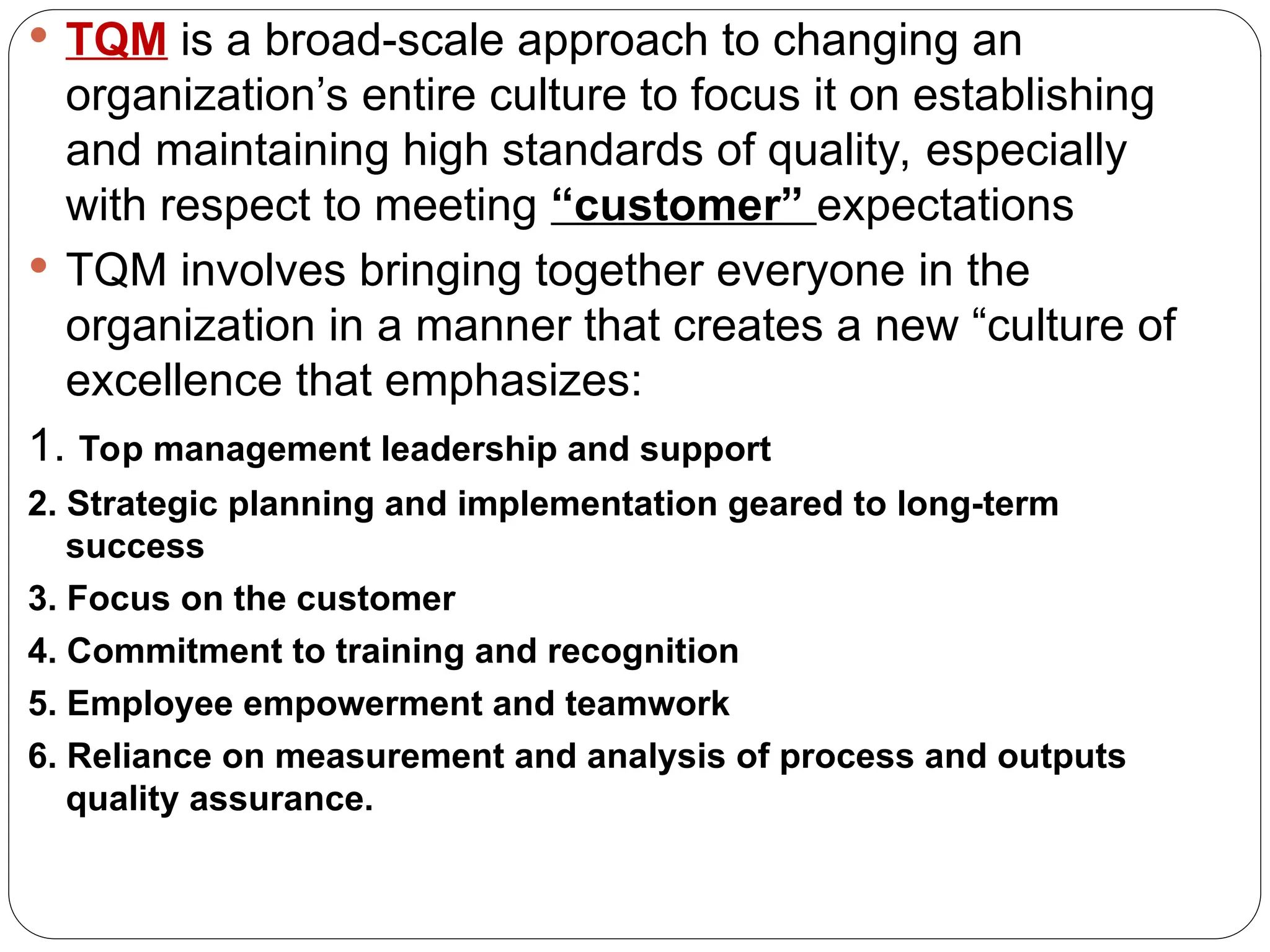
 TQM is a broad-scale approach to changing an
organization’s entire culture to focus it on establishing
and maintaining high standards of quality, especially
with respect to meeting “customer” expectations
 TQM involves bringing together everyone in the
organization in a manner that creates a new “culture of
excellence that emphasizes:
1. Top management leadership and support
2. Strategic planning and implementation geared to long-term
success
3. Focus on the customer
4. Commitment to training and recognition
5. Employee empowerment and teamwork
6. Reliance on measurement and analysis of process and outputs
quality assurance.

Chapter 3.ppt- Managing Public Organizations

  • 1.
  • 2.
    Organizational Design  Thetraditional organization chart expresses both the division of labor within an organization and the structure of command or control.  There are several ways to divide work  Among these were. (1) purpose. (2) Process, (3) Persons or Things, or (4) Place
  • 3.
    Process Charting:  Processcharting is most useful where a considerable number of clerical or nonprofessional employees perform the same general classes of work and follow the same general sequence of operating steps
  • 4.
    System Analysis:  Anysuch system receives inputs from its environment, and then translates these through some sort of conversion process into outputs that are retuned to the environment.  These outputs in turn affect future inputs to the system through feedback loop.
  • 5.
    Reengineering  The coretenet of reengineering centers on redesigning work processes and organizational structures to be in line with agency outcomes.  Through this technique, they attempt to make public organizations more flexible and capable of responding to the dynamic conditions in contemporary society.
  • 6.
    Organizational Culture, Organizational Learning,and Strategic Management:  organizational culture can be defined as “the basic pattern of attitudes, beliefs and values that underlie the organization’s operations”.  It can be manifested in many ways , including,
  • 7.
    1. Observed behavioralregularities when people interact:  The language they use, the customs and traditions that evolve, and the rituals they employ in a wide variety of situations. 2.Group norms:  The implicit standards and values that evolve in working groups 3. Espoused values:  The articulated, publicly announced principles and values that the group claims to be trying to achieve.
  • 8.
    4. Formal philosophy: The broad policies and ideological principles that guide a group’s actions toward stockholders, employees, customers, and other stakeholders. 5. Rules of the game:  Implicit rules for getting along in the organizations and “the ropes” that a newcomer must learn to be an accepted member 6. Climate:  The feeling that is conveyed in a group by the physical layout and the way in which members of the organization interact with each other.
  • 9.
    7. Embodied skills: The special competencies group members display in accomplishing certain tasks 8.Habits of thinking, mental models, and/or linguistic paradigms:  The shared cognitive frames that guide the perceptions, thought, and language used by the members of a group 9. Shared meanings.  The emergent understandings that are created by group members as they interact with each other. 10. Integrating symbols  The ideas, feelings, and images groups develop to characterize themselves
  • 10.
    Building Learning Organizations:  Five elements contribute to building a learning organization. Those elements are: 1. Personal Mastery:  A discipline that connects individual learning, personal skills, and spiritual growth with organizational learning. 2. Mental models:  A discipline that links the way in which we view the world and our assumptions about “how things work” with innovation and learning
  • 11.
    3.Shared Vision:  Adiscipline in which an image or idea becomes transformed into a powerful force that is shared throughout the organization or group. 4. Team Learning:  Reflects the capacity of a group of individuals to engage their respective energies into an integrated team. 5.Systems Thinking:  A discipline that shows how human action represents a systemic, interrelated set of events.
  • 12.
    Criteria to Defineexcellence  USA adopted eight criteria to define ‘excellence in local government. 1.Action orientation-- excellent governments identify problems and deal with them quickly. 2. Closeness to citizens-- Excellent local governments listen and are sensitive and to public input. 3. Autonomy and entrepreneurship– developing climates conducive to conceiving ideas and doing new things to solve problems.
  • 13.
    4. Employee orientation--intensive, pervasive treatment of em­ ployees as human beings and adults. 5. Values- Defined set of values 6. Mission, goals, and competence-- Excellent local governments have evaluated their missions based on changing resource levels and citizen demands. 7. Structure:  In excellent local governments, bureaucratic structures have been minimized.  Organizations have fewer management levels and fewer centralized support staffs 8. Political Relationships :  In excellent local governments, managers and policy makers are tuned in to the political environment
  • 14.
    Approaches to PublicManagement 1)A commitment to values 2) Serving the public 3)Empowerment and shared leadership 4) Pragmatic style 5) A dedication to public service
  • 15.
    1)A commitment tovalues:  The manager seeks organizational change by developing a pervasive commitment to the mission and values of the organization. 2) Serving the public:  The manager gives priority to service to both clients and citizens  that priority is supported by high standards of performance and accountability
  • 16.
    3)Empowerment and sharedleadership:  The manager encourages a high level of participation of all members of the organization to improve the quality and productivity of the organization. 4) Pragmatic style:  Change occurs through a free flowing process  the manager pursues a wide variety of unexpected opportunities to move the organization in the desired direction. 5) A dedication to public service:  Individuals throughout the organization understand and appreciate the special character of public service
  • 17.
     TQM isa broad-scale approach to changing an organization’s entire culture to focus it on establishing and maintaining high standards of quality, especially with respect to meeting “customer” expectations  TQM involves bringing together everyone in the organization in a manner that creates a new “culture of excellence that emphasizes: 1. Top management leadership and support 2. Strategic planning and implementation geared to long-term success 3. Focus on the customer 4. Commitment to training and recognition 5. Employee empowerment and teamwork 6. Reliance on measurement and analysis of process and outputs quality assurance.