


Di akhir pembelajaran, pelajar akan dapat: menjelaskan faktor yang mempengaruhi permintaan dan penawaran membezakan konsep pergerakan dan peralihan  keluk DD dan SS, dan perubahan  Q D  dan Q S menerangkan tentang keseimbangan pasaran menunjukkan perubahan keseimbangan bagi harga dan kuantiti OBJEKTIF
PERMINTAAN (DD) Sesuatu barang atau perkhidmatan yang diminta ( Q D )  dan yang sanggup dibayar oleh pembeli pada harga (P) tertentu. The quantity demanded will depend on e.g.: Harga barang itu sendiri   (t he price level) Pendapatan  (c ustomers’ incomes) Harga barang lain  (t he price of competitors’ products ) The price of complementary  products The number of customers in the market Customers’ taste Environment factors (weather) etc.
Harga barang itu sendiri Hukum Permintaan Apabila  P   ↑  -  Q D  ↓ Apabila  P   ↓  -  Q D  ↑
Pendapatan (Y) Apabila Y  ↑  –  Q D   ??  bagi barang normal Apabila Y  ↑   – Q D   ??  Bagi barang bawahan Apabila Y  ↑   – Q D   ??  Bagi barang mewah
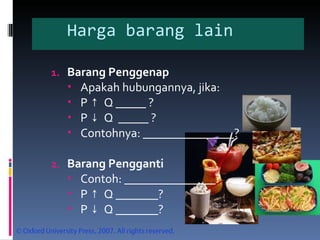
Harga barang lain Barang Penggenap Apakah hubungannya, jika:  P  ↑   Q _____ ?  P  ↓   Q  _____ ? Contohnya: _______________? Barang Pengganti Contoh: _______________? P  ↑   Q _______?  P  ↓   Q _______?                          
Demand curve: The  demand curve  is derived from the Law of Diminishing Marginal Utility (hukum MU semakin berkurangan); it is  usually  downward sloping . P and Q D  : berhubungan secara negatif.
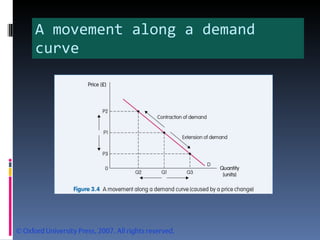
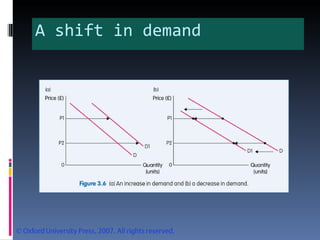
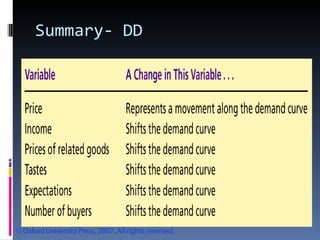
Movements and shifts along DD curve A change in  price  leads to a  movement  (pergerakan) along the demand curve     change in quantity demanded     extension and contraction of demand, with assumption that other influences remain unchanged:  Ceteris Paribus : faktor-faktor lain tidak berubah A change in other factors  leads to a  shift  (peralihan) of the demand curve =  change in demand
A movement along a demand curve
A shift in demand
Summary- DD
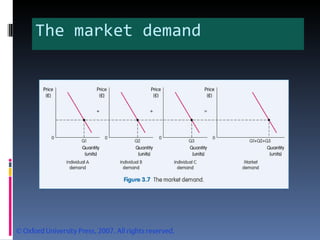
The market demand
PENAWARAN (SS) Penawaran  (supply)  ialah kuantiti sesuatu barang yang sanggup dan mampu dijual oleh pengeluar pada suatu tingkat harga tertentu dan dalam masa tertentu.
Supply The  supply curve   shows the amount (Qs) that producers are willing and able to produce at each and every price, assuming that all others things unchanged  P & Qs positive relation
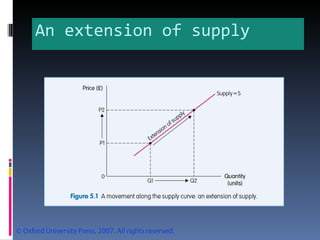
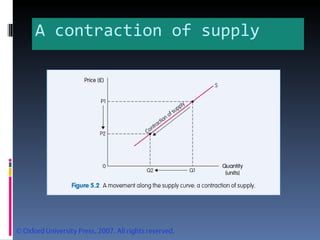
Perubahan Kuantiti Ditawarkan (Qs)  vs  Perubahan SS Δ  Q yang ditawarkan:  disebabkan  Δ  P (harga) barang itu sendiri P ↑ Q ↑, P ↓ Q ↓ Δ  Qs berlaku di sepanjang keluk SS yang sama =  m ovement  along the supply curve : this shows a change in quantity supplied caused by a change in price
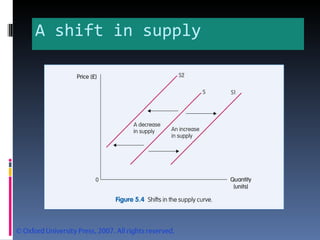
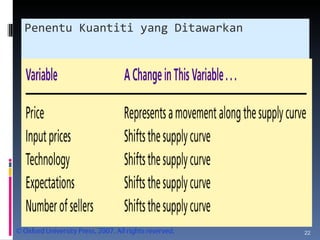
Supply Shift in supply : change in factors other than price e.g.: a change in other product price  a change in the number of producers a change in technology  a change in costs of production a change in  input prices
An extension of supply
A contraction of supply
A shift in supply
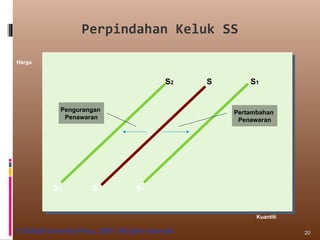
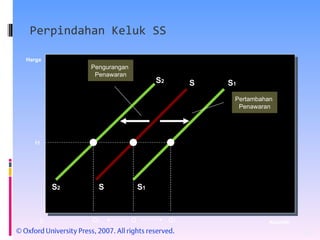
Perpindahan Keluk SS Harga Kuantiti Pertambahan  Penawaran Pengurangan  Penawaran S S S 2 S 2 S 1 S 1
Perpindahan Keluk SS Harga Kuantiti 0 Q 1 S 1 S S 2 Pertambahan  Penawaran Pengurangan  Penawaran S 2 S S 1 Q Q 2 H
Penentu Kuantiti yang Ditawarkan
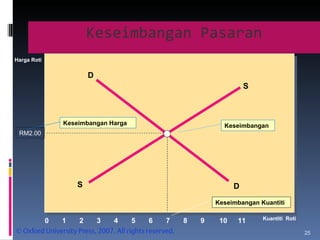
Markets and equilibrium  (k eseimbangan pasaran)  A  market  occurs when buyers and sellers interact to exchange goods and services Equilibrium  occurs in a market when the quantity supplied equals the quantity demanded and there is no incentive for this position to change     berlaku apabila keluk DD dan SS bersilang  In a  free market  equilibrium is reached by changes in the price
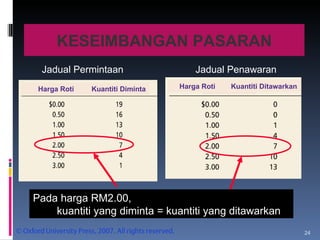
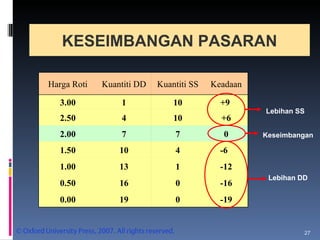
Pada harga RM2.00,  kuantiti yang diminta = kuantiti yang ditawarkan Jadual Permintaan  Jadual Penawaran Harga Roti Roses Kuantiti Diminta  Harga Roti Kuantiti Ditawarkan KESEIMBANGAN PASARAN
Keseimbangan Pasaran 6 8 10 0 Kuantiti  Roti Harga Roti 4 2 1 3 5 7 9 11 D S Keseimbangan Harga D S RM2.00 Keseimbangan Keseimbangan Kuantiti
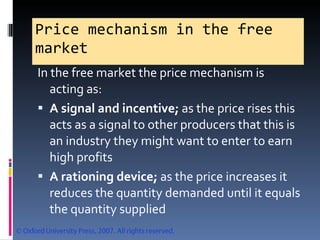
Price mechanism in the free market In the free market the price mechanism is acting as: A signal and incentive;  as the price rises this acts as a signal to other producers that this is an industry they might want to enter to earn high profits A rationing device;  as the price increases it reduces the quantity demanded until it equals the quantity supplied
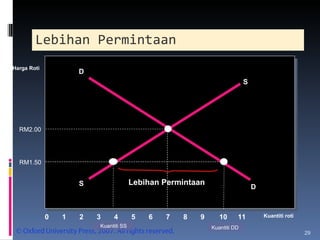
KESEIMBANGAN PASARAN Keseimbangan Lebihan SS Lebihan DD Harga Roti Kuantiti DD Kuantiti SS Keadaan 3.00 1 10 +9  2.50 4 10 +6 2.00 7 7 0 1.50 10 4 -6  1.00 13 1 -12 0.50 16 0 -16 0.00 19 0 -19
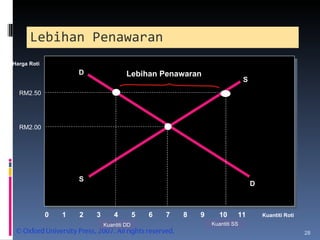
Lebihan Penawaran  6 8 10 0 Kuantiti Roti  Harga Roti  4 2 1 3 5 7 9 11 Lebihan Penawaran D S D S RM2.00 RM2.50 Kuantiti DD Kuantiti SS
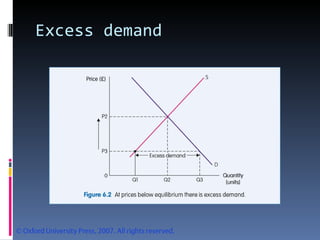
Lebihan Permintaan 6 8 10 0 Kuantiti roti 4 2 1 3 5 7 9 11 Harga Roti  Lebihan Permintaan S D D S RM2.00 RM1.50 Kuantiti SS Kuantiti DD
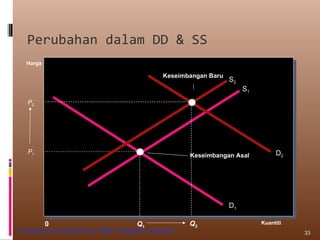
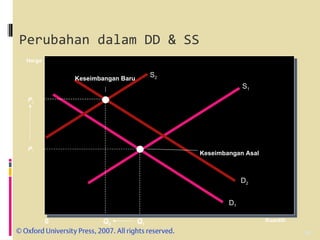
PERUBAHAN DD & SS  Keseimbangan pasaran boleh dipengaruhi oleh 3 keadaan: Δ  DD tetapi SS tetap Δ  SS tetapi DD tetap Δ  dalam DD & SS
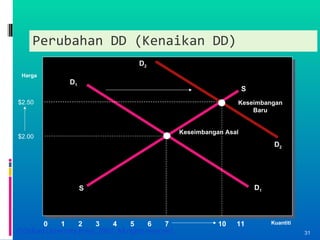
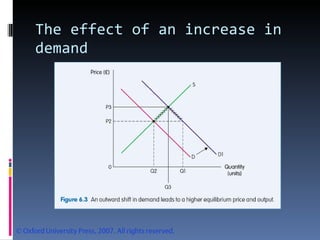
Perubahan DD (Kenaikan DD) D 1 6 10 0 Kuantiti  Harga 4 2 1 3 5 7 11 Keseimbangan Baru S D 1 D 2 Keseimbangan Asal  S $2.00 D 2 $2.50
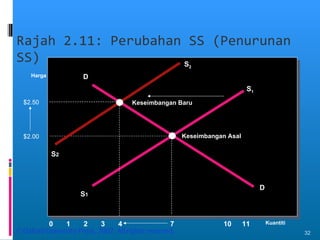
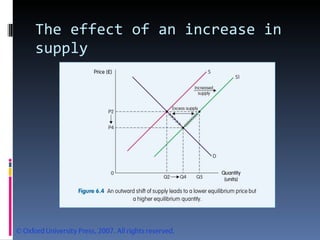
Rajah 2.11: Perubahan SS (Penurunan SS) D 10 0 Kuantiti Harga 4 2 1 3 7 11 Keseimbangan Baru Keseimbangan Asal D S 1 S 2 S 1 $2.00 S 2 $2.50
Perubahan dalam DD & SS  S 1 0 Kuantiti Harga Q 1 P 1 D 1 D 2 P 2 S 2 Q 2 Keseimbangan Baru Keseimbangan Asal
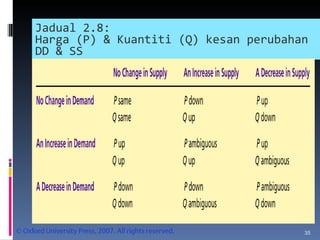
Jadual 2.8:  Harga (P) & Kuantiti (Q) kesan perubahan DD & SS
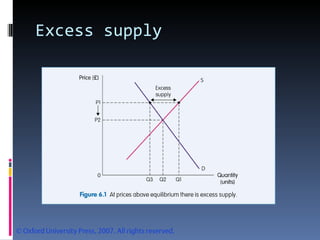
Excess supply
Excess demand
The effect of an increase in demand
The effect of an increase in supply
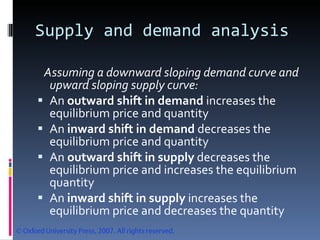
Supply and demand analysis Assuming a downward sloping demand curve and upward sloping supply curve: An  outward shift in demand  increases the equilibrium price and quantity An  inward shift in demand  decreases the equilibrium price and quantity An  outward shift in supply  decreases the equilibrium price and increases the equilibrium quantity An  inward shift in supply  increases the equilibrium price and decreases the quantity
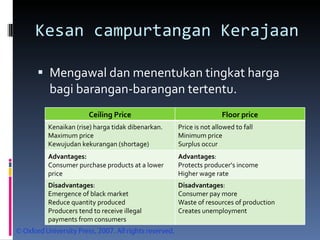
Kesan campurtangan Kerajaan  Mengawal dan menentukan tingkat harga bagi barangan-barangan tertentu. Ceiling Price Floor price Kenaikan (rise) harga tidak dibenarkan. Maximum price Kewujudan kekurangan (shortage) Price is not allowed to fall Minimum price Surplus occur Advantages: Consumer purchase products at a lower price Advantages : Protects producer’s income Higher wage rate Disadvantages : Emergence of black market Reduce quantity produced Producers tend to receive illegal payments from consumers Disadvantages : Consumer pay more Waste of resources of production Creates unemployment
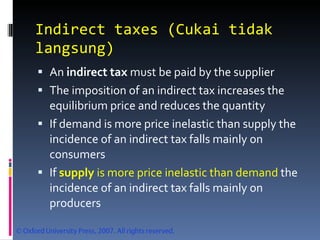
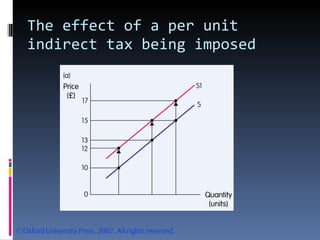
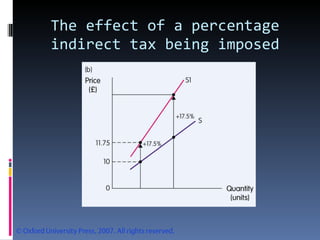
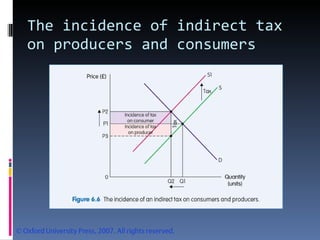
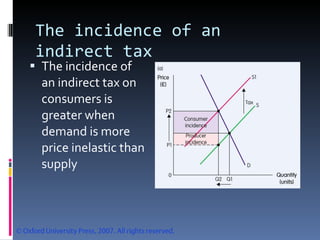
Indirect taxes (Cukai tidak langsung) An  indirect tax  must be paid by the supplier The imposition of an indirect tax increases the equilibrium price and reduces the quantity If demand is more price inelastic than supply the incidence of an indirect tax falls mainly on consumers If  supply   is more price inelastic than demand  the incidence of an indirect tax falls mainly on producers
The effect of a per unit indirect tax being imposed
The effect of a percentage indirect tax being imposed
The incidence of indirect tax on producers and consumers
The incidence of an indirect tax The incidence of an indirect tax on consumers is greater when demand is more price inelastic than supply
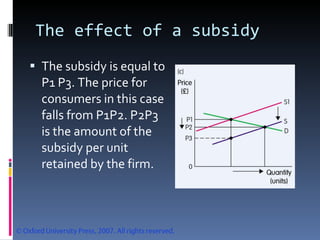
The effect of a subsidy The subsidy is equal to P1 P3. The price for consumers in this case falls from P1P2. P2P3 is the amount of the subsidy per unit retained by the firm.
Keseimbangan kuantiti  Kuantiti yang ditawarkan/diminta pada tingkat keseimbangan  Keseimbangan harga  Harga yang dijual/dibeli pada tingkat keseimbangan  KESEIMBANGAN PASARAN
Excercise Bagaimanakah anda menentukan samada sesuatu barangan itu merupakan barangan pengganti atau penggenap? How would you determine if a particular good is a substitute or a complement? Bagaimanakah anda menentukan samada sesuatu barangan itu merupakan barangan normal, mewah dan bawahan?
Excercise Bentukkan keluk permintaan pasaran. Derive a market demand curve. Bentukkan keluk penawaran pasaran Derive a market supply curve. Dengan bantuan geraf tunjukkan bagaimana  harga keseimbangan pasaran bebas ditentukan. With the help of graph(s) show how a free market equilibrium price is being determined.

Chapter 2 demand, supply & market equilibrium

  • 1.
                                            
  • 2.
    Di akhir pembelajaran,pelajar akan dapat: menjelaskan faktor yang mempengaruhi permintaan dan penawaran membezakan konsep pergerakan dan peralihan keluk DD dan SS, dan perubahan Q D dan Q S menerangkan tentang keseimbangan pasaran menunjukkan perubahan keseimbangan bagi harga dan kuantiti OBJEKTIF
  • 3.
    PERMINTAAN (DD) Sesuatubarang atau perkhidmatan yang diminta ( Q D ) dan yang sanggup dibayar oleh pembeli pada harga (P) tertentu. The quantity demanded will depend on e.g.: Harga barang itu sendiri (t he price level) Pendapatan (c ustomers’ incomes) Harga barang lain (t he price of competitors’ products ) The price of complementary products The number of customers in the market Customers’ taste Environment factors (weather) etc.
  • 4.
    Harga barang itusendiri Hukum Permintaan Apabila P ↑ - Q D ↓ Apabila P ↓ - Q D ↑
  • 5.
    Pendapatan (Y) ApabilaY ↑ – Q D ?? bagi barang normal Apabila Y ↑ – Q D ?? Bagi barang bawahan Apabila Y ↑ – Q D ?? Bagi barang mewah
  • 6.
    Harga barang lainBarang Penggenap Apakah hubungannya, jika: P ↑ Q _____ ? P ↓ Q _____ ? Contohnya: _______________? Barang Pengganti Contoh: _______________? P ↑ Q _______? P ↓ Q _______?                       
  • 7.
    Demand curve: The demand curve is derived from the Law of Diminishing Marginal Utility (hukum MU semakin berkurangan); it is usually downward sloping . P and Q D : berhubungan secara negatif.
  • 8.
    Movements and shiftsalong DD curve A change in price leads to a movement (pergerakan) along the demand curve  change in quantity demanded  extension and contraction of demand, with assumption that other influences remain unchanged: Ceteris Paribus : faktor-faktor lain tidak berubah A change in other factors leads to a shift (peralihan) of the demand curve = change in demand
  • 9.
    A movement alonga demand curve
  • 10.
    A shift indemand
  • 11.
  • 12.
  • 13.
    PENAWARAN (SS) Penawaran (supply) ialah kuantiti sesuatu barang yang sanggup dan mampu dijual oleh pengeluar pada suatu tingkat harga tertentu dan dalam masa tertentu.
  • 14.
    Supply The supply curve shows the amount (Qs) that producers are willing and able to produce at each and every price, assuming that all others things unchanged P & Qs positive relation
  • 15.
    Perubahan Kuantiti Ditawarkan(Qs) vs Perubahan SS Δ Q yang ditawarkan: disebabkan Δ P (harga) barang itu sendiri P ↑ Q ↑, P ↓ Q ↓ Δ Qs berlaku di sepanjang keluk SS yang sama = m ovement along the supply curve : this shows a change in quantity supplied caused by a change in price
  • 16.
    Supply Shift insupply : change in factors other than price e.g.: a change in other product price a change in the number of producers a change in technology a change in costs of production a change in input prices
  • 17.
  • 18.
  • 19.
    A shift insupply
  • 20.
    Perpindahan Keluk SSHarga Kuantiti Pertambahan Penawaran Pengurangan Penawaran S S S 2 S 2 S 1 S 1
  • 21.
    Perpindahan Keluk SSHarga Kuantiti 0 Q 1 S 1 S S 2 Pertambahan Penawaran Pengurangan Penawaran S 2 S S 1 Q Q 2 H
  • 22.
  • 23.
    Markets and equilibrium (k eseimbangan pasaran) A market occurs when buyers and sellers interact to exchange goods and services Equilibrium occurs in a market when the quantity supplied equals the quantity demanded and there is no incentive for this position to change  berlaku apabila keluk DD dan SS bersilang In a free market equilibrium is reached by changes in the price
  • 24.
    Pada harga RM2.00, kuantiti yang diminta = kuantiti yang ditawarkan Jadual Permintaan Jadual Penawaran Harga Roti Roses Kuantiti Diminta Harga Roti Kuantiti Ditawarkan KESEIMBANGAN PASARAN
  • 25.
    Keseimbangan Pasaran 68 10 0 Kuantiti Roti Harga Roti 4 2 1 3 5 7 9 11 D S Keseimbangan Harga D S RM2.00 Keseimbangan Keseimbangan Kuantiti
  • 26.
    Price mechanism inthe free market In the free market the price mechanism is acting as: A signal and incentive; as the price rises this acts as a signal to other producers that this is an industry they might want to enter to earn high profits A rationing device; as the price increases it reduces the quantity demanded until it equals the quantity supplied
  • 27.
    KESEIMBANGAN PASARAN KeseimbanganLebihan SS Lebihan DD Harga Roti Kuantiti DD Kuantiti SS Keadaan 3.00 1 10 +9 2.50 4 10 +6 2.00 7 7 0 1.50 10 4 -6 1.00 13 1 -12 0.50 16 0 -16 0.00 19 0 -19
  • 28.
    Lebihan Penawaran 6 8 10 0 Kuantiti Roti Harga Roti 4 2 1 3 5 7 9 11 Lebihan Penawaran D S D S RM2.00 RM2.50 Kuantiti DD Kuantiti SS
  • 29.
    Lebihan Permintaan 68 10 0 Kuantiti roti 4 2 1 3 5 7 9 11 Harga Roti Lebihan Permintaan S D D S RM2.00 RM1.50 Kuantiti SS Kuantiti DD
  • 30.
    PERUBAHAN DD &SS Keseimbangan pasaran boleh dipengaruhi oleh 3 keadaan: Δ DD tetapi SS tetap Δ SS tetapi DD tetap Δ dalam DD & SS
  • 31.
    Perubahan DD (KenaikanDD) D 1 6 10 0 Kuantiti Harga 4 2 1 3 5 7 11 Keseimbangan Baru S D 1 D 2 Keseimbangan Asal S $2.00 D 2 $2.50
  • 32.
    Rajah 2.11: PerubahanSS (Penurunan SS) D 10 0 Kuantiti Harga 4 2 1 3 7 11 Keseimbangan Baru Keseimbangan Asal D S 1 S 2 S 1 $2.00 S 2 $2.50
  • 33.
    Perubahan dalam DD& SS S 1 0 Kuantiti Harga Q 1 P 1 D 1 D 2 P 2 S 2 Q 2 Keseimbangan Baru Keseimbangan Asal
  • 34.
    Perubahan dalam DD& SS S 1 0 Kuantiti Harga Q 1 P 1 D 1 D 2 P 2 S 2 Q 2 Keseimbangan Baru Keseimbangan Asal
  • 35.
    Jadual 2.8: Harga (P) & Kuantiti (Q) kesan perubahan DD & SS
  • 36.
  • 37.
  • 38.
    The effect ofan increase in demand
  • 39.
    The effect ofan increase in supply
  • 40.
    Supply and demandanalysis Assuming a downward sloping demand curve and upward sloping supply curve: An outward shift in demand increases the equilibrium price and quantity An inward shift in demand decreases the equilibrium price and quantity An outward shift in supply decreases the equilibrium price and increases the equilibrium quantity An inward shift in supply increases the equilibrium price and decreases the quantity
  • 41.
    Kesan campurtangan Kerajaan Mengawal dan menentukan tingkat harga bagi barangan-barangan tertentu. Ceiling Price Floor price Kenaikan (rise) harga tidak dibenarkan. Maximum price Kewujudan kekurangan (shortage) Price is not allowed to fall Minimum price Surplus occur Advantages: Consumer purchase products at a lower price Advantages : Protects producer’s income Higher wage rate Disadvantages : Emergence of black market Reduce quantity produced Producers tend to receive illegal payments from consumers Disadvantages : Consumer pay more Waste of resources of production Creates unemployment
  • 42.
    Indirect taxes (Cukaitidak langsung) An indirect tax must be paid by the supplier The imposition of an indirect tax increases the equilibrium price and reduces the quantity If demand is more price inelastic than supply the incidence of an indirect tax falls mainly on consumers If supply is more price inelastic than demand the incidence of an indirect tax falls mainly on producers
  • 43.
    The effect ofa per unit indirect tax being imposed
  • 44.
    The effect ofa percentage indirect tax being imposed
  • 45.
    The incidence ofindirect tax on producers and consumers
  • 46.
    The incidence ofan indirect tax The incidence of an indirect tax on consumers is greater when demand is more price inelastic than supply
  • 47.
    The effect ofa subsidy The subsidy is equal to P1 P3. The price for consumers in this case falls from P1P2. P2P3 is the amount of the subsidy per unit retained by the firm.
  • 48.
    Keseimbangan kuantiti Kuantiti yang ditawarkan/diminta pada tingkat keseimbangan Keseimbangan harga Harga yang dijual/dibeli pada tingkat keseimbangan KESEIMBANGAN PASARAN
  • 49.
    Excercise Bagaimanakah andamenentukan samada sesuatu barangan itu merupakan barangan pengganti atau penggenap? How would you determine if a particular good is a substitute or a complement? Bagaimanakah anda menentukan samada sesuatu barangan itu merupakan barangan normal, mewah dan bawahan?
  • 50.
    Excercise Bentukkan kelukpermintaan pasaran. Derive a market demand curve. Bentukkan keluk penawaran pasaran Derive a market supply curve. Dengan bantuan geraf tunjukkan bagaimana harga keseimbangan pasaran bebas ditentukan. With the help of graph(s) show how a free market equilibrium price is being determined.