1
2 
What is the Terminology ??? 
• Basic Medical language 
• Explain body parts 
• Pathological conditions 
• Diagnostic techniques
3 
CHAPTER 1 
• Word 
• Building Rules
4 
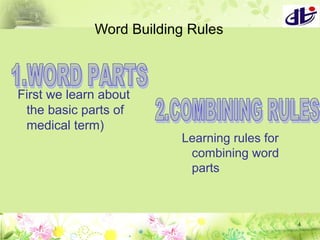
Word Building Rules 
Learning rules for 
combining word 
parts 
First we learn about 
the basic parts of 
medical term)
5 
• Basic foundation of a word 
– Component parts are added to change 
meaning 
• Example word: cardiologist 
– cardi (word root) = heart 
– Words with cardi will always refer to the 
heart
6 
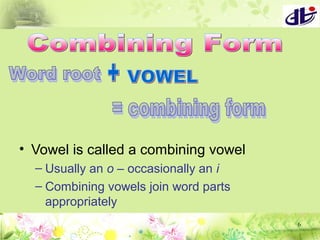
• Vowel is called a combining vowel 
– Usually an o – occasionally an i 
– Combining vowels join word parts 
appropriately
7 
• When using more than one word root – as 
in compound word 
• i.e. 1.HEPAT-O-2.CYTES 
– Combining vowel is needed to separate the 
different word roots 
– Usually done whether or not second or third 
word root begins with a vowel
8 
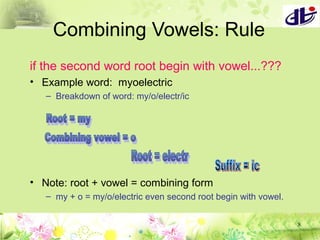
Combining Vowels: Rule 
if the second word root begin with vowel...??? 
• Example word: myoelectric 
– Breakdown of word: my/o/electr/ic 
• Note: root + vowel = combining form 
– my + o = my/o/electric even second root begin with vowel.
9 
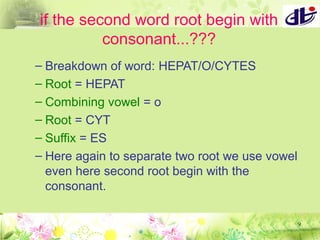
if the second word root begin with 
consonant...??? 
– Breakdown of word: HEPAT/O/CYTES 
– Root = HEPAT 
– Combining vowel = o 
– Root = CYT 
– Suffix = ES 
– Here again to separate two root we use vowel 
even here second root begin with the 
consonant.
10 
Combining Vowels: Rule 
• A word cannot end in a combining form to 
complete term should add suffix. 
–Drop the combining vowel 
–Add a suffix 
–Makes the word a noun or an 
adjective
11 
Combining Vowels: Rule 
• Example word: megalocardia 
– Breakdown of word: megal/o/card/ia 
– Root = megal 
– Combining vowel = o 
– Root = card 
– Suffix = ia 
• Note: Word cannot be megal/o/card/o 
– Must drop combining vowel o 
– Must add ending
12 
Suffix 
• Attaches to the end of the word root 
– Makes a word a noun or an adjective 
• Meaning of suffix remains the same 
– Suffix changes meaning of root to which it is 
attached
13 
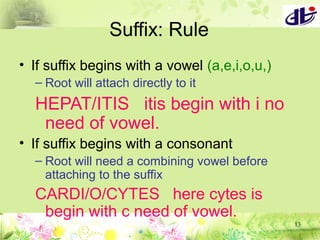
Suffix: Rule 
• If suffix begins with a vowel (a,e,i,o,u,) 
– Root will attach directly to it 
HEPAT/ITIS itis begin with i no 
need of vowel. 
• If suffix begins with a consonant 
– Root will need a combining vowel before 
attaching to the suffix 
CARDI/O/CYTES here cytes is 
begin with c need of vowel.
14 
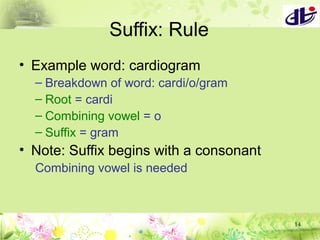
Suffix: Rule 
• Example word: cardiogram 
– Breakdown of word: cardi/o/gram 
– Root = cardi 
– Combining vowel = o 
– Suffix = gram 
• Note: Suffix begins with a consonant 
Combining vowel is needed
15 
Suffix: Rule 
• Example word: cardialgia 
– Breakdown of word: cardi/algia 
– Root = cardi 
– Suffix = algia 
• Note: Suffix begins with a vowel 
– Combining vowel is not needed
16 
Prefix 
• Attaches to the beginning of a word 
• Meaning of prefix always remains the 
same 
– Prefix changes meaning of root to which it is 
attached 
– Not all words have prefixes
17 
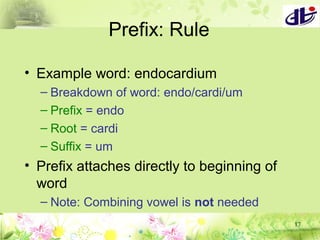
Prefix: Rule 
• Example word: endocardium 
– Breakdown of word: endo/cardi/um 
– Prefix = endo 
– Root = cardi 
– Suffix = um 
• Prefix attaches directly to beginning of 
word 
– Note: Combining vowel is not needed
18 
Word Structure 
• Review 
– Prefix is placed at beginning of word 
– Suffix is placed at end of word root 
– Combining forms are used when word has 
more than one word root = compound word
19 
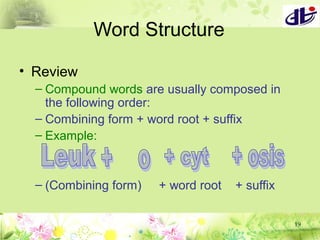
Word Structure 
• Review 
– Compound words are usually composed in 
the following order: 
– Combining form + word root + suffix 
– Example: 
– (Combining form) + word root + suffix
20 
Word Structure 
• Review 
• Defining a medical term: 
– Define suffix first 
– Read from right to left and define each word 
element 
• Example: carditis 
– Suffix = itis = inflammation 
– Word root = card = heart 
– Definition = inflammation of the heart
21 
• Review 
• Medical words with prefixes 
– Define suffix first, prefix second, word roots 
last 
Word Structure
22 
Word Structure 
• Example: intracardiac 
– Suffix = ac = pertaining to 
– Prefix = intra = within 
– Word root = cardi = heart 
– Definition = pertaining to within the heart
23 
Word Structure 
• Review 
• When medical words identify body 
systems or parts 
– Define suffix first, body organs in order they 
are studied in body system
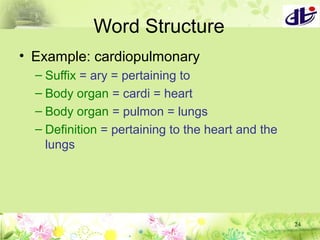
24 
• Example: cardiopulmonary 
– Suffix = ary = pertaining to 
– Body organ = cardi = heart 
– Body organ = pulmon = lungs 
– Definition = pertaining to the heart and the 
lungs 
Word Structure
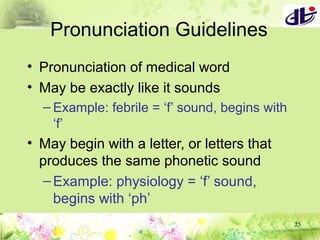
25 
Pronunciation Guidelines 
• Pronunciation of medical word 
• May be exactly like it sounds 
– Example: febrile = ‘f’ sound, begins with 
‘f’ 
• May begin with a letter, or letters that 
produces the same phonetic sound 
–Example: physiology = ‘f’ sound, 
begins with ‘ph’
26 
Pronunciation Guidelines 
• If it sounds like ‘f’ 
– Look for ‘f’ = febrile 
– Look for ‘ph’ = physiology 
• If it sounds like ‘j’ 
– Look for ‘j’ = jejunum 
– Look for ‘ge’ = genesis 
– Look for ‘gi’ = gingivitis 
– Look for ‘gy’ = gyrus
27 
Pronunciation Guidelines 
• If it sounds like ‘k’ 
– Look for ‘k’ = kyphosis (backward curvature 
of supine) 
– Look for ‘c’ = cornea ( part of eye) 
– Look for ‘ch’ = chorion( fetal covering layer) 
– Look for ‘qu’ = quadruplet( represent four) 
• If it sounds like ‘n’ 
– Look for ‘n’ = neonatal(baby of 28 day) 
– Look for ‘pn’ = pneumonia( lung infection) 
– Look for ‘kn’ = knee
28 
Pronunciation Guidelines 
• If it sounds like ‘s’ 
– Look for ‘s’ = sarcoma( connective tissue 
cancer) 
– Look for ‘c’ = cervix( reproductive part) 
– Look for ‘ps’ = psychology 
• If it sounds like ‘sk’ 
– Look for ‘sk’ = skeleton 
– Look for ‘sc’ = sclera 
– Look for ‘sch’ = schizophrenia( psychosis)
29 
Pronunciation Guidelines 
• If it sounds like ‘z’ 
– Look for ‘z’ = zygomatic( cheek bone) 
– Look for ‘x’ = xanthoma( fat deposition)
30 
Additional Pronunciation Rules 
• Words that begin with ‘c’ 
– If followed by ‘e’, ‘i’, or ‘y’ 
– Pronounced as soft ‘c’ 
– Has ‘j’ sound 
• Examples 
– ‘ce’ = cervix 
– ‘ci’ = circumduction( removal of foreskin of 
penis) 
– ‘cy’ = cyst( thick wall fluid filled )
31 
Additional Pronunciation Rules 
• Words that begin with ‘c’ 
– If followed by ‘a’, ‘o’, ‘u’, or consonant 
– Pronounced as hard ‘c’ 
– Has a ‘k’ sound 
• Examples 
– ‘ca’ = cancer 
– ‘co’ = collagen( fibrous protien) 
– ‘cu’ = cuticle (thin covering) 
– ‘ch’ = cheiloplasty (Lip Surgery)
32 
Additional Pronunciation Rules 
• Word roots that end in ‘g’ 
– If followed by ‘e’ or ‘i’ 
– Pronounced as soft ‘g’ 
– Sounds like ‘j’ 
• Examples 
– Laryng / ectomy 
– Pharyng / itis
33 
Additional Pronunciation Rules 
• Word roots that end in ‘g’ 
– If followed by ‘a’, ‘o’, or consonant 
– Pronounced as hard ‘g’ 
– Has ‘guh’ sound 
• Examples 
– Laryng / algia 
– Mening / ocele 
– Glossal
34 
Possessive Forms 
• Some diseases are named after 
individuals 
– Pronounced and written in possessive forms 
• Eponym (EP-oh-nim) 
– Name for a disease, organ, procedure, or 
body function 
– Derived from the name of a person
35

Chapter01 wordbuildingrules Terminology

  • 1.
  • 2.
    2 What isthe Terminology ??? • Basic Medical language • Explain body parts • Pathological conditions • Diagnostic techniques
  • 3.
    3 CHAPTER 1 • Word • Building Rules
  • 4.
    4 Word BuildingRules Learning rules for combining word parts First we learn about the basic parts of medical term)
  • 5.
    5 • Basicfoundation of a word – Component parts are added to change meaning • Example word: cardiologist – cardi (word root) = heart – Words with cardi will always refer to the heart
  • 6.
    6 • Vowelis called a combining vowel – Usually an o – occasionally an i – Combining vowels join word parts appropriately
  • 7.
    7 • Whenusing more than one word root – as in compound word • i.e. 1.HEPAT-O-2.CYTES – Combining vowel is needed to separate the different word roots – Usually done whether or not second or third word root begins with a vowel
  • 8.
    8 Combining Vowels:Rule if the second word root begin with vowel...??? • Example word: myoelectric – Breakdown of word: my/o/electr/ic • Note: root + vowel = combining form – my + o = my/o/electric even second root begin with vowel.
  • 9.
    9 if thesecond word root begin with consonant...??? – Breakdown of word: HEPAT/O/CYTES – Root = HEPAT – Combining vowel = o – Root = CYT – Suffix = ES – Here again to separate two root we use vowel even here second root begin with the consonant.
  • 10.
    10 Combining Vowels:Rule • A word cannot end in a combining form to complete term should add suffix. –Drop the combining vowel –Add a suffix –Makes the word a noun or an adjective
  • 11.
    11 Combining Vowels:Rule • Example word: megalocardia – Breakdown of word: megal/o/card/ia – Root = megal – Combining vowel = o – Root = card – Suffix = ia • Note: Word cannot be megal/o/card/o – Must drop combining vowel o – Must add ending
  • 12.
    12 Suffix •Attaches to the end of the word root – Makes a word a noun or an adjective • Meaning of suffix remains the same – Suffix changes meaning of root to which it is attached
  • 13.
    13 Suffix: Rule • If suffix begins with a vowel (a,e,i,o,u,) – Root will attach directly to it HEPAT/ITIS itis begin with i no need of vowel. • If suffix begins with a consonant – Root will need a combining vowel before attaching to the suffix CARDI/O/CYTES here cytes is begin with c need of vowel.
  • 14.
    14 Suffix: Rule • Example word: cardiogram – Breakdown of word: cardi/o/gram – Root = cardi – Combining vowel = o – Suffix = gram • Note: Suffix begins with a consonant Combining vowel is needed
  • 15.
    15 Suffix: Rule • Example word: cardialgia – Breakdown of word: cardi/algia – Root = cardi – Suffix = algia • Note: Suffix begins with a vowel – Combining vowel is not needed
  • 16.
    16 Prefix •Attaches to the beginning of a word • Meaning of prefix always remains the same – Prefix changes meaning of root to which it is attached – Not all words have prefixes
  • 17.
    17 Prefix: Rule • Example word: endocardium – Breakdown of word: endo/cardi/um – Prefix = endo – Root = cardi – Suffix = um • Prefix attaches directly to beginning of word – Note: Combining vowel is not needed
  • 18.
    18 Word Structure • Review – Prefix is placed at beginning of word – Suffix is placed at end of word root – Combining forms are used when word has more than one word root = compound word
  • 19.
    19 Word Structure • Review – Compound words are usually composed in the following order: – Combining form + word root + suffix – Example: – (Combining form) + word root + suffix
  • 20.
    20 Word Structure • Review • Defining a medical term: – Define suffix first – Read from right to left and define each word element • Example: carditis – Suffix = itis = inflammation – Word root = card = heart – Definition = inflammation of the heart
  • 21.
    21 • Review • Medical words with prefixes – Define suffix first, prefix second, word roots last Word Structure
  • 22.
    22 Word Structure • Example: intracardiac – Suffix = ac = pertaining to – Prefix = intra = within – Word root = cardi = heart – Definition = pertaining to within the heart
  • 23.
    23 Word Structure • Review • When medical words identify body systems or parts – Define suffix first, body organs in order they are studied in body system
  • 24.
    24 • Example:cardiopulmonary – Suffix = ary = pertaining to – Body organ = cardi = heart – Body organ = pulmon = lungs – Definition = pertaining to the heart and the lungs Word Structure
  • 25.
    25 Pronunciation Guidelines • Pronunciation of medical word • May be exactly like it sounds – Example: febrile = ‘f’ sound, begins with ‘f’ • May begin with a letter, or letters that produces the same phonetic sound –Example: physiology = ‘f’ sound, begins with ‘ph’
  • 26.
    26 Pronunciation Guidelines • If it sounds like ‘f’ – Look for ‘f’ = febrile – Look for ‘ph’ = physiology • If it sounds like ‘j’ – Look for ‘j’ = jejunum – Look for ‘ge’ = genesis – Look for ‘gi’ = gingivitis – Look for ‘gy’ = gyrus
  • 27.
    27 Pronunciation Guidelines • If it sounds like ‘k’ – Look for ‘k’ = kyphosis (backward curvature of supine) – Look for ‘c’ = cornea ( part of eye) – Look for ‘ch’ = chorion( fetal covering layer) – Look for ‘qu’ = quadruplet( represent four) • If it sounds like ‘n’ – Look for ‘n’ = neonatal(baby of 28 day) – Look for ‘pn’ = pneumonia( lung infection) – Look for ‘kn’ = knee
  • 28.
    28 Pronunciation Guidelines • If it sounds like ‘s’ – Look for ‘s’ = sarcoma( connective tissue cancer) – Look for ‘c’ = cervix( reproductive part) – Look for ‘ps’ = psychology • If it sounds like ‘sk’ – Look for ‘sk’ = skeleton – Look for ‘sc’ = sclera – Look for ‘sch’ = schizophrenia( psychosis)
  • 29.
    29 Pronunciation Guidelines • If it sounds like ‘z’ – Look for ‘z’ = zygomatic( cheek bone) – Look for ‘x’ = xanthoma( fat deposition)
  • 30.
    30 Additional PronunciationRules • Words that begin with ‘c’ – If followed by ‘e’, ‘i’, or ‘y’ – Pronounced as soft ‘c’ – Has ‘j’ sound • Examples – ‘ce’ = cervix – ‘ci’ = circumduction( removal of foreskin of penis) – ‘cy’ = cyst( thick wall fluid filled )
  • 31.
    31 Additional PronunciationRules • Words that begin with ‘c’ – If followed by ‘a’, ‘o’, ‘u’, or consonant – Pronounced as hard ‘c’ – Has a ‘k’ sound • Examples – ‘ca’ = cancer – ‘co’ = collagen( fibrous protien) – ‘cu’ = cuticle (thin covering) – ‘ch’ = cheiloplasty (Lip Surgery)
  • 32.
    32 Additional PronunciationRules • Word roots that end in ‘g’ – If followed by ‘e’ or ‘i’ – Pronounced as soft ‘g’ – Sounds like ‘j’ • Examples – Laryng / ectomy – Pharyng / itis
  • 33.
    33 Additional PronunciationRules • Word roots that end in ‘g’ – If followed by ‘a’, ‘o’, or consonant – Pronounced as hard ‘g’ – Has ‘guh’ sound • Examples – Laryng / algia – Mening / ocele – Glossal
  • 34.
    34 Possessive Forms • Some diseases are named after individuals – Pronounced and written in possessive forms • Eponym (EP-oh-nim) – Name for a disease, organ, procedure, or body function – Derived from the name of a person
  • 35.