17 Chapter -17
10-1
Alternative Marketing
Red Bull’s Buzz
• Launched in Australia, 1984
• By 2001, held 70% of energy drink
market in U.S. ($140 million in sales)
• Entry in United States
• Buzz marketing
• Consumer educators -- parties
• Extreme sporting events
• Competitive reaction slow
• Recently – more traditional advertising
17
10-2
Chapter Overview
• Traditional media declining
• Alternative media rising
• Ugg – fashion conscious consumers
• Alternative approaches
• Buzz marketing
• Guerilla marketing
• Product placement
• Branded entertainment
• Lifestyle marketing
• In-store marketing
• Brand communities
Discussion Slide
17
Alternative Marketing
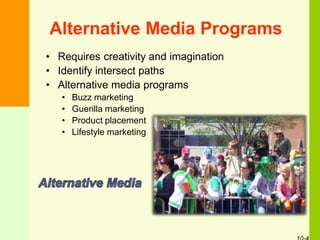
Alternative Media Programs
• Requires creativity and imagination
• Identify intersect paths
• Alternative media programs
• Buzz marketing
• Guerilla marketing
• Product placement
• Lifestyle marketing
Buzz Marketing
• Word-of-mouth marketing
• Higher credibility
• Fast growth – now $1 billion annually
• Methods of generating buzz
• Consumers who like a brand
• Sponsored consumers
• Company or agency generated buzz
Consumers Who Like a Brand
• Ideal ambassador
• Buzz spread
• In person
• Internet
• Chat rooms
• Blogs
• E-mails
Sponsored Consumers
• Agent or advocate for a new brand
• Dawn Direct Foam (P & G)
• Sony
• Brand ambassadors or customer evangelists
• Typically individuals who already like brand
• Offer incentives in exchange for advocacy
• Selection based on
• Devotion to brand
• Size of social circles
• Expected to delivery messages
• Grassroots efforts
• Low-cost marketing events
• Lee jeans
Company Employees
• Employees posing as customers
• High risk approach
• Word of Mouth Marketing Association (WOMMA)
• Honesty of relationship
• Honesty of opinion
• Honesty of identity
Buzz Marketing Stages
• Three stages
1. Inoculation
2. Incubation
3. infection
• Buzz marketing difficult during inoculation stage
• Must use brand ambassadors or customer evangelists
• True customer-generated buzz occurs after awareness
• Awareness generated through traditional advertising
Buzz Marketing Preconditions
• Brand must be unique, new, or perform better
• Brand must stand out
• Memorable advertising helps
• Intriguing, different, and unique
• Customers must get involved
• Buzz marketing works because
• People trust someone’s else’s opinion
• People like to give their opinion
Guerilla Marketing
• Developed by Jay Conrad Levinson
• Instant results with unique, low-cost approaches
• Focus on region or area
• Create excitement
• Involve interacting with consumers
• Goal is to generate buzz
• Harley Davidson “Cat shoot”
• Grassroots efforts
• Alternative media
Reasons for Using Guerilla Marketing
• To find new ways to communicate with customers
• To interact with customers
• To make advertising accessible to consumers
• To impact a spot market
• To create buzz
• To build relationships with consumers
F I G U R E 10 . 3
Source:Adapted from Lin Zuo and Shari Veil, “Guerilla Marketing and theAqua Teen Hunger Force Fiasco,” Public
Relations Quarterly, Vol. 51, No. 4 (Winter 2006/.2007), pp. 8-11
Product Placement
• Advertisers believe
• Increased brand awareness
• Positive attitude towards the brand
• No immediate impact on sales
• Nielsen Research
• “Emotionally engaging” TV shows recognized by 43%
more viewers
• “Highly enjoyed programs” brand recognition increased
29% compared to 21% for commercial spots
• Positive brand feelings increased 85% compared to
75% for commercial spots.
• Low cost per viewer
Branded Entertainment
• Brand woven into the storyline
• Use increased sharply with reality shows
• Also found in novels, plays, songs, and movies
F I G U R E 10 . 5
Key Factors in Product Placement and Branded Entertainment
• Media
• Supporting promotional activities
• Consumer attitudes toward placements
• Placement characteristics
• Regulations
Source:Adapted from Simon Hudson and David Hudson, “Branded Entertainment:A New Advertising Technique
or Product Placement in Disguise?” Journal of Marketing Management, Vol. 22, No. 5/6 (July 2006), pp. 489-504.
Product Placement and
Branded Entertainment
• Work because no call to action
• Goal is to increase brand awareness and liking
• Placements work best when logical fit
• Negative/positive scene impacts reaction
• Bypasses legislation
• Increase in placement budgets
• Brand’s appeal stronger in non-advertising context
• Perception of what others think is important to consumers
• Provides postpurchase reassurance
• Program can provide evidence of a brand’s advantage
Video Game Advertising
• $1 billion per year spent on in-game ads
• Very attractive market
• 75% of online households spend at least 1
hour per month playing online games
• 27% average 30 hours or more
• Primary market is 17-34 year old males
• Have become difficult to reach
• Play shooting games
• Fastest growing market is females
• Now 20% of market
• Play puzzle and cerebral games
F I G U R E 10 . 6
Video Game Advertising
• In-game advertisements
• Rotating in-game advertising
• Interactive ads
• Game-related Web sites
• Advergames
• Sponsored downloads
Video Game Advertising
• Benefits
• Online games allow Web analytics
• Ads can be targeted to match audience
• Disadvantage
• Ads soon become static
• New technologies
• Ad rotations within game
• New ads can be added to online games
• Time-sensitive ads can be used
• Ads can be made interactive
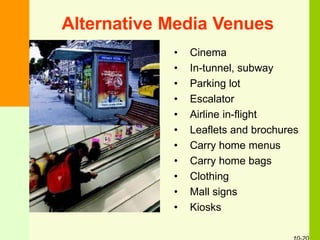
Alternative Media Venues
• Cinema
• In-tunnel, subway
• Parking lot
• Escalator
• Airline in-flight
• Leaflets and brochures
• Carry home menus
• Carry home bags
• Clothing
• Mall signs
• Kiosks
F I G U R E 10 . 7
Types of Advertising that Most Influenced Clothing
Purchases
• In-store advertising (52.6%)
• Print ads (23.9%)
• Word-of-mouth communications (15.8%)
• Television ads (14.1%)
• Internet ads (10.4%)
• Direct mail (7.4%)
• Radio ads (1.8%)
Source:Adapted fromAmy Johannes, “Snap Decisions,” Promo, Vol. 18, No. 11 (October 2005), p. 16.
In-Store Marketing
• 70% of purchase decisions made in store
• In-store atmospherics
• Sight, sound, and scent
• Video screens and television monitors
• Customize messages
• The Salon Channel
• Wal-Mart
• 127 million shoppers per week
• Unilever
Point-of-Purchase Displays
• Location is key
• Last chance to reach buyer
• Facts
• 70% of decisions are in store
• 50% of money spent at mass-merchandisers and
supermarkets is unplanned
• 50% of Coca-Cola products from displays
• Average increase in sales is 9%
• Half of POP displays not effective
• Half that are effective – 20% increase in sales
F I G U R E 10 . 8
Effective Point of Purchase Displays
• Integrate the brand’s image into the display.
• Integrate the display with current advertising and promotions.
• Make the display dramatic to get attention.
• Keep the color of the display down so the product and signage
stand out.
• Make the display versatile so it can be easily adapted by
retailers.
• Make the display re-usable and easy to assemble.
• Make the display easy to stock.
• Customize the display to fit the retailer’s store.
Measuring POP Effectiveness
• Both retailers and manufacturers want displays that
are effective
• Point-of-sales (POS) data
• For retailers
• Indicates time to withdraw or change display
• Identify POP displays with largest impact
• Test market different displays
• For manufacturers
• Data can improve quality of displays
• Strengthen relationships with retailers
Combination Approaches
• Digital, LED displays
• Interactive displays
• Integration of advertising and marketing with POP
• Interface of digital technology with in-store networks
• Interface with retail computers
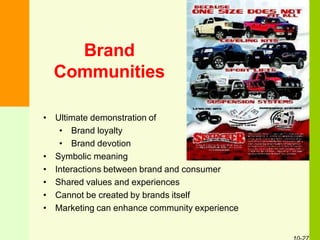
Brand
Communities
• Ultimate demonstration of
• Brand loyalty
• Brand devotion
• Symbolic meaning
• Interactions between brand and consumer
• Shared values and experiences
• Cannot be created by brands itself
• Marketing can enhance community experience
F I G U R E 10 . 9
Reasons Brand Communities Form
• Affirmation of the buying decision.
• Social identity and bond.
• Swap stories.
• Swap advice and provide help to others.
• Feedback and new ideas.
Harley Davidson
Brand Community
Click to play clip from
Harley Davidson
VIDEO
F I G U R E 10 . 10
Ways to Enhance a Brand Community
• Create benefits to encourage new customers to join.
• Provide materials not available anywhere else.
• Involve firm representatives in the groups.
• Sponsor special events and regular meetings.
• Promote communications among members.
• Build a strong brand reputation.
Source:Adapted from “Brand Communities,” Bulletpoint, No. 133 (July 2006), pp. 12-16.
International Implications
• Alternative marketing - U.S. minorities
• Alternative media used in other countries
• “A Sunny Day” – China (Pepsi and Starbucks)
• Brand communities developing in other countries
• Jeep - China
• Ad clutter a global problem
• Growing use of alternative media tactics
• New alternative marketing programs

Chapter 17 alternative marketing

  • 1.
  • 2.
    Red Bull’s Buzz •Launched in Australia, 1984 • By 2001, held 70% of energy drink market in U.S. ($140 million in sales) • Entry in United States • Buzz marketing • Consumer educators -- parties • Extreme sporting events • Competitive reaction slow • Recently – more traditional advertising 17 10-2
  • 3.
    Chapter Overview • Traditionalmedia declining • Alternative media rising • Ugg – fashion conscious consumers • Alternative approaches • Buzz marketing • Guerilla marketing • Product placement • Branded entertainment • Lifestyle marketing • In-store marketing • Brand communities Discussion Slide 17 Alternative Marketing
  • 4.
    Alternative Media Programs •Requires creativity and imagination • Identify intersect paths • Alternative media programs • Buzz marketing • Guerilla marketing • Product placement • Lifestyle marketing
  • 5.
    Buzz Marketing • Word-of-mouthmarketing • Higher credibility • Fast growth – now $1 billion annually • Methods of generating buzz • Consumers who like a brand • Sponsored consumers • Company or agency generated buzz
  • 6.
    Consumers Who Likea Brand • Ideal ambassador • Buzz spread • In person • Internet • Chat rooms • Blogs • E-mails
  • 7.
    Sponsored Consumers • Agentor advocate for a new brand • Dawn Direct Foam (P & G) • Sony • Brand ambassadors or customer evangelists • Typically individuals who already like brand • Offer incentives in exchange for advocacy • Selection based on • Devotion to brand • Size of social circles • Expected to delivery messages • Grassroots efforts • Low-cost marketing events • Lee jeans
  • 8.
    Company Employees • Employeesposing as customers • High risk approach • Word of Mouth Marketing Association (WOMMA) • Honesty of relationship • Honesty of opinion • Honesty of identity
  • 9.
    Buzz Marketing Stages •Three stages 1. Inoculation 2. Incubation 3. infection • Buzz marketing difficult during inoculation stage • Must use brand ambassadors or customer evangelists • True customer-generated buzz occurs after awareness • Awareness generated through traditional advertising
  • 10.
    Buzz Marketing Preconditions •Brand must be unique, new, or perform better • Brand must stand out • Memorable advertising helps • Intriguing, different, and unique • Customers must get involved • Buzz marketing works because • People trust someone’s else’s opinion • People like to give their opinion
  • 11.
    Guerilla Marketing • Developedby Jay Conrad Levinson • Instant results with unique, low-cost approaches • Focus on region or area • Create excitement • Involve interacting with consumers • Goal is to generate buzz • Harley Davidson “Cat shoot” • Grassroots efforts • Alternative media
  • 12.
    Reasons for UsingGuerilla Marketing • To find new ways to communicate with customers • To interact with customers • To make advertising accessible to consumers • To impact a spot market • To create buzz • To build relationships with consumers F I G U R E 10 . 3 Source:Adapted from Lin Zuo and Shari Veil, “Guerilla Marketing and theAqua Teen Hunger Force Fiasco,” Public Relations Quarterly, Vol. 51, No. 4 (Winter 2006/.2007), pp. 8-11
  • 13.
    Product Placement • Advertisersbelieve • Increased brand awareness • Positive attitude towards the brand • No immediate impact on sales • Nielsen Research • “Emotionally engaging” TV shows recognized by 43% more viewers • “Highly enjoyed programs” brand recognition increased 29% compared to 21% for commercial spots • Positive brand feelings increased 85% compared to 75% for commercial spots. • Low cost per viewer
  • 14.
    Branded Entertainment • Brandwoven into the storyline • Use increased sharply with reality shows • Also found in novels, plays, songs, and movies
  • 15.
    F I GU R E 10 . 5 Key Factors in Product Placement and Branded Entertainment • Media • Supporting promotional activities • Consumer attitudes toward placements • Placement characteristics • Regulations Source:Adapted from Simon Hudson and David Hudson, “Branded Entertainment:A New Advertising Technique or Product Placement in Disguise?” Journal of Marketing Management, Vol. 22, No. 5/6 (July 2006), pp. 489-504.
  • 16.
    Product Placement and BrandedEntertainment • Work because no call to action • Goal is to increase brand awareness and liking • Placements work best when logical fit • Negative/positive scene impacts reaction • Bypasses legislation • Increase in placement budgets • Brand’s appeal stronger in non-advertising context • Perception of what others think is important to consumers • Provides postpurchase reassurance • Program can provide evidence of a brand’s advantage
  • 17.
    Video Game Advertising •$1 billion per year spent on in-game ads • Very attractive market • 75% of online households spend at least 1 hour per month playing online games • 27% average 30 hours or more • Primary market is 17-34 year old males • Have become difficult to reach • Play shooting games • Fastest growing market is females • Now 20% of market • Play puzzle and cerebral games
  • 18.
    F I GU R E 10 . 6 Video Game Advertising • In-game advertisements • Rotating in-game advertising • Interactive ads • Game-related Web sites • Advergames • Sponsored downloads
  • 19.
    Video Game Advertising •Benefits • Online games allow Web analytics • Ads can be targeted to match audience • Disadvantage • Ads soon become static • New technologies • Ad rotations within game • New ads can be added to online games • Time-sensitive ads can be used • Ads can be made interactive
  • 20.
    Alternative Media Venues •Cinema • In-tunnel, subway • Parking lot • Escalator • Airline in-flight • Leaflets and brochures • Carry home menus • Carry home bags • Clothing • Mall signs • Kiosks
  • 21.
    F I GU R E 10 . 7 Types of Advertising that Most Influenced Clothing Purchases • In-store advertising (52.6%) • Print ads (23.9%) • Word-of-mouth communications (15.8%) • Television ads (14.1%) • Internet ads (10.4%) • Direct mail (7.4%) • Radio ads (1.8%) Source:Adapted fromAmy Johannes, “Snap Decisions,” Promo, Vol. 18, No. 11 (October 2005), p. 16.
  • 22.
    In-Store Marketing • 70%of purchase decisions made in store • In-store atmospherics • Sight, sound, and scent • Video screens and television monitors • Customize messages • The Salon Channel • Wal-Mart • 127 million shoppers per week • Unilever
  • 23.
    Point-of-Purchase Displays • Locationis key • Last chance to reach buyer • Facts • 70% of decisions are in store • 50% of money spent at mass-merchandisers and supermarkets is unplanned • 50% of Coca-Cola products from displays • Average increase in sales is 9% • Half of POP displays not effective • Half that are effective – 20% increase in sales
  • 24.
    F I GU R E 10 . 8 Effective Point of Purchase Displays • Integrate the brand’s image into the display. • Integrate the display with current advertising and promotions. • Make the display dramatic to get attention. • Keep the color of the display down so the product and signage stand out. • Make the display versatile so it can be easily adapted by retailers. • Make the display re-usable and easy to assemble. • Make the display easy to stock. • Customize the display to fit the retailer’s store.
  • 25.
    Measuring POP Effectiveness •Both retailers and manufacturers want displays that are effective • Point-of-sales (POS) data • For retailers • Indicates time to withdraw or change display • Identify POP displays with largest impact • Test market different displays • For manufacturers • Data can improve quality of displays • Strengthen relationships with retailers
  • 26.
    Combination Approaches • Digital,LED displays • Interactive displays • Integration of advertising and marketing with POP • Interface of digital technology with in-store networks • Interface with retail computers
  • 27.
    Brand Communities • Ultimate demonstrationof • Brand loyalty • Brand devotion • Symbolic meaning • Interactions between brand and consumer • Shared values and experiences • Cannot be created by brands itself • Marketing can enhance community experience
  • 28.
    F I GU R E 10 . 9 Reasons Brand Communities Form • Affirmation of the buying decision. • Social identity and bond. • Swap stories. • Swap advice and provide help to others. • Feedback and new ideas.
  • 29.
    Harley Davidson Brand Community Clickto play clip from Harley Davidson VIDEO
  • 30.
    F I GU R E 10 . 10 Ways to Enhance a Brand Community • Create benefits to encourage new customers to join. • Provide materials not available anywhere else. • Involve firm representatives in the groups. • Sponsor special events and regular meetings. • Promote communications among members. • Build a strong brand reputation. Source:Adapted from “Brand Communities,” Bulletpoint, No. 133 (July 2006), pp. 12-16.
  • 31.
    International Implications • Alternativemarketing - U.S. minorities • Alternative media used in other countries • “A Sunny Day” – China (Pepsi and Starbucks) • Brand communities developing in other countries • Jeep - China • Ad clutter a global problem • Growing use of alternative media tactics • New alternative marketing programs