This document outlines ten principles of economics from an economics textbook. It discusses the principles in three categories: how people make decisions, how people interact, and how the overall economy works. Some of the key principles covered are that people face tradeoffs, the cost of something is what you give up to get it, markets are generally a good way to organize economic activity, and a country's standard of living depends on its productivity.
Overview and introduction to the principles of economics, addressing questions related to decision-making and resource management.
Explains scarcity and its impact on society’s resource management, consumer choices, and firm production decisions.
Principles of decision-making including tradeoffs, opportunity costs, rationality, and marginal thinking.
Discusses how incentives influence people's decisions based on the prospect of rewards and punishments.
Explains how people interact within an economy, the benefits of trade and specialization, and the role of markets.Describes how government interventions can improve market outcomes by addressing market failures and promoting equity.
Discusses living standards, productivity, and their relationship, highlighting economic disparities.
Addresses the tradeoff between inflation and unemployment, emphasizing economic policies that influence both.
Tips on how to effectively read and study textbook material for better comprehension and retention. A conclusion summarizing the key principles of decision-making, interactions, and overall economy.
1
CHAPTER 1 TENPRINCIPLES OF ECONOMICS
In this chapter, look for the answers to
these questions:
What kinds of questions does economics
address?
What are the principles of how people make
decisions?
What are the principles of how people interact?
What are the principles of how the economy as a
whole works?
3.
2
CHAPTER 1 TENPRINCIPLES OF ECONOMICS
What Economics Is All About
Scarcity refers to the limited nature of society’s
resources.
Economics is the study of how society manages
its scarce resources, including
• how people decide how much to work, save,
and spend, and what to buy
• how firms decide how much to produce,
how many workers to hire
• how society decides how to divide its resources
between national defense, consumer goods,
protecting the environment, and other needs
4.
3
CHAPTER 1 TENPRINCIPLES OF ECONOMICS
HOW PEOPLE MAKE DECISIONS
Decision making is
at the heart of
economics.
The first four
principles deal with
how people make
decisions.
5.
4
CHAPTER 1 TENPRINCIPLES OF ECONOMICS
HOW PEOPLE MAKE DECISIONS
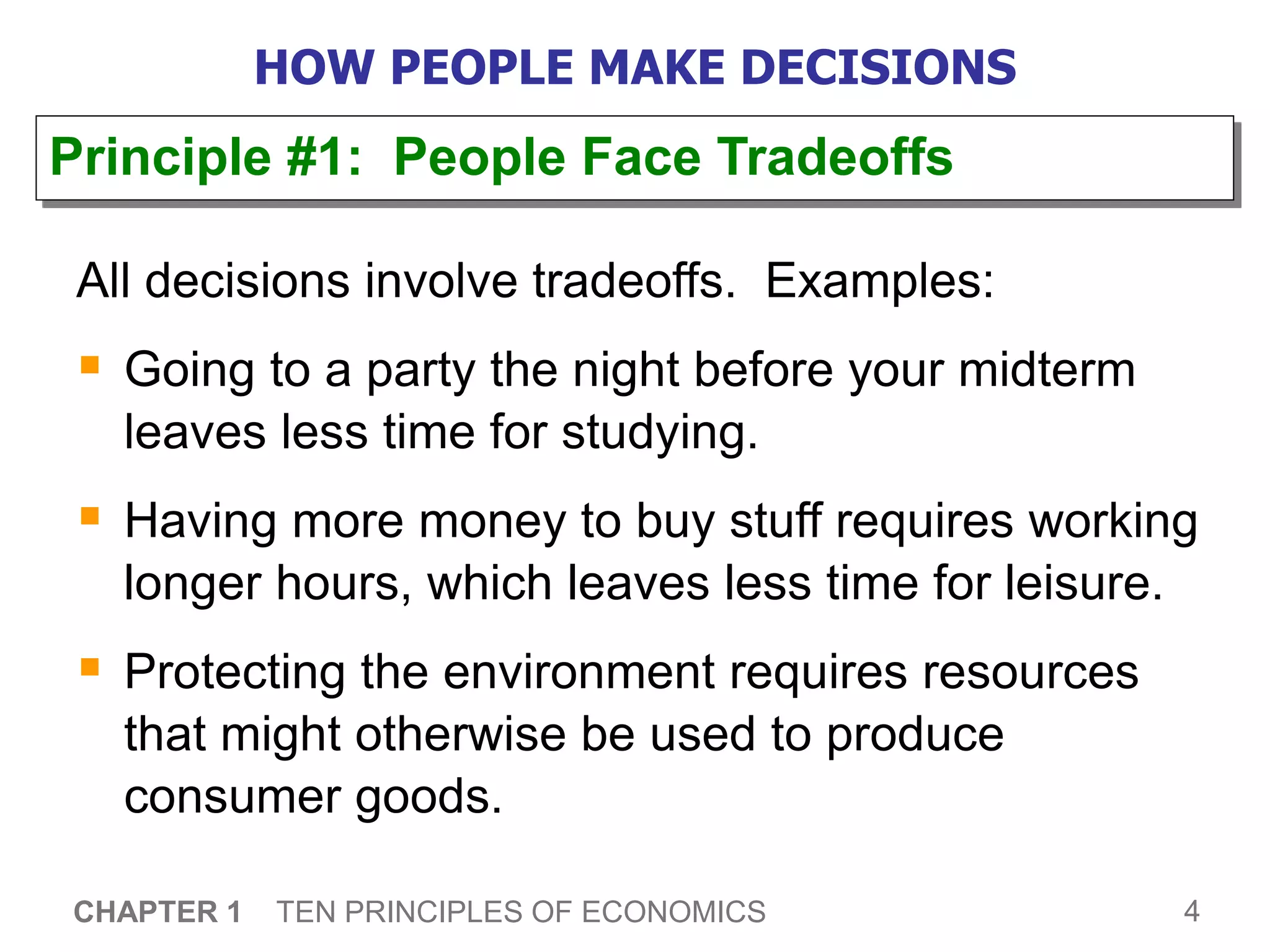
All decisions involve tradeoffs. Examples:
Going to a party the night before your midterm
leaves less time for studying.
Having more money to buy stuff requires working
longer hours, which leaves less time for leisure.
Protecting the environment requires resources
that might otherwise be used to produce
consumer goods.
Principle #1: People Face Tradeoffs
6.
5
CHAPTER 1 TENPRINCIPLES OF ECONOMICS
HOW PEOPLE MAKE DECISIONS
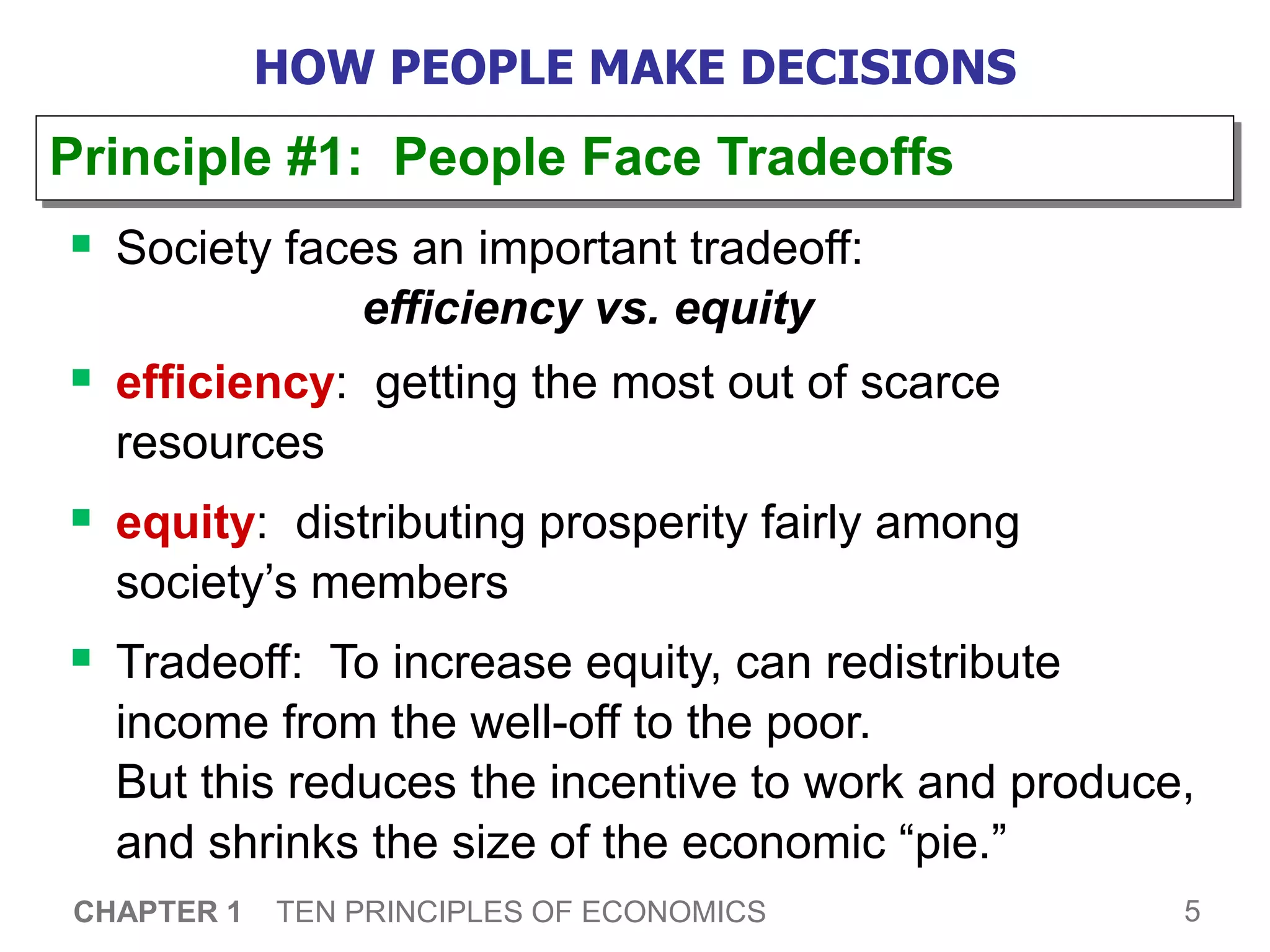
Society faces an important tradeoff:
efficiency vs. equity
efficiency: getting the most out of scarce
resources
equity: distributing prosperity fairly among
society’s members
Tradeoff: To increase equity, can redistribute
income from the well-off to the poor.
But this reduces the incentive to work and produce,
and shrinks the size of the economic “pie.”
Principle #1: People Face Tradeoffs
7.
6
CHAPTER 1 TENPRINCIPLES OF ECONOMICS
HOW PEOPLE MAKE DECISIONS
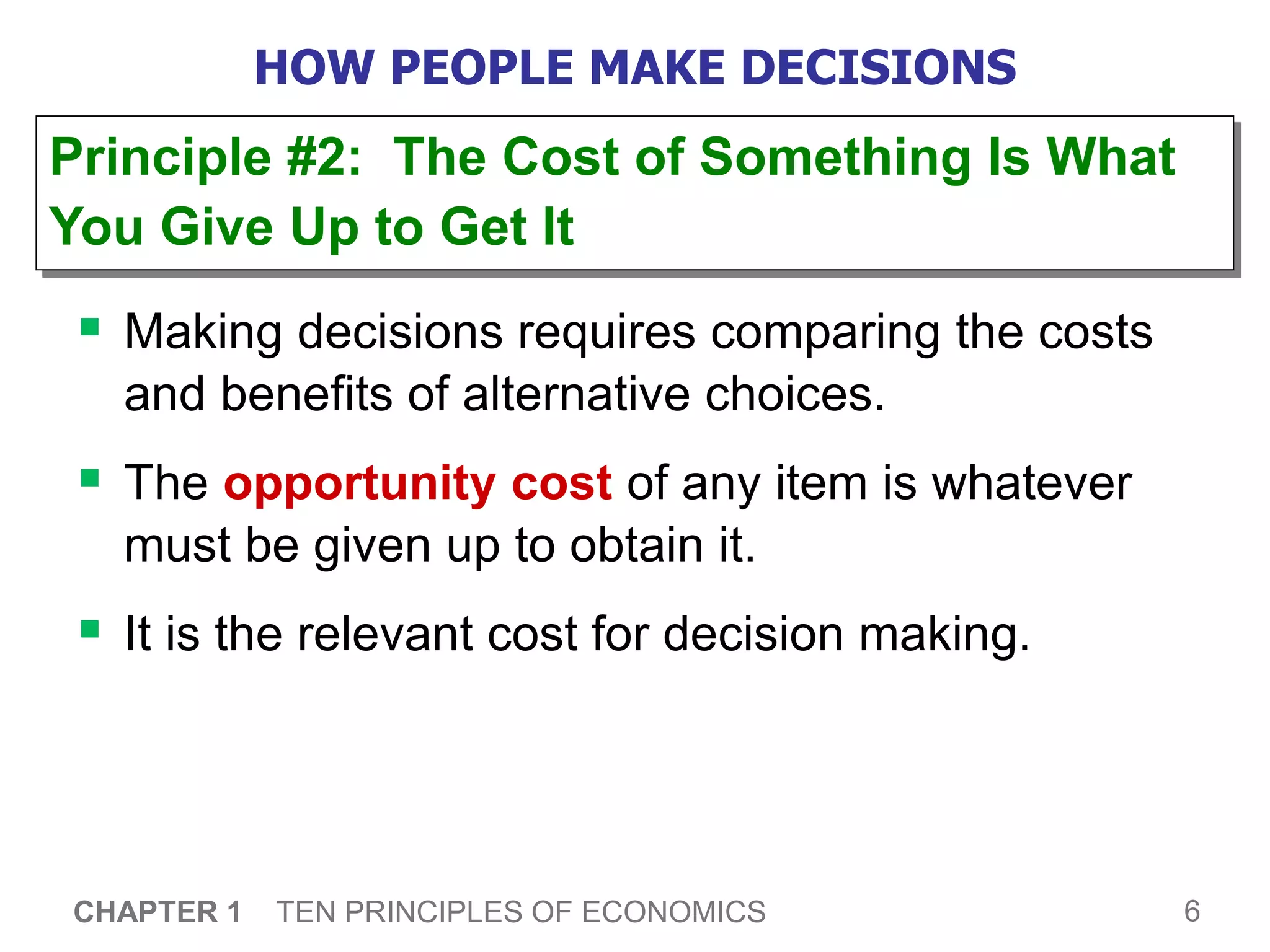
Making decisions requires comparing the costs
and benefits of alternative choices.
The opportunity cost of any item is whatever
must be given up to obtain it.
It is the relevant cost for decision making.
Principle #2: The Cost of Something Is What
You Give Up to Get It
8.
7
CHAPTER 1 TENPRINCIPLES OF ECONOMICS
HOW PEOPLE MAKE DECISIONS
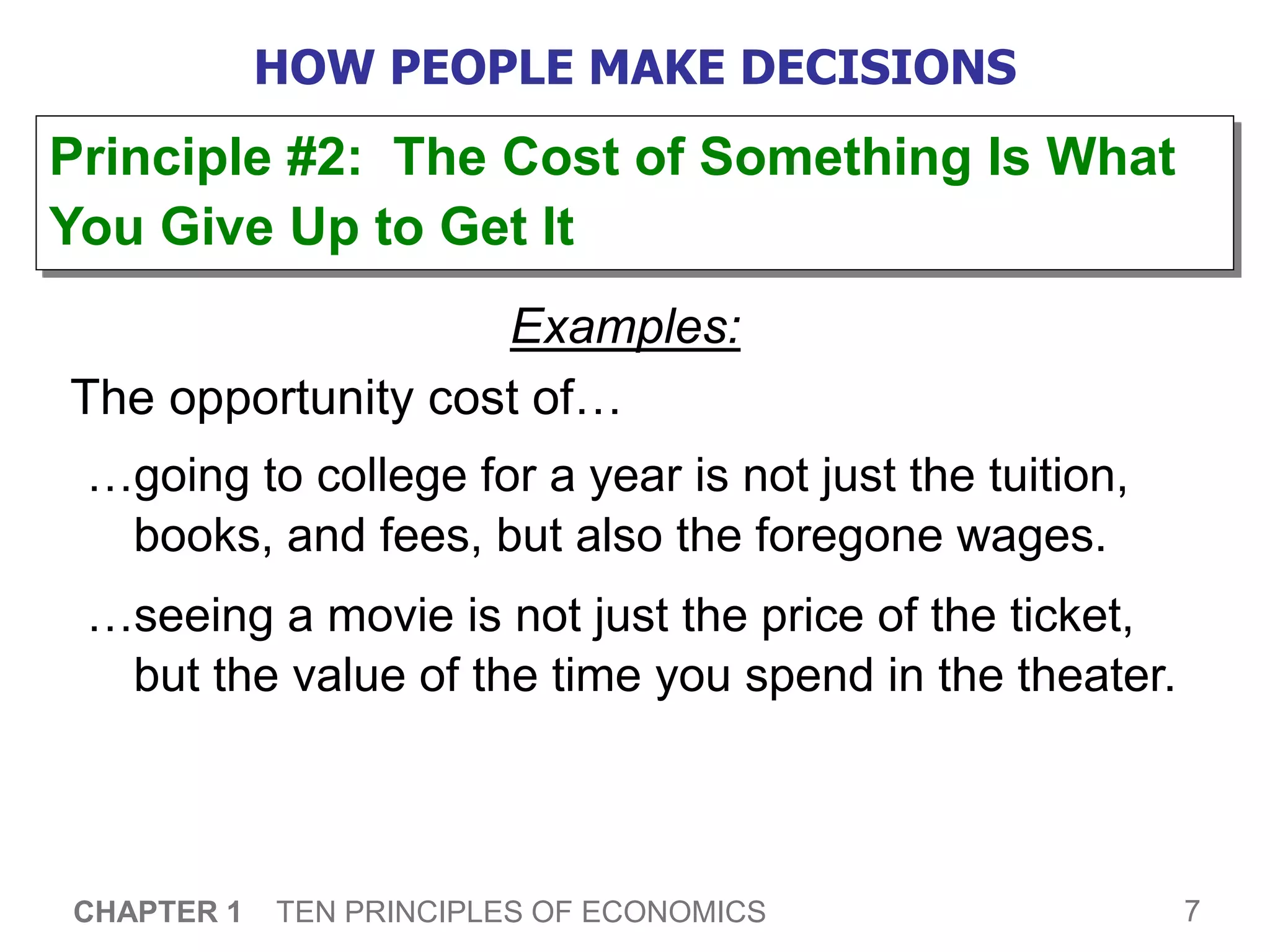
Examples:
The opportunity cost of…
…going to college for a year is not just the tuition,
books, and fees, but also the foregone wages.
…seeing a movie is not just the price of the ticket,
but the value of the time you spend in the theater.
Principle #2: The Cost of Something Is What
You Give Up to Get It
9.
8
CHAPTER 1 TENPRINCIPLES OF ECONOMICS
HOW PEOPLE MAKE DECISIONS
A person is rational if she systematically and
purposefully does the best she can to achieve
her objectives.
Many decisions are not “all or nothing,”
but involve marginal changes – incremental
adjustments to an existing plan.
Evaluating the costs and benefits of marginal
changes is an important part of decision making.
Principle #3: Rational People Think at the
Margin
10.
9
CHAPTER 1 TENPRINCIPLES OF ECONOMICS
HOW PEOPLE MAKE DECISIONS
Examples:
A student considers whether to go to college
for an additional year, comparing the fees &
foregone wages to the extra income he could
earn with an extra year of education.
A firm considers whether to increase output,
comparing the cost of the needed labor and
materials to the extra revenue.
Principle #3: Rational People Think at the
Margin
11.
10
CHAPTER 1 TENPRINCIPLES OF ECONOMICS
HOW PEOPLE MAKE DECISIONS
incentive: something that induces a person to
act, i.e. the prospect of a reward or punishment.
Rational people respond to incentives because
they make decisions by comparing costs and
benefits. Examples:
• In response to higher gas prices,
sales of “hybrid” cars (e.g., Toyota Prius) rise.
• In response to higher cigarette taxes,
teen smoking falls.
Principle #4: People Respond to Incentives
12.
A C TI V E L E A R N I N G 1:
Exercise
You are selling your 1996 Mustang. You have
already spent $1000 on repairs.
At the last minute, the transmission dies. You can
pay $600 to have it repaired, or sell the car “as is.”
In each of the following scenarios, should you have
the transmission repaired?
A. Blue book value is $6500 if transmission works,
$5700 if it doesn’t
B. Blue book value is $6000 if transmission works,
$5500 if it doesn’t
11
13.
A C TI V E L E A R N I N G 1:
Answers
Cost of fixing transmission = $600
A. Blue book value is $6500 if transmission works,
$5700 if it doesn’t
Benefit of fixing the transmission = $800
($6500 – 5700).
It’s worthwhile to have the transmission fixed.
B. Blue book value is $6000 if transmission works,
$5500 if it doesn’t
Benefit of fixing the transmission is only $500.
Paying $600 to fix transmission is not worthwhile.
12
14.
A C TI V E L E A R N I N G 1:
Answers
Observations:
The $1000 you previously spent on repairs is
irrelevant. What matters is the cost and benefit
of the marginal repair (the transmission).
The change in incentives from scenario A
to scenario B caused your decision to change.
13
15.
14
CHAPTER 1 TENPRINCIPLES OF ECONOMICS
HOW PEOPLE INTERACT
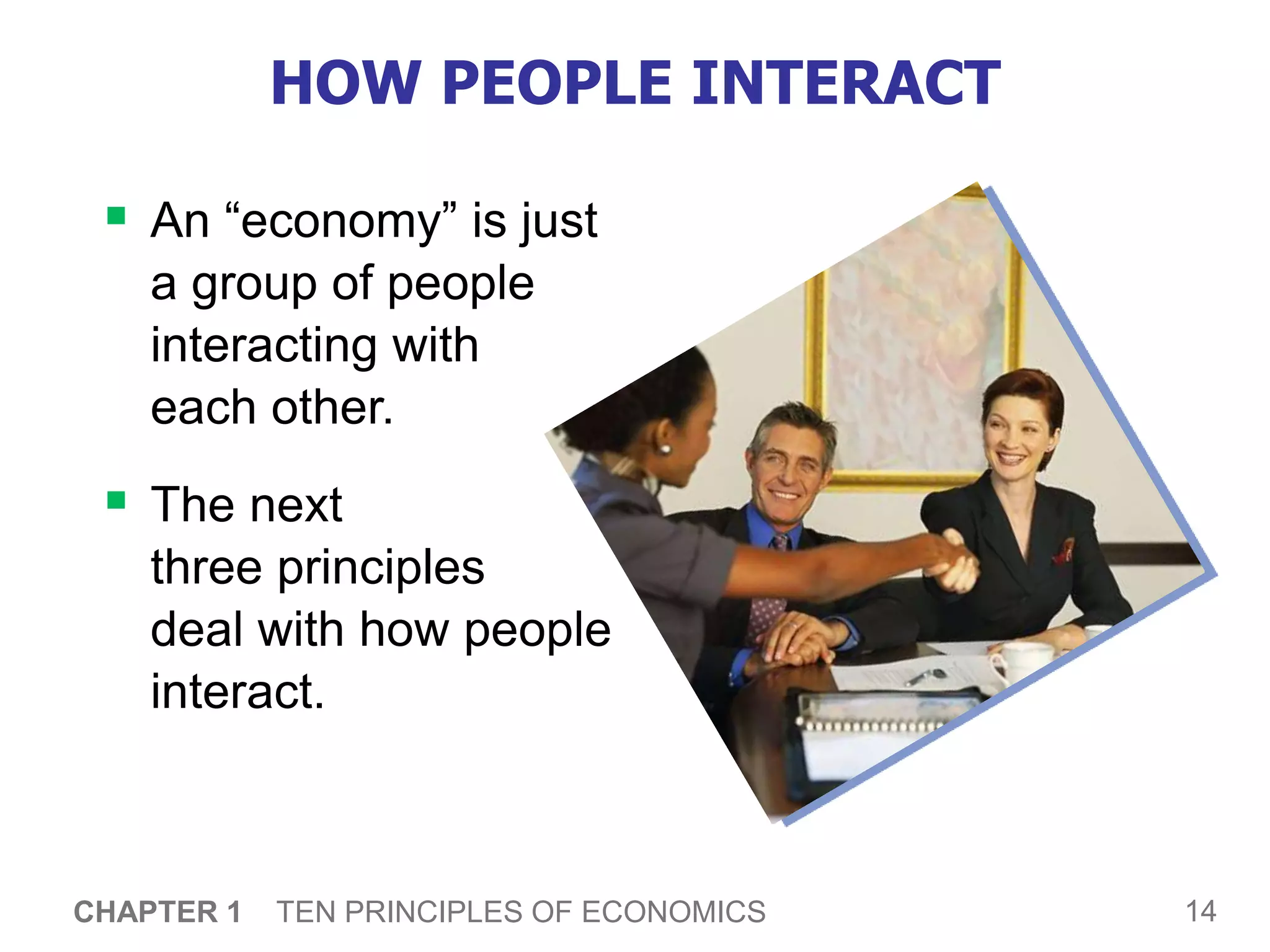
An “economy” is just
a group of people
interacting with
each other.
The next
three principles
deal with how people
interact.
16.
15
CHAPTER 1 TENPRINCIPLES OF ECONOMICS
HOW PEOPLE INTERACT
Rather than being self-sufficient, people can
specialize in producing one good or service
and exchange it for other goods.
Countries also benefit from trade & specialization:
• get a better price abroad for goods they
produce
• buy other goods more cheaply from abroad
than could be produced at home
Principle #5: Trade Can Make Everyone Better
Off
17.
16
CHAPTER 1 TENPRINCIPLES OF ECONOMICS
HOW PEOPLE INTERACT
A market is a group of buyers and sellers.
(They need not be in a single location.)
“Organize economic activity” means determining
• what goods to produce
• how to produce them
• how much of each to produce
• who gets them
Principle #6: Markets Are Usually A Good Way
to Organize Economic Activity
18.
17
CHAPTER 1 TENPRINCIPLES OF ECONOMICS
HOW PEOPLE INTERACT
In a market economy, these decisions result from
the interactions of many households and firms.
Famous insight by Adam Smith in
The Wealth of Nations (1776):
Each of these households and firms
acts as if “led by an invisible hand”
to promote general economic well-being.
Principle #6: Markets Are Usually A Good Way
to Organize Economic Activity
19.
18
CHAPTER 1 TENPRINCIPLES OF ECONOMICS
HOW PEOPLE INTERACT
The invisible hand works through the price system:
• The interaction of buyers and sellers
determines prices of goods and services.
• Each price reflects the good’s value to buyers
and the cost of producing the good.
• Prices guide self-interested households and
firms to make decisions that, in many cases,
maximize society’s economic well-being.
Principle #6: Markets Are Usually A Good Way
to Organize Economic Activity
20.
19
CHAPTER 1 TENPRINCIPLES OF ECONOMICS
HOW PEOPLE INTERACT
Important role for govt: enforce property rights
(with police, courts)
People are less inclined to work, produce, invest, or
purchase if large risk of their property being stolen.
• A restaurant won’t serve meals if customers
do not pay before they leave.
• A music company won’t produce CDs if too many
people avoid paying by making illegal copies.
Principle #7: Governments Can Sometimes
Improve Market Outcomes
21.
20
CHAPTER 1 TENPRINCIPLES OF ECONOMICS
HOW PEOPLE INTERACT
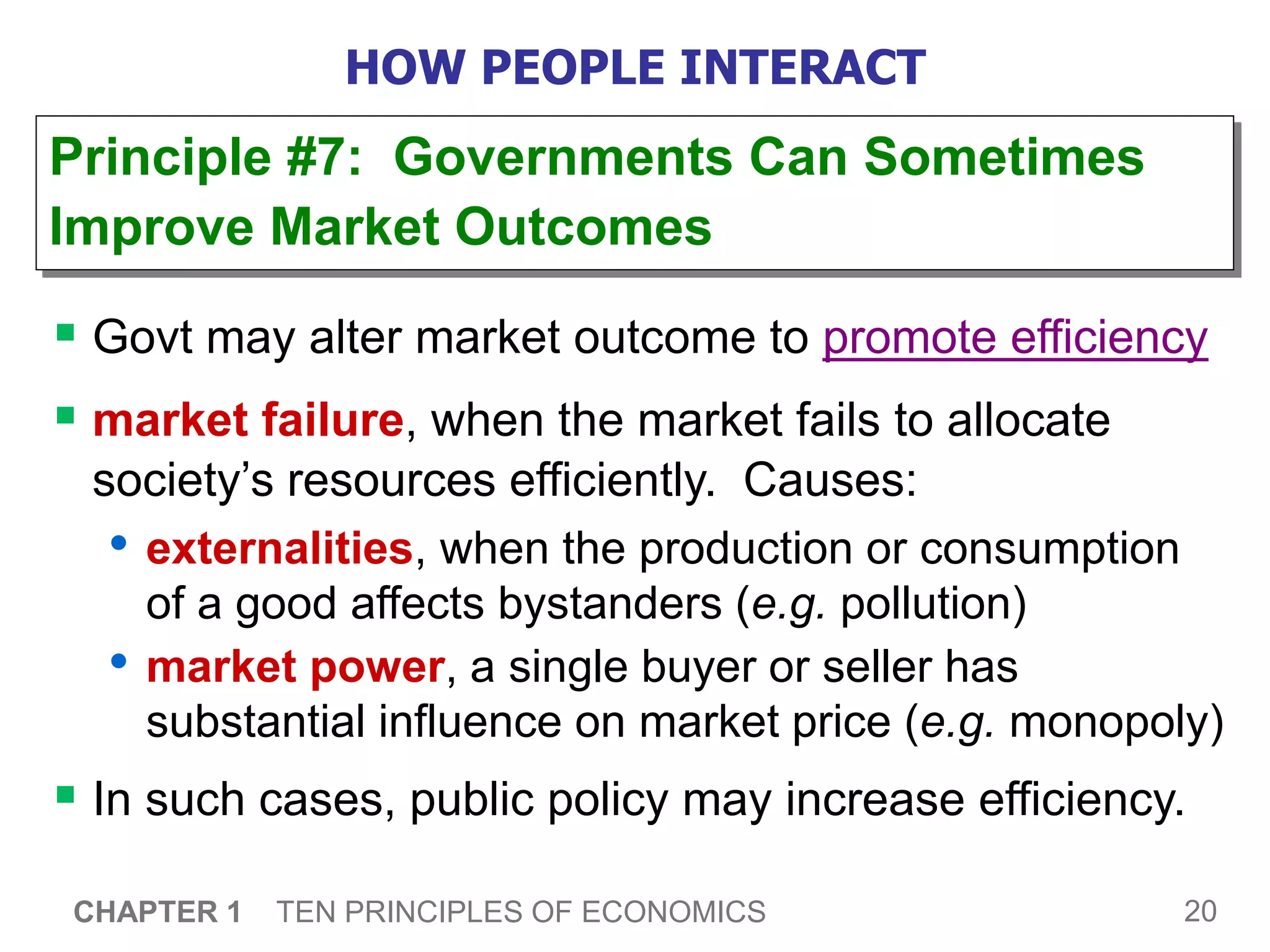
Govt may alter market outcome to promote efficiency
market failure, when the market fails to allocate
society’s resources efficiently. Causes:
• externalities, when the production or consumption
of a good affects bystanders (e.g. pollution)
• market power, a single buyer or seller has
substantial influence on market price (e.g. monopoly)
In such cases, public policy may increase efficiency.
Principle #7: Governments Can Sometimes
Improve Market Outcomes
22.
21
CHAPTER 1 TENPRINCIPLES OF ECONOMICS
HOW PEOPLE INTERACT
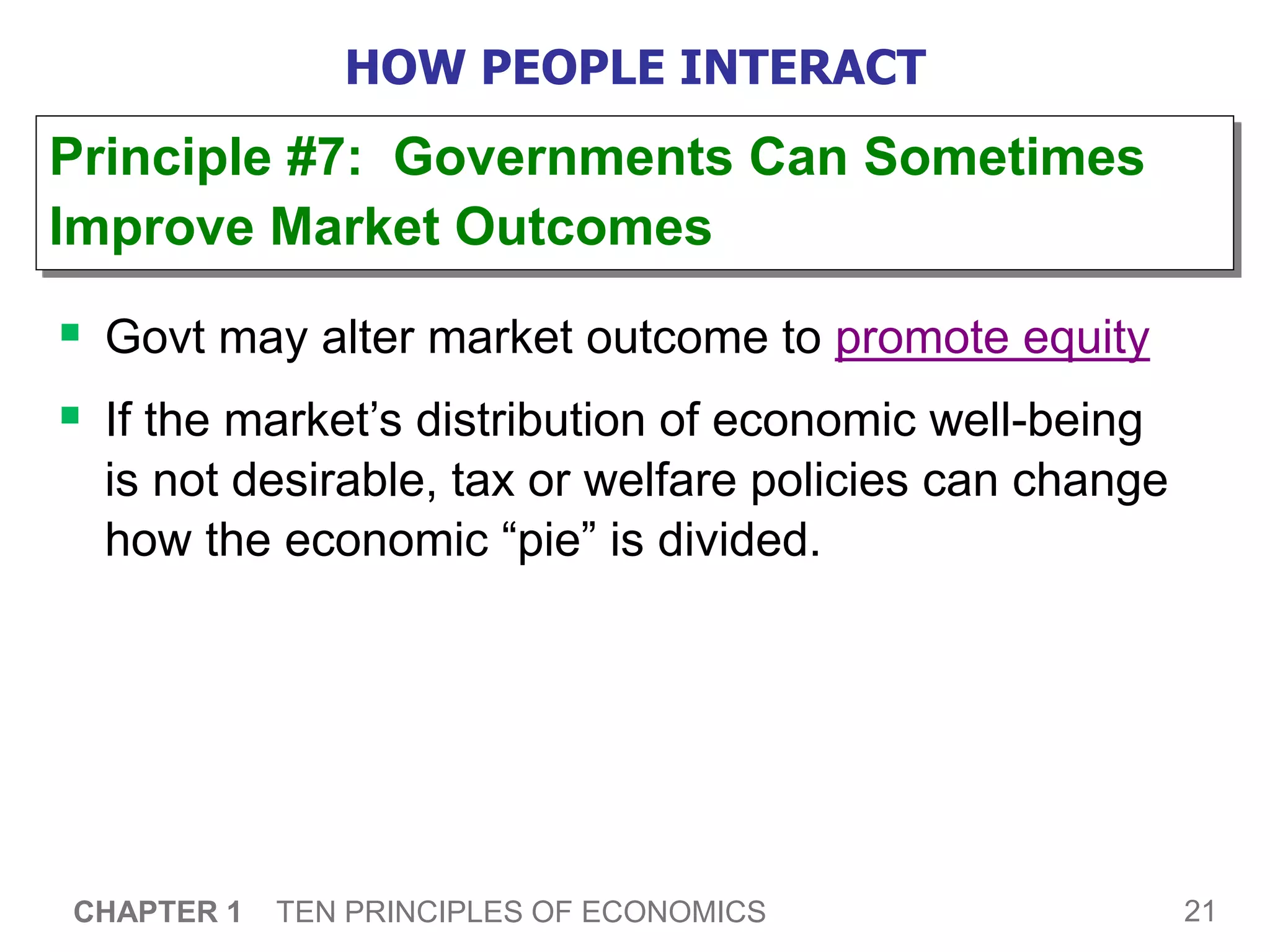
Govt may alter market outcome to promote equity
If the market’s distribution of economic well-being
is not desirable, tax or welfare policies can change
how the economic “pie” is divided.
Principle #7: Governments Can Sometimes
Improve Market Outcomes
23.
A C TI V E L E A R N I N G 2:
Discussion Questions
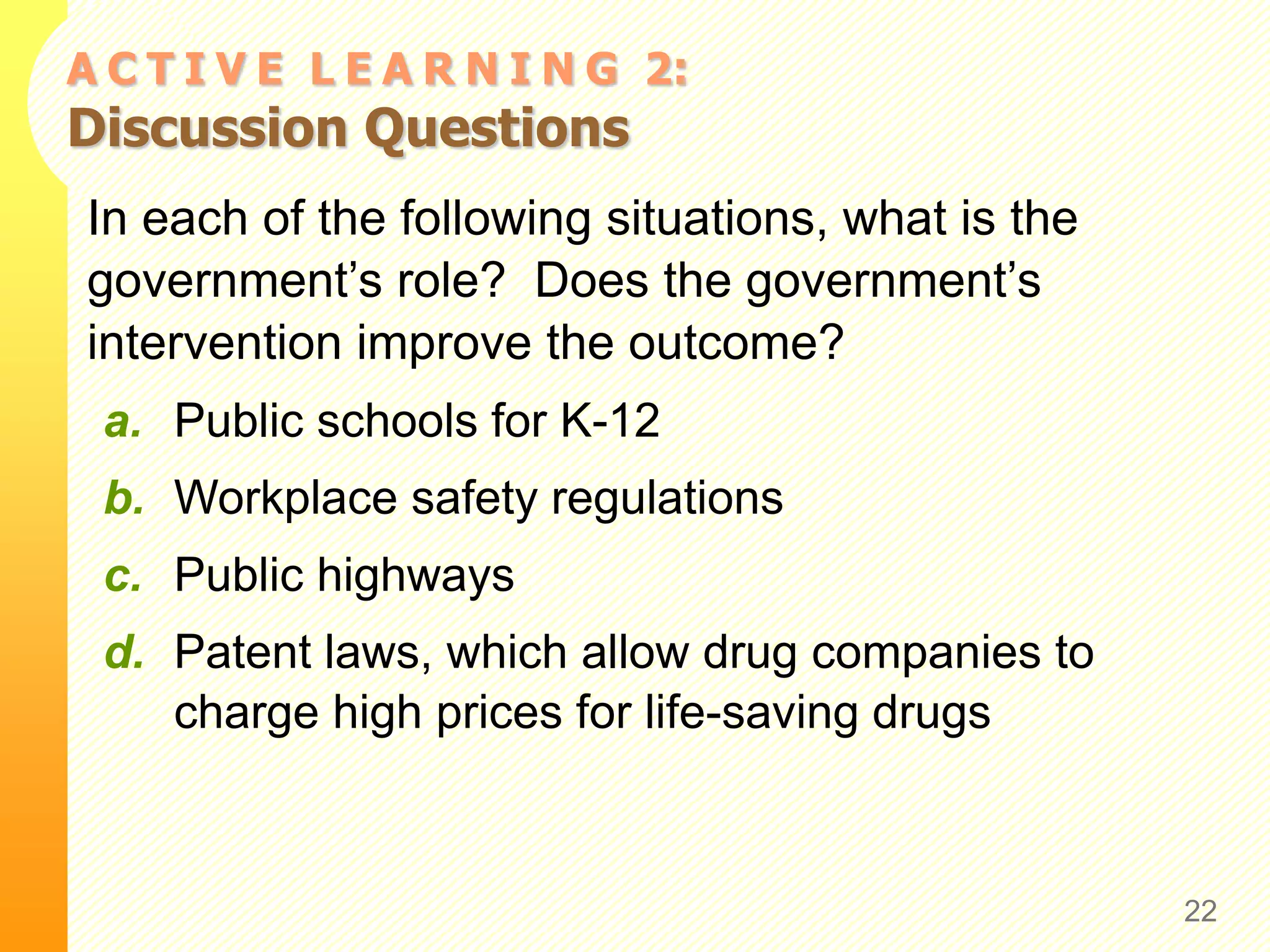
In each of the following situations, what is the
government’s role? Does the government’s
intervention improve the outcome?
a. Public schools for K-12
b. Workplace safety regulations
c. Public highways
d. Patent laws, which allow drug companies to
charge high prices for life-saving drugs
22
24.
23
CHAPTER 1 TENPRINCIPLES OF ECONOMICS
HOW THE ECONOMY AS A WHOLE WORKS
The last three
principles deal with
the economy as a
whole.
25.
24
CHAPTER 1 TENPRINCIPLES OF ECONOMICS
HOW THE ECONOMY AS A WHOLE WORKS
Huge variation in living standards across
countries and over time:
• Average income in rich countries is more than
ten times average income in poor countries.
• The U.S. standard of living today is about
eight times larger than 100 years ago.
Principle #8: A country’s standard of living
depends on its ability to produce goods &
services.
26.
25
CHAPTER 1 TENPRINCIPLES OF ECONOMICS
HOW THE ECONOMY AS A WHOLE WORKS
The most important determinant of living standards:
productivity, the amount of goods and services
produced per unit of labor.
Productivity depends on the equipment, skills, and
technology available to workers.
Other factors (e.g., labor unions, competition from
abroad) have far less impact on living standards.
Principle #8: A country’s standard of living
depends on its ability to produce goods &
services.
27.
26
CHAPTER 1 TENPRINCIPLES OF ECONOMICS
HOW THE ECONOMY AS A WHOLE WORKS
Inflation: increases in the general level of prices.
In the long run, inflation is almost always caused
by excessive growth in the quantity of money,
which causes the value of money to fall.
The faster the govt creates money,
the greater the inflation rate.
Principle #9: Prices rise when the
government prints too much money.
28.
27
CHAPTER 1 TENPRINCIPLES OF ECONOMICS
HOW THE ECONOMY AS A WHOLE WORKS
In the short-run (1 – 2 years),
many economic policies push inflation and
unemployment in opposite directions.
Other factors can make this tradeoff more or less
favorable, but the tradeoff is always present.
Principle #10: Society faces a short-run
tradeoff between inflation and unemployment
29.
28
CHAPTER 1 TENPRINCIPLES OF ECONOMICS
FYI: How to Read Your Textbook
1. Summarize, don’t highlight.
Highlighting is a passive activity that won’t improve
your comprehension or retention. Instead, summarize
each section in a few sentences of your own words.
When you finish, compare your summary to the one
at the end of the chapter.
2. Test yourself.
Try the “QuickQuiz” that follows each section before
moving on to the next section. Write your answers
down, and compare them to the answers in the back
of the book. If your answers are incorrect, review the
section before moving on.
30.
29
CHAPTER 1 TENPRINCIPLES OF ECONOMICS
FYI: How to Read Your Textbook
3. Practice, practice, practice.
Work through the end-of-chapter review questions
and problems. They are often good practice for the
exams. And the more you use your new knowledge,
the more solid it will become.
4. Go online.
The book comes with excellent web resources,
including practice quizzes, tools to strengthen your
graphing skills, helpful video clips, and other
resources to help you learn the textbook material
more easily and effectively.
31.
30
CHAPTER 1 TENPRINCIPLES OF ECONOMICS
FYI: How to Read Your Textbook
5. Study in groups.
Get together with a few of your classmates to review
each chapter, quiz each other, and help each other
understand the material in the chapter.
6. Don’t forget the real world.
Read the Case Studies and In The News boxes in
each chapter. They will help you see how the new
terms, concepts, models, and graphs apply to the real
world. As you read the newspaper or watch the
evening news, see if you can find the connections
with what you’re learning in the textbook.
32.
31
CHAPTER 1 TENPRINCIPLES OF ECONOMICS
CONCLUSION
Economics offers many insights about the
behavior of people, markets, and economies.
It is based on a few ideas that can be applied
in many situations.
Whenever we refer back to one of the
Ten Principles from this chapter,
you will see an icon like this one:
33.
32
CHAPTER 1 TENPRINCIPLES OF ECONOMICS
CHAPTER SUMMARY
The principles of decision making are:
• People face tradeoffs.
• The cost of any action is measured in terms of
foregone opportunities.
• Rational people make decisions by comparing
marginal costs and marginal benefits.
• People respond to incentives.
34.
33
CHAPTER 1 TENPRINCIPLES OF ECONOMICS
CHAPTER SUMMARY
The principles of interactions among people are:
• Trade can be mutually beneficial.
• Markets are usually a good way of
coordinating trade.
• Govt can potentially improve market
outcomes if there is a market failure
or if the market outcome is inequitable.
35.
34
CHAPTER 1 TENPRINCIPLES OF ECONOMICS
CHAPTER SUMMARY
The principles of the economy as a whole are:
• Productivity is the ultimate source of living
standards.
• Money growth is the ultimate source of
inflation.
• Society faces a short-run tradeoff between
inflation and unemployment.