Marketing Essentials
Chapter 13
Basics Of Marketing
MARKET: a group of customers who share common
wants and needs
    • Can be individuals or a country as a whole

MARKETING: process of creating, promoting, and
presenting a product or service to meet the wants and
needs of consumers

                 Marketing different
                  products requires
                 different strategies!
Functions of Marketing (7)
1.           DISTRIBUTION: the process of getting goods and services
      to customers
     • Purchasing, stock handling, inventory control, and physical distribution


2.          FINANCING: getting the money that is necessary for setting
      up and running a business


3.            MARKETING INFORMATION MANAGEMENT:
      gathering and analyzing information about consumers, trends, and
      competitors’ products
Functions (Continued)
4.      PRICING: Deciding how much to charge for a
     product/service.

5. PRODUCT/SERVICE MANAGEMENT: obtaining, developing,
   maintaining, and improving a product in response to market
   opportunities.

6.          PROMOTION: effort to inform, persuade, or remind
     potential customers about a business’s products or services.

7.         SELLING: providing customers with the goods/services
     they choose to buy.
The Marketing Mix – the 4 P’s
MARKETING MIX- the 4 basic marketing strategies

1. PRODUCT:
      a) Is there a demand for a product?
      b) How can I make the product appeal to customers (packaging)?


 Do you think the SNICKERS® packaging     What holiday(s) do you think the
    is appealing? Why or why not?       demand for SNICKERS® might increase?
The Marketing Mix (continued)
2. PLACE:
        a) How will customers buy their product?
        b) Where will customers buy the product/service?

CHANNEL OF DISTRIBUTION: pathway to direct products to consumers
                          2 TYPES
DIRECT DISTRIBUTION: sold      INDIRECT DISTRIBUTION:
from producer directly to customers   one or more intermediaries
                                      (distributors, wholesalers, or retailers)

Example: farmer to YOU!               Example: farmer to HyVee to YOU!

                        Are SNICKERS® sold directly or indirectly?
Marketing Mix (Continued)
3. PRICE:
   a) What are customers willing to pay?
   b) Is the price competitive with other products?
   c) Can the company make a profit?

BREAK-EVEN POINT: point at which…
total revenue/sales
           =
the total costs/expenses of developing
and offering the product/service
Marketing Mix (Continued)
4. PROMOTION:
  a) How will customers be aware of a product?
 • Advertising, discounts/coupons, rebates, sales, give away items


                        Where does SNICKERS® advertise?
Marketing Mix (Continued)
5. 5th New Element: PEOPLE:
  Good employees and customers
Market Research
MARKET RESEARCH: gathering and analysis of information on
the size, location, and makeup of a market.
  • Market research helps businesses discover
    consumers’ wants & needs!


DEMOGRAPHICS: facts about the population
  •   Age
  •   Gender              What are your demographics?
  •   Location
  •   Income
Market Research
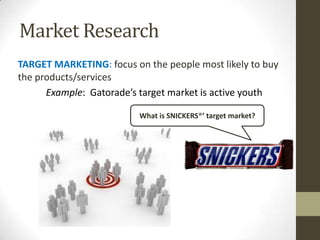
TARGET MARKETING: focus on the people most likely to buy
the products/services
      Example: Gatorade’s target market is active youth

                          What is SNICKERS®’ target market?
Market Research
MARKET SEGMENTATION: division of a market for a product
into groups of customers who have the same needs and traits

    Example: a product that generally is marketed to adult
    males (let’s say men’s deodorant) might be presented
    differently on the country music channel than it would be
    on a sports channel
Product Development (7 Steps)
1. GENERATE IDEAS:
 • Product development/market research


2. SCREEN IDEAS:
 • Does the product fit the company?
 • Does it compete with existing company products?


3. DEVELOP A BUSINESS PLAN:
 • Written proposal that includes estimated sales, costs, profit
   potential, market trends, and competing products
Product Development (continued)
4.                  DEVELOP THE PRODUCT:
     • Prototype: model of the actual product
       - tests how it can be made, if changes need to be made


5. TEST-MARKET THE PRODUCT:
     • Offer in a limited market for a limited time
     • Collect customer responses if they like the product
     • Disadvantage: competitor can have time to develop similar product!


6. INTRODUCE THE PRODUCT:
     • Publicity campaign to introduce product
     • Launch of new product cost can be high
Product Development (continued)
7. EVALUATE CUSTOMER ACCEPTANCE:
 • Track customer responses to product
 • What new products are they buying?

       PRODUCT FAILURES: not all products succeed!

Chapter 13 - Marketing

  • 1.
  • 2.
    Basics Of Marketing MARKET:a group of customers who share common wants and needs • Can be individuals or a country as a whole MARKETING: process of creating, promoting, and presenting a product or service to meet the wants and needs of consumers Marketing different products requires different strategies!
  • 3.
    Functions of Marketing(7) 1. DISTRIBUTION: the process of getting goods and services to customers • Purchasing, stock handling, inventory control, and physical distribution 2. FINANCING: getting the money that is necessary for setting up and running a business 3. MARKETING INFORMATION MANAGEMENT: gathering and analyzing information about consumers, trends, and competitors’ products
  • 4.
    Functions (Continued) 4. PRICING: Deciding how much to charge for a product/service. 5. PRODUCT/SERVICE MANAGEMENT: obtaining, developing, maintaining, and improving a product in response to market opportunities. 6. PROMOTION: effort to inform, persuade, or remind potential customers about a business’s products or services. 7. SELLING: providing customers with the goods/services they choose to buy.
  • 5.
    The Marketing Mix– the 4 P’s MARKETING MIX- the 4 basic marketing strategies 1. PRODUCT: a) Is there a demand for a product? b) How can I make the product appeal to customers (packaging)? Do you think the SNICKERS® packaging What holiday(s) do you think the is appealing? Why or why not? demand for SNICKERS® might increase?
  • 6.
    The Marketing Mix(continued) 2. PLACE: a) How will customers buy their product? b) Where will customers buy the product/service? CHANNEL OF DISTRIBUTION: pathway to direct products to consumers 2 TYPES DIRECT DISTRIBUTION: sold INDIRECT DISTRIBUTION: from producer directly to customers one or more intermediaries (distributors, wholesalers, or retailers) Example: farmer to YOU! Example: farmer to HyVee to YOU! Are SNICKERS® sold directly or indirectly?
  • 7.
    Marketing Mix (Continued) 3.PRICE: a) What are customers willing to pay? b) Is the price competitive with other products? c) Can the company make a profit? BREAK-EVEN POINT: point at which… total revenue/sales = the total costs/expenses of developing and offering the product/service
  • 8.
    Marketing Mix (Continued) 4.PROMOTION: a) How will customers be aware of a product? • Advertising, discounts/coupons, rebates, sales, give away items Where does SNICKERS® advertise?
  • 9.
    Marketing Mix (Continued) 5.5th New Element: PEOPLE: Good employees and customers
  • 10.
    Market Research MARKET RESEARCH:gathering and analysis of information on the size, location, and makeup of a market. • Market research helps businesses discover consumers’ wants & needs! DEMOGRAPHICS: facts about the population • Age • Gender What are your demographics? • Location • Income
  • 11.
    Market Research TARGET MARKETING:focus on the people most likely to buy the products/services Example: Gatorade’s target market is active youth What is SNICKERS®’ target market?
  • 12.
    Market Research MARKET SEGMENTATION:division of a market for a product into groups of customers who have the same needs and traits Example: a product that generally is marketed to adult males (let’s say men’s deodorant) might be presented differently on the country music channel than it would be on a sports channel
  • 13.
    Product Development (7Steps) 1. GENERATE IDEAS: • Product development/market research 2. SCREEN IDEAS: • Does the product fit the company? • Does it compete with existing company products? 3. DEVELOP A BUSINESS PLAN: • Written proposal that includes estimated sales, costs, profit potential, market trends, and competing products
  • 14.
    Product Development (continued) 4. DEVELOP THE PRODUCT: • Prototype: model of the actual product - tests how it can be made, if changes need to be made 5. TEST-MARKET THE PRODUCT: • Offer in a limited market for a limited time • Collect customer responses if they like the product • Disadvantage: competitor can have time to develop similar product! 6. INTRODUCE THE PRODUCT: • Publicity campaign to introduce product • Launch of new product cost can be high
  • 15.
    Product Development (continued) 7.EVALUATE CUSTOMER ACCEPTANCE: • Track customer responses to product • What new products are they buying? PRODUCT FAILURES: not all products succeed!