







Welingkar’s Distance Learning Division
Financial Accounting
CHAPTER-12. Understanding Financial
Statement
We Learn – A Continuous Learning Forum
Chapter Twelve- Understanding Financial Statements
Financial figures in absolute amounts do not provide
complete picture.
Net earnings from operations disclose profitability of a company.
But the figure can include one time item like sale of assets, in which
case earnings from operations are less to that extent.
Chapter Twelve- Understanding Financial Statements
Financial figures in absolute amounts do not provide
complete picture.
Net earnings from operations disclose profitability of a company
which can be a respectable figure say Ten crores.
But the figure when compared to previous year, say Fifteen crores,
shows a significant dip.
Chapter Twelve- Understanding Financial Statements
Financial figures in absolute amounts do not provide
complete picture.
Hence focus should be on Trends over years & Financial Ratios
Chapter Twelve- Understanding Financial Statements
Financial figures in absolute amounts do not provide
complete picture.
We study three types of Ratios
Profit Ratios
Balance Sheet Ratios
Debt Paying Ability Ratio
Chapter Twelve- Understanding Financial Statements
Financial figures in absolute amounts do not provide
complete picture.
Profit Ratios
Gross Profit
Gross Return on Sales =
Total sales
a stronger company in the Industry will have a high ratio
Chapter Twelve- Understanding Financial Statements
Financial figures in absolute amounts do not provide
complete picture. Hence focus should be on Financial Ratios
Profit Ratios
Net Profit
Net Return on Sales =
Total sales
a high ratio indicates greater capacity to declare dividends
Chapter Twelve- Understanding Financial Statements
Financial figures in absolute amounts do not provide
complete picture. Hence focus should be on Financial Ratios
- Profit Ratios
Balance Sheet Ratios
Net Worth
Book Value per share =
No of outstanding shares
Higher the ratio , stronger the company
Chapter Twelve- Understanding Financial Statements
Financial figures in absolute amounts do not provide
complete picture. Hence focus should be on Financial Ratios
- Profit Ratios ; Balance Sheet Ratios
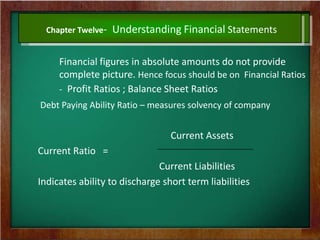
Debt Paying Ability Ratio – measures solvency of company
Current Assets
Current Ratio =
Current Liabilities
Indicates ability to discharge short term liabilities
Chapter Twelve- Understanding Financial Statements
Financial figures in absolute amounts do not provide
complete picture. Hence focus should be on Financial Ratios
- Profit Ratios ; Balance Sheet Ratios
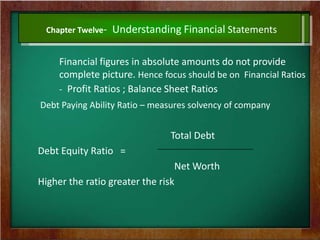
Debt Paying Ability Ratio – measures solvency of company
Total Debt
Debt Equity Ratio =
Net Worth
Higher the ratio greater the risk
Chapter Twelve- Understanding Financial Statements
Financial figures in absolute amounts do not provide
complete picture. Hence focus should be on Financial Ratios
- Profit Ratios ; Balance Sheet Ratios
Debt Paying Ability Ratio – measures solvency of company
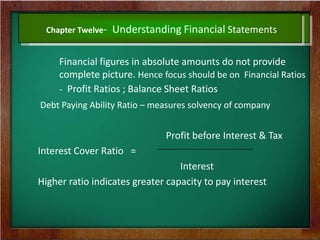
Profit before Interest & Tax
Interest Cover Ratio =
Interest
Higher ratio indicates greater capacity to pay interest
Chapter Twelve- Understanding Financial Statements
Financial figures in absolute amounts do not provide
complete picture. Hence focus should be on Financial Ratios
- Profit Ratios ; Balance Sheet Ratios
Debt Paying Ability Ratio – measures solvency of company
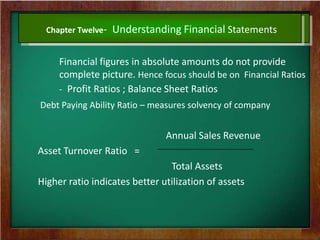
Annual Sales Revenue
Asset Turnover Ratio =
Total Assets
Higher ratio indicates better utilization of assets
Chapter Twelve – Understanding Financial Statements
Ultimately,
understanding financial
statements is a fine art and calls
for deep understanding of accounting techniques!

Understanding Financial Statement

  • 1.
    Welingkar’s Distance LearningDivision Financial Accounting CHAPTER-12. Understanding Financial Statement We Learn – A Continuous Learning Forum
  • 2.
    Chapter Twelve- UnderstandingFinancial Statements Financial figures in absolute amounts do not provide complete picture. Net earnings from operations disclose profitability of a company. But the figure can include one time item like sale of assets, in which case earnings from operations are less to that extent.
  • 3.
    Chapter Twelve- UnderstandingFinancial Statements Financial figures in absolute amounts do not provide complete picture. Net earnings from operations disclose profitability of a company which can be a respectable figure say Ten crores. But the figure when compared to previous year, say Fifteen crores, shows a significant dip.
  • 4.
    Chapter Twelve- UnderstandingFinancial Statements Financial figures in absolute amounts do not provide complete picture. Hence focus should be on Trends over years & Financial Ratios
  • 5.
    Chapter Twelve- UnderstandingFinancial Statements Financial figures in absolute amounts do not provide complete picture. We study three types of Ratios Profit Ratios Balance Sheet Ratios Debt Paying Ability Ratio
  • 6.
    Chapter Twelve- UnderstandingFinancial Statements Financial figures in absolute amounts do not provide complete picture. Profit Ratios Gross Profit Gross Return on Sales = Total sales a stronger company in the Industry will have a high ratio
  • 7.
    Chapter Twelve- UnderstandingFinancial Statements Financial figures in absolute amounts do not provide complete picture. Hence focus should be on Financial Ratios Profit Ratios Net Profit Net Return on Sales = Total sales a high ratio indicates greater capacity to declare dividends
  • 8.
    Chapter Twelve- UnderstandingFinancial Statements Financial figures in absolute amounts do not provide complete picture. Hence focus should be on Financial Ratios - Profit Ratios Balance Sheet Ratios Net Worth Book Value per share = No of outstanding shares Higher the ratio , stronger the company
  • 9.
    Chapter Twelve- UnderstandingFinancial Statements Financial figures in absolute amounts do not provide complete picture. Hence focus should be on Financial Ratios - Profit Ratios ; Balance Sheet Ratios Debt Paying Ability Ratio – measures solvency of company Current Assets Current Ratio = Current Liabilities Indicates ability to discharge short term liabilities
  • 10.
    Chapter Twelve- UnderstandingFinancial Statements Financial figures in absolute amounts do not provide complete picture. Hence focus should be on Financial Ratios - Profit Ratios ; Balance Sheet Ratios Debt Paying Ability Ratio – measures solvency of company Total Debt Debt Equity Ratio = Net Worth Higher the ratio greater the risk
  • 11.
    Chapter Twelve- UnderstandingFinancial Statements Financial figures in absolute amounts do not provide complete picture. Hence focus should be on Financial Ratios - Profit Ratios ; Balance Sheet Ratios Debt Paying Ability Ratio – measures solvency of company Profit before Interest & Tax Interest Cover Ratio = Interest Higher ratio indicates greater capacity to pay interest
  • 12.
    Chapter Twelve- UnderstandingFinancial Statements Financial figures in absolute amounts do not provide complete picture. Hence focus should be on Financial Ratios - Profit Ratios ; Balance Sheet Ratios Debt Paying Ability Ratio – measures solvency of company Annual Sales Revenue Asset Turnover Ratio = Total Assets Higher ratio indicates better utilization of assets
  • 13.
    Chapter Twelve –Understanding Financial Statements Ultimately, understanding financial statements is a fine art and calls for deep understanding of accounting techniques!