1 | Pa g e
SUSTAINABLE AGRICULTURE
(Chapter 7)
Introduction
Throughout history, agriculture has evolved to meet the changing needs of the
growing human population. This transformation has been particularly notable since the
end of World War II. Food and fiber productivity surged due to the adoption of new
technologies, such as high-yield varieties (HYV), mechanization, increased use of
fertilizers and pesticides, specialized farming practices, water resource development,
improved irrigation techniques, and government policies aimed at maximizing
production.
In the early 1960s, the Green Revolution emerged in developing countries,
especially in India, leading to self-sufficiency in food grain production. Donald Plunkett
(1993), a scientific adviser to the CGIAR, described this as the greatest agricultural
transformation in human history, much of which has occurred within our lifetime. This
change was fueled by the rise of science-based agriculture, which enabled higher and
more stable food production, ensuring food stability and security for a continuously
growing global population.
However, a significant drawback of this transformation has been the inequitable
distribution of its benefits. Many individuals have been left behind, and hunger persists
in various regions of the world. Estimates from the FAO, WHO (1992), and the Hunger
Project (1991) indicate that around 1 billion people globally have diets too inadequate to
meet the energy needs for healthy growth in children and minimal activity in adults. The
causes of this issue are complex and cannot be solely attributed to the overall availability
of food. Nevertheless, the process of agricultural modernization has played a crucial role,
as the technologies have often been more accessible to those who are better off.
Modern agriculture starts at research stations, where researchers have access to all
necessary inputs, such as fertilizers, pesticides, and labor, at the right times. However,
when these resources are made available to farmers, even the most productive farms
struggle to achieve the yields obtained in research settings. To achieve high productivity
per hectare, farmers need access to the complete package, which includes modern seeds,
water, labor, capital or credit, fertilizers, and pesticides. Many poorer farming
households simply cannot adopt the entire package. If any single element is lacking—be
it a malfunctioning seed delivery system, delayed fertilizer arrival, or insufficient
irrigation water—yields may not significantly exceed those of traditional varieties. Even
when farmers are eager to utilize external resources, delivery systems often fail to provide
them in a timely manner. In instances where modern technologies have improved
production, there have frequently been negative environmental and social consequences
in both advanced and developing countries, including India. These consequences include
the following:
2.
2 | Pa g e
Adverse effects of modern high- input agriculture
• Overuse of natural resources is leading to the depletion of groundwater, loss of
forests and wildlife habitats, and a decreased capacity to absorb water, resulting
in waterlogging and increased salinity.
• The atmosphere is being contaminated by ammonia, nitrous oxide, methane, and
combustion byproducts, contributing to ozone depletion, global warming, and
atmospheric pollution.
• Food and fodder are contaminated with residues of pesticides, nitrates, and
antibiotics.
• Water is being polluted by pesticides, nitrates, soil, and livestock runoff, harming
wildlife, disrupting ecosystems, and posing potential health risks in drinking
water.
• There is a growing resistance to pesticides among pests and diseases, including
herbicide resistance in weeds.
• Pesticides are damaging both farm and natural resources, which harms farm
workers and the public, disrupts ecosystems, and negatively affects wildlife.
• The erosion of genetic diversity in agriculture is occurring due to the
standardization and specialization associated with modern varieties, displacing
traditional varieties and breeds.
• New health hazards are emerging for workers in the agrochemical and food
processing industries.
In addition to the aforementioned adverse effects, the growing populations of
humans and cattle are placing significant pressure on available natural resources. This
situation has created a challenge that demands a new vision, holistic approaches to
ecosystem management, and a revitalized partnership between science and society.
In December 1983, the UN General Assembly established the World Commission
on Environment and Development. On April 27, 1987, at Queen Elizabeth Hall in London,
Norway's Prime Minister, Mrs. Brundtland, who also chaired the Commission, released
the publication "Our Common Future." She stated, “Securing our common future will
require new energy and openness, fresh insights, and an ability to look beyond the
narrow bounds of national frontiers and separate scientific disciplines. The young are
better at such vision than we, who are too often constrained by the traditions of a former,
more fragmented world. We must tap their energy, their openness, their ability to see the
interdependence of issues.”
She emphasized the need to adopt a new paradigm based on an entirely new value
system. “Our generation has too often been willing to use the resources of the future to
meet our own short-term goals. It is a debt we can never repay. If we fail to change our
ways, these young men and women will suffer more than we do, and they and their
children will be denied their fundamental right to a healthy, productive, life-enhancing
environment.” Her speech highlighted the urgency of recognizing that our consumption
of resources must consider the needs of future generations. Given that resources are
limited; we must pursue a sustainable way of life.
3.
3 | Pa g e
The recognition of the crucial role that staple food production plays in achieving food
security for future generations has brought the concept of "Sustainable Agriculture" to
the forefront. This concept can be understood through three key points:
1. The interconnectedness of all farming systems, including the farmer and their
family.
2. The significance of various biological balances within the agricultural system.
3. The necessity to enhance favorable biological relationships while minimizing the
use of materials and practices that disrupt these relationships.
Today, the sustainability of agricultural systems is a global concern, leading to the
emergence of numerous definitions of Sustainable Agriculture.
Definition of Sustainable Agriculture
Sustainable Agriculture refers to a range of strategies for addressing many
problems that effect agriculture. Such problems include loss of soil productivity from
excessive soil erosion and associated plant nutrient losses, surface and ground water
pollution from pesticides, fertilizers and sediments, impending shortages of non-
renewable resources, and low farm income from depressed commodity prices and high
production costs. Furthermore, “Sustainable” implies a time dimension and the capacity
of a farming system to endure indefinitely. (Lockertz, 1988)
The successful management of resources for agriculture to satisfy changing human
needs while maintaining or enhancing the (Natural resource- base and avoiding
environmental degradation) (TAC-CGIAR, 1988)
A sustainable Agriculture is a system of agriculture that is committed to maintain
and preserve the agriculture base of soil, water, and atmosphere ensuring future
generations the capacity to feed themselves with an adequate supply of safe and
wholesome food’ (Gracet, 1990)
A Sustainable Agriculture system is one that can indefinitely meet demands for
food and fiber at socially acceptable, economic and environment cost’ (Crosson, 1992)
A broad and commonly accepted definition of sustainable Agriculture is as follows:
Sustainable Agriculture refers to an agricultural production and distribution system that:
• Achieves the integration of natural biological cycles and controls
• Protects and renews soil fertility and the natural resource base
• Reduces the use of nonrenewable resources and purchased (external or off-farm)
production inputs
• Optimizes the management and use of on- farm inputs
• Provides on adequate and dependable farm income
• Promotes opportunity in family farming and farm communities, and
• Minimizes adverse impacts on health, safety, wildlife, water quality and the
environment
4.
4 | Pa g e
Current concept of sustainable agriculture
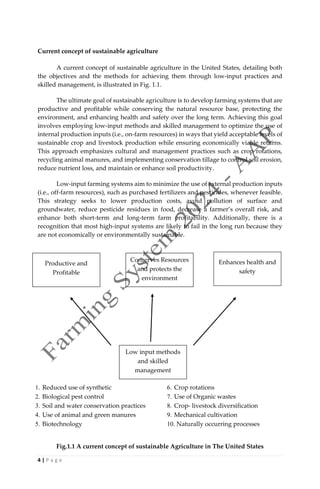
A current concept of sustainable agriculture in the United States, detailing both
the objectives and the methods for achieving them through low-input practices and
skilled management, is illustrated in Fig. 1.1.
The ultimate goal of sustainable agriculture is to develop farming systems that are
productive and profitable while conserving the natural resource base, protecting the
environment, and enhancing health and safety over the long term. Achieving this goal
involves employing low-input methods and skilled management to optimize the use of
internal production inputs (i.e., on-farm resources) in ways that yield acceptable levels of
sustainable crop and livestock production while ensuring economically viable returns.
This approach emphasizes cultural and management practices such as crop rotations,
recycling animal manures, and implementing conservation tillage to control soil erosion,
reduce nutrient loss, and maintain or enhance soil productivity.
Low-input farming systems aim to minimize the use of external production inputs
(i.e., off-farm resources), such as purchased fertilizers and pesticides, whenever feasible.
This strategy seeks to lower production costs, avoid pollution of surface and
groundwater, reduce pesticide residues in food, decrease a farmer’s overall risk, and
enhance both short-term and long-term farm profitability. Additionally, there is a
recognition that most high-input systems are likely to fail in the long run because they
are not economically or environmentally sustainable.
1. Reduced use of synthetic
2. Biological pest control
3. Soil and water conservation practices
4. Use of animal and green manures
5. Biotechnology
6. Crop rotations
7. Use of Organic wastes
8. Crop- livestock diversification
9. Mechanical cultivation
10. Naturally occurring processes
Fig.1.1 A current concept of sustainable Agriculture in The United States
Productive and
Profitable
Conserves Resources
and protects the
environment
Enhances health and
safety
Low input methods
and skilled
management
5.
5 | Pa g e
Goals of sustainable Agriculture
A sustainable Agriculture, therefore, is any system of food or fiber production that
systematically pursues the following goals:
• A more comprehensive integration of natural processes, such as nutrient cycling,
nitrogen fixation, and pest-predator relationships, into agricultural production
systems.
• A reduction in the use of off-farm, external, and non-renewable inputs that pose
the greatest risk to the environment and the health of farmers and consumers,
alongside a more targeted application of the remaining inputs to minimize
variable costs.
• Full participation of farmers and rural communities in all aspects of problem
analysis, technology development, adoption, and extension.
• Improved equitable access to predictive resources and opportunities, progressing
towards more socially just forms of agriculture.
• Enhanced productive use of the biological and genetic potential of plant and
animal species.
• Increased utilization of local knowledge and practices, including innovations in
approaches that are not yet fully understood by scientists or widely adopted by
farmers.
• A rise in self-reliance among farmers and rural communities.
• An improved alignment between cropping patterns and the productive potential
and environmental constraints of climate and landscape, ensuring long-term
sustainability of current production levels.
• Profitable and efficient production, emphasizing integrated farm management
and the conservation of soil, water, energy, and biological resources.
Elements of sustainability
There are many ways to enhance the sustainability of farming systems, and these
methods can differ by region. However, farmers seeking a more sustainable approach
often share common practices. These practices typically involve greater use of on-farm or
local resources, contributing to long-term profitability, environmental stewardship, and
improved rural quality of life.
a. Soil conservation- Many soil conservation methods, such as contour cultivation,
contour bunding, graded bunding, vegetative barriers, strip cropping, cover
cropping, and reduced tillage, help prevent soil loss due to wind and water
erosion.
b. Crop diversity- Growing a greater variety of crops on a farm can help mitigate
risks associated with extreme weather, fluctuating market conditions, and crop
pests. Additionally, introducing diverse crops along with other plants, such as
trees and shrubs, can enhance soil conservation, create wildlife habitats, and boost
populations of beneficial insects.
c. Nutrient management- Proper management of nitrogen and other plant nutrients
can improve soil quality and protect the environment. Additionally, increasing the
use of farm nutrient sources like manure and leguminous cover crops can help
reduce the costs associated with purchasing fertilizers.
6.
6 | Pa g e
d. Integrated pest management (IPM)- IPM is a sustainable approach to pest
management that integrates biological, cultural, physical, and chemical methods
in a way that minimizes risks to the economy, health, and the environment.
e. Cover crops- Growing plants such as sun hemp, horse gram, and pillipesara in the
off-season after harvesting a grain or vegetable crop can offer several benefits.
These include weed suppression, erosion control, and enhanced soil nutrients and
quality.
f. Rotational grazing- New management-intensive grazing systems move animals
from the barn to the pasture, providing high-quality forage and reducing feed
costs.
g. Water quality & water conservation- Water conservation and protection are
essential components of agricultural stewardship. Many practices have been
developed to conserve water, such as deep ploughing, mulching, and micro-
irrigation techniques, which also help protect the quality of drinking water and
surface water.
h. Agro forestry- Trees and other woody perennials are frequently underutilized.
Various practices, such as agro-silviculture, silvopastoral systems, agri-silvi-
pastoral horticulture, horti-silvipastoral methods, alley cropping, tree farming,
and lay farming, contribute to soil and water conservation.
i. Marketing - Farmers across the country are discovering that improved marketing
is a key way to enhance profitability. Direct marketing of agricultural products
from farmers to consumers is becoming increasingly.